2003 Hyundai Tiburon lock
[x] Cancel search: lockPage 20 of 169
FEATURES OF YOUR HYUNDAI
1- 12
B190A01GK-AAT
SEAT BELTS Rear Seat 3-Point Sys-
tem with Combination Locking Re-
tractor
To Fasten Your Belt
Combination retractor type seat belts are in-
stalled in the rear seat positions to help accom-
modate the installation of child restraint sys-
tems. Although a combination retractor is also
installed in the front passenger seat position,
Hyundai strongly recommends that children al-
ways be seated in the rear seat. NEVER place
any infant restraint system in the front seat of
the vehicle.
This type of seat belt combines the features of
both an emergency locking retractor seat belt
and an automatic locking retractor seat belt. To
fasten your seat belt, pull it out of the retractor
and insert the metal tab into the buckle. There
will be an audible "click" when the tab locks into
the buckle. When not securing a child restraint,
the seat belt operates in the same way as
driver's seat belt (Emergency Locking Retrac-
tor Type). It automatically adjusts to the proper
length only after the lap belt portion of the seat
FUA1090P B180A01GK-AAT
SEAT BELT-Driver's and front pas-
sengers 3-Point System with Emer-
gency Locking Retractor
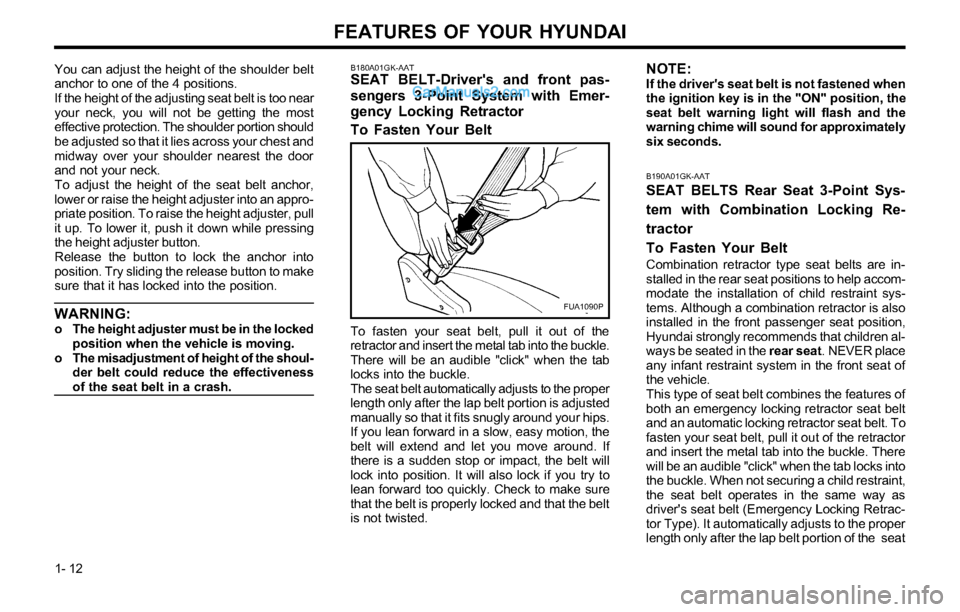
To Fasten Your BeltYou can adjust the height of the shoulder belt
anchor to one of the 4 positions.
If the height of the adjusting seat belt is too near
your neck, you will not be getting the most
effective protection. The shoulder portion should
be adjusted so that it lies across your chest and
midway over your shoulder nearest the door
and not your neck.
To adjust the height of the seat belt anchor,
lower or raise the height adjuster into an appro-
priate position. To raise the height adjuster, pull
it up. To lower it, push it down while pressing
the height adjuster button.
Release the button to lock the anchor into
position. Try sliding the release button to make
sure that it has locked into the position.
WARNING:o The height adjuster must be in the locked
position when the vehicle is moving.
o The misadjustment of height of the shoul-
der belt could reduce the effectiveness
of the seat belt in a crash.To fasten your seat belt, pull it out of the
retractor and insert the metal tab into the buckle.
There will be an audible "click" when the tab
locks into the buckle.
The seat belt automatically adjusts to the proper
length only after the lap belt portion is adjusted
manually so that it fits snugly around your hips.
If you lean forward in a slow, easy motion, the
belt will extend and let you move around. If
there is a sudden stop or impact, the belt will
lock into position. It will also lock if you try to
lean forward too quickly. Check to make sure
that the belt is properly locked and that the belt
is not twisted.
NOTE:If the driver's seat belt is not fastened when
the ignition key is in the "ON" position, the
seat belt warning light will flash and the
warning chime will sound for approximately
six seconds.
Page 21 of 169

FEATURES OF YOUR HYUNDAI
1- 13 belt is adjusted manually so that it fits snugly
around your hips. When the seat belt is fully
extended from the retractor to allow the instal-
lation of a child restraint system, the seat belt
operation changes to allow the belt to retract,
but not to extend. (Automatic Locking Retractor
Type)
NOTE:Although the combination retractor provides
the same level of protection for seated pas-
sengers in either emergency or automatic
locking modes, it is recommended that
seated passengers use the emergency lock-
ing feature for improved convenience. The
automatic locking function is intended to
facilitate child restraint installation. To con-
vert from the automatic locking feature to
the emergency locking operation mode, al-
low the unbuckled seat belt to fully retract.
WARNING:o For maximum restraint system protec-
tion, seat belts must always be used
whenever the car is moving.
o Seat belts are most effective when
seatbacks are in the upright position.
o Children must always be seatbelted in
the rear seats. Never allow children to
ride in the front passenger seat.
o The shoulder belt should be positioned
midway over the shoulder nearest the
door for the most effective protection.
Never wear the seat belt under the arm
nearest the door. Wearing the belt under
the arm nearest the door could cause
serious or fatal injuries in an accident.
o Avoid wearing twisted seat belts. A twist-
ed belt can't do its job as well. In a
collision, it could even cut into you. Be
sure the belt is straight and not twisted.
o Be careful not to damage the belt web-
bing or hardware. If the belt webbing or
hardware is damaged, replace it.
WARNING:You should place the lap belt portion as low
as possible and snugly across your hips,
not on your waist. If the lap belt is located
too high on your waist, it may increase the
chance of injury in the event of a collision.
Both arms should not be under or over the
B200A01A-AAT
Adjusting Your Seat Belt
FUA1090Q
B210A01A-AAT
To Release the Seat Belt
The seat belt is released by pressing the release
button in the locking buckle. When it is released,
the belt should automatically draw back into the
retractor.
If this does not happen, check the belt to be sure
it is not twisted, then try again.
FUA1090R
belt. Rather, one should be over and the
other under, as shown in the illustration.
Never wear the seat belt under the arm
nearest the door.
Page 23 of 169

FEATURES OF YOUR HYUNDAI
1- 15
B230B01GK-GAT
Using a Child Restraint System
For small children and babies, the use of a child
seat or infant seat is strongly recommended.
This child seat or infant seat should be of
appropriate size for the child and should be
installed in accordance with the manufacturer's
instructions. It is further recommended that the
seat be placed in the vehicle's rear seat since
this can make an important contribution to safety.
Your vehicle is provided with two child restraint
hook holders for installing the child seat or
infant seat.
B230B01Y
Cover, Child Restraint
Hook Holder (4 door only)
Bolt, Holder (5/16"-30 mm)
Washer, Conical Spring
Holder, Child Restraint Hook
Spacer (10 mm), Child Restraint
Hook Holder
Retainer Washer Spacer, Hook Holder Cover
B230C02F-AAT
Installing a child Restraint Seat
Two child restraint hook holders are located on
the vertical back panel.
To install the child restraint seat, remove the
blanking covers on the covering shelf.
And, connect the child restraint tether strap
hook to the child restraint hook holder through
the hole on the covering shelf.
B230E01GK
Covering shelf
Back panel
Front of Vehicle
Tether
strap hook
Blanking covers
To install a child restraint system in the out-
board rear seats, extend the shoulder/lap belt
entirely from its retractor until a "click" is felt.
This will engage the seat belt retractor auto-
matic locking feature, which allows the seat belt
to retract but not extend. Install the child re-
straint system, buckle the seat belt and allow
the seat belt to take up any slack. Make sure
that the lap portion of the belt is tight around the
child restraint system and the shoulder portion
of the belt is positioned so that it can not
interfere with the child's head or neck. Also,
double check to be sure that the retractor has
engaged the automatic locking feature by trying
to extend webbing out of the retractor. If the
retractor is in the automatic locking mode, the
belt will be locked. After installation of the child
restraint system, try to move it in all directions
to be sure the child restraint system is securely
B230G01GK-AAT
Installation on outboard Rear Seats
B230G01GK
On outboard rear seats
Page 24 of 169

FEATURES OF YOUR HYUNDAI
1- 16
B230D01GK-AAT
Securing the Child Restraint Seat with
the "ISOFIX" System
B230F01GK
Some child seat manufacturers make child re-
straint seats that are labeled as ISOFIX or
ISOFIX-compatible child restraint seats. These
seats include two rigid or webbing mounted
attachments that connect to two ISOFIX an-
chors at specific seating positions in your ve-
hicle. This type of child restraint seat eliminates
the need to use seat belts to attach the child
seat for forward-facing child restraint seats.
ISOFIX anchors have been provided in your
vehicle. The ISOFIX anchors are located in the
left and right outboard rear seating positions.
Their locations are shown in the illustration.
There is no center rear seating position.
WARNING:o There is no center rear seat position.
o Do not install a child restraint seat at the
center of the rear seat using the vehicle's
ISOFIX anchors. The ISOFIX anchors are
only provided for the left and right out-
board of the rear seat. Do not misuse the
ISOFIX anchors by attempting to attach a
child restraint seat in the middle of rear
seat position to the ISOFIX anchors. In a
crash, the child restraint seat ISOFIX at-
tachments may not be strong enough to
secure the child restraint seat properly in
the center of the rear seat and may break,
causing serious injury or death.
o Do not mount more than one child re-
straint to a single tether or to a child
restraint lower anchorage point. The im-
proper increased load may cause the
anchorage points or tether anchor to
break, causing serious injury or death.
o Attach the ISOFIX or ISOFIX-compatible
child restraint seat only to the appropri-
ate locations shown in the illustration.
o Always follow the installation and use
instructions provided by the manufac-
turer of the child restraint.
installed. If you need to tighten the belt, pull
more webbing toward the retractor. When you
unbuckle the seat belt and allow it to retract, the
retractor will automatically revert back to its
normal seated passenger emergency locking
usage condition.
NOTE:o Before installing the child restraint sys-
tem in any seating position, read the
instructions supplied by the child restraint
system manufacturer.
o If the seat belt does not operate as de-
scribed, have the system checked imme-
diately by your authorized Hyundai deal-
er.
WARNING:o If the retractor is not in the Automatic
Locking mode, the child restraint system
can move when your vehicle turns or
stops abruptly.
o Do not install a child restraint system in
the front passenger seat. Should an acci-
dent occur and cause the passenger side
supplemental airbag to deploy, it could
severely injure or kill an infant or child
seated in an infant or child seat. There-
fore, only use a child restraint system in
the rear seat of your vehicle.
Page 25 of 169

FEATURES OF YOUR HYUNDAI
1- 17
The ISOFIX anchors are located between the
seatback and the seat cushion of the rear seat
left and right outboard seating positions.
Follow the child seat manufacturer's instruc-
tions to properly install child restraint seats with
ISOFIX or ISOFIX-compatible attachments.
Once you have installed the ISOFIX child re-
straint, assure that the seat is properly attached
to the ISOFIX and tether anchors. Also, test the
child restraint seat before you place the child in
it. Tilt the seat from side to side. Also try to tug
the seat forward. Check to see if the anchors
hold the seat in place.
WARNING:If the child restraint is not anchored prop-
erly, the risk of a child being seriously in-
jured or killed in a collision greatly increases.
B230D02GK
B180B01GK-GAT
Pre-tensioner Seat Belt (If Installed)
Your Hyundai vehicle is equipped with driver's
and front passenger's pre-tensioner seat belts.
The purpose of the pre-tensioner is to make
sure that the seat belts fit tightly against the
occupant's body in certain frontal collisions.
The pre-tensioner seat belts can be activated
alone or, where the frontal collision is severe
enough, together with the airbags.
B180B01S
The pre-tensioner seat belt operates in the
same way as an Emergency Locking Retractor
(ELR) type of seat belt. When the vehicle stops
suddenly, or if the occupant tries to lean for-
ward too quickly, the seat belt retractor will lock
into position. However, in certain frontal colli-
sions, the pre-tensioner will activate and pull
the seat belt into tighter contact against the
occupant's body.
B180B01GK
Driver's airbag1
23Passenger's
airbag
The seat belt pre-tensioner system consists
mainly of the following components.
Their locations are shown in the illustration.
1. SRS airbag warning light
2. Seat belt pre-tensioner assembly
3. SRS control module
WARNING:To obtain maximum benefit from a pre-
tensioner seat belt:
1. The seat belt must be worn correctly.
2. The seat belt must be adjusted to the
correct position.
ISOFIX
AnchorISOFIX
Anchor Position
Indicator
Page 29 of 169

FEATURES OF YOUR HYUNDAI
1- 21
WARNING:o When the SRS is activated, there may be
a loud noise and fine dust will be re-
leased throughout the vehicle. These
conditions are normal and are not haz-
ardous. However, the fine dust generat-
ed during airbag deployment may cause
skin irritation. Be sure to wash your hands
and face thoroughly with lukewarm wa-
ter and a mild soap after an accident in
which the airbags were deployed.
o The SRS can function only when the
ignition key is in the "ON" position. If the
SRS SRI does not come on or illumi-
nates continuously when the ignition key
is turned to "ON", or continuously re-
mains on after flashing for about 6 sec-
onds when the ignition key is turned to
the "ON" position, or after the engine is
started, or comes on while driving, the
SRS is not working properly. If this oc-
curs, have your vehicle immediately in-
spected by your Hyundai dealer.
o Before you replace a fuse or disconnect
a battery terminal, turn the ignition key to
the "LOCK" position or remove the igni-
tion key. Never remove or replace the air
bag related fuse(s) when the ignition key
is in the "ON" position. Failure to heed
this warning will cause the SRS SRI to
illuminate.
FUA1115A
A fully inflated airbag in combination with a
properly worn seat belt slows the driver's or the
passenger's forward motion, thus reducing the
risk of head and chest injury.
After complete inflation, the airbag immediately
starts deflating, enabling the driver to maintain
forward visibility.
CAUTION:When installing a container of liquid air
freshener inside a vehicle, do not place it
near the instrument cluster nor on the in-
strument panel pad surface. If there is any
leakage from the air freshener onto these
areas (instrument cluster, instrument panel
pad or air ventilator), it may damage these
parts. If the liquid from the air freshener
does leak onto these areas, wash them with
water immediately.Your Hyundai is equipped with a side impact
airbag in each front seat. The purpose of the
airbag is to provide the vehicle's driver and/or
the front passenger with additional protection
than that offered by the seat belt alone. The
side impact airbags are designed to deploy only
during certain side-impact collisions, depending
on the crash severity, angle, speed and point of
impact. The side impact airbags are not de-
signed to deploy in all side impact situations.
WARNING:o For best protection from the side impact
airbag system and to avoid being injured
by the deploying side impact airbag, both
front seat occupants should sit in an
upright position with the seat belt prop-
erly fastened. The driver's hands should
be placed on the steering wheel at the
B990B03Y-AAT
Side Impact Airbag (If installed)
B990B02Y
Page 30 of 169

FEATURES OF YOUR HYUNDAI
1- 22
WARNING:o Do not install a child restraint system in
the front passenger seat position. A
child restraint system must never be
placed in the front seat. The infant or
child could be severely injured or killed
by an airbag deployment in case of an
accident.
o Modification to SRS components or wir-
ing, including the addition of any kind of
badges to the pad covers or modifica-
tions to the body structure, can adversely
affect SRS performance and lead to pos-
sible injury.
o For cleaning the airbag pad covers, use
only a soft, dry cloth or one which has
been moistened with plain water. Sol-
vents or cleaners could adversely affect
the airbag covers and proper deploy-
ment of the system.
o No objects should be placed over or near
the airbag modules on the steering wheel,
instrument panel, and the front passen-
ger’s panel above the glove box, because
any such object could cause harm if the
vehicle is in a crash severe enough to
cause the airbags to inflate.
o If the airbags inflate, they must be re-
placed by an authorized Hyundai dealer.
o Do not tamper with or disconnect SRS
wiring, or other components of the SRS
system. Doing so could result in injury,
due to accidental firing of the airbags or
by rendering the SRS inoperative.
B240C02A-AAT
SRS Care
o The SRS is virtually maintenance free and
there are no parts you can safely service by
yourself. The entire SRS system must be
inspected by an authorized Hyundai dealer in
10 years after the date that the vehicle was
manufactured.
o Any work on the SRS system, such as re-
moving, installing, repairing, or any work on
the steering wheel must be performed by a
qualified Hyundai technician. Improper han-
dling of the airbag system may result in
serious personal injury.
B240C01A
9:00 and 3:00 o'clock positions. The
passenger's arms and hands should be
placed in their laps.
o Do not use any accessory seat covers.
o Use of seat covers could prevent or re-
duce the effectiveness of the system.
o Do not install any accessories on the
side or near the side impact airbag.
o Do not use excessive force on the side of
the seat.
o Do not place any objects over the airbag
or between the airbag and yourself.
o Do not place any objects (an umbrella,
bag, etc.) between the front door and the
front seat. Such objects may become
dangerous projectiles and cause injury if
the supplemental side impact airbag in-
flates.
o To prevent unexpected deployment of
the side impact airbag that may result in
personal injury,avoid impact to the side
airbag sensor when the ignition key is
on.
Page 32 of 169

FEATURES OF YOUR HYUNDAI
1- 24
B250A01GK-AAT
INSTRUMENTS AND CONTROLS
1. Traction Control System (If installed)
2. Panel Brightness Control Knob
(Rheostat Switch)
3. Multi-Function Light
4. Windshield Wiper/Washer Switch
5. Front Fog Light Switch (If installed)
6. Hazard Warning Switch
7. Digital Clock
8. Passenger Air Bag
9. Hood Release Lever
10. Fuse Box Relay
11. Steering Wheel Tilt Lever (If installed)
12. Horn and Driver Airbag
13. Cruise Control Switch (If installed)
14. Heating and Cooling Controls
15. Ashtray
16. Cigarette Lighter
17. Shift Lever
18. Audio System
19. Parking Brake Lever
20. Glove Box
21. Center Console
CAUTION:When installing a container of liquid air freshener inside a vehicle, do not place it near the
instrument cluster nor on the instrument panel pad surface. If there is any leakage from the
air freshener onto these areas (Instrument cluster, instrument panel pad or air ventilator), it
may damage these parts. If the liquid from the air freshener does leak onto these areas, wash
them with water immediately.
HGK001B
12
34
5
67
8
910 11 12131415161718192021