Page 233 of 349
CONTROLS AND EQUIPMENT1- 39
B300A01Y-EAT SPEEDOMETER Your Hyundai's speedometer is calibrated in
miles per hour or kilometers per hour. B300A03HP-EB290A02A-EAT COOLANT TEMPERATURE GAUGE WARNING: Never remove the radiator cap when the
engine is hot. The coolant is under pressure and could erupt and cause severe burns.Wait until the engine is cool before remov-ing the radiator cap.
The needle on the coolant temperature gauge
should stay in the normal range. If it movesacross the dial to "H" (Hot), pull over and stopas soon as possible and turn off the engine.Then open the bonnet and check the coolantlevel and the water pump drive belt. If yoususpect cooling system trouble, have your cool-ing system checked by Hyundai dealer as soonas possible.
B280A01A-AAT FUEL GAUGE The needle on the gauge indicates the approx-
imate fuel level in the fuel tank. The fuel capac- ity is given in Section 9.
B280A01HPB290A01HP
Petrol Engine
Reset Knob
B300A01HP-E
Diesel EngineReset Knob
Page 234 of 349
CONTROLS AND EQUIPMENT
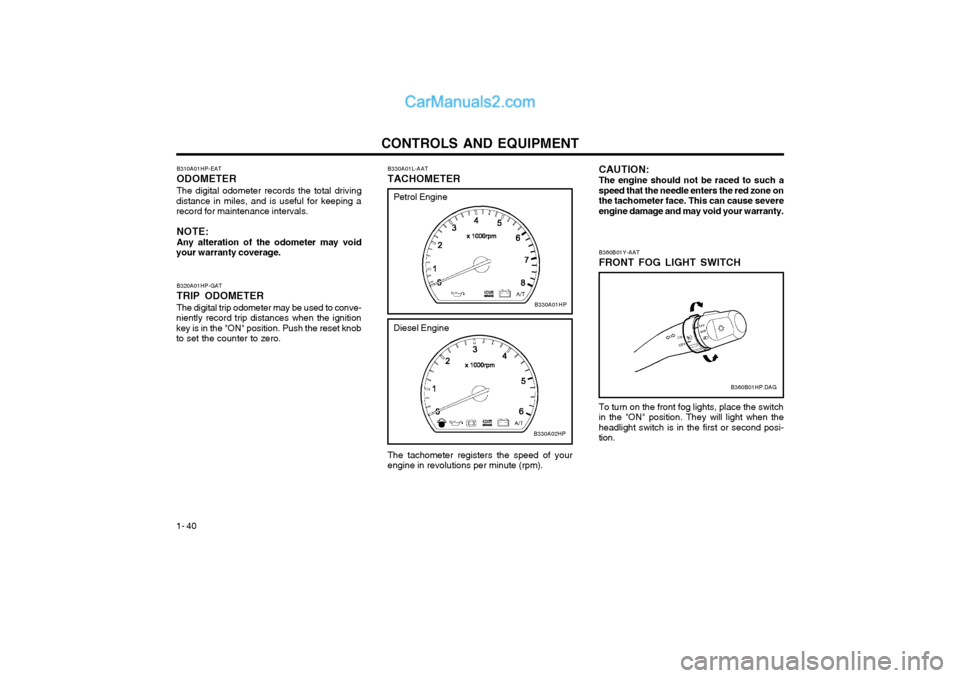
1- 40 CAUTION: The engine should not be raced to such a speed that the needle enters the red zone onthe tachometer face. This can cause severeengine damage and may void your warranty.
B330A01L-AAT TACHOMETER The tachometer registers the speed of your engine in revolutions per minute (rpm).
B310A01HP-EAT ODOMETERThe digital odometer records the total driving
distance in miles, and is useful for keeping a record for maintenance intervals.
NOTE: Any alteration of the odometer may void
your warranty coverage.
B320A01HP-GAT TRIP ODOMETERThe digital trip odometer may be used to conve-
niently record trip distances when the ignition key is in the "ON" position. Push the reset knobto set the counter to zero.
B330A01HP
Petrol Engine
Diesel Engine
B330A02HP
B360B01HP.DAG
B360B01Y-AAT FRONT FOG LIGHT SWITCH To turn on the front fog lights, place the switch in the "ON" position. They will light when theheadlight switch is in the first or second posi-tion.
Page 237 of 349

CONTROLS AND EQUIPMENT1- 43
ZB130A2-E WINDSCREEN WIPER ANDWASHER SWITCH The windscreen wiper switch has three posi-
tions.
1. Intermittent operation
2. Low speed operation
3. High speed operation
NOTE: To prevent damage to the wiper system, do
not attempt to wipe away heavy accumula- tions of snow or ice. Accumulated snow andice should be removed manually. If there isonly a light layer of snow or ice, operate theheater in the defrost mode to melt the snowor ice before using the wiper. YB130B1-E WINDSCREEN WASHER OPERATION
To use the windscreen washer, pull the wiper/
washer lever toward the steering wheel. When the washer lever is operated, the wipers auto-matically make two passes across the wind-shield. The washer continues to operate untilthe lever is released.
NOTE: In winter conditions where screen washer
icing occurs, a winter screen wash additive containing an anti-freeze component maybe used. Only fluids specifically intendedfor this purpose should be used. Ensurethat undiluted additive is not spilt upon thevehicle paintwork and that engine coolantanti-freeze is not used for this purpose ordamage to the paintwork may occur. HXG199J
3
2
HXG119J
1
OFF
INT
LOW HI Mist Wiper Operation If a single wipe is desired in mist, push the
MIST operation switch at the end of the windscreen wiper and washer control lever. HXG201J
Page 250 of 349

CONTROLS AND EQUIPMENT
1- 56
WARNING: Fuel vapors are dangerous. Before refuel-
ing, always stop the engine and never allowsparks or open flames near the filler area. Ifyou need to replace the filler cap, use agenuine Hyundai replacement part.
If you open the fuel filler cap during high
ambient temperatures, a slight "pressuresound" may be heard. This is normal andnot a cause for concern.
Whenever you open the fuel filler cap, turn
it slowly.
The fuel-filler flap may be opened from insidethe vehicle by pulling up on the fuel-filler flapopener located below the left of the driver's sidecrash pad. NOTE: If the fuel-filler flap will not open because ice has formed around it, tap lightly or pushon it to break the ice and release it. Do notlever the flap. If necessary, spray around theflap with an approved de-icer fluid (do notuse radiator anti-freeze) or move the vehicleto a warm place and allow the ice to melt.
HPB360A1-E REMOTE FUEL-FILLER FLAP RELEASE
B560A01HP.DAG
In addition to the lower-mounted rear stoplights on either side of the car, the high mounted rearstoplight in the centre of the rear window alsolights when the brakes are applied.
B550A01A-EAT HIGH-MOUNTED REAR STOP LIGHT (Not all models)B550A01HP
B560A02HP
Page 255 of 349

CONTROLS AND EQUIPMENT1- 61
o Pay particular attention to the driving
conditions whenever using the cruise control system.
o During cruise-speed driving with manual transmission vehicle, do not shift intoneutral without depressing the clutchpedal, since the engine will be overrevved.If this happens, depress the clutch pedalor release the main switch.
o During normal cruise control operation, when the set button is activated or reac-tivated after applying the brakes, thecruise control will energize after approxi-mately 3 seconds. This delay is normal.
B660E01L-EAT To Reset at a Faster Speed
1. Push the control switch "RESUME (ACCEL)"
2. Accelerate to desired speed. Whilst the con- trol switch is held, the vehicle will gradually gain speed.
B660D01L-AAT To Resume the Preset Speed
The vehicle will automatically resume the speed
set prior to cancellation when you push the control switch "RESUME (ACCEL)" (when trav-elling above 25 mph).
B660D01HP
B660F01L-EAT To Reset at a Slower Speed
B660B01HP
1. Push the control button "SET (COAST)". The vehicle will decelerate.
2. When the desired speed is obtained, re- lease the control button. Whilst the control switch is pushed, the vehicle speed willgradually decrease.
WARNING:
o Keep the main switch off when not using the cruise control.
o Do not use the cruise control when it may not be safe to keep the car at a constant speed, for instance, driving inheavy or varying traffic, or on slippery(rainy, icy or snow-covered) or windingroads or over 6% up-hill or down-hillroads.
Page 266 of 349

CONTROLS AND EQUIPMENT
1- 72 B980D01Y-AAT Heating and Cooling System OffPress the "OFF" button to stop the operation of
the heating and cooling system. With the "Recirculation" mode selected, air from
within the passenger compartment will be drawn through the heating system heated or cooledaccording to the function selected. NOTE:
o It should be noted that prolonged opera- tion of the heating in "recirculation" modewill give rise to fogging of the windscreenand side windows and the air within thepassenger compartment will becomestale. In addition, prolonged use of theair conditioning with the "Recirculation"mode selected may result in the air withinthe passenger compartment becomingexcessively dry.
o When the ignition switch is turned "ON" the air intake control will be changed to"FRESH" mode (regardless of switch po-sition). This is normal operation. The airintake control operates in "AUTO" modewhen turning the ignition to the ON posi-tion if the "AUTO" mode was used beforeshutting off the engine. B980E01L-EAT Air Flow Control
B980E01HP
This is used to direct the flow of air. Air can be directed to the floor, dashboard outlets, orwindscreen. Four symbols are used to repre-sent Face, Bi-Level, Floor and Floor-Defrost airposition.
Face-Level
When selecting the "Face" mode, the indicatorlight will come on, causing air to be dischargedthrough the face level vents.
B670D02HP-D
B670D03HP-D
Bi-Level
When selecting the "Bi-Level" mode, the indica- tor light will come on and the air will be dis-
Page 268 of 349
CONTROLS AND EQUIPMENT
1- 74 B740D01Y-AAT Operation Tips
o If the interior of the car is hot when you first get in, open the windows for a few minutes to expel the hot air.
o When you are using the air conditioning system, keep all windows closed to keephot air out.
o When moving slowly, as in heavy traffic, shift to a lower gear. This increases enginespeed, which in turn increases the speed ofthe air conditioning compressor.
o On steep grades, turn the air conditioning off to avoid the possibility of the engine over-heating.
o During winter months or in periods when the air conditioning is not used regularly, run theair conditioning once every month for a fewminutes. This will help circulate the lubri-cants and keep your system in peak operat-ing condition.
Page 269 of 349

CONTROLS AND EQUIPMENT1- 75
FM broadcasts are transmitted at high frequency and do not bend to follow the earth's surface.Because of this, FM broadcasts generally beginto fade at short distances from the station. Also,FM signals are easily affected by buildings, moun-tains, or other obstructions. These can result incertain listening conditions which might lead youto believe a problem exists with your radio. Thefollowing conditions are normal and do not indi-cate radio trouble:
Mountains
Buildings
Obstructed area
Unobstructed area
FM radio station
SSAR012A
Iron bridges
Ionosphere
SSAR011A
AM reception
AM broadcasts can be received at greater dis- tances than FM broadcasts. This is because AMradio waves are transmitted at low frequency.These long, low frequency radio waves canfollow the curvature of the earth rather thantravelling straight out into the ionosphere. Inaddition, they curve around obstructions so thatthey can provide better signal coverage.
B750A02A-AAT STEREO SOUND SYSTEM How Car Audio Works
Ionosphere
FM reception
SSAR010A
AM and FM radio signals are broadcast from transmitter towers located around your city. Theyare intercepted by the radio antenna on your car.This signal is then received by the radio and sentto your car speakers.When a strong radio signal has reached yourvehicle, the precise engineering of your audiosystem ensures high quality reproduction. How-ever, in some cases the signal coming to yourvehicle is not strong and clear. This can be dueto factors such as the distance from the radiostation, closeness of other strong radio stationsor the presence of buildings, bridges or otherlarge obstructions in the area.