2003 Hyundai Santa Fe check engine light
[x] Cancel search: check engine lightPage 171 of 221
6. Do-It-Yourself Maintenance
Engine Compartment ....................................................................... 6-2
General Checks ............................................................................... 6-5
Checking the Engine Oil ................................................................... 6-6
Changing the Oil and Filter ............................................................... 6-7
Checking and Changing the Engine Coolant .................................... 6-8
Spark Plugs ................................................................................... 6-10
Changing the Air Cleaner Filter ...................................................... 6-12
Checking the Transaxle Oil (Manual) ............................................. 6-13
Checking the Transaxle Fluid (Automatic) ..................................... 6-13
Checking the Brakes ..................................................................... 6-15
Air Conditioning Care ..................................................................... 6-17
Checking Drive Belts ..................................................................... 6-19
Checking and Replacing Fuses ..................................................... 6-20
Checking the Battery ..................................................................... 6-21
Power Steering Fluid Level ............................................................ 6-22
Replacement of Light Bulbs ........................................................... 6-24
6
Page 175 of 221
DO-IT-YOURSELF MAINTENANCE 6- 5
G020C01A-AATVehicle Interior
The following should be checked each time
when the vehicle is driven:
o Lights operation
o Windshield wiper operation
o Horn operation
o Defroster, heating system operation (and air
conditioning, if installed)
o Steering operation and condition
o Mirror condition and operation
o Turn signal operation
o Accelerator pedal operation
o Brake operation, including parking brake
o Manual transaxle operation, including clutch
operation
o Automatic transaxle operation, including
"Park" mechanism operation
o Seat control condition and operation
o Seat belt condition and operation
o Sunvisor operation
If you notice anything that does not operate
correctly or appears to be functioning incor-
rectly, inspect it carefully and seek assistance
from your Hyundai dealer if service is needed.
G020B01A-AATVehicle Exterior
The following should be checked monthly:
o Overall appearance and condition
o Wheel condition and wheel nut torque
o Exhaust system condition
o Light condition and operation
o Windshield glass condition
o Wiper blade condition
o Paint condition and body corrosion
o Fluid leaks
o Door and hood lock condition
o Tire pressure and condition (including spare
tire)
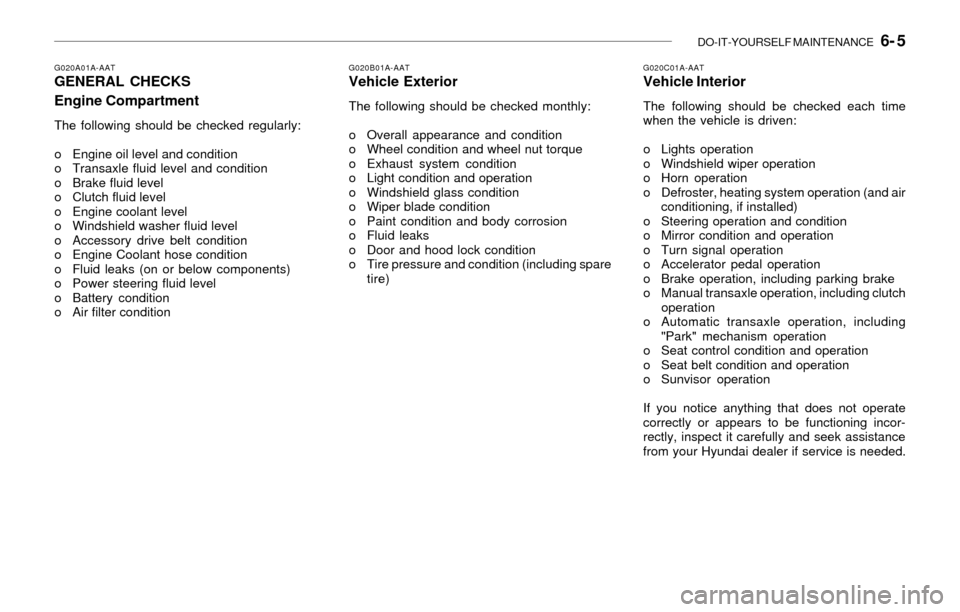
G020A01A-AATGENERAL CHECKS
Engine Compartment
The following should be checked regularly:
o Engine oil level and condition
o Transaxle fluid level and condition
o Brake fluid level
o Clutch fluid level
o Engine coolant level
o Windshield washer fluid level
o Accessory drive belt condition
o Engine Coolant hose condition
o Fluid leaks (on or below components)
o Power steering fluid level
o Battery condition
o Air filter condition
Page 188 of 221
6- 18 DO-IT-YOURSELF MAINTENANCE
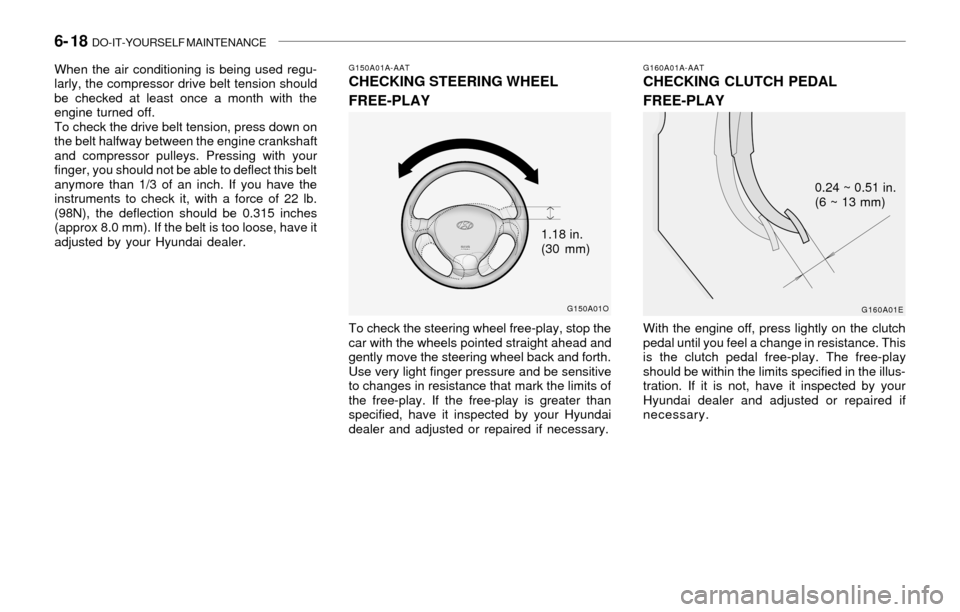
G150A01A-AATCHECKING STEERING WHEEL
FREE-PLAYG160A01A-AATCHECKING CLUTCH PEDAL
FREE-PLAY
To check the steering wheel free-play, stop the
car with the wheels pointed straight ahead and
gently move the steering wheel back and forth.
Use very light finger pressure and be sensitive
to changes in resistance that mark the limits of
the free-play. If the free-play is greater than
specified, have it inspected by your Hyundai
dealer and adjusted or repaired if necessary.With the engine off, press lightly on the clutch
pedal until you feel a change in resistance. This
is the clutch pedal free-play. The free-play
should be within the limits specified in the illus-
tration. If it is not, have it inspected by your
Hyundai dealer and adjusted or repaired if
necessary.
G150A01O
G160A01E
1.18 in.
(30 mm)0.24 ~ 0.51 in.
(6 ~ 13 mm)
When the air conditioning is being used regu-
larly, the compressor drive belt tension should
be checked at least once a month with the
engine turned off.
To check the drive belt tension, press down on
the belt halfway between the engine crankshaft
and compressor pulleys. Pressing with your
finger, you should not be able to deflect this belt
anymore than 1/3 of an inch. If you have the
instruments to check it, with a force of 22 lb.
(98N), the deflection should be 0.315 inches
(approx 8.0 mm). If the belt is too loose, have it
adjusted by your Hyundai dealer.
Page 190 of 221
6- 20 DO-IT-YOURSELF MAINTENANCE
!
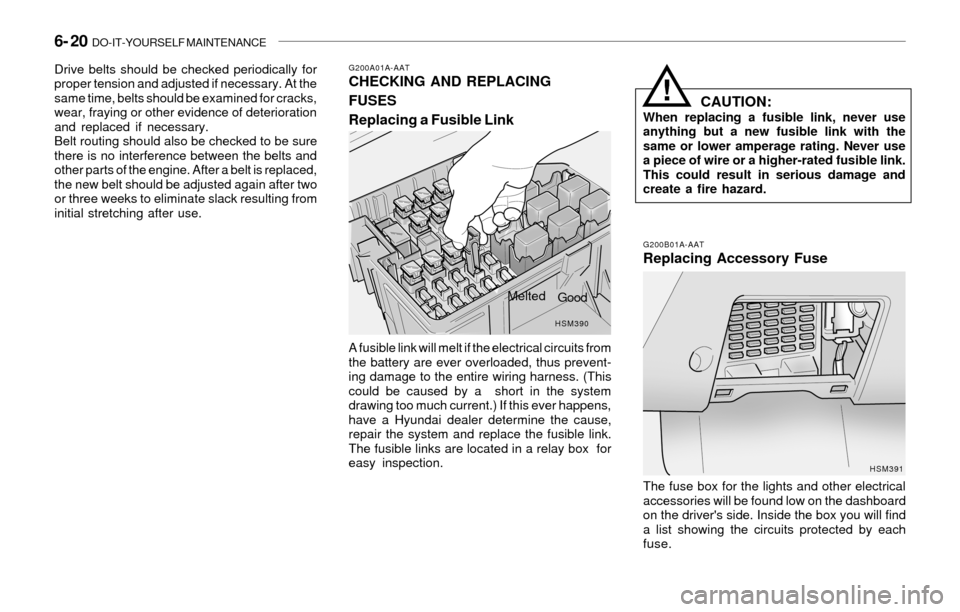
G200A01A-AATCHECKING AND REPLACING
FUSES
Replacing a Fusible Link
G200B01A-AATReplacing Accessory Fuse
A fusible link will melt if the electrical circuits from
the battery are ever overloaded, thus prevent-
ing damage to the entire wiring harness. (This
could be caused by a short in the system
drawing too much current.) If this ever happens,
have a Hyundai dealer determine the cause,
repair the system and replace the fusible link.
The fusible links are located in a relay box for
easy inspection.
CAUTION:When replacing a fusible link, never use
anything but a new fusible link with the
same or lower amperage rating. Never use
a piece of wire or a higher-rated fusible link.
This could result in serious damage and
create a fire hazard.
The fuse box for the lights and other electrical
accessories will be found low on the dashboard
on the driver's side. Inside the box you will find
a list showing the circuits protected by each
fuse.
HSM390
HSM391
Melted
Good Drive belts should be checked periodically for
proper tension and adjusted if necessary. At the
same time, belts should be examined for cracks,
wear, fraying or other evidence of deterioration
and replaced if necessary.
Belt routing should also be checked to be sure
there is no interference between the belts and
other parts of the engine. After a belt is replaced,
the new belt should be adjusted again after two
or three weeks to eliminate slack resulting from
initial stretching after use.
Page 192 of 221
6- 22 DO-IT-YOURSELF MAINTENANCE
!
!
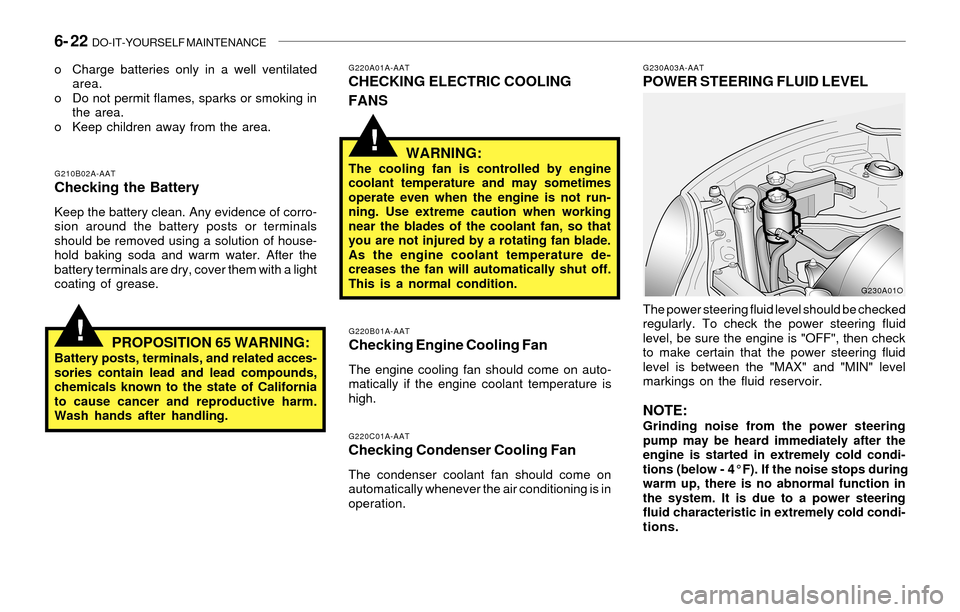
G230A03A-AATPOWER STEERING FLUID LEVEL
G220B01A-AATChecking Engine Cooling Fan
The engine cooling fan should come on auto-
matically if the engine coolant temperature is
high.
G220A01A-AATCHECKING ELECTRIC COOLING
FANS
G220C01A-AATChecking Condenser Cooling Fan
The condenser coolant fan should come on
automatically whenever the air conditioning is in
operation.
WARNING:The cooling fan is controlled by engine
coolant temperature and may sometimes
operate even when the engine is not run-
ning. Use extreme caution when working
near the blades of the coolant fan, so that
you are not injured by a rotating fan blade.
As the engine coolant temperature de-
creases the fan will automatically shut off.
This is a normal condition.
The power steering fluid level should be checked
regularly. To check the power steering fluid
level, be sure the engine is "OFF", then check
to make certain that the power steering fluid
level is between the "MAX" and "MIN" level
markings on the fluid reservoir.
NOTE:Grinding noise from the power steering
pump may be heard immediately after the
engine is started in extremely cold condi-
tions (below - 4°F). If the noise stops during
warm up, there is no abnormal function in
the system. It is due to a power steering
fluid characteristic in extremely cold condi-
tions.
G230A01O G210B02A-AAT
Checking the Battery
Keep the battery clean. Any evidence of corro-
sion around the battery posts or terminals
should be removed using a solution of house-
hold baking soda and warm water. After the
battery terminals are dry, cover them with a light
coating of grease. o Charge batteries only in a well ventilated
area.
o Do not permit flames, sparks or smoking in
the area.
o Keep children away from the area.
PROPOSITION 65 WARNING:Battery posts, terminals, and related acces-
sories contain lead and lead compounds,
chemicals known to the state of California
to cause cancer and reproductive harm.
Wash hands after handling.
Page 193 of 221
DO-IT-YOURSELF MAINTENANCE 6- 23
!
G250A01A-AATFOR MORE INFORMATION ABOUT
YOUR HYUNDAI
If you desire additional information about main-
taining and servicing your Hyundai, you may
purchase a factory Shop Manual at your Hyundai
dealer's parts department. This is the same
manual used by dealership technicians and
while it is highly technical it can be useful in
obtaining a better understanding of your car and
how it works.
G240A01A-AATPOWER STEERING HOSES
It is suggested that you check the power steer-
ing hose connections for fluid leakage at regular
intervals. The power steering hoses should be
replaced if there is severe surface cracking,
scuffing or worn spots. Deterioration of the hose
could cause premature failure. Recommended Fluid
Use PSF-3 type fluid
NOTE:Do not start the engine when the power
steering oil reservoir is empty.
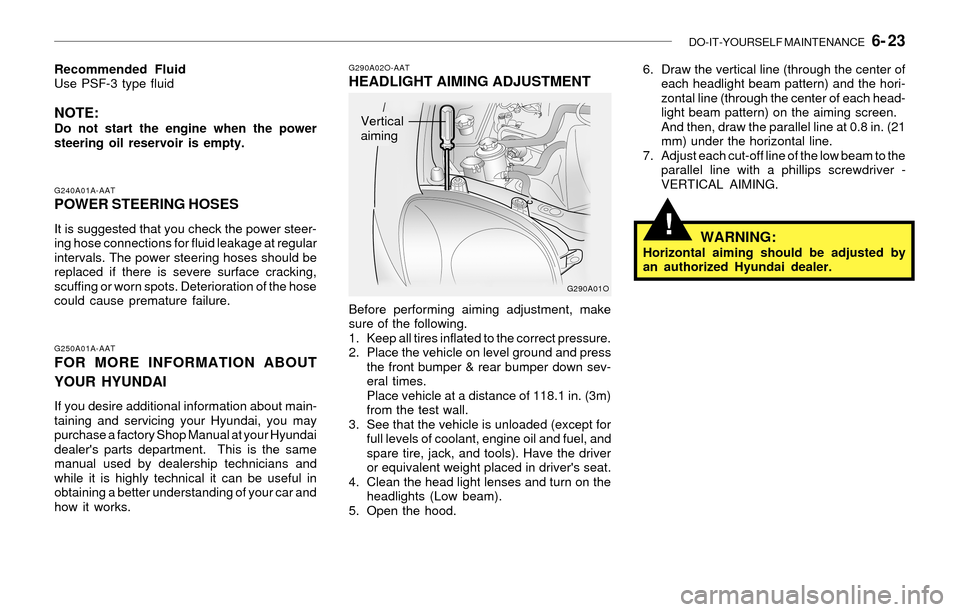
G290A02O-AATHEADLIGHT AIMING ADJUSTMENT
Before performing aiming adjustment, make
sure of the following.
1. Keep all tires inflated to the correct pressure.
2. Place the vehicle on level ground and press
the front bumper & rear bumper down sev-
eral times.
Place vehicle at a distance of 118.1 in. (3m)
from the test wall.
3. See that the vehicle is unloaded (except for
full levels of coolant, engine oil and fuel, and
spare tire, jack, and tools). Have the driver
or equivalent weight placed in driver's seat.
4. Clean the head light lenses and turn on the
headlights (Low beam).
5. Open the hood.6. Draw the vertical line (through the center of
each headlight beam pattern) and the hori-
zontal line (through the center of each head-
light beam pattern) on the aiming screen.
And then, draw the parallel line at 0.8 in. (21
mm) under the horizontal line.
7. Adjust each cut-off line of the low beam to the
parallel line with a phillips screwdriver -
VERTICAL AIMING.
WARNING:Horizontal aiming should be adjusted by
an authorized Hyundai dealer.
G290A01O
Vertical
aiming
Page 194 of 221
6- 24 DO-IT-YOURSELF MAINTENANCE
!
G260A01L-AATREPLACEMENT OF LIGHT BULBS
Before attempting to replace a light bulb, be sure
the switch is turned to the "OFF" position.
The next paragraph shows how to reach the
light bulbs so they may be changed. Be sure to
replace the burned-out bulb with one of the
same number and wattage rating.
See page 6-30 for the wattage description.
CAUTION:Keep the lamps out of contact with petro-
leum products, such as oil, gasoline, etc.
G270A01O-AATHeadlight and Front Turn Signal Light
1. Allow the bulb to cool. Wear eye protection.
2. Open the engine hood.
3. Always grasp the bulb by its plastic base,
avoid touching the glass.
4. Using a socket wrench of the correct size,
remove the headlight assembly mounting
bolts.
HSM353
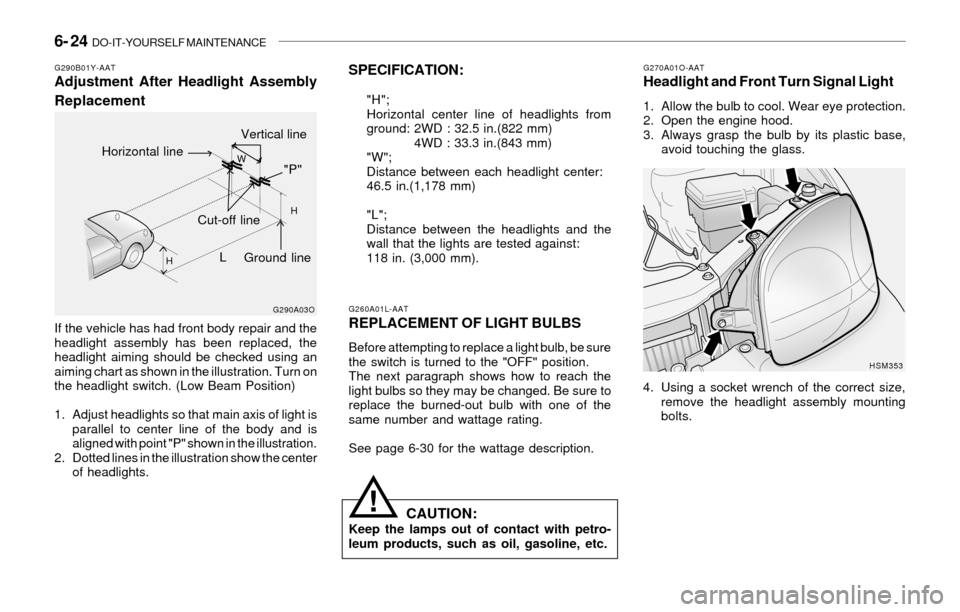
SPECIFICATION:
"H";
Horizontal center line of headlights from
ground: 2WD : 32.5 in.(822 mm)
4WD : 33.3 in.(843 mm)
"W";
Distance between each headlight center:
46.5 in.(1,178 mm)
"L";
Distance between the headlights and the
wall that the lights are tested against:
118 in. (3,000 mm).
G290B01Y-AATAdjustment After Headlight Assembly
Replacement
If the vehicle has had front body repair and the
headlight assembly has been replaced, the
headlight aiming should be checked using an
aiming chart as shown in the illustration. Turn on
the headlight switch. (Low Beam Position)
1. Adjust headlights so that main axis of light is
parallel to center line of the body and is
aligned with point "P" shown in the illustration.
2. Dotted lines in the illustration show the center
of headlights.
G290A03O
L
W
H
H
Cut-off line
Ground line
"P"
Horizontal line
Vertical line
Page 218 of 221
INDEX 10- 3
D
Defrosting / Defogging ......................................................................1-77
Door
Locking, unlocking front door with a key ...................................... 1-4
Drink Holder ......................................................................................1-49
Drive Belts .........................................................................................6-19
Driving
Driving for economy .....................................................................2-16
Smooth cornering .........................................................................2-17
Winter driving ...............................................................................2-17
E
Emission Control System ................................................................... 7-2
Engine
Before starting the engine .............................................................. 2-3
Compartment (2.4 DOHC) ............................................................ 6-2
Compartment (2.7 V6) ................................................................... 6-3
Compartment (3.5 V6) ................................................................... 6-4
Coolant ........................................................................................... 6-8
Coolant temperature gauge .........................................................1-41
If the engine overheats .................................................................. 3-3
Number........................................................................................... 8-2
Oil ................................................................................................... 6-6
Starting ........................................................................................... 2-5
Engine Exhaust Can Be Dangerous .................................................. 2-2
F
Fan Speed Control ............................................................................1-70
Floor Mat Anchor ..............................................................................1-64
Fog Light
Front.............................................................................................1-46Front Seats
Adjustable front seats ..................................................................1-10
Adjustable headrests ...................................................................1-12
Adjusting seat forward and rearward ..........................................1-11
Adjusting seatback angle .............................................................1-11
Fuel
Auto fuel cut switch ......................................................................1-62
Capacity......................................................................................... 9-2
Gauge...........................................................................................1-40
Recommendations......................................................................... 1-2
Fuel Filler Lid
Remote release ............................................................................1-62
Full-time 4WD Operation ..................................................................2-13
Fuses................................................................................................6-20
G
General Checks .................................................................................. 6-5
Glove Box ..........................................................................................1-53
H
Hazard Warning System ..................................................................1-46
Heating and Cooling Control .............................................................1-69
Heating and Ventilation
Air flow control ..............................................................................1-71
Air intake control ..........................................................................1-70
Bi-level heating .............................................................................1-75
Defrosting / Defogging .................................................................1-77
Fan speed control (Blower control) .............................................1-70
Temperature control ....................................................................1-74
High-Mounted Rear Stoplight ............................................................1-61
Homelink Mirror .................................................................................1-56