2003 Hyundai Santa Fe 4WD
[x] Cancel search: 4WDPage 143 of 221
DRIVING YOUR HYUNDAI 2- 21
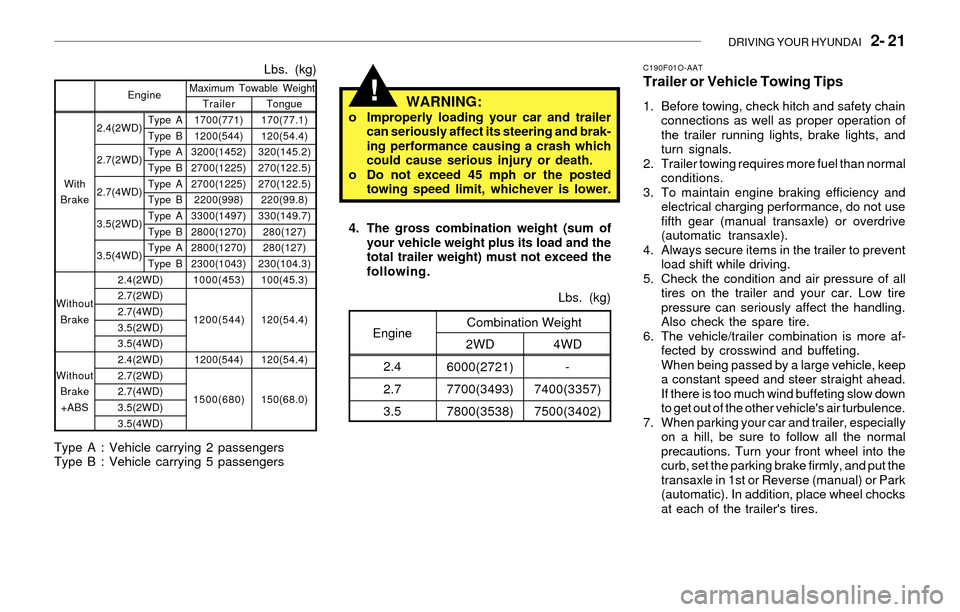
2.4(2WD)
2.7(2WD)
2.7(4WD)
3.5(2WD)
3.5(4WD)Tongue
170(77.1)
120(54.4)
320(145.2)
270(122.5)
270(122.5)
220(99.8)
330(149.7)
280(127)
280(127)
230(104.3)
100(45.3)
120(54.4)
120(54.4)
150(68.0)
Lbs. (kg)
Trailer
1700(771)
1200(544)
3200(1452)
2700(1225)
2700(1225)
2200(998)
3300(1497)
2800(1270)
2800(1270)
2300(1043)
1000(453)
1200(544)
1200(544)
1500(680) Maximum Towable Weight
Type A
Type B
Type A
Type B
Type A
Type B
Type A
Type B
Type A
Type B With
Brake
Without
Brake
Without
Brake
+ABSEngine
2.4(2WD)
2.7(2WD)
2.7(4WD)
3.5(2WD)
3.5(4WD)
2.4(2WD)
2.7(2WD)
2.7(4WD)
3.5(2WD)
3.5(4WD)
Type A : Vehicle carrying 2 passengers
Type B : Vehicle carrying 5 passengers
!
C190F01O-AATTrailer or Vehicle Towing Tips
1. Before towing, check hitch and safety chain
connections as well as proper operation of
the trailer running lights, brake lights, and
turn signals.
2. Trailer towing requires more fuel than normal
conditions.
3. To maintain engine braking efficiency and
electrical charging performance, do not use
fifth gear (manual transaxle) or overdrive
(automatic transaxle).
4. Always secure items in the trailer to prevent
load shift while driving.
5. Check the condition and air pressure of all
tires on the trailer and your car. Low tire
pressure can seriously affect the handling.
Also check the spare tire.
6. The vehicle/trailer combination is more af-
fected by crosswind and buffeting.
When being passed by a large vehicle, keep
a constant speed and steer straight ahead.
If there is too much wind buffeting slow down
to get out of the other vehicle's air turbulence.
7. When parking your car and trailer, especially
on a hill, be sure to follow all the normal
precautions. Turn your front wheel into the
curb, set the parking brake firmly, and put the
transaxle in 1st or Reverse (manual) or Park
(automatic). In addition, place wheel chocks
at each of the trailer's tires. 4. The gross combination weight (sum of
your vehicle weight plus its load and the
total trailer weight) must not exceed the
following.
4WD
-
7400(3357)
7500(3402)Lbs. (kg)
2WD
6000(2721)
7700(3493)
7800(3538)Combination WeightEngine
2.4
2.7
3.5
WARNING:o Improperly loading your car and trailer
can seriously affect its steering and brak-
ing performance causing a crash which
could cause serious injury or death.
o Do not exceed 45 mph or the posted
towing speed limit, whichever is lower.
Page 155 of 221
3- 10 WHAT TO DO IN AN EMERGENCY
!
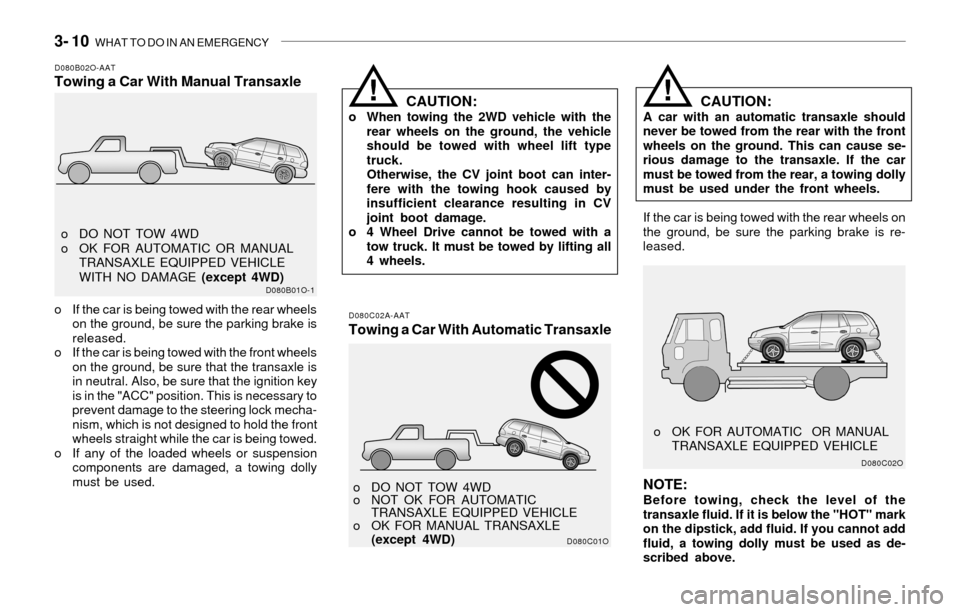
D080B02O-AATTowing a Car With Manual Transaxle
D080C02A-AATTowing a Car With Automatic Transaxle
o If the car is being towed with the rear wheels
on the ground, be sure the parking brake is
released.
o If the car is being towed with the front wheels
on the ground, be sure that the transaxle is
in neutral. Also, be sure that the ignition key
is in the "ACC" position. This is necessary to
prevent damage to the steering lock mecha-
nism, which is not designed to hold the front
wheels straight while the car is being towed.
o If any of the loaded wheels or suspension
components are damaged, a towing dolly
must be used.
CAUTION:o When towing the 2WD vehicle with the
rear wheels on the ground, the vehicle
should be towed with wheel lift type
truck.
Otherwise, the CV joint boot can inter-
fere with the towing hook caused by
insufficient clearance resulting in CV
joint boot damage.
o 4 Wheel Drive cannot be towed with a
tow truck. It must be towed by lifting all
4 wheels.CAUTION:A car with an automatic transaxle should
never be towed from the rear with the front
wheels on the ground. This can cause se-
rious damage to the transaxle. If the car
must be towed from the rear, a towing dolly
must be used under the front wheels.
If the car is being towed with the rear wheels on
the ground, be sure the parking brake is re-
leased.
NOTE:Before towing, check the level of the
transaxle fluid. If it is below the "HOT" mark
on the dipstick, add fluid. If you cannot add
fluid, a towing dolly must be used as de-
scribed above.
D080B01O-1
D080C01OD080C02O
o DO NOT TOW 4WD
o OK FOR AUTOMATIC OR MANUAL
TRANSAXLE EQUIPPED VEHICLE
WITH NO DAMAGE (except 4WD)
o DO NOT TOW 4WD
o NOT OK FOR AUTOMATIC
TRANSAXLE EQUIPPED VEHICLE
o OK FOR MANUAL TRANSAXLE
(except 4WD)o OK FOR AUTOMATIC OR MANUAL
TRANSAXLE EQUIPPED VEHICLE
!
Page 156 of 221
WHAT TO DO IN AN EMERGENCY 3- 11
!
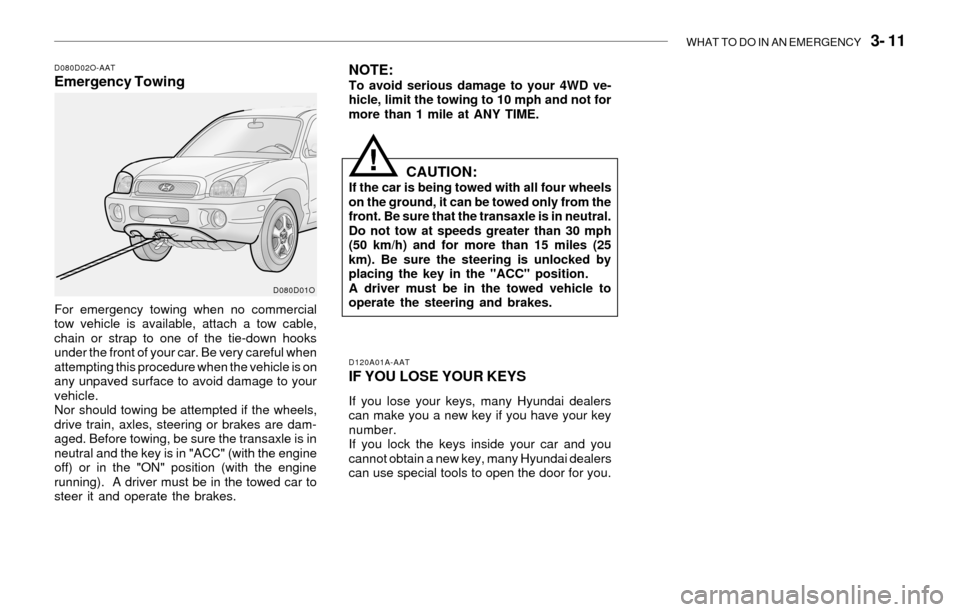
D080D02O-AATEmergency Towing
For emergency towing when no commercial
tow vehicle is available, attach a tow cable,
chain or strap to one of the tie-down hooks
under the front of your car. Be very careful when
attempting this procedure when the vehicle is on
any unpaved surface to avoid damage to your
vehicle.
Nor should towing be attempted if the wheels,
drive train, axles, steering or brakes are dam-
aged. Before towing, be sure the transaxle is in
neutral and the key is in "ACC" (with the engine
off) or in the "ON" position (with the engine
running). A driver must be in the towed car to
steer it and operate the brakes.
NOTE:To avoid serious damage to your 4WD ve-
hicle, limit the towing to 10 mph and not for
more than 1 mile at ANY TIME.
CAUTION:If the car is being towed with all four wheels
on the ground, it can be towed only from the
front. Be sure that the transaxle is in neutral.
Do not tow at speeds greater than 30 mph
(50 km/h) and for more than 15 miles (25
km). Be sure the steering is unlocked by
placing the key in the "ACC" position.
A driver must be in the towed vehicle to
operate the steering and brakes.
D120A01A-AAT
IF YOU LOSE YOUR KEYS
If you lose your keys, many Hyundai dealers
can make you a new key if you have your key
number.
If you lock the keys inside your car and you
cannot obtain a new key, many Hyundai dealers
can use special tools to open the door for you.
D080D01O
Page 166 of 221
VEHICLE MAINTENANCE REQUIREMENTS 5- 5
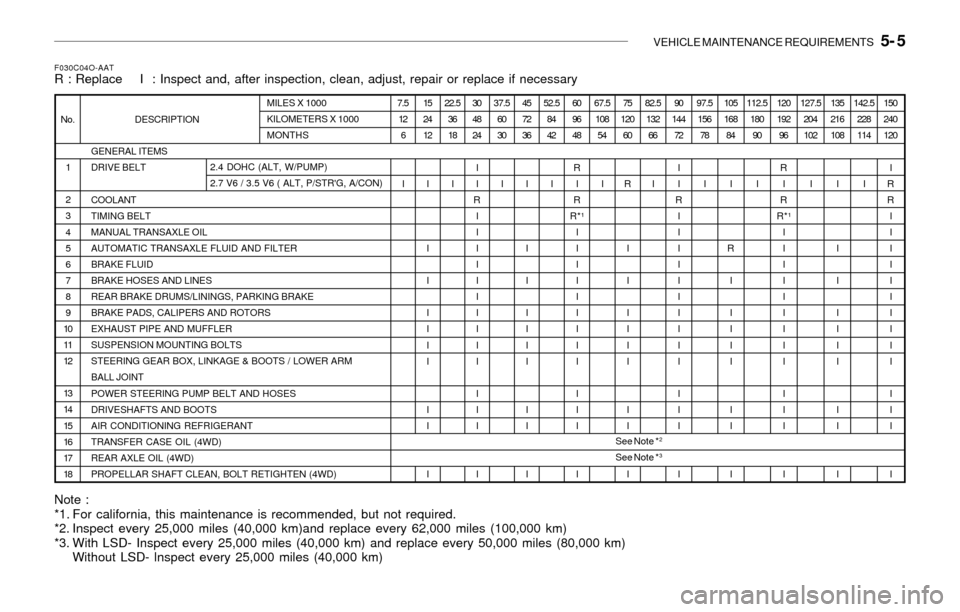
Note :
*1. For california, this maintenance is recommended, but not required.
*2. Inspect every 25,000 miles (40,000 km)and replace every 62,000 miles (100,000 km)
*3. With LSD- Inspect every 25,000 miles (40,000 km) and replace every 50,000 miles (80,000 km)
Without LSD- lnspect every 25,000 miles (40,000 km)
F030C04O-AATR : Replace I : Inspect and, after inspection, clean, adjust, repair or replace if necessary
GENERAL ITEMS
DRIVE BELT
COOLANT
TIMING BELT
MANUAL TRANSAXLE OIL
AUTOMATIC TRANSAXLE FLUID AND FILTER
BRAKE FLUID
BRAKE HOSES AND LINES
REAR BRAKE DRUMS/LININGS, PARKING BRAKE
BRAKE PADS, CALIPERS AND ROTORS
EXHAUST PIPE AND MUFFLER
SUSPENSION MOUNTING BOLTS
STEERING GEAR BOX, LINKAGE & BOOTS / LOWER ARM
BALL JOINT
POWER STEERING PUMP BELT AND HOSES
DRIVESHAFTS AND BOOTS
AIR CONDITIONING REFRIGERANT
TRANSFER CASE OIL (4WD)
REAR AXLE OIL (4WD)
PROPELLAR SHAFT CLEAN, BOLT RETIGHTEN (4WD) 1
2
3
4
5
6
7
8
9
10
11
12
13
14
15
16
17
18 No. DESCRIPTIONMILES X 1000
KILOMETERS X 1000
MONTHS
2.4 DOHC (ALT, W/PUMP)
2.7 V6 / 3.5 V6 ( ALT, P/STR'G, A/CON)7.5
12
6
I15
24
12
I
I
I
I
I
I
I
I
I
I22.5
36
18
I30
48
24
I
I
R
I
I
I
I
I
I
I
I
I
I
I
I
I
I37.5
60
30
I45
72
36
I
I
I
I
I
I
I
I
I
I52.5
84
42
I60
96
48
R
I
R
R*¹
I
I
I
I
I
I
I
I
I
I
I
I
I67.5
108
54
I75
120
60
R
I
I
I
I
I
I
I
I
I82.5
132
66
I90
144
72
I
I
R
I
I
I
I
I
I
I
I
I
I
I
I
I
I97.5
156
78
I105
168
84
I
R
I
I
I
I
I
I
I
I112.5
180
90
I120
192
96
R
I
R
R*¹
I
I
I
I
I
I
I
I
I
I
I
I
I127.5
204
102
I135
216
108
I
I
I
I
I
I
I
I
I
I142.5
228
114
I150
240
120
I
R
R
I
I
I
I
I
I
I
I
I
I
I
I
I
I See Note *
2
See Note *3
Page 167 of 221
5- 6 VEHICLE MAINTENANCE REQUIREMENTS
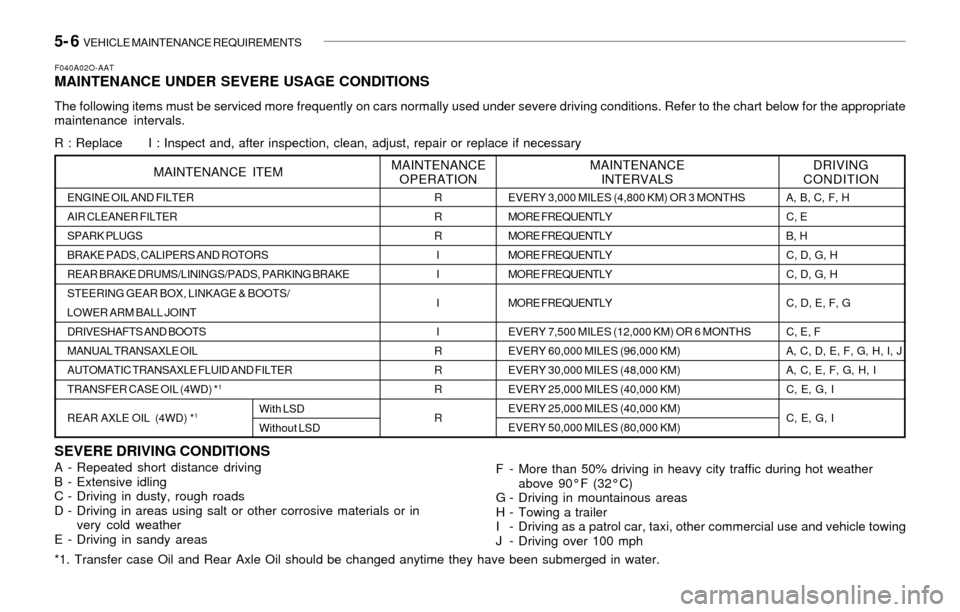
SEVERE DRIVING CONDITIONSA - Repeated short distance driving
B - Extensive idling
C - Driving in dusty, rough roads
D - Driving in areas using salt or other corrosive materials or in
very cold weather
E - Driving in sandy areas
F040A02O-AATMAINTENANCE UNDER SEVERE USAGE CONDITIONS
The following items must be serviced more frequently on cars normally used under severe driving conditions. Refer to the chart below for the appropriate
maintenance intervals.
R : Replace I : Inspect and, after inspection, clean, adjust, repair or replace if necessary
*1. Transfer case Oil and Rear Axle Oil should be changed anytime they have been submerged in water.F - More than 50% driving in heavy city traffic during hot weather
above 90°F (32°C)
G - Driving in mountainous areas
H - Towing a trailer
I - Driving as a patrol car, taxi, other commercial use and vehicle towing
J - Driving over 100 mph
ENGINE OIL AND FILTER
AIR CLEANER FILTER
SPARK PLUGS
BRAKE PADS, CALIPERS AND ROTORS
REAR BRAKE DRUMS/LININGS/PADS, PARKING BRAKE
STEERING GEAR BOX, LINKAGE & BOOTS/
LOWER ARM BALL JOINT
DRIVESHAFTS AND BOOTS
MANUAL TRANSAXLE OIL
AUTOMATIC TRANSAXLE FLUID AND FILTER
TRANSFER CASE OIL (4WD) *
1
REAR AXLE OIL (4WD) *1
MAINTENANCE ITEM
R
R
R
I
I
I
I
R
R
R
REVERY 3,000 MILES (4,800 KM) OR 3 MONTHS
MORE FREQUENTLY
MORE FREQUENTLY
MORE FREQUENTLY
MORE FREQUENTLY
MORE FREQUENTLY
EVERY 7,500 MILES (12,000 KM) OR 6 MONTHS
EVERY 60,000 MILES (96,000 KM)
EVERY 30,000 MILES (48,000 KM)
EVERY 25,000 MILES (40,000 KM)
EVERY 25,000 MILES (40,000 KM)
EVERY 50,000 MILES (80,000 KM)
With LSD
Without LSD
DRIVING
CONDITION MAINTENANCE
INTERVALS MAINTENANCE
OPERATION
A, B, C, F, H
C, E
B, H
C, D, G, H
C, D, G, H
C, D, E, F, G
C, E, F
A, C, D, E, F, G, H, I, J
A, C, E, F, G, H, I
C, E, G, I
C, E, G, I
Page 194 of 221
6- 24 DO-IT-YOURSELF MAINTENANCE
!
G260A01L-AATREPLACEMENT OF LIGHT BULBS
Before attempting to replace a light bulb, be sure
the switch is turned to the "OFF" position.
The next paragraph shows how to reach the
light bulbs so they may be changed. Be sure to
replace the burned-out bulb with one of the
same number and wattage rating.
See page 6-30 for the wattage description.
CAUTION:Keep the lamps out of contact with petro-
leum products, such as oil, gasoline, etc.
G270A01O-AATHeadlight and Front Turn Signal Light
1. Allow the bulb to cool. Wear eye protection.
2. Open the engine hood.
3. Always grasp the bulb by its plastic base,
avoid touching the glass.
4. Using a socket wrench of the correct size,
remove the headlight assembly mounting
bolts.
HSM353
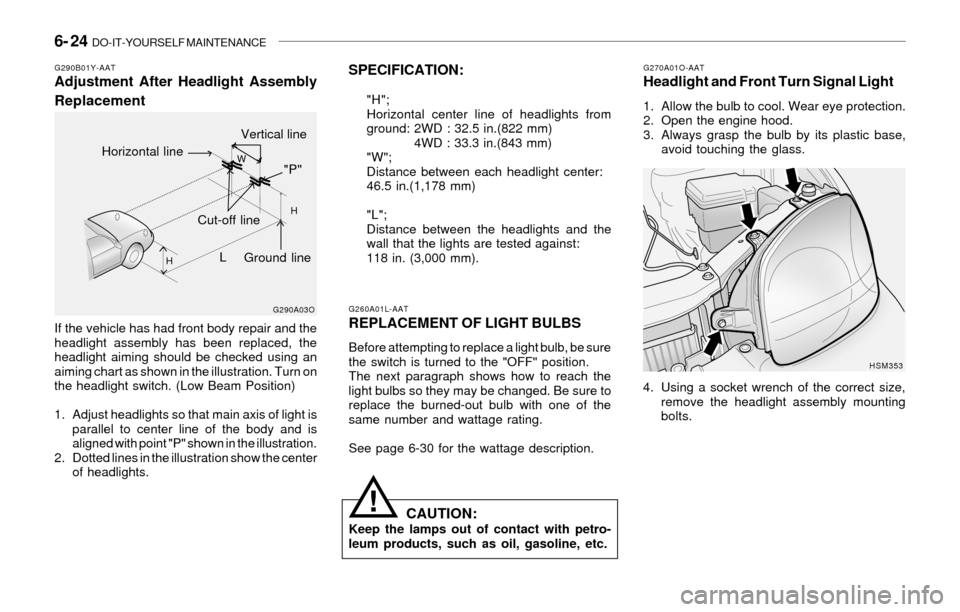
SPECIFICATION:
"H";
Horizontal center line of headlights from
ground: 2WD : 32.5 in.(822 mm)
4WD : 33.3 in.(843 mm)
"W";
Distance between each headlight center:
46.5 in.(1,178 mm)
"L";
Distance between the headlights and the
wall that the lights are tested against:
118 in. (3,000 mm).
G290B01Y-AATAdjustment After Headlight Assembly
Replacement
If the vehicle has had front body repair and the
headlight assembly has been replaced, the
headlight aiming should be checked using an
aiming chart as shown in the illustration. Turn on
the headlight switch. (Low Beam Position)
1. Adjust headlights so that main axis of light is
parallel to center line of the body and is
aligned with point "P" shown in the illustration.
2. Dotted lines in the illustration show the center
of headlights.
G290A03O
L
W
H
H
Cut-off line
Ground line
"P"
Horizontal line
Vertical line
Page 218 of 221
INDEX 10- 3
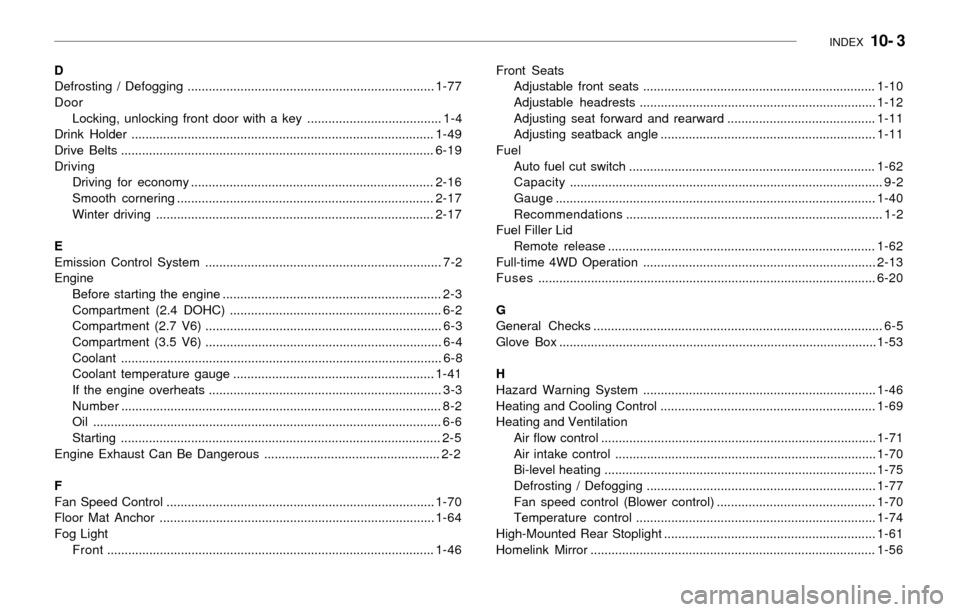
D
Defrosting / Defogging ......................................................................1-77
Door
Locking, unlocking front door with a key ...................................... 1-4
Drink Holder ......................................................................................1-49
Drive Belts .........................................................................................6-19
Driving
Driving for economy .....................................................................2-16
Smooth cornering .........................................................................2-17
Winter driving ...............................................................................2-17
E
Emission Control System ................................................................... 7-2
Engine
Before starting the engine .............................................................. 2-3
Compartment (2.4 DOHC) ............................................................ 6-2
Compartment (2.7 V6) ................................................................... 6-3
Compartment (3.5 V6) ................................................................... 6-4
Coolant ........................................................................................... 6-8
Coolant temperature gauge .........................................................1-41
If the engine overheats .................................................................. 3-3
Number........................................................................................... 8-2
Oil ................................................................................................... 6-6
Starting ........................................................................................... 2-5
Engine Exhaust Can Be Dangerous .................................................. 2-2
F
Fan Speed Control ............................................................................1-70
Floor Mat Anchor ..............................................................................1-64
Fog Light
Front.............................................................................................1-46Front Seats
Adjustable front seats ..................................................................1-10
Adjustable headrests ...................................................................1-12
Adjusting seat forward and rearward ..........................................1-11
Adjusting seatback angle .............................................................1-11
Fuel
Auto fuel cut switch ......................................................................1-62
Capacity......................................................................................... 9-2
Gauge...........................................................................................1-40
Recommendations......................................................................... 1-2
Fuel Filler Lid
Remote release ............................................................................1-62
Full-time 4WD Operation ..................................................................2-13
Fuses................................................................................................6-20
G
General Checks .................................................................................. 6-5
Glove Box ..........................................................................................1-53
H
Hazard Warning System ..................................................................1-46
Heating and Cooling Control .............................................................1-69
Heating and Ventilation
Air flow control ..............................................................................1-71
Air intake control ..........................................................................1-70
Bi-level heating .............................................................................1-75
Defrosting / Defogging .................................................................1-77
Fan speed control (Blower control) .............................................1-70
Temperature control ....................................................................1-74
High-Mounted Rear Stoplight ............................................................1-61
Homelink Mirror .................................................................................1-56