2003 Hyundai Matrix belt
[x] Cancel search: beltPage 199 of 312
CONTROLS AND EQUIPMENT
1- 18 WARNING:
o Do not install a child restraint seat at
the rear centre seating position using the vehicle's ISOFIX anchors. The ISOFIXanchors are only provided for the leftand right outboard rear seating posi-tions. Do not misuse the ISOFIX an-chors by attempting to attach a childrestraint seat in the middle rear seatingposition to the ISOFIX anchors. In acrash, the child restraint seat ISOFIXattachments may not be strong enoughto secure the child restraint seat prop-erly in the centre seating position andmay break, causing serious injury ordeath.
o Do not mount more than one child re- straint to a child restraint lower anchor-age point. The improper increased loadmay cause the anchorage points ortether anchor to break, causing seriousinjury or death.
o Attach the ISOFIX or ISOFIX-compatible child restraint seat only to the appropri-ate locations shown in the illustration.
o Always follow the installation and use instructions provided by the manufac-turer of the child restraint.
the lap portion of the belt is tight around thechild restraint system and the shoulder por-tion of the belt is positioned so that it cannotinterfere with the child's head or neck. Afterinstallation of the child restraint system, try tomove it in all directions to be sure the childrestraint system is securely installed. If you need to tighten the belt, pull more webbing toward the retractor. When you un-buckle the seat belt and allow it to retract, theretractor will automatically revert back to itsnormal seated passenger emergency lockingusage condition. NOTE:
o Before installing the child restraint sys-
tem, read the instructions supplied by the child restraint system manufacturer.
o If the seat belt does not operate as described, have the system checkedimmediately by your authorized Hyundaidealer.
WARNING: Do not install any child restraint system in the front passenger seat. Should an acci-dent occur and cause the passenger sideairbag to deploy, it could severely injure orkill an infant or child seated in an infant orchild seat. Therefore, only use a child re-straint system in the rear seat of yourvehicle. B230D01FC-EAT
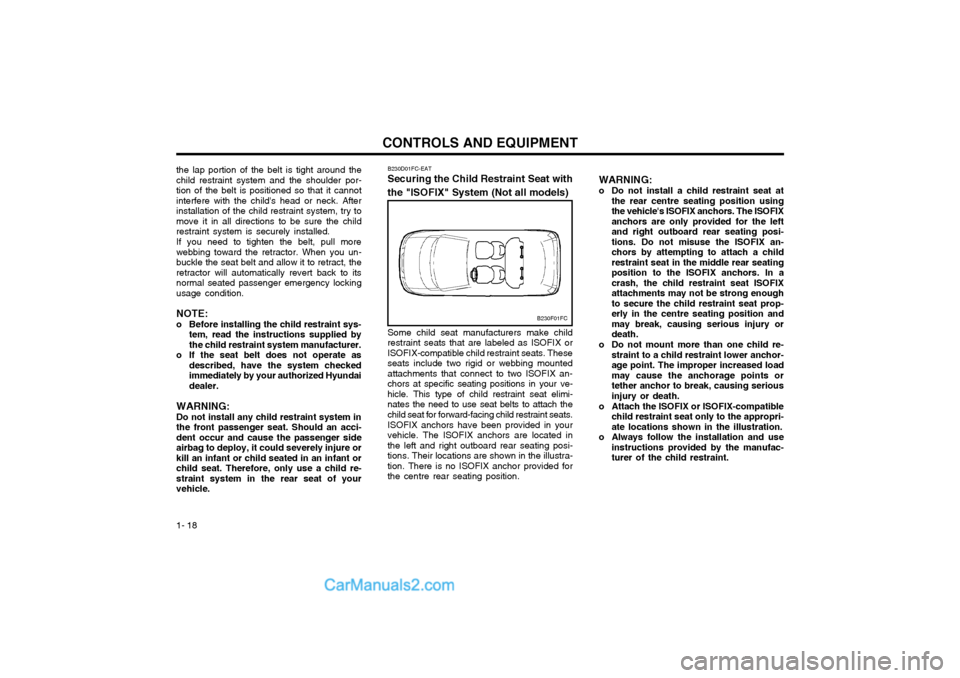
Securing the Child Restraint Seat with
the "ISOFIX" System (Not all models)
B230F01FC
Some child seat manufacturers make child restraint seats that are labeled as ISOFIX orISOFIX-compatible child restraint seats. Theseseats include two rigid or webbing mountedattachments that connect to two ISOFIX an-chors at specific seating positions in your ve-hicle. This type of child restraint seat elimi-nates the need to use seat belts to attach thechild seat for forward-facing child restraint seats. ISOFIX anchors have been provided in your vehicle. The ISOFIX anchors are located inthe left and right outboard rear seating posi-tions. Their locations are shown in the illustra-tion. There is no ISOFIX anchor provided forthe centre rear seating position.
Page 200 of 312
1- 19
CONTROLS AND EQUIPMENT
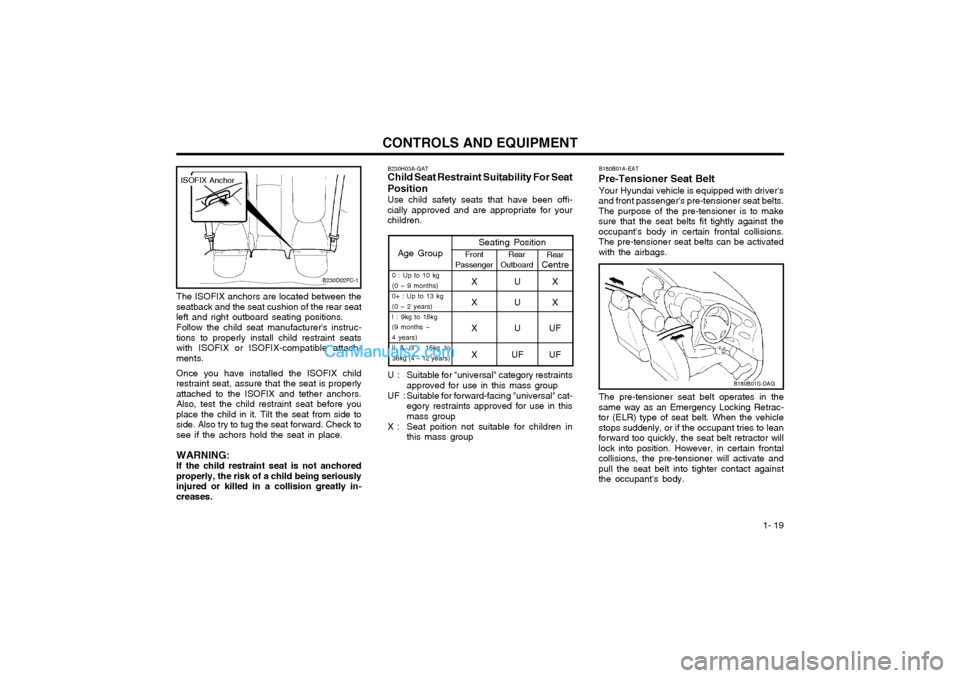
Age GroupSeating PositionFront
Passenger Rear
Outboard Rear
Centre
0 : Up to 10 kg (0 ~ 9 months)0+ : Up to 13 kg(0 ~ 2 years)I : 9kg to 18kg (9 months ~ 4 years)II & III : 15kg to 36kg (4 ~ 12 years)XUX
XUX
XUU F
XU FUF
The ISOFIX anchors are located between the
seatback and the seat cushion of the rear seat left and right outboard seating positions.
Follow the child seat manufacturer's instruc-
tions to properly install child restraint seatswith ISOFIX or ISOFIX-compatible attach-ments.
Once you have installed the ISOFIX child
restraint seat, assure that the seat is properlyattached to the ISOFIX and tether anchors.Also, test the child restraint seat before youplace the child in it. Tilt the seat from side toside. Also try to tug the seat forward. Check tosee if the achors hold the seat in place.
WARNING:If the child restraint seat is not anchored
properly, the risk of a child being seriouslyinjured or killed in a collision greatly in-creases.
B230D02FC-1
ISOFIX Anchor
B180B01S-DAG
B180B01A-EAT
Pre-Tensioner Seat Belt
Your Hyundai vehicle is equipped with driver's
and front passenger's pre-tensioner seat belts. The purpose of the pre-tensioner is to makesure that the seat belts fit tightly against theoccupant's body in certain frontal collisions.The pre-tensioner seat belts can be activatedwith the airbags.
The pre-tensioner seat belt operates in the
same way as an Emergency Locking Retrac- tor (ELR) type of seat belt. When the vehiclestops suddenly, or if the occupant tries to leanforward too quickly, the seat belt retractor willlock into position. However, in certain frontalcollisions, the pre-tensioner will activate andpull the seat belt into tighter contact againstthe occupant's body.
B230H03A-GAT Child Seat Restraint Suitability For Seat Position Use child safety seats that have been offi- cially approved and are appropriate for yourchildren.
U : Suitable for "universal" category restraints approved for use in this mass group
UF : Suitable for forward-facing "universal" cat- egory restraints approved for use in this mass group
X : Seat poition not suitable for children in this mass group
Page 201 of 312

CONTROLS AND EQUIPMENT
1- 20 pre-tensioner seat belt or SRS airbag system as soon as possible.
WARNING:
o Pre-tensioners are designed to operate only one time. After activation, pre-tensioner seat belts must be replaced.All seat belts, of any type, should al-ways be replaced after they have beenworn during a collision.
o The pre-tensioner seat belt assembly mechanisms become hot during activa-tion. Do not touch the pre-tensionerseat belt assemblies for several min-utes after they have been activated.
o Do not attempt to inspect or replace the pre-tensioner seat belts yourself. Thismust be done by an authorized Hyundaidealer.
o Do not strike the pre-tensioner seat belt assemblies.
o Do not attempt to service or repair the pre-tensioner seat belt system in anymanner.
o Improper handling of the pre-tensioner seat belt assemblies, and failure to heedthe warnings to not strike, modify, in-spect, replace, service or repair the pre-tensioner seat belt assemblies may leadto improper operation or inadvertentactivation and serious injury.
o Always wear the seat belts when driving or travelling in a motor vehicle.
Driver's airbag conditions even if the seat belts are not being worn at the time of the collision.
o When the pre-tensioner seat belts are activated, a loud noise may be heardand fine dust, which may appear to besmoke, may be visible in the passengercompartment. These are normal operat-ing conditions and are not hazardous.
o Although it is harmless, the fine dust may cause skin irritation and shouldnot be breathed for prolonged periods.Wash your hands and face thoroughlyafter an accident in which the pre-tensioner seat belts were activated.
CAUTION:
o Because the sensor that activates the SRS airbag is connected with the pre- tensioner seat belt, the SRS airbag warn-ing light on the instrument panel willblink for approximately 6 seconds afterthe ignition key has been turned to the
"ON" position and then it should turn off.
o If the pre-tensioner seat belt is not work- ing properly, this warning light will illu-minate even if there is no malfunctionof the SRS airbag system. If the SRS airbag warning light does not illuminate when the ignition key is turnedto "ON", or if it remains illuminatedafter blinking for approximately 6 sec-onds, or if it illuminates while the ve-hicle is being driven, please have anauthorized Hyundai dealer inspect the
The seat belt pre-tensioner system consists
mainly of the following components. Theirlocations are shown in the illustration.
1. SRS airbag warning light
2. Seat belt pre-tensioner assembly
3. SRS control module
WARNING:To obtain maximum benefit from a pre-
tensioner seat belt:
1. The seat belt must be worn correctly.
2. The seat belt must be adjusted to the correct position.
NOTE:
o Both the driver's and front passenger's pre-tensioner seat belts will be acti- vated in certain frontal collisions. Thepre-tensioner seat belts can be acti-vated with the airbags. The pre-tensioners will be activated under these
1
2
3
B180B02S-DAG
Passenger's airbag
AIR
BAG
Page 202 of 312
1- 21
CONTROLS AND EQUIPMENT
Your Hyundai is equipped with a Supplemen-
tal Restraint (Airbag) System. The indications of the system's presence are the letters "SRSAIR BAG" embossed on the airbag pad coverin the steering wheel and the passenger'sside front panel pad above the glove box.
The Hyundai SRS consists of airbags in-
stalled under the pad covers in the centre ofthe steering wheel and the passenger's sidefront panel above the glove box. The purposeof the SRS is to provide the vehicle's driverand/or the front passenger with additionalprotection than that offered by the seat beltsystem alone, in case of a frontal impact ofsufficient severity. NOTE: Be sure to read information about the SRS on the labels provided on the backside ofthe sun visor and in the glove box. WARNING:
o As its name implies, the SRS is de-
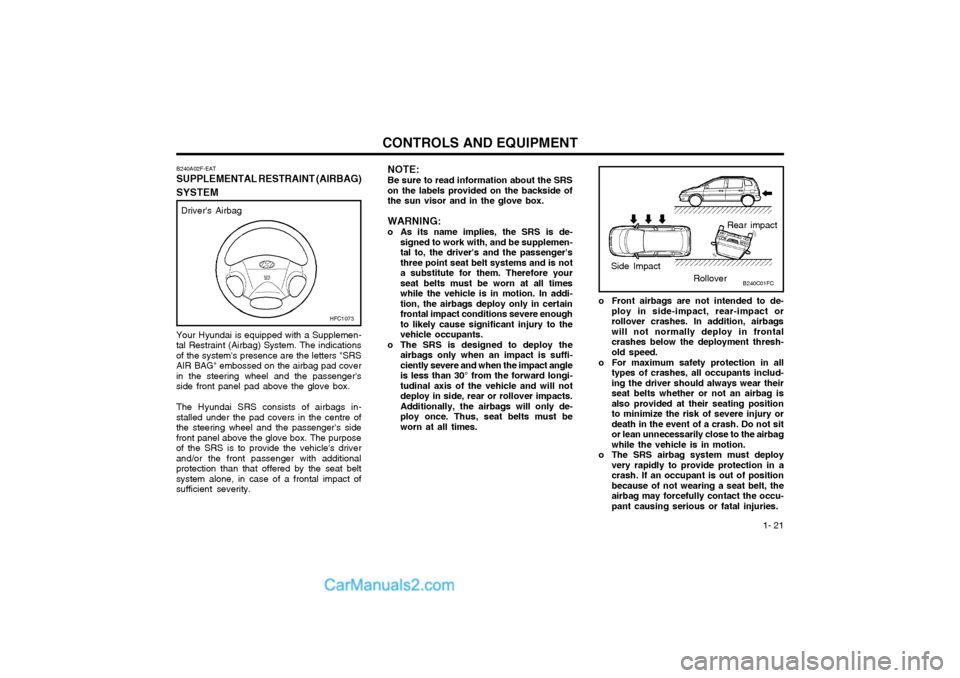
signed to work with, and be supplemen- tal to, the driver's and the passenger'sthree point seat belt systems and is nota substitute for them. Therefore yourseat belts must be worn at all timeswhile the vehicle is in motion. In addi-tion, the airbags deploy only in certainfrontal impact conditions severe enoughto likely cause significant injury to thevehicle occupants.
o The SRS is designed to deploy the airbags only when an impact is suffi-ciently severe and when the impact angleis less than 30° from the forward longi-tudinal axis of the vehicle and will notdeploy in side, rear or rollover impacts.Additionally, the airbags will only de-ploy once. Thus, seat belts must beworn at all times.
Driver's Airbag
B240A02F-EAT
SUPPLEMENTAL RESTRAINT (AIRBAG)
SYSTEM
HFC1073
Rear impact
Side Impact RolloverB240C01FC
o Front airbags are not intended to de-
ploy in side-impact, rear-impact or rollover crashes. In addition, airbagswill not normally deploy in frontalcrashes below the deployment thresh-old speed.
o For maximum safety protection in all types of crashes, all occupants includ-ing the driver should always wear theirseat belts whether or not an airbag isalso provided at their seating positionto minimize the risk of severe injury ordeath in the event of a crash. Do not sitor lean unnecessarily close to the airbagwhile the vehicle is in motion.
o The SRS airbag system must deploy very rapidly to provide protection in acrash. If an occupant is out of positionbecause of not wearing a seat belt, theairbag may forcefully contact the occu-pant causing serious or fatal injuries.
Page 203 of 312

CONTROLS AND EQUIPMENT
1- 22
Passenger's Airbag
B240B04FC-D
Upon deployment, tear seams molded di- rectly into the pad covers will separate underpressure from the expansion of the airbags.Further opening of the covers then allows fullinflation of the airbags. A fully inflated airbag in combination with a properly worn seat belt slows the driver's orthe passenger's forward motion, thus reduc-ing the risk of head or chest injury. CAUTION: Do not install or place any accessories (drink holder, cassette holder, sticker, etc)on the front passenger's panel above theglove box in a vehicle with passenger'sside air bag. Such objects may become
the SRSCM detects a considerable impact tothe front of the vehicle, it will automaticallydeploy the airbags.
SSA1110C
The SRS service reminder indicator (SRI) on the instrument panel will blink for about 6seconds after the ignition key is turned to the"ON" position or after the engine is started,after which the SRI should go out.
SSA1110D
The airbag modules are located both in the centre of the steering wheel and in the frontpassenger's panel above the glove box. When
B240B03A-DAT SRS Components and Functions
SSA1110B
The SRS consists of the following compo- nents:
- Driver's Airbag Module
- Passenger's Airbag Module
- SRS Service Reminder Indicator (SRI)
- SRS Control Module (SRSCM)
The SRSCM continually monitors all elements while the ignition is "ON" to determine if afrontal or near-frontal impact is severe enoughto require airbag deployment.
Page 204 of 312

1- 23
CONTROLS AND EQUIPMENT
WARNING:
o When the SRS is activated, there maybe a loud noise and fine dust will be released throughout the vehicle. Theseconditions are normal and are not haz-ardous. However, the fine dust generat-ed during airbag deployment may causeskin irritation. Be sure to wash yourhands and face thoroughly with luke-warm water and a mild soap after anaccident in which the airbags were de-ployed.
o The SRS can function only when the ignition key is in the "ON" position. Ifthe SRS SRI does not come on, orcontinuously remains on, after flashingfor about 6 seconds when the ignitionkey is turned to the "ON" position, orafter the engine is started, or comes onwhile driving, the SRS is not workingproperly. If this occurs, have your ve-hicle immediately inspected by yourHyundai dealer.
o Before you replace a fuse or disconnect a battery terminal, turn the ignition keyto the "LOCK" position or remove theignition key. Never remove or replacethe air bag related fuse(s) when theignition key is in the "ON" position.Failure to heed this warning will causethe SRS SRI to illuminate.
Passenger's Airbag
After complete inflation, the airbag immedi- ately starts deflating, enabling the driver tomaintain forward visibility. CAUTION: When installing a container of liquid air freshener inside a vehicle, do not place itnear the instrument cluster nor on theinstrument panel pad surface. If there isany leakage from the air freshener ontothese areas (instrument cluster, instrumentpanel pad or air ventilator), it may damagethese parts. If the liquid from the air fresh-ener does leak onto these areas, washthem with water immediately. YR10353A
dangerous projectiles and cause injury ifthe passenger's side air bag inflates.
B990B04Y-EAT
Side Impact Airbag
Your Hyundai is equipped with a side impact airbag in each front seat. The purpose of theairbag is to provide the vehicle's driver and/orthe front passenger with additional protectionthan that offered by the seat belt alone. Theside impact airbags are designed to deployonly during certain side impact collisions, de-pending on the crash severity, angle, speedand point of impact. The air bags are notdesigned to deploy in all side impact situa-tions. B990B02Y
Page 205 of 312

CONTROLS AND EQUIPMENT
1- 24
YT10355A
WARNING:
o Do not install a child restraint system in the front passenger seat position.
A child restraint system must never be placed in the front seat. The infant orchild could be severely injured by anairbag deployment in case of an accident.
o Extreme Hazard! Do not use a rearward facing child restraint on a seat pro-tected by an airbag in front of it!
o Modification to SRS components or wir- ing, including the addition of any kindof badges to the pad covers or modifi-cations to the body structure, can ad-versely affect SRS performance and leadto possible injury.
WARNING:
o For best protection from the side airbag
system and to avoid being injured is by the deploying side impact airbag, both front seat occupants should sit in an upright position with the seat belt prop-erly fastened. The driver's hands shouldbe placed on the steering wheel at the9:00 and 3:00 o'clock positions. Thepassenger's arms and hands should beplaced in their laps.
o Do not use any accessory seat covers.
o Use of seat covers could reduce or prevent the effectiveness of the system.
o Do not install any accessories on the side or near the side impact airbag.
o Do not use excessive force on the side of the seat.
o Do not place any objects over the airbag or between the airbag and yourself. B240C03Y-GAT SRS Care The SRS is virtually maintenance-free and there are no parts you can safely service byyourself. The entire SRS system must beinspected by an authorized Hyundai dealer in10 years after the date that the vehicle wasmanufactured. Any work on the SRS system, such as remov- ing, installing, repairing, or any work on thesteering wheel must be performed by a quali-fied Hyundai technician. Improper handling ofthe SRS system may result in serious per-sonal injury.
HFC2092-DSide airbag sensor
o Do not place any objects (an umbrella,
bag, etc.) between the front door and the front seat. Such objects may be-come dangerous projectiles and causeinjury if the supplemental side impactair bag inflates.
o To prevent unexpected deployment of the side impact air bag that may resultin personal injury, avoid impact to theside airbag sensor when the ignitionkey is on.
Page 211 of 312

CONTROLS AND EQUIPMENT
1- 30 circuits becoming defective, approximately fifty per cent of the normal braking perfor-mance will be available.
If failure of one of the circuits occurs, the
required amount of pedal effort, pedal traveland stopping distance will be increased. Useof the gearbox is recommended to assist inbringing the vehicle to rest. The vehicle mustnot be driven once brake failure has occurreduntil the system has been repaired and isfunctioning normally.
The braking system employs a vacuum servo
in order that the pedal efforts are reduced.Power for the servo is derived from the engineand therefore, in the event of the enginestopping or the vehicle being towed, pedalefforts will be substantially increased.
SB210L2-E
PARKING BRAKE/BRAKE FLUID LEVEL WARNING LIGHT
WARNING: In the event of problems being suspected with the braking system, the advice of thenearest Hyundai dealer must be soughtbefore the vehicle is driven. Driving thevehicle with either an electrical or hydrau-lic braking system defect may be danger-ous, resulting in accident or personal in-jury. Warning light operation The parking brake/brake fluid level warning light will be illuminated whenever the ignitionswitch is turned to the "ON" position irrespec-tive of whether or not the parking brake isapplied and must be extinguished when theengine starts and the parking brake released. If the warning light fails to extinguish or illumi- nates at any other time, the vehicle must bebrought to rest in a safe location and the levelof brake fluid in the reservoir checked. If thefluid level is incorrect, fluid conforming to DOT3 or DOT 4 specifications should be added. If,after correcting the brake fluid level, the warn-ing light continues to be illuminated, the ad-vice of the nearest Hyundai dealer must besought before the vehicle is driven again.The Hyundai Matrix is equipped with a diago-nally split dual braking system which will en-sure that in the event of one of the brake
CAUTION: If the drive belt (generator belt) is loosen,
broken, or missing while the vehicle is driving, there may be a serious malfunc-tion, engine could overheat because thisbelt also drives the water pump.
SB210M1-E CHARGING SYSTEM WARNING LIGHT
The charging system warning light should
illuminate when the ignition switch is turned to the "ON" position and should be extinguishedwhen the engine is started. If the light fails toilluminate when the ignition is turned "ON" orfails to extinguish after starting the engine, thenearest Hyundai dealer should be contacted.If the light illuminates whilst the vehicle isbeing driven, stop the vehicle as soon as it issafe to do so and check the condition of thegenerator drive belt. If the belt is in place andthe tension is satisfactory, the advice of aHyundai dealer should be sought.
B260B01FC-EAT
TAIL GATE OPEN WARNING LIGHT
The tail gate warning light indicates when the
tail gate is open or is not fully closed. Ensure that the light has extinguished prior to drivingthe vehicle.
SB2100I-E DOOR AJAR WARNING LIGHT
The door ajar warning light indicates that a
door is not correctly closed. Ensure that the light is extinguished prior to driving the vehicle.
SB210P1-E
LOW FUEL LEVEL WARNING LIGHT
The low fuel warning light serves to warn the
driver that the remaining fuel quantity is ap- proximately 9 litres and that the vehicle shouldbe refuelled. If the vehicle is driven for anextended period with the low fuel warning lightilluminated there exists a possibility that mis-firing due to fuel shortage may occur. Thissituation must be avoided to prevent damageto the catalyst occurring.