2003 Hyundai Matrix radio
[x] Cancel search: radioPage 143 of 312

DO-IT-YOURSELF MAINTENANCE
6-10
CHAMPION NGK RC10YC BKR5ES
Unleaded
engine Leaded
engine
RC10YC4 BKR5ES-11
4. Turn the radiator cap counterclockwise with-
out pressing down on it, until it stops. This relieves any pressure remaining in the cool-ing system. And remove the radiator cap bypushing down and turning counterclockwise. Now fill the radiator with clean demineralized or distilled water. Continue to add clean deminer-alized or distilled water in small quantities untilthe fluid level stays up in the radiator neck. G060B02S-GAT
REPLACING THE SPARK PLUGS The spark plugs should be changed at theintervals specified in the vehicle maintenancesschedule in Section 5 or whenever engine per-formance indicates they should be changed.Symptoms that suggest poor spark plug perfor-mance include engine misfiring under load, lossof fuel economy, poor acceleration, etc. Whenspark plugs are replaced, always use sparkplugs recommended by Hyundai. The use ofother spark plugs can result in loss of perfor-mance, radio interference or engine damage. NOTE: When replacing the spark plugs, genuine Hyundai replacement parts are recom-mended. Recommended Spark Plugs:
SSA6060A
Unleaded: 1.0 ~ 1.1 mm (0.039 ~ 0.043 in.) Leaded: 0.7 ~ 0.8 mm (0.028 ~ 0.032 in.)
G050D01FC
5. Start the engine, top off the radiator with
water and then add engine coolant to the reservoir until the level is between "LOW"and "FULL".
6. Replace the radiator and reservoir caps and check to be sure the drain cocks are fullyclosed and not leaking.
WARNING: The cooling fan is controlled by engine cool- ant temperature and may sometimes oper-ate even when the engine is not running.Use extreme caution when working near theblades of the cooling fan so that you are notinjured by a rotating fan blade. As the en-gine coolant temperature decreases, the fanwill automatically shut off. This is a normalcondition.
G050D02FC
Page 153 of 312

DO-IT-YOURSELF MAINTENANCE
6-20 G210A01A-AAT
CHECKING THE BATTERY
WARNING: Batteries can be dangerous! When working with batteries, carefully observe the follow-ing precautions to avoid serious injuries. The fluid in the battery contains a strong solu- tion of sulfuric acid, which is poisonous andhighly corrosive. Be careful not to spill it onyourself or the car. If you do spill battery fluid onyourself, immediately do the following:
o If battery fluid is on your skin, flush the affected areas with water for at least 15minutes and then seek medical assistance.
o If battery fluid is in your eyes, rinse out your eyes with water and get medical assistanceas soon as possible. While you are beingdriven to get medical assistance, continueto rinse your eyes by using a sponge or softcloth saturated with water.
D010B01FCCAUTION: A burned-out fuse indicates that there is a
problem in the electrical circuit. If you re-place a fuse and it blows as soon as theaccessory is turned on, the problem is seri-ous and should be referred to a Hyundaidealer for diagnosis and repair. Never re-place a fuse with anything except a fusewith the same or a lower amperage rating. Ahigher capacity fuse could cause damageand create a fire hazard.
Burned out
G200B03YGood
4. Replace the blown fuse by pressing a new fuse of the same rating into place. The fuse should be a snug fit. If it is not, have the fuseclip repaired or replaced by a Hyundai dealer.If you do not have a spare fuse, you may beable to borrow a fuse of the same or lowerrating from an accessory you can tempo-rarily get along without (the radio or cigarettelighter, for example). Always remember toreplace the borrowed fuse.
AXA6201B
Page 172 of 312

INDEX10-3
R
Rear Fog Audible Warning Sound
....................................................1-35
Rear Seat Adjustable headrests ..................................................................... 1-11
Adjusting seatback angle .............................................................. 1-11
Adjusting seat forward and rearward ............................................ 1-11
Arm Rest ....................................................................................... 1-43
Fold down ........................................................................... 1-12 ~ 1-13
Rear Window Defroster Switch ......................................................... 1-41
Recommended Shift Poi nts ................................................................ 2-5
Removal of water from the fuel fiter ................................................. 6-22
Replacing Light Bulbs ....................................................................... 6-22
Replacing The Spark Plugs .............................................................. 6-10
Roof R ack ......................................................................................... 1-53
SSeat Belts 2-Point Static Type ............................................................ 1-16 ~ 1-173-Point system ................................................................... 1-15 ~ 1-16
Adjustable height ........................................................................... 1-15
Adjusting your seat belt ................................................................ 1-16
Care of seat belts ......................................................................... 1-14
Precautions ................................................................................... 1-13
Seat Warmer ..................................................................................... 1-13
Spark Plugs ........................................................................... 6-10 ~ 6-11
Spectacle Case ................................................................................. 1-46
Speedometer ..................................................................................... 1-35
Starting Procedures ............................................................................ 2-3Steering Wheel Free play ....................................................................................... 6-17
Tilt lever ........................................................................................ 1-54
Stereo Radio Operation (H210, H220, H260, H280) ............................ 1-64 ~ 1-65, 1-66 ~ 1-67, 1-70 ~ 1-72, 1-77 ~ 1-79
Stereo Sound System ............................................................ 1-62 ~ 1-63
K
Keys .................................................................................................... 1-2
If you lose your keys .................................................................... 3-10
Positions .......................................................................................... 2-2
LLight Bulb Replacement ......................................................... 6-22 ~ 6-23
Lubrication Chart ................................................................................. 9-3
Luggaga Net ..................................................................................... 1-52
M Maintenance Intervals Explanation of scheduled maintenance items ........................ 5-7 ~ 5-8
Maintenance under severe usage conditions ................................. 5-6
Scheduled maintenance ......................................................... 5-3 ~ 5-5
Service requirements ...................................................................... 5-1
Mirros Day-night inside rearview .............................................................. 1-48
Outside rear view .......................................................................... 1-47
Multi Box ........................................................................................... 1-47
O Odometer .......................................................................................... 1-36
Outside Rearview Mirror Heater ....................................................... 1-48
PParking Brake ................................................................................... 1-49
Power Outlet ..................................................................................... 1-50
Power Steering Fluid Level .............................................................. 6-21
Pre-tensioner Seat Belt .......................................................... 1-22 ~ 1-23
Page 178 of 312
SA040A1-ECAUTION: MODIFICATIONS TO ORIGINAL VEHICLE SPECIFICATION
Modification to the original vehicle specification may invalidate the manufactur- ers warranty and may adversely affect the safety and durability of the vehicle. Components which are subject to modification or are added to the original vehicle specification without the express approval of the manufacturer and resultin consequential loss or damage are not covered by the vehicle manufacturers warranty.
SA050A1-E TWO WAY RADIO INSTALLATION
This vehicle is fitted with electronically controlled fuel injection or other micro processor controlled equipment. It is possible for incorrectly installed two way radio equipment including mobile telephones to adversely affect these systems.Before radio equipment of this kind is installed, please contact your Hyundai dealer for recommendation regarding the suitability of the particular radio equipment concerned and the recommended method of installation and equip-ment location. Incorrectly installed or unsuitable equipment which gives rise to incorrect functioning of or damage to electronic vehicle components will not fall within the scope of the vehicle manufacturers warranty.
Page 240 of 312

1- 59
CONTROLS AND EQUIPMENT
FM broadcasts are transmitted at high fre- quency and do not bend to follow the earth'ssurface. Because of this, FM broadcasts gen-erally begin to fade at short distances from thestation. Also, FM signals are easily affected bybuildings, mountains, or other obstructions.These can result in certain listening conditionswhich might lead you to believe a problemexists with your radio. The following conditionsare normal and do not indicate radio trouble:
Buildings
Obstructed area
Unobstructed area
FM radio station
SSAR012A
Mountains
Iron bridges
B750A02A-AAT
STEREO SOUND SYSTEM How Car Audio Works
IonosphereFM reception
SSAR010A
AM and FM radio signals are broadcast from transmitter towers located around your city.They are intercepted by the radio antenna onyour car. This signal is then received by theradio and sent to your car speakers.When a strong radio signal has reached yourvehicle, the precise engineering of your audiosystem ensures high quality reproduction. How-ever, in some cases the signal coming to yourvehicle is not strong and clear. This can be dueto factors such as the distance from the radiostation, closeness of other strong radio stationsor the presence of buildings, bridges and otherlarge obstructions in the area.
Ionosphere
SSAR011A
AM reception
AM broadcasts can be received at greater distances than FM broadcasts. This is becauseAM radio waves are transmitted at low fre-quency. These long, low frequency radio wavescan follow the curvature of the earth rather thantravelling straight out into the atmosphere. Inaddition, they curve around obstructions sothat they can provide better signal coverage.
Page 241 of 312

CONTROLS AND EQUIPMENT
1- 60 B750B02Y-AAT
Using a cellular phone or a two-way radio
When a cellular phone is used inside the
vehicle, noise may be produced from the audio equipment. This does not mean thatsomething is wrong with the audio equipment.In such a case, use the cellular phone at aplace as far as possible from the audio equip-ment.
CAUTION: When using a communication system such
as a cellular phone or a radio inside the vehicle, a separate external antenna mustbe fitted. When a cellular phone or a radio set is
used with an internal antenna alone, it mayinterfere with the vehicle's electrical sys-tem and adversely affect safe operation ofthe vehicle.
WARNING: Don't use a cellular phone when you are
driving, you must stop at a safe place to use a cellular phone.
SSAR014A
o Station Swapping - As a FM signal weakens, another more powerful signal near the same frequency may begin to play. This is becauseyour radio is designed to lock onto the clearestsignal. If this occurs, select another stationwith a stronger signal.
o Multi-Path Cancellation - Radio signals be- ing received from several directions can causedistortion or fluttering. This can be caused bya direct and a reflected signal from the samestation, or by signals from two stations withclose frequencies. If this occurs, select an-other station until the condition has passed.SSAR013A
o Fading - As your car moves away from the radio station, the signal will weaken and sound will begin to fade. When this occurs,we suggest that you select another strongerstation.
o Flutter/Static - Weak FM signals or large obstructions between the transmitter andyour radio can disturb the signal causingstatic or fluttering noises to occur. Reducingthe treble level may lessen this effect untilthe disturbance clears.
Page 245 of 312
DRIVING YOUR HYUNDAI 2- 3
SB050B1-E
STEERING WHEEL LOCK When the key is removed, the steering col-
umn lock will be activated and will engage when the steering wheel is turned to theappropriate position. It is not necessary toturn the wheel until locked each time the keyis removed since in the event of any unautho-rized attempt at removal, the lock will becomeeffective as soon as the steering wheel isturned. To unlock the steering, insert the keyand turn to the "ACC" position. If the steeringis locked, it may be necessary to rock thesteering wheel slightly to facilitate turning thekey. Under no circumstances should the keybe forced since breakage of the key will occur. SC060A1-E
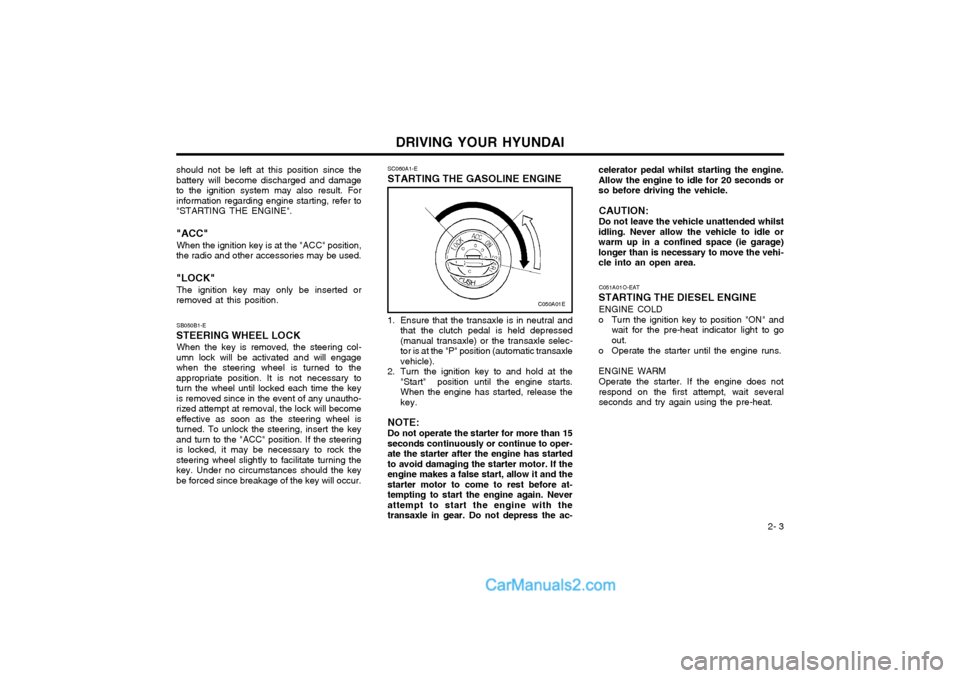
STARTING THE GASOLINE ENGINE
1. Ensure that the transaxle is in neutral and that the clutch pedal is held depressed (manual transaxle) or the transaxle selec-tor is at the "P" position (automatic transaxlevehicle).
2. Turn the ignition key to and hold at the "Start" position until the engine starts.When the engine has started, release thekey.
NOTE: Do not operate the starter for more than 15
seconds continuously or continue to oper- ate the starter after the engine has startedto avoid damaging the starter motor. If theengine makes a false start, allow it and thestarter motor to come to rest before at-tempting to start the engine again. Neverattempt to start the engine with thetransaxle in gear. Do not depress the ac-
C050A01E
should not be left at this position since the battery will become discharged and damageto the ignition system may also result. Forinformation regarding engine starting, refer to"STARTING THE ENGINE". "ACC"
When the ignition key is at the "ACC" position,
the radio and other accessories may be used."LOCK"
The ignition key may only be inserted or
removed at this position. celerator pedal whilst starting the engine. Allow the engine to idle for 20 seconds orso before driving the vehicle.
CAUTION: Do not leave the vehicle unattended whilst
idling. Never allow the vehicle to idle or warm up in a confined space (ie garage)longer than is necessary to move the vehi-cle into an open area.
C051A01O-EAT
STARTING THE DIESEL ENGINE
ENGINE COLD
o Turn the ignition key to position "ON" and wait for the pre-heat indicator light to goout.
o Operate the starter until the engine runs. ENGINE WARM Operate the starter. If the engine does not respond on the first attempt, wait severalseconds and try again using the pre-heat.