2003 Hyundai Matrix weight
[x] Cancel search: weightPage 246 of 312

DRIVING YOUR HYUNDAI
2- 4 C050B02S-GAT
NORMAL CONDITIONS The Starting Procedure:
1. Insert key, and fasten the seat belt.
2. Depress the clutch pedal fully and place the gearshift lever (manual transaxle) in neutral or the selector lever (automatictransaxle) in "P" (park) position.
3. After turning the ignition key to the "ON" position, make certain all warning lightsand gauges are functioning properly be-fore starting the engine.
4. On vehicles equipped with the diesel pre- heat indicator light, turn the ignition key tothe "ON" position. The diesel pre-heat indi-cator light will first illuminate in amber, andthen after a short time, the amber illumina-tion will goes off, indicating that preheatingis completed. SC060B1-E FUEL ECONOMY
The following suggestions are made to assist in achieving the greatest degree of fueleconomy.
o Maintaining a constant check on fuel con- sumption will enable the most economicaluse pattern and driving style to be adopt-ed.
o Avoid using the vehicle for very short jour- neys if possible, particularly when a coldstart is involved.
o Ensure that tyre pressures are maintained at the correct level.
o Use only the recommended grade of fuel.
o Avoid carrying unnecessary weight, and if a roof rack is in use, remove it as soon aspossible after use.
o Anticipate the road and conditions ahead to enable adjustments in speed to be madesmoothly. Avoid heavy acceleration andsharp braking.
NOTE: If the engine were not started 10 seconds
after the preheating is completed, turn the ignition key once more to the "LOCK"position, and then to the "ON" position, inorder to preheat again.
WARNING: Be sure that the clutch is fully depressed
when starting a manual transaxle vehicle. Otherwise there is the potential to cause damage to the vehicle or injury to some-
one inside or outside the vehicle as aresult of the forward or backward move-ment of the vehicle that will occur if theclutch is not depressed when the vehicle isstarted.
5. Turn the ignition key to the "Start" position and release it when the engine starts.
C055B01B-GAT
STARTING AND STOPPING THE EN- GINE FOR TURBO CHARGER INTER- COOLER (DIESEL ENGINE)
(1) Do not race the engine or sudden acceler-
ate the engine immediately after start it. If the engine is cold, allow the engine to idlefor several seconds before it is driven toensure sufficient lubrication of the turbocharger unit.
(2) After high speed or extended driving, re- quiring a heavy engine load, the engineshould be allowed to idle about 1 minutebefore turning it off. This idle time will allow the turbo charger tocool prior to shutting the engine off.
WARNING: Do not turn the engine off immediately after it has been subjected to a heavy load.Doing so may cause severe damage to theengine or turbo charger unit.
C050B01HP
Amber lamp ON Amber lamp OFF
Page 253 of 312

DRIVING YOUR HYUNDAI 2- 11
o Don't "lug" or "over-rev" the engine. Lug-
ging is driving too slowly in too high a gear resulting in the engine bucking. If thishappens to you, shift to a lower gear. Over-revving is racing the engine beyond its safe limit. This can be avoided byshifting at the recommended speeds.
o Use your air conditioning sparingly. The air conditioning system is operated by theengine power so your fuel economy isreduced when you use it.
SC150A1-F
DRIVING FOR ECONOMY
You can save fuel and get more miles fromyour car if you follow these suggestions:
o Drive smoothly. Accelerate at a moderate rate. Don't make "jack-rabbit" starts or full-throttle shifts and maintain a steady cruis-ing speed. Don't race between stoplights.Try to adjust your speed to that of the othertraffic so you don't have to change speedsunnecessarily. Avoid heavy traffic whenever possible. Al- ways maintain a safe distance from othervehicles so you can avoid unnecessarybraking. This also reduces brake wear.
o Drive at a moderate speed. The faster you drive, the more fuel your car uses. Drivingat a moderate speed, especially on thehighway, is one of the most effective waysto reduce fuel consumption.
o Don't "ride" the brake or clutch pedal. This can increase fuel consumption and alsoincrease wear on these components. Inaddition, driving with your foot resting onthe brake pedal may cause the brakes tooverheat, which reduces their effective-ness and may lead to more serious con-
sequences.
o Take care of your tyres. Keep them inflated to the recommended pressure. Incorrectinfla-tion, either too much or too little, re-sults in unnecessary tyre wear. Check thetyre pres-sures at least once a month. o Be sure that the wheels are aligned cor-
rectly. Improper alignment can result fromhitting curbs or driving too fast over irregu-lar surfaces. Poor alignment causes fastertyre wear and may also result in otherproblems as well as greater fuel consump-tion.
o Keep your car in good condition. For better fuel economy and reduced maintenancecosts, maintain your car in accordancewith the maintenance schedule in Section5. If you drive your car in severe condi-tions, more frequent maintenance is re-quired (see Section 5 for details).
o Keep your car clean. For maximum ser- vice, your car should be kept clean andfree of corrosive materials. It is especiallyimportant that mud, dirt, ice, etc. not beallowed to accumulate on the underside ofthe car. This extra weight can result inincreased fuel consumption and also con-tribute to corrosion.
o Travel lightly. Don't carry unnecessary weight in your car. Weight is an enemy ofgood fuel economy.
o Don't let the engine idle longer than neces- sary. If you are waiting (and not in traffic),turn off your engine and restart only whenyou're ready to go.
o Remember, your car does not require extended warm-up. As soon as the engineis running smoothly, you can drive away.In very cold weather, however, give yourengine a slightly longer warm-up period. SC160A1-F SMOOTH CORNERING Avoid braking or gear changing in corners, especially when roads are wet. Ideally, cor-ners should always be taken under gentleacceleration. If you follow these suggestions,tyre wear will be held to a minimum. SC170A1-E WINTER MOTORING The onset of winter conditions subject motor vehicles to greater operating demands. There-fore, the following suggestions will assist inmaintaining peak performance and reliabilityduring these periods:
Page 255 of 312

DRIVING YOUR HYUNDAI 2- 13
SC200B3-E TOWING ATTACHMENTS It is strongly recommended that only an Hyundai Approved towing attachment is usedto ensure that the loads placed upon the bodystructure are correctly distributed. The use ofa non approved attachment will result in theinvalidation of the vehicle warranty. Hyundaitowing attachments are designed and con-structed to ensure maximum towing perfor-mance and ease of fitment. A range of acces-sories including electrical kits are availablethrough the Hyundai dealer network. It is of the utmost importance that those areas of the vehicle which are subjected to greaterstress during towing are maintained in accor-dance with the recommendations given at theend of this book. In addition, the daily operatingchecks relating to engine oil, transmission oiland tyres must be performed at each refuellingto ensure maximum reliability and safety. The use of a proprietary stabiliser will assist in achieving an inherently stable outfit but whilstthe use of such equipment will improve thecharacteristics of a balanced outfit, it will notcompensate for a badly loaded and thereforeunstable outfit. The tyres and braking equipment fitted to the trailer or caravan must be maintained in ac-cordance with the recommendations of themanufacturer. Special attention should be paidto tyres which deteriorate through time and
WARNING:
It is not recommended that the vehicle be
used for towing until the first 1,000 milesof Running In has been completed. AllHyundai MATRIX models are suited to tow-ing trailers and caravans up to the limitsindicated below. MATRIX models fitted withautomatic transaxle have a transaxle oilcooler and further transaxle cooling shouldnot be required. C190E01FC-EAT
TRAILER AND CARAVAN TOWING
Tongue loadSSA2200B
Total trailer weight
exposure rather than as a result of the dis- tances towed. The inside walls of the tyresshould be inspected along with the outsidewalls for cracking and damage. The trailerwheel nut torque must be checked on a regularbasis, preferably before each towing session.
The trailer hitch and the safety catch mecha-
nism must be maintained in good workingorder. The trailer break away cable or chainshould be inspected for damage and shouldbe attached to the vehicle towing attachmenteach and every time the trailer is hitched tothe vehicle.
Whilst towing, the performance of the vehicle
will be reduced in terms of acceleration, brak-ing and handling due to the increased loadsplaced upon the vehicle. The driver shouldanticipate the change in characteristics andadjust the driving style in keeping with thesechanges. Care should be exercised whencornering and braking to prevent the outfitbecoming uncontrollable by reducing corner-ing speeds and allowing increased brakingdistances.
The driver should exercise care to ensure that
when pulling away from rest particularly onuphill gradients the clutch unit is not subjectedto excessive slippage which will reduce theuseful life of this component. Use of the"Overdrive Off" "2" and "L" positions whendriving vehicles with automatic transmission
Page 256 of 312
DRIVING YOUR HYUNDAI
2- 14 YC200E2-E Trailer or Vehicle Towing Tips
1. Before towing, check hitch and safety chain
connections as well as proper operation of the trailer running lights, brake lights, andturn signals.
2. Always drive your vehicle at a moderate speed (Less than 62 MPH)
3. Trailer towing requires more fuel than nor- mal conditions.
4. To maintain engine braking efficiency and electrical charging performance, do not usefifth gear (manual transaxle) or overdrive(automatic transaxle). Towing Bracket Attachment Location
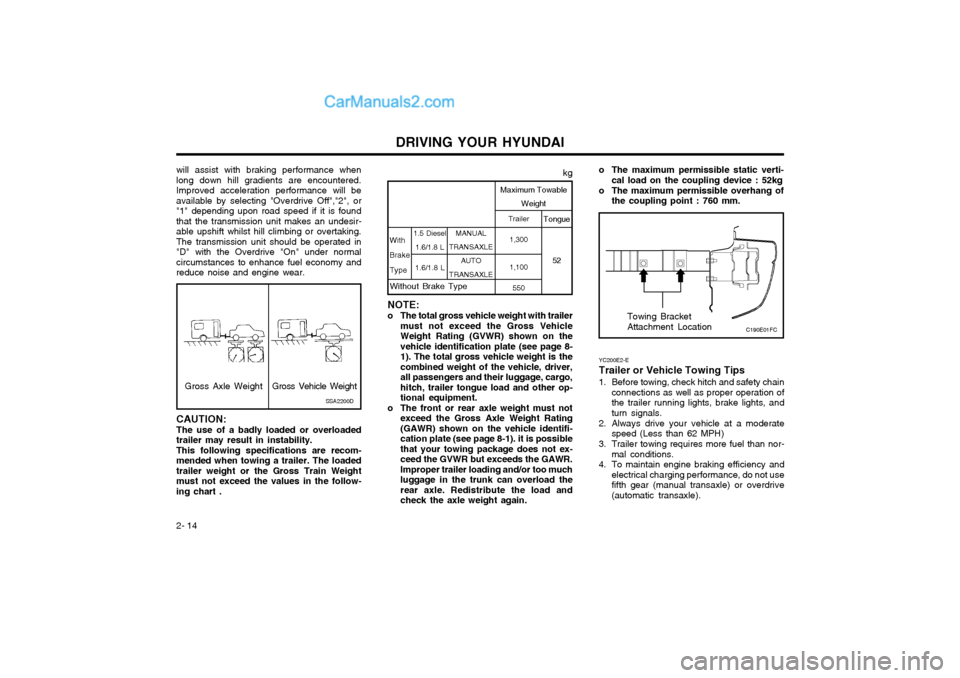
NOTE:
o The total gross vehicle weight with trailer must not exceed the Gross Vehicle Weight Rating (GVWR) shown on thevehicle identification plate (see page 8-1). The total gross vehicle weight is thecombined weight of the vehicle, driver,all passengers and their luggage, cargo,hitch, trailer tongue load and other op-tional equipment.
o The front or rear axle weight must not exceed the Gross Axle Weight Rating(GAWR) shown on the vehicle identifi-cation plate (see page 8-1). it is possiblethat your towing package does not ex-ceed the GVWR but exceeds the GAWR.Improper trailer loading and/or too muchluggage in the trunk can overload therear axle. Redistribute the load andcheck the axle weight again. MANUAL
TRANSAXLE
AUTO
TRANSAXLE Trailer
1,300 1,100 550 Tongue
52
kg
Maximum Towable Weight
With BrakeType
1.5 Diesel 1.6/1.8 L
1.6/1.8 L
Without Brake Type
o The maximum permissible static verti- cal load on the coupling device : 52kg
o The maximum permissible overhang of the coupling point : 760 mm.
C190E01FC
will assist with braking performance when long down hill gradients are encountered.Improved acceleration performance will beavailable by selecting "Overdrive Off","2", or"1" depending upon road speed if it is foundthat the transmission unit makes an undesir-able upshift whilst hill climbing or overtaking.The transmission unit should be operated in"D" with the Overdrive "On" under normalcircumstances to enhance fuel economy andreduce noise and engine wear.
Gross Axle Weight
CAUTION: The use of a badly loaded or overloaded trailer may result in instability.This following specifications are recom-mended when towing a trailer. The loadedtrailer weight or the Gross Train Weightmust not exceed the values in the follow-ing chart . SSA2200DGross Vehicle Weight