2003 Hyundai Matrix glove box
[x] Cancel search: glove boxPage 171 of 312

INDEX
10-2 Driving
Economical dr iving ........................................................................ 2-10
Smooth cornering .......................................................................... 2-10
Winter driving ................................................................................ 2-10
E Emissions Control Systems ................................................................ 7-1
Engine Before starting the engine ............................................................... 2-2Compartment .......................................................................... 6-1 ~ 6-3
Coolant ................................................................................. 6-8 ~ 6-10
Coolant temperature gauge ........................................................... 1-35
If the engine overheats ................................................................... 3-2
Number ............................................................................................ 8-1
Oil ........................................................................................... 6-4 ~ 6-5Starting ............................................................................................ 2-3
Engine Exhaust Can Be Dangerous ................................................... 2-1
FFold-up Tray ...................................................................................... 1-49
Front Fog Light Sw itch ...................................................................... 1-41
Front Seats Adjustable front seats ..................................................................... 1-9
Lumbar support control ................................................................. 1-10
Seat cushion height adjustment .................................................... 1-10
Fuel Capacity .......................................................................................... 9-1
Gauge ............................................................................................ 1-35
Recommendations ........................................................................... 1-1
Fuel Filler Lid
Remote release ............................................................................. 1-51
Fuse Panel Description .......................................................... 6-26 ~ 6-28
Fuses ...................................................................................... 6-19 ~6-20 GGeneral Checks
.................................................................................. 6-4
Glove box .......................................................................................... 1-46
H Hazard Warning System ................................................................... 1-40
Headlight Aiming Adjustment ........................................................... 6-23
Headlight Bulb ................................................................................... 6-23
Headlight Leveling Device System ........................................ 1-43 ~ 1-44
Heating and Ventilation
Air flow control .............................................................................. 1-57
Air intake control ........................................................................... 1-56
Bi-level heating .............................................................................. 1-58
Fan speed control ......................................................................... 1-56
Heating controls ............................................................................ 1-58
Temperature control ...................................................................... 1-58
High-mounted Rear Stoplight ............................................................ 1-49
Hood Release ................................................................................... 1-50
Horn .................................................................................................. 1-54
IIgnition Switch ..................................................................................... 2-2
Immobilizer System ............................................................................. 1-3
Instrument Cluster and Indicator ............................................ 1-30 ~ 1-34
Instruments and Controls .................................................................. 1-29
Interior Light Interior light ................................................................................... 1-46
Map light ........................................................................................ 1-45
Intermittent Wiper .............................................................................. 1-40
JJump Starting ...................................................................................... 3-1
Page 202 of 312
1- 21
CONTROLS AND EQUIPMENT
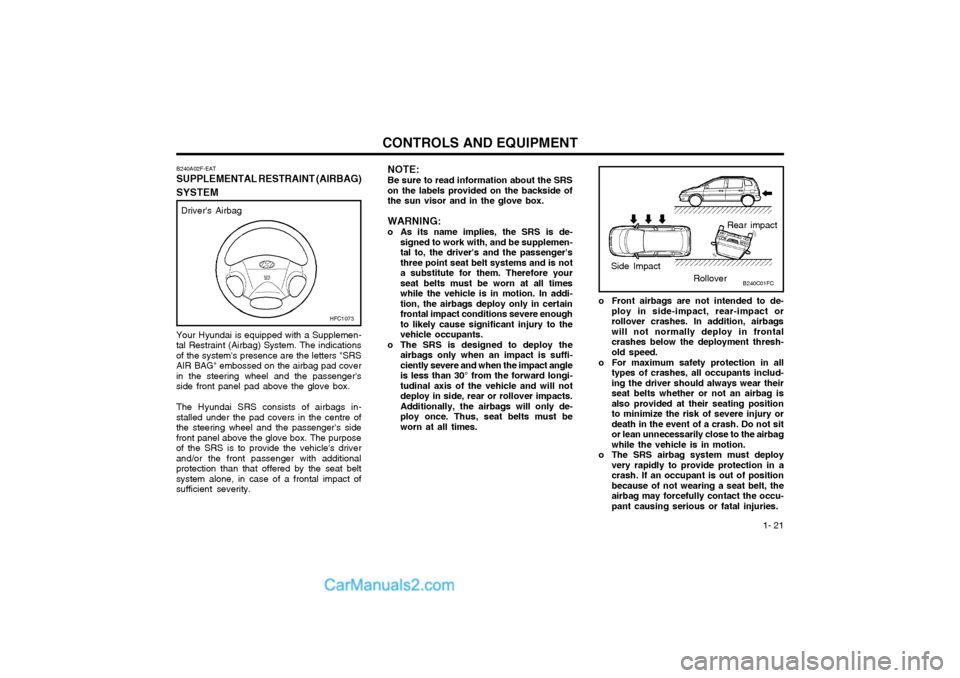
Your Hyundai is equipped with a Supplemen-
tal Restraint (Airbag) System. The indications of the system's presence are the letters "SRSAIR BAG" embossed on the airbag pad coverin the steering wheel and the passenger'sside front panel pad above the glove box.
The Hyundai SRS consists of airbags in-
stalled under the pad covers in the centre ofthe steering wheel and the passenger's sidefront panel above the glove box. The purposeof the SRS is to provide the vehicle's driverand/or the front passenger with additionalprotection than that offered by the seat beltsystem alone, in case of a frontal impact ofsufficient severity. NOTE: Be sure to read information about the SRS on the labels provided on the backside ofthe sun visor and in the glove box. WARNING:
o As its name implies, the SRS is de-
signed to work with, and be supplemen- tal to, the driver's and the passenger'sthree point seat belt systems and is nota substitute for them. Therefore yourseat belts must be worn at all timeswhile the vehicle is in motion. In addi-tion, the airbags deploy only in certainfrontal impact conditions severe enoughto likely cause significant injury to thevehicle occupants.
o The SRS is designed to deploy the airbags only when an impact is suffi-ciently severe and when the impact angleis less than 30° from the forward longi-tudinal axis of the vehicle and will notdeploy in side, rear or rollover impacts.Additionally, the airbags will only de-ploy once. Thus, seat belts must beworn at all times.
Driver's Airbag
B240A02F-EAT
SUPPLEMENTAL RESTRAINT (AIRBAG)
SYSTEM
HFC1073
Rear impact
Side Impact RolloverB240C01FC
o Front airbags are not intended to de-
ploy in side-impact, rear-impact or rollover crashes. In addition, airbagswill not normally deploy in frontalcrashes below the deployment thresh-old speed.
o For maximum safety protection in all types of crashes, all occupants includ-ing the driver should always wear theirseat belts whether or not an airbag isalso provided at their seating positionto minimize the risk of severe injury ordeath in the event of a crash. Do not sitor lean unnecessarily close to the airbagwhile the vehicle is in motion.
o The SRS airbag system must deploy very rapidly to provide protection in acrash. If an occupant is out of positionbecause of not wearing a seat belt, theairbag may forcefully contact the occu-pant causing serious or fatal injuries.
Page 203 of 312

CONTROLS AND EQUIPMENT
1- 22
Passenger's Airbag
B240B04FC-D
Upon deployment, tear seams molded di- rectly into the pad covers will separate underpressure from the expansion of the airbags.Further opening of the covers then allows fullinflation of the airbags. A fully inflated airbag in combination with a properly worn seat belt slows the driver's orthe passenger's forward motion, thus reduc-ing the risk of head or chest injury. CAUTION: Do not install or place any accessories (drink holder, cassette holder, sticker, etc)on the front passenger's panel above theglove box in a vehicle with passenger'sside air bag. Such objects may become
the SRSCM detects a considerable impact tothe front of the vehicle, it will automaticallydeploy the airbags.
SSA1110C
The SRS service reminder indicator (SRI) on the instrument panel will blink for about 6seconds after the ignition key is turned to the"ON" position or after the engine is started,after which the SRI should go out.
SSA1110D
The airbag modules are located both in the centre of the steering wheel and in the frontpassenger's panel above the glove box. When
B240B03A-DAT SRS Components and Functions
SSA1110B
The SRS consists of the following compo- nents:
- Driver's Airbag Module
- Passenger's Airbag Module
- SRS Service Reminder Indicator (SRI)
- SRS Control Module (SRSCM)
The SRSCM continually monitors all elements while the ignition is "ON" to determine if afrontal or near-frontal impact is severe enoughto require airbag deployment.
Page 206 of 312

1- 25
CONTROLS AND EQUIPMENT
o For cleaning the airbag pad covers, use only a soft, dry cloth or one which has been moistened with plain water.Solvents or cleaners could adverselyaffect the airbag covers and properdeployment of the system.
o No objects should be placed over or near the airbag modules on the steeringwheel, instrument panel, and the frontpassenger's panel above the glove box,because any such object could causeharm if the vehicle is in a crash severeenough to cause the airbags to inflate.
o If the airbags inflate, they must be re- placed by an authorized Hyundai dealer.
o Do not tamper with or disconnect SRS wiring, or other components of the SRSsystem. Doing so could result in injury,due to accidental firing of the airbags orby rendering the SRS inoperative.
o If components of the airbag system must be discarded, or if the vehicle must bescrapped, certain safety precautionsmust be observed. Your Hyundai dealerknows these precautions and can giveyou the necessary information. Failureto follow these precautions and proce-dures could increase the risk of per-sonal injury. o If you sell your vehicle, be sure to
inform the new owner of these impor-tant points and make certain that thismanual is transferred to the new owner.
o If your car was flooded and has soaked carpeting or water on flooring, youshouldn't try to start engine; have thecar towed to authorized Hyundaidealer.
o Do not replace the bumper or the bumper guard with the one other thanthe Hyundai genuine parts. Otherwise,it can adversely affect SRS performanceand lead to unexpected injury.
Page 207 of 312

CONTROLS AND EQUIPMENT
1- 26 HFC002-D
B250A01FC-EAT INSTRUMENTS AND CONTROLS
1. Passenger's Side Drink Holder
2. Passenger's Airbag
3. Accessory Tray
4. Heating/Air Conditioning Control Panel(Not all models)
5. Hazard Warning Light
6. Instrument Cluster
7. Windscreen Wiper/Washer Switch
8. Horn and Driver's Airbag
9. Indicator and Warning Light
10. Multi-Function Light Switch
11. Front Fog Light Switch (Not all models)
12. Headlight Leveling Switch
13. Rear Fog Light Switch
14. Glove Box
15. Centre Console (Not all models)
16. Parking Brake Lever
17. Drink Holder
18. Shift Lever (Not all models)
19. Cigarette Lighter
20. Ashtray
21. Multi Box
22. Bonnet Release Lever
CAUTION: When installing a container of liquid air freshener inside a vehicle, do not place it near the instrument cluster nor on the instrument panel pad surface.If there is any leakage from the air freshener onto these areas (instrument cluster, instrumentpanel pad or air ventilator), it may damage these parts. If the liquid from the air freshener does leak onto these areas, wash them with water immediately. 1
2
34 5
67
89 1011
1213
14 15 1617
1819
20 2122
Page 223 of 312
CONTROLS AND EQUIPMENT
1- 42
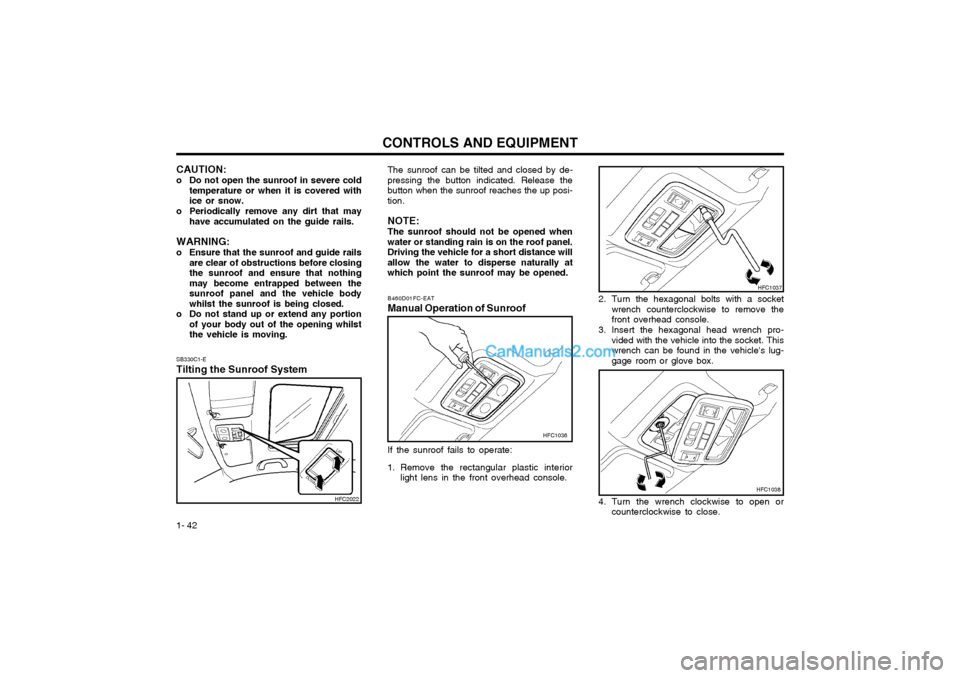
SB330C1-E Tilting the Sunroof System The sunroof can be tilted and closed by de-
pressing the button indicated. Release the button when the sunroof reaches the up posi-tion.
NOTE: The sunroof should not be opened when
water or standing rain is on the roof panel. Driving the vehicle for a short distance willallow the water to disperse naturally atwhich point the sunroof may be opened.
2. Turn the hexagonal bolts with a socketwrench counterclockwise to remove thefront overhead console.
3. Insert the hexagonal head wrench pro- vided with the vehicle into the socket. Thiswrench can be found in the vehicle's lug-gage room or glove box.
B460D01FC-EAT
Manual Operation of Sunroof
HFC1036
If the sunroof fails to operate:
1. Remove the rectangular plastic interior light lens in the front overhead console.
HFC1037
4. Turn the wrench clockwise to open or counterclockwise to close.
CAUTION:
o Do not open the sunroof in severe cold
temperature or when it is covered with ice or snow.
o Periodically remove any dirt that may have accumulated on the guide rails.
WARNING:
o Ensure that the sunroof and guide rails are clear of obstructions before closing the sunroof and ensure that nothingmay become entrapped between thesunroof panel and the vehicle bodywhilst the sunroof is being closed.
o Do not stand up or extend any portion of your body out of the opening whilstthe vehicle is moving.
HFC2022HFC1038
Page 225 of 312

CONTROLS AND EQUIPMENT
1- 44
B500A01A-EAT GLOVE BOX WARNING: To avoid the possibility of injury, the glove box lid must be kept closed whilst the vehicle is in motion.
o To open the glove box, pull the glove box
release lever. The multi box may be opened by pulling it out
by its grip.
It is used for storing small commodities. If the multi box is removed, the fuse box for
the lights and other electrical accessories will be exposed. B500B02E-GAT
MULTI BOX
HFC2095-DHFC2058-D
HFC2011-D
B510B01FC-EAT
EXTERIOR REAR VIEW MIRROR Electric Type
The outside rear view mirror can be adjusted
in any direction to give the maximum rear view vision.
The remote control outside rear view mirror
switch controls the adjustments for passengerside door mirror. To adjust the position of either mirror:
1. Move the selecting switch to the "L" (or "R") position to activate the adjustable mechanism for the adjusting door mirror.
2. Now, adjust mirror angle by depressing the appropriate perimeter switch as illustrated.
Page 239 of 312
CONTROLS AND EQUIPMENT
1- 58
B760A01E
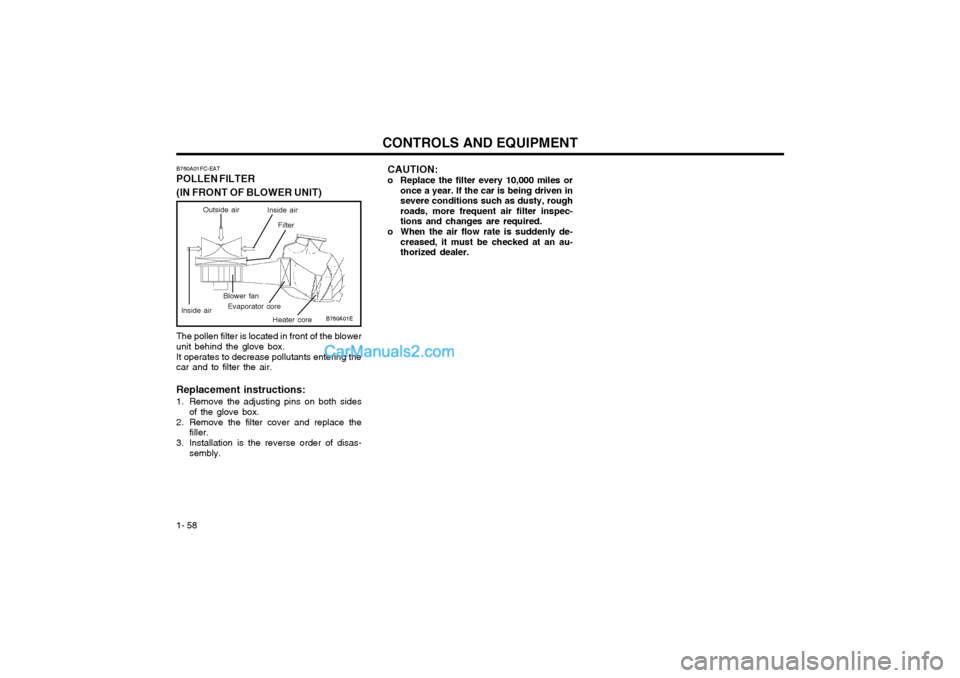
The pollen filter is located in front of the blower unit behind the glove box. It operates to decrease pollutants entering the car and to filter the air. Replacement instructions:
1. Remove the adjusting pins on both sides of the glove box.
2. Remove the filter cover and replace the filler.
3. Installation is the reverse order of disas- sembly.
Evaporator coreBlower fan
Heater core
B760A01FC-EAT POLLEN FILTER (IN FRONT OF BLOWER UNIT)
Outside air
Filter
Inside air
Inside air CAUTION:
o Replace the filter every 10,000 miles or once a year. If the car is being driven in severe conditions such as dusty, roughroads, more frequent air filter inspec-tions and changes are required.
o When the air flow rate is suddenly de- creased, it must be checked at an au-thorized dealer.