2003 Hyundai Getz Brake
[x] Cancel search: BrakePage 299 of 444

FEATURES OF YOUR HYUNDAI 1- 39
SB210M1-E
CHARGING SYSTEM WARNING LIGHT
The charging system warning light should illuminate when the ignitionswitch is turned to the "ON" position and should be extinguished when the engine is started. If the light fails toilluminate when the ignition is turned "ON" or fails to extinguish after starting the engine, the nearest Hyundai dealershould be contacted. If the light illumi- nates whilst the vehicle is being driven, stop the vehicle as soon as it is safe todo so and check the condition of the generator drive belt. If the belt is in SB2100I-E
DOOR AJAR WARNING LIGHT
The door ajar warning light indicates that a door is not correctly closed. Ensure that the light is extinguishedprior to driving the vehicle.
B260B01FC-EAT
TAIL GATE OPEN WARNING LIGHT
The tail gate warning light indicates when the tail gate is open or is not fullyclosed. Ensure that the light has extin- guished prior to driving the vehicle. SB210P1-E
LOW FUEL LEVEL WARNING LIGHT
The low fuel warning light serves to warn the driver that the remaining fuel quantity is approximately 9 litres and that the vehicle should be refuelled. Ifthe vehicle is driven for an extended period with the low fuel warning light illuminated there exists a possibilitythat misfiring due to fuel shortage may occur. This situation must be avoided to prevent damage to the catalyst oc-curring.
recommended to assist in bringing the vehicle to rest. The vehicle must not be driven once brake failure has occurreduntil the system has been repaired and is functioning normally. The braking system employs a vacuumservo in order that the pedal efforts are reduced. Power for the servo is derived from the engine and therefore, in theevent of the engine stopping or the vehicle being towed, pedal efforts will be substantially increased.
place and the tension is satisfactory, the advice of a Hyundai dealer should be sought.
CAUTION:
If the drive belt (generator belt) is loose, broken, or missing while the vehicle is driving, there may be aserious malfunction, engine could overheat because this belt also drives the water pump.
!
B260N02FC-EAT MALFUNCTION INDICA- TOR LIGHT
This light illuminates when there is a malfunction of an exhaust gas related component, and the system is not func-tioning properly so that the exhaust gas regulation values are not satisfied. This light will illuminate when the ignition keyis tuned to the "ON" position, and will go out after the engine start. If it illumi- nates while driving, or does not illumi-nate when the ignition key is turned to the "ON" position, take your car to your
Page 301 of 444

FEATURES OF YOUR HYUNDAI 1- 41
SB210S1-E BRAKE PAD WEAR INDICATOR The front brake disc pads are fitted with an audible wear indicator which willcause a high pitched noise to be emit- ted when the remaining amount of fric- tion lining is below the specified value.When the wear indicator is heard, the brake pads should be replaced without delay to avoid damage occurring to thebrake discs and a severe reduction in braking efficiency.
B900A01A-EAT ACOUSTIC WARNING SOUND (Not all models) The acoustic warning chime sounds when the tail lights are on and the door in driver side is open. This prevents thebattery from discharging when the car is left with the tail lights on. The chime sounds until the tail lights are turned off. HTB006A
The fuel gauge indicates the quantity of fuel remaining in the fuel tank. NOTE: The fuel gauge is not intended to give other than an approximate indi- cation of the fuel level and is unsuit- able for the purposes of calculatingfuel consumption figures.
SB215A1-E FUEL GAUGE
B265A01B-GAT
FUEL FILTER WARNING LIGHT-RED(Diesel Engine)
This light illuminates when the ignition switch is set to the "ON" position and goes off after the engine has started. Ifit lights up while the engine is running, it indicates that water has accumu- lated inside the fuel filter. If this hap-pens, remove the water from the fuel filter. (Refer to "6-26 page")
Page 320 of 444

1- 60 FEATURES OF YOUR HYUNDAI
The parking brake must always be set when the vehicle is to be left unat- tended. When the parking brake is ap-plied, and the ignition key is at the "ON" position, the parking brake warning light will be illuminated. Before driving thevehicle, the parking brake must be fully released and the warning light extin- guished.
o To set the parking brake, apply the
foot brake and pull the parking brake lever up with the button depressed. Release the button when the brake is fully applied.
SB380A1-E PARKING BRAKE
B550A01S-DATHIGH-MOUNTED REAR STOP LIGHT In addition to the lower-mounted rear stoplights on either side of the car, thehigh mounted rear stoplight in the cen- tre of the rear window or inserted in the rear spoiler also lights when the brakesare applied.
HTB251
HTB255
o To release the parking brake, apply
the foot brake and pull up the parkingbrake lever slightly. Depress thebutton and lower the lever.
B750A01TB-DAT BONNET RELEASE
HTB070-D
1. Pull the release knob to unlatch the bonnet.
HTB069
2. Push the safety catch lever sidewards and lift the bonnet.
Page 343 of 444

2. DRIVING YOUR HYUNDAI
Before starting the engine .............................................................. 2-3
Key position .................................................................................... 2-4Starting............................................................................................ 2-5
Operating the manual transaxle ..................................................... 2-8
Automatic transaxle ........................................................................ 2-9
Effective Braking ........................................................................... 2-13
Anti-Lock brake system (ABS) ...................................................... 2-13
Driving for economy ...................................................................... 2-14
Winter Driving ............................................................................... 2-15
Trailer and Caravan Towing ......................................................... 2-17
2
Page 345 of 444

DRIVING YOUR HYUNDAI 2- 3
!
C020A01O-EAT BEFORE STARTING THE EN- GINE Before you start the engine, you should always:
1. Look around the vehicle to be sure
there are no flat tyres, puddles of oil or water or other indications of pos-sible trouble.
2. After entering the car, check to be
sure the parking brake is engaged.
3. Check that all windows, and lights are clean.
4. Check that the interior and exterior mirrors are clean and in position.
5. Check your seat, seatback and
headrestraint to be sure they are intheir proper positions.
6. Close all the doors.
7. Fasten your seat belt and be sure
that all other occupants have fas- tened theirs.
8. Turn off all lights and accessories that are not needed.
9. When you turn the ignition switch to
"ON" check that all appropriate warn- ing lights are operating and that you have sufficient fuel. 10.Check the operation of warning
lights and all bulbs when key is in the "ON" position.
WARNING: (DIESEL ENGINE)
To ensure that sufficient vacuum exists within the brake system dur-ing cold weather start-up condi- tions, it is necessary to run the engine at idle for several secondsafter starting the engine. SC040A1-F COMBINATION IGNITION SWITCH AND STEERING LOCKTo Start the Engine
o If your Hyundai is equipped with a
manual transaxle, place the shift lever in neutral and depress theclutch pedal fully.
o If your Hyundai has an automatic
transaxle, place the shift lever in "P"(park).
o To start the engine, insert the igni-
tion key and turn it to the "START"position. Release it as soon as the engine starts. Do not hold the key in the "START" position for more that15 seconds.
NOTE: For safety, the engine will not start if the shift lever is not in "P" or "N"Position (automatic transaxle).
Page 350 of 444

2- 8 DRIVING YOUR HYUNDAI
HTB206 CAUTION:
o Do not attempt to engage reverse gear when the car is in motion.
o To avoid damaging the selector mechanism, do not use the gear shift lever as a hand rest. Releasethe lever immediately the shift is completed.
o To avoid premature clutch wear, do not use the clutch pedal as afoot rest, and do not hold the vehicle on a gradient using theclutch.
o Ensure that the engine is not
over-revved by upshifting beforethe tachometer needle enters the red zone.
o Do not coast with the shift lever at the neutral position.
o When descending long gradi-
ents, make use of the engine brak- ing to assist the footbrake to avoid brake fade or over-heating.
o When slippery conditions are en- countered, increased cautionshould be exercised when gear changing, braking or accelerat-
SC090A03-E MANUAL TRANSAXLE The five speed fully synchronized transaxle is controlled by a floor mounted shift lever upon which the shift pattern is indicated. It is importantthat when changing gear, the clutch pedal is fully depressed to avoid transaxle damage. ing. Abrupt changes in speedmay cause a loss of traction or control of the vehicle.
o During cold weather, shifting may
be difficult until the transaxle lu-bricant has warmed up. This is normal and not harmful to thetransaxle.
o If you 've come to a complete
stop and it's hard to shift into 1stor R(Reverse), put the shift lever in N(Neutral) position and release the clutch. Press the clutch pedalback down, and then shift into 1st or R(Reverse) gear position.
o Do not use the shift lever as a handrest during driving, as thiscan result in premature wear of the transaxle shift forks.
o Always ensure that the periodic
maintenance services are performedby a Hyundai dealer at the time and/or mileage intervals specified.
o Use the air conditioning only when
necessary.
!
Page 351 of 444
DRIVING YOUR HYUNDAI 2- 9
C070E03A-EAT RECOMMENDED SHIFT POINTS
1-2 2-3 3-44-5
Shift
from-to Recommended
15 mph (20 km/h)25 mph (40 km/h)35 mph (55 km/h) 45 mph (75 km/h)
The shift points as shown above are recommended for optimum fuel economy and performance. SC090B1-F Using the Clutch The clutch should be pressed all the way to the floor before shifting, thenreleased slowly. Do not rest your foot on the clutch pedal while driving. This can cause unnecessary wear.Do not partially engage the clutch to hold the car on an incline. This causes unnecessary wear.Use the parking brake to hold the car on an incline. Do not operate the clutch pedal rapidly and repeatedly.
HTB185-D
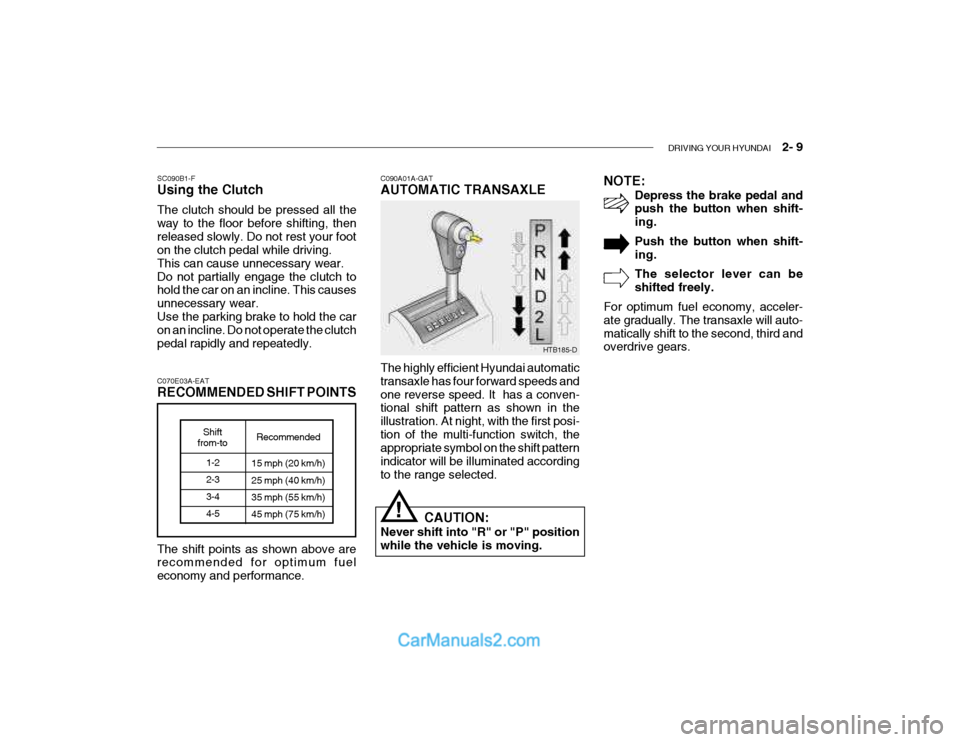
C090A01A-GAT AUTOMATIC TRANSAXLE The highly efficient Hyundai automatic transaxle has four forward speeds andone reverse speed. It has a conven- tional shift pattern as shown in the illustration. At night, with the first posi-tion of the multi-function switch, the appropriate symbol on the shift pattern indicator will be illuminated accordingto the range selected.
CAUTION:
Never shift into "R" or "P" positionwhile the vehicle is moving. NOTE:
Depress the brake pedal and push the button when shift- ing. Push the button when shift- ing. The selector lever can be shifted freely.
For optimum fuel economy, acceler-ate gradually. The transaxle will auto-matically shift to the second, third and overdrive gears.
!
Page 353 of 444

DRIVING YOUR HYUNDAI 2- 11
C090H01A-EAT NOTE:
o The brake pedal should be de-
pressed when shifting from NEU- TRAL to a forward or reversegear.
o The brake pedal fully depressed
in order to move the shift leverfrom the "P" (Park) position to any of the other positions.
o It is always possible to shift from "R", "N", "D", "2", "L" position.
!
C090I02A-EAT
CAUTION:
o Shift into "R" and "P" only when the vehicle has completely stopped.
o Do not accelerate the engine in reverse or any of the forwardpositions with the brakes applied.
o Always apply the footbrake when shifting from "P" or "N", to "R","D", "2" or "L" position.
o Do not use the "P" (Park) posi- tion in place of the parking brake.Always set the parking brake,shift the transaxle into "P" (Park) and turn off the ignition when you leave the vehicle, even mo-mentarily. Never leave the vehicle unattended whilst the engine is running.
o Check the automatic transaxle fluid level regularly, and add fluidas necessary.See the maintenance schedule for the proper fluid recommen- dation. FC120D1-E General Operating Instructions
o The button in the selector handle
must be depressed before the se- lector can be moved.
o The engine may only be started
when the selector is at position "P"or "N".
o Ensure that the footbrake is firmly
applied when shifting from "P" or"N" to "D", "2", "L" or "R" and vice versa.
o Always engage the parking brake when the vehicle is unattended,never use the "P" position in place of the parking brake.
o Under normal circumstances, the selector should be placed in the "D"position and the transaxle allowedto select the most ideal ratio for the circumstances. In this position maxi- mum fuel economy will be achieved.
o When descending steep gradients where engine braking is required,the selector should be placed at the"2" or "L" position depending upon the vehicle speed.