2003 Hyundai Getz ABS
[x] Cancel search: ABSPage 295 of 444

FEATURES OF YOUR HYUNDAI 1- 35
B260B02TB-EAT INSTRUMENT CLUSTER AND INDICATOR A Type (Without Trip Computer)
1. Electric Power Steering Warning Light (Not all models)
2. Tail Gate Open Warning Light
3. Door Ajar Warning Light
4. Tachometer
5. Immobilizer Warning Indicator Light
6. Turn Signal Indicator Light
7. Temperature Gauge
8. High Beam Indicator Light
9. Speedometer HTB001B
10. Parking Brake/Brake Fluid Level Warning Light
11. Oil Pressure Warning Light
12. Charging System Warning Light
13. Overdrive off Indicator Light (Auto T/A only)
14. Fuel Filter Warning Light (Diesel only)
15. Diesel Pre-heat Indicator Light (Diesel only)
16. Digital Clock 17. Low Fuel Warning Light
18. Fuel Gauge
19. Odometer/Trip Odometer
20. Trip odometer Reset Switch
21. Clock Reset Switch
22. ABS Warning Light
23. SRS (Airbag) Warning Light
(Not all models)
24. Malfunction Indicator Light (MIL)
25. Seat Belt Warning Light
1
2
4
53 6
7 8
9 1011
12
13 14
15 16
17 18
19 20 21
22
23 24
6
25
Page 296 of 444

1- 36 FEATURES OF YOUR HYUNDAI
B260C02TB-EAT B Type (With Trip Computer)
1. Electric Power Steering Warning
Light (Not all models)
2. Tail Gate Open Warning Light
3. Door Ajar Warning Light
4. Tachometer
5. Turn Signal Indicator Light
6. Temperature Gauge
7. Speedometer
8. Parking Brake/Brake Fluid Level
Warning Light
9. Oil Pressure Warning Light HTB002B
10. Charging System Warning Light
11. Overdrive Off Indcator Light (Auto T/A only)
12. Fuel Filter Warning Light (Diesel only)
13. Diesel Pre-heat Indicator Light
(Diesel only)
14. Immobilizer Warning Indicator Light
15. High Beam Indicator Light
16. Low Fuel Warning Light
17. Trip Computer (Not all models) 18. Odometer/Trip Odometer
19. Fuel Gauge
20. Trip Computer Mode Convert Switch
21. Clock Reset Switch
22. ABS Warning Light
23. SRS (Airbag) Warning Light
(Not all models)
24. Malfunction Indicator Light (MIL)
25. Seat Belt Warning Light
12 3 4
5
5
6
78
910
11 12 13 14 15 16 17 18 19 20 22 23
242521
Page 297 of 444

FEATURES OF YOUR HYUNDAI 1- 37
SB210C1-F
SRS (Airbag) SERVICE REMINDER INDICATOR
The SRS service reminder indicator (SRI) comes on and flashes for about 6 seconds after the ignition key is turnedto the "ON" position or after the engine is started, after which it will go out. This light also comes on when the SRS is not working properly. If the SRI does not come on, or continu-ously remains on after flashing for about 6 seconds when you turned the ignition key to the "ON" position or started theengine, or if it comes on while driving, have the SRS inspected by an autho- rized Hyundai Dealer. B260P02Y-EAT
ABS SERVICE REMINDER INDICATOR(SRI) (Not all models)
When the key is turned to the "ON" position, the Anti-Lock Brake System SRI will come on and then go off in a fewseconds. If the ABS SRI remains on, comes on while driving, or does not come on when the key is turned to the"ON" position, this indicates that there may be a problem with the ABS. If this occurs, have your vehiclechecked by your Hyundai dealer as soon as possible. The normal braking system will still be operational, butwithout the assistance of the anti-lock brake system. SB210E1-E
OVERDRIVE OFF INDI CATORLIGHT(Not all models)
When the overdrive (4th gear) switch is turned off and the operation of overdrive (4th gear) is cancelled, the overdrivewarning light (O/D OFF) will be illumi- nated. When the switch is at the on position, the gearbox will operate in thenormal fully automatic mode and the warning light will be extinguished. SB210G1-E TURN SIGNAL INDICATOR LIGHT
Operation of a turn signal is indicated by the warning light located in the in- strument cluster. If the light fails toilluminate or does not flash, a malfunc- tion within the turn signal system is indicated.
! CAUTION:
If the both ABS SRI and Parking Brake/Brake fluid level warning lightsremain "ON" or come on while driv- ing, there may be a problem with E.B.D (Electronic brake force distri-bution). If this occurs, avoid sudden stops and have your vehicle checked byyour Hyundai dealer as soon as pos- sible.
Page 343 of 444

2. DRIVING YOUR HYUNDAI
Before starting the engine .............................................................. 2-3
Key position .................................................................................... 2-4Starting............................................................................................ 2-5
Operating the manual transaxle ..................................................... 2-8
Automatic transaxle ........................................................................ 2-9
Effective Braking ........................................................................... 2-13
Anti-Lock brake system (ABS) ...................................................... 2-13
Driving for economy ...................................................................... 2-14
Winter Driving ............................................................................... 2-15
Trailer and Caravan Towing ......................................................... 2-17
2
Page 355 of 444

DRIVING YOUR HYUNDAI 2- 13
SC140B1-E ANTI-LOCK BRAKE SYSTEM (Not all models) The Anti-Lock Brake System (ABS) is designed to prevent wheel lock-up during sudden braking or on hazard-ous road surfaces. The ABS control module monitors the wheel speed and controls the pressure applied to eachbrake. Thus, in emergency situations or on slick roads, ABS will increase vehicle control during braking. NOTE: During ABS operation, a slight pul- sation may be felt in the brake pedalwhen the brakes are applied. Also, a noise may be heard in the engine compartment whilst braking. Theseconditions are normal and indicate that the anti-lock brake system is functioning properly.
located in the instrument cluster will be illuminated. When the overdrive switch is turned "ON", the transaxle functionsas a fully automatic four speed unit with the maximum fuel economy po- tential of the vehicle being realized.
SC140A1-E EFFECTIVE BRAKING Braking system performance and fric- tion material life are greatly affected bythe driving style adopted. The follow- ing suggestions are made to assist in achieving the best results from the braking system.
o Anticipate the road and conditions ahead in order that heavy braking may be avoided.
o When descending long gradients, use the engine to assist in retardingthe vehicle to minimize the possibil-ity of brake fade occurring.
o When trailer towing, ensure that the
trailer brakes function correctly anduse engine braking to assist the vehicle braking system. o Use only genuine Hyundai replace-
ment brake pads and shoes to en- sure consistent friction characteris-tics and wear rates.
o After driving through deep water
(e.g. fording), the brakes may be-come wet and performance reduced. Always check brake efficiency after emerging from the water and dry thebrakes by lightly depressing the brake pedal several times whilst driving slowly.
o Apply the parking brake only when the vehicle is at rest.
o Since the power assistance pro- vided by the brake servo is derived from the engine, coasting with the engine turned off or towing of thevehicle with the engine turned off will result in greatly increased pedal pressures being required to stop thevehicle.
o Do not hold the vehicle on the up-
grade with the accelerator pedal.This can cause the transmission to overheat. Always use the brake pedal or parking brake.
Page 356 of 444
2- 14 DRIVING YOUR HYUNDAI
!WARNING:
ABS will not prevent accidents due to improper or dangerous driving maneuvers. Even though vehicle control is improved during emer-gency braking, always maintain a safe distance between you and ob- jects ahead. Vehicle speeds shouldalways be reduced during extreme road conditions. The braking distance for carsequipped with an anti-lock braking system may be longer than for those without it in the following road con- ditions.
o Driving on rough, gravel or snow- covered roads.
o Driving with tyre chains installed.
o Driving on roads where the road surface is pitted or has differentsurface height. These roads should be driven atreduced speeds. The safety featuresof an ABS equipped vehicle should not be tested by high speed driving or cornering. This could endangerthe safety of yourself or others. SC150A1-F DRIVING FOR ECONOMY You can save fuel and get more miles from your car if you follow these sug- gestions:
o Drive smoothly. Accelerate at a
moderate rate. Don't make "jack- rabbit" starts or full-throttle shifts and maintain a steady cruisingspeed. Don't race between stop- lights. Try to adjust your speed to that of the other traffic so you don'thave to change speeds unneces- sarily. Avoid heavy traffic whenever pos-sible. Al-ways maintain a safe dis- tance from other vehicles so you can avoid unnecessary braking. Thisalso reduces brake wear. o Drive at a moderate speed. The
faster you drive, the more fuel yourcar uses. Driving at a moderatespeed, especially on the highway, is one of the most effective ways to reduce fuel consumption.
o Don't "ride" the brake or clutch pedal. This can increase fuel consumptionand also increase wear on thesecomponents. In addition, driving with your foot resting on the brake pedal may cause the brakes to overheat,which reduces their effectiveness and may lead to more serious con- sequences.
o Take care of your tyres. Keep them inflated to the recommended pres-sure. Incorrect infla-tion, either toomuch or too little, results in unnec- essary tyre wear. Check the tyre pres-sures at least once a month.
o Be sure that the wheels are aligned correctly. Improper alignment canresult from hitting curbs or drivingtoo fast over irregular surfaces. Poor alignment causes faster tyre wear and may also result in other prob-lems as well as greater fuel con- sumption.
Page 378 of 444

CORROSION PREVENTION AND APPEARANCE CARE 4- 3
SE040A1-E VALETING Regular cleaning of the exterior paintwork serves two important func-tions. Firstly, the removal of abrasive dirt and contaminants will maintain the lustre of the paintwork and will preventdiscolouration and dulling due to pro- longed contact. Secondly, the presence of damagethrough impact or abrasion will be ap- parent allowing early rectification to be made thus preventing corrosion frombecoming established and spreading beneath the paint film. To avoid "water spotting" the vehicle should not bewashed in direct sunlight particularly in the case of vehicles having dark body colours. The heat from the sun rays isabsorbed by the paint film increasing the surface temperature. This action causes water used for washing toevaporate quickly leaving behind the deposits from the water and the sham- poo used.Use only a shampoo intended for the purpose and ensure that the body work is thoroughly wetted to soften the dirtfilm prior to attempting to remove this. After removing the dirt film with a soft sponge, the body work should be thor- oughly rinsed and then dried with agood quality chamois leather to pre- vent streaking or spotting of the paint work.Household detergents, solvents and abrasive cleaning materials should not be used in order to avoid damaging thepaint film. Plastic wheel covers should be cleaned using a sponge and water. Cast alloywheels should be cleaned using a mild soap or neutral detergent. Abrasive compounds must not be used since inthe event of these damaging the lac- quer coating, oxidization of the alu- minium wheel will occur, spoiling theappearance. The use of an a toothbrush will facili- tate cleaning between the wheel"spokes".
SE040B1-E STAIN/SPOT REMOVAL Should tree sap, dead insects or tar prove to be difficult to remove from thepaint film, turpentine or a proprietary paint cutting compound may be used. Ensure that the area to be cleaned isnot rubbed intensively to prevent break- ing through the colour coat and expos- ing the under coat. SE040C1-E POLISHING The exterior paint work should be pol- ished with a proprietary wax polish when water no longer collects in bead form on the paint work. The instruc-tions of the product manufacturer should be adhered to.
Page 424 of 444
6- 34 DO-IT-YOURSELF MAINTENANCE
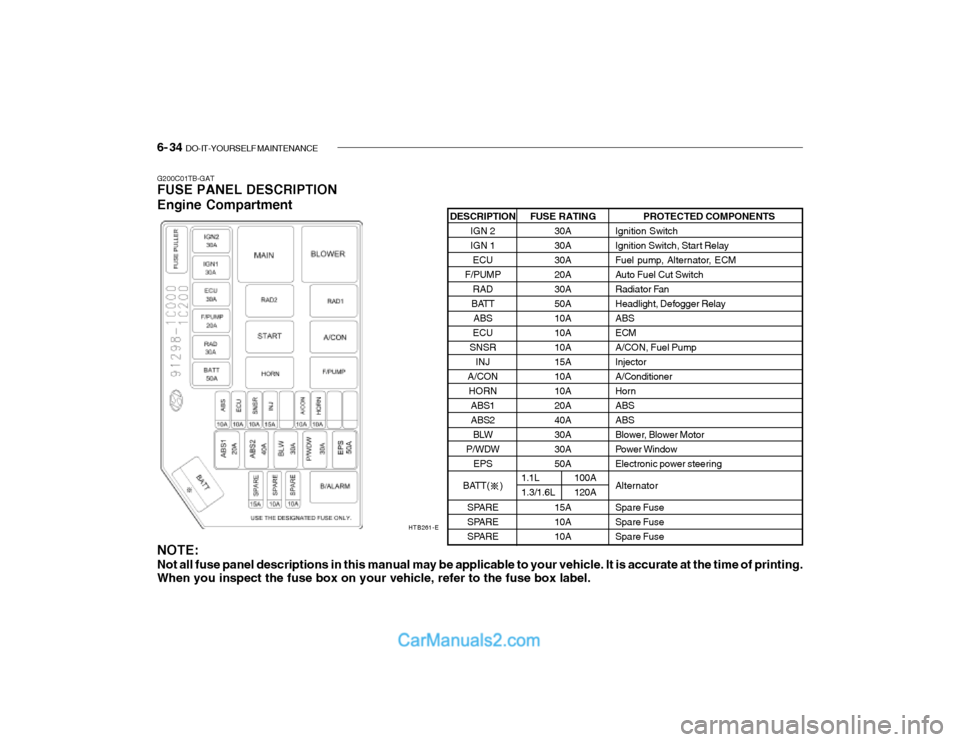
G200C01TB-GAT FUSE PANEL DESCRIPTION Engine Compartment
HTB261-EPROTECTED COMPONENTS
Ignition Switch
Ignition Switch, Start Relay
Fuel pump, Alternator, ECM
Auto Fuel Cut Switch
Radiator Fan
Headlight, Defogger RelayABSECMA/CON, Fuel PumpInjectorA/Conditioner
HornABSABS
Blower, Blower Motor
Power Window
Electronic power steering AlternatorSpare Fuse Spare FuseSpare Fuse
FUSE RATING
30A30A30A20A30A50A10A10A10A15A10A10A20A40A30A30A50A 15A 10A10A
DESCRIPTION
IGN 2IGN 1ECU
F/PUMP RAD
BATT ABS
ECU
SNSR INJ
A/CON HORN ABS1ABS2 BLW
P/WDW EPS
BATT( ) SPARE
SPARE
SPARE
NOTE:
Not all fuse panel descriptions in this manual may be applicable to your vehicle. It is accurate at the time of printing. When you inspect the fuse box on your vehicle, refer to the fuse box label.
1.1L 1.3/1.6L 100A120A