Page 315 of 444

FEATURES OF YOUR HYUNDAI 1- 55
2. Insert the hexagonal head wrench
provided with the vehicle into the socket. This wrench can be found in the vehicle’s trunk or glove box.
3. Turn the wrench counterclockwise to open or clockwise to close thesunroof. HGK033B460E01TB-GAT Resetting the Sunroof System If the battery has been recharged, disconnected, if the sunroof is oper- ated with the hexagonal head wrenchmanually, or if the sunroof operation is stopped by that ignition key is turned to the "OFF" position while it is moving,you may need to reset the sunroof. To do this;
1. Turn the ignition switch "OFF".
2. With pressing "open" "up" button at
the same time, turn the ignition switch "ON".
3. If the sunroof is set like this, the
sunroof is reset with tilting up/downautomatically once for all.
! CAUTION:
If the sunroof is not reset, it may not be operated properly.
B460D01TB-AAT Manual Operation of Sunroof If the sunroof does not electrically op- erate:
HGK032
1. Remove the cap located in the rear roof panel by using a coin or screw driver.
Page 321 of 444

FEATURES OF YOUR HYUNDAI 1- 61
!
SB440A2-E REMOTE FUEL FILLER LID RELEASE (Not all models) The fuel filler lid may be opened from inside the vehicle by pulling up on the fuel filler lid release.
HTB115-D
Before closing the bonnet, return the support rod to its clip to prevent it from rattling. Lower the bonnet until it isabout 30 cm (1 ft.) above the closed position and let it drop. Make sure that it locks into place.
HTB288
3. Pull the support rod from the bonnet.
HTB308
CAUTION:
Make sure that the support rod has been released prior to closing the bonnet.
4. Hold the bonnet open with the sup- port rod. WARNING:
o Always double check to be sure that the bonnet is firmly latchedbefore driving away. If it is not latched, the bonnet could fly openwhile the vehicle is being driven, causing a total loss of visibility, which might result in an accident.
o The support rod must be inserted completely into the hole providedin the bonnet whenever you in-spect the engine compartment. This will prevent the bonnet from falling and possibly injuring you. o Do not move the vehicle with the
bonnet in the raised position, as vision is obstructed and the bon- net could fall or be damaged.
!
Page 322 of 444

1- 62 FEATURES OF YOUR HYUNDAI
!!
NOTE: If the fuel filler lid will not open because ice has formed around it, tap lightly or push on the lid to breakthe ice and release the lid. Do not lever the flap. If necessary, spray around the lid with an approved de-icer fluid (do not use radiator anti- freeze) or move the vehicle to a warm place and allow the ice to melt.
B540A01FC-GAT TAIL GATE
HTB067WARNING:
The tail gate should always be kept completely closed while the vehicleis in motion. If it is left open or ajar, poisonous exhaust gases may en- ter the car resulting in serious ill-ness or death to the occupants. See additional warnings concerning ex- haust gases on page 2-2.
HTB068 WARNING:
Fuel vapours are dangerous. Beforerefuelling, turn off the engine andnever allow sparks, lit cigarettes or open flames near the filler area. When releasing the filler cap, a smallamount of residual pressure may generate a slight hissing sound which
is not indicative of an abnormality. In the event of the fuel filler cap requir- ing replacement, only a Genuine Hyundai replacement part should beused to prevent fuel leakage. o The tail gate can be locked or un-
locked with a key.
o The tail gate is opened by pulling the
outside handle up, raising the tailgate manually.
o To close, lower the tail gate, then
press down on it until it is closed. Tobe sure the tail gate is fully closed, always try to pull it up again without using the outside handle.
Page 327 of 444

FEATURES OF YOUR HYUNDAI 1- 67
!
!
B610B01A-DAT HORN
Press the centre hub of the steering wheel to sound the horn. HTB110SB520A1-F STEERING WHEEL TILT LEVER To adjust the steering wheel:
HTB085
1. Push the lever downward to unlock.
2. Raise or lower the steering wheel to the desired position.
3. After adjustment, securely tighten the lever by pulling it upward
WARNING:
Do not attempt to adjust the steering wheel while driving as this may re- sult in loss of control of the vehicle and result in death or serious injury.
Your Hyundai is equipped with sun visors to give the driver and front pas- senger either frontal or side ward shade.The sun visors are fitted on both sides on all models. To reduce glare or to shut out direct rays of the sun, turn thesun visor down to block the annoy- ance. A ticket holder is provided on the back of the sun visor for the driver.Vanity mirrors are provided on the back of the sunvisor for the driver and the front passenger (If installed). NOTE: The Supplemental Restraint Sys- tem (SRS) label containing useful information can be found on the front of each sun visor.
WARNING:
Do not place the sun visor in such a manner that it obscures visibility of the roadway, traffic or other ob-jects.
Page 334 of 444

1- 74 FEATURES OF YOUR HYUNDAI
B740A01A-AAT AIR CONDITIONING SWITCH (Not all models)
B730A01FC-EAT Operation Tips
o To keep dust or unpleasant fumes
from entering the car through the ventilation system, temporarily set the air intake control at "Recircula- tion". Be sure to return the control to"Fresh" when the irritation has passed to keep fresh air in the ve- hicle. This will help keep the driveralert and comfortable.
o Air for the heating/cooling system is
drawn in through the grilles justahead of the windscreen. Care should be taken that these are not blocked by leaves, snow, ice or other ob-structions.
o To prevent interior fog on the
windscreen, set the air intake controlto the fresh air ( ) position and fan speed to the desired position.
To remove the frost or exterior fog on the windscreen:
o Set the air intake control to the fresh
( ) position.
o Set the air flow control to the defrost ( ) position
o Set the temperature control to warm.
o Set the fan speed control to position
"3" or "4".
NOTE: When the A/C is operated continu- ously on the floor-defrost level ( ) or defrost level ( ), it may cause fog to form on the exteriorwindscreen. If this occurs, set the air flow control to the face level posi- tion ( ) and fan speed control tothe low position. The air conditioning is turned on by pushing the A/C button on the heating/ air conditioning control panel.
HTB037-D
Page 338 of 444
1- 78 FEATURES OF YOUR HYUNDAI
!
B750A04L B750A05L
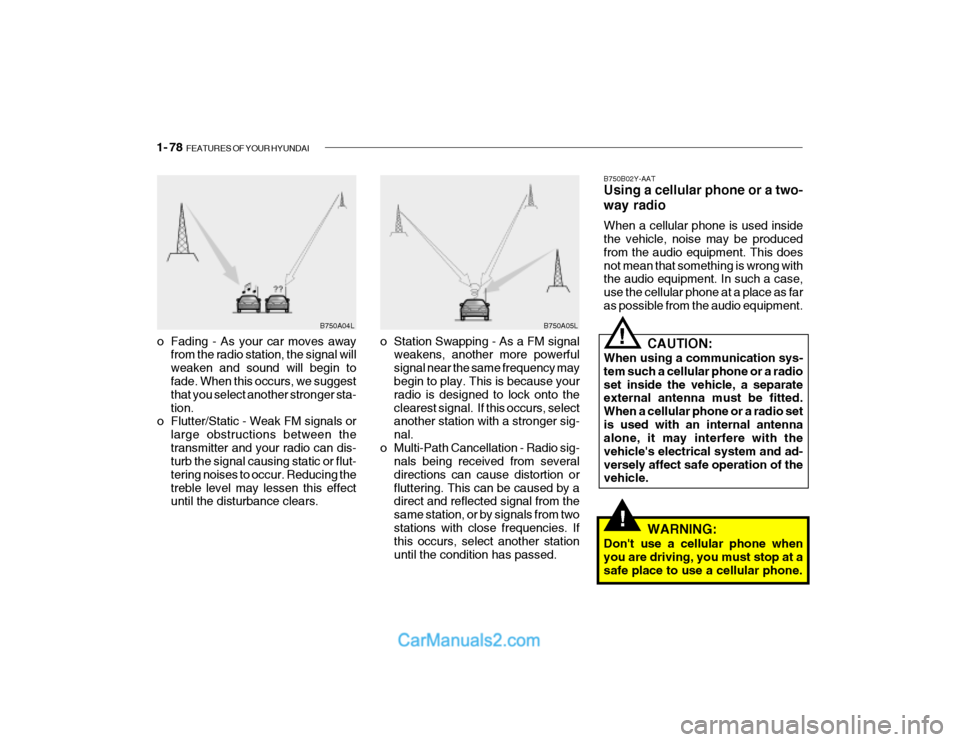
o Station Swapping - As a FM signal weakens, another more powerful signal near the same frequency may begin to play. This is because your radio is designed to lock onto theclearest signal. If this occurs, select another station with a stronger sig- nal.
o Multi-Path Cancellation - Radio sig- nals being received from severaldirections can cause distortion orfluttering. This can be caused by a direct and reflected signal from the same station, or by signals from twostations with close frequencies. If this occurs, select another station until the condition has passed.
o Fading - As your car moves away
from the radio station, the signal willweaken and sound will begin to fade. When this occurs, we suggest that you select another stronger sta-tion.
o Flutter/Static - Weak FM signals or
large obstructions between thetransmitter and your radio can dis- turb the signal causing static or flut- tering noises to occur. Reducing thetreble level may lessen this effect until the disturbance clears. B750B02Y-AAT Using a cellular phone or a two- way radio When a cellular phone is used inside the vehicle, noise may be produced from the audio equipment. This doesnot mean that something is wrong with the audio equipment. In such a case, use the cellular phone at a place as faras possible from the audio equipment.
!
CAUTION:
When using a communication sys- tem such a cellular phone or a radio set inside the vehicle, a separate external antenna must be fitted. When a cellular phone or a radio setis used with an internal antenna alone, it may interfere with the vehicle's electrical system and ad-versely affect safe operation of the vehicle.
WARNING:
Don't use a cellular phone when you are driving, you must stop at a safe place to use a cellular phone.
Page 341 of 444
FEATURES OF YOUR HYUNDAI 1- 81
HTB111
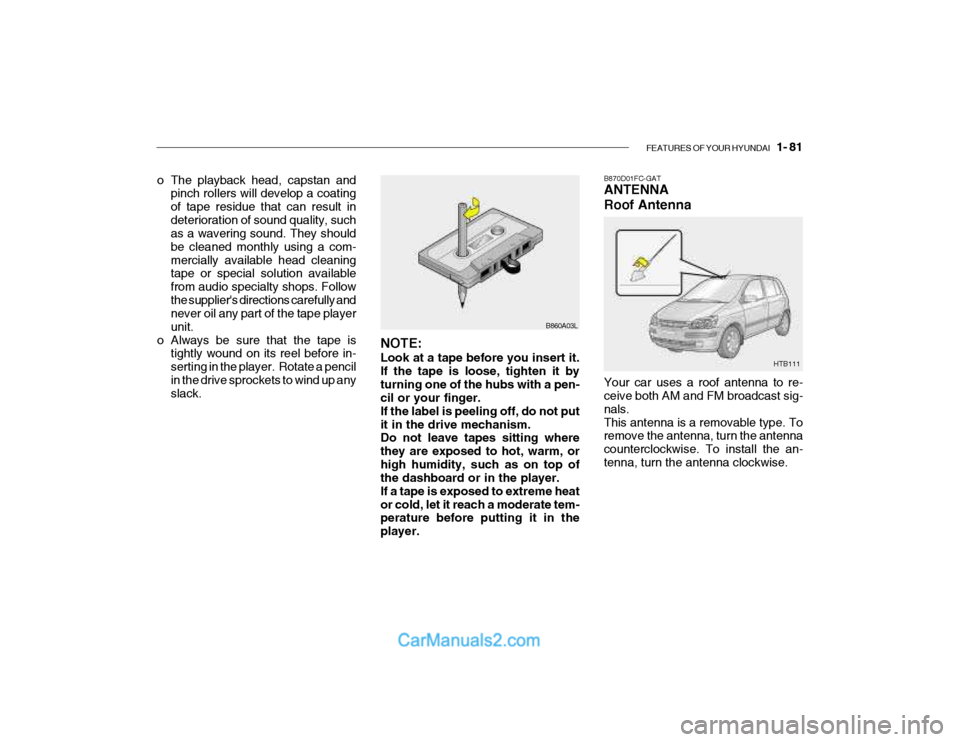
B870D01FC-GAT ANTENNA Roof Antenna Your car uses a roof antenna to re- ceive both AM and FM broadcast sig- nals.This antenna is a removable type. To remove the antenna, turn the antenna counterclockwise. To install the an-tenna, turn the antenna clockwise.
o The playback head, capstan and
pinch rollers will develop a coating of tape residue that can result indeterioration of sound quality, such as a wavering sound. They should be cleaned monthly using a com-mercially available head cleaning tape or special solution available from audio specialty shops. Followthe supplier's directions carefully and never oil any part of the tape player unit.
o Always be sure that the tape is tightly wound on its reel before in-serting in the player. Rotate a pencilin the drive sprockets to wind up any slack. B860A03L
NOTE: Look at a tape before you insert it. If the tape is loose, tighten it byturning one of the hubs with a pen- cil or your finger. If the label is peeling off, do not putit in the drive mechanism. Do not leave tapes sitting where they are exposed to hot, warm, orhigh humidity, such as on top of the dashboard or in the player. If a tape is exposed to extreme heator cold, let it reach a moderate tem- perature before putting it in the player.
Page 343 of 444
2. DRIVING YOUR HYUNDAI
Before starting the engine .............................................................. 2-3
Key position .................................................................................... 2-4Starting............................................................................................ 2-5
Operating the manual transaxle ..................................................... 2-8
Automatic transaxle ........................................................................ 2-9
Effective Braking ........................................................................... 2-13
Anti-Lock brake system (ABS) ...................................................... 2-13
Driving for economy ...................................................................... 2-14
Winter Driving ............................................................................... 2-15
Trailer and Caravan Towing ......................................................... 2-17
2
