2003 Hyundai Elantra key
[x] Cancel search: keyPage 83 of 172

FEATURES OF YOUR HYUNDAI FEATURES OF YOUR HYUNDAIFEATURES OF YOUR HYUNDAI FEATURES OF YOUR HYUNDAI
FEATURES OF YOUR HYUNDAI
1- 74
3. BASS Control KnobPress to pop the knob out and turn to the left or
right for the desired bass tone.
TREB (Treble Control) KnobPull the bass control knob further out. Turn to
the left or right for the desired treble tone.
4. SCAN ButtonWhen the scan button is pressed, the fre-
quency will increase and the receivable sta-
tions will be tuned in one after another, receiv-
ing each station for 5 seconds. To stop scan-
ning, press the scan button again.
5. TUNE (Manual) Select ButtonPress the ( ) side or ( ) side to increase or to
decrease the frequency. Press either button
and hold down to continuously scroll. Release
button once the desired station is reached.
SEEK Operation (Automatic Channel
Selection)
Press the TUNE select button for 0.5 sec or
more. Releasing it will automatically tune to the
next available station with a beep sound.
When the ( ) side is pressed longer than 0.5
second, releasing will automatically tune to the
next higher frequency and when the ( ) side is
pressed longer than 0.5 second, releasing will
automatically tune to the next lower frequency.
6. BAND SelectorPressing the button changes the AM, FM1
and FM2 bands. The mode selected is dis-
played on LCD.
7. PRESET STATION SELECT ButtonSix (6) stations for AM, FM or FM2 respectively
can be preset in the electronic memory circuit
on this unit.
HOW TO PRESET STATIONSSix AM and twelve FM stations may be pro-
grammed into the memory of the radio. Then,
by simply pressing the band select button and/
or one of the six station select buttons, you may
recall any of these stations instantly. To pro-
gram the stations, follow these steps:
o Press band selector to set the band for AM,
FM or FM2.
o Select the desired station to be stored by
seek, scan or manual tuning.
o Determine the preset station select button
you wish to use to access that station.
o Press the station select button for more than
two seconds. A select button indicator will
show in the display indicating which select
button you have depressed. The frequency
display will flash after it has been stored into
the memory.
H260B02E-AAT1. POWER ON-OFF Control KnobThe radio unit may be operated when the
ignition key is in the "ACC" or "ON" position.
Press the knob to switch the power on. The
LCD shows the radio frequency in the radio
mode or the CD track indicator in either the CD
mode or CD AUTO CHANGER mode. To switch
the power off, press the knob again.
VOLUME ControlRotate the knob clockwise to increase the
volume and turn the knob counterclockwise to
reduce the volume.
BALANCE ControlPull and turn the control knob clockwise to
emphasize right speaker sound (Left speaker
sound will be attenuated). When the control
knob is turned counterclockwise, left speaker
sound will be emphasized. (Right speaker sound
will be attenuated)
2. FAD (Fader Control) KnobTurn the control knob counterclockwise to em-
phasize front speaker sound. (Rear speaker
sound will be attenuated) When the control
knob is turned clockwise, rear speaker sound
will be emphasized. (Front speaker sound will
be attenuated)
FM/AM
Page 90 of 172

FEATURES OF YOUR HYUNDAI FEATURES OF YOUR HYUNDAIFEATURES OF YOUR HYUNDAI FEATURES OF YOUR HYUNDAI
FEATURES OF YOUR HYUNDAI
1- 81
H290B03E-GAT1. POWER ON-OFF Control KnobThe radio unit may be operated when the
ignition key is in the "ACC" or "ON" position.
Press the button to switch the power on. The
display shows the radio frequency in the radio
mode, the tape direction indicator in the tape
mode or CD track in either the CD mode or CD
AUTO CHANGER mode. To switch the power
off, press the button again.
VOLUME ControlRotate the knob clockwise to increase the
volume and turn the knob counterclockwise to
reduce the volume.
2. BASS/BALANCE Control Knob
BASS Control Knob
Press to pop the knob out. To increase the
bass, rotate the knob clockwise, while to de-
crease the bass, rotate the knob counterclock-
wise.
BALANCE Control knobPull the Bass control knob out further. Rotate
the knob clockwise to emphasize right speaker
sound. (Left speaker sound will be attenuated)
When the control knob is turned counterclock-
wise, left speaker sound will be emphasized
(Right speaker sound will be attenuated).
3. TREBLE/FAD Knob
TREBLE Control Knob
Press to pop the knob out and turn to the left or
right for the desired treble tone.
FAD (Fader Control) KnobPull the Treble control knob out further. Turn
the control knob counterclockwise to empha-
size front speaker sound. (Rear speaker sound
will be attenuated) When the control knob is
turned clockwise, rear speaker sound will be
emphasized. (Front speaker sound will be at-
tenuated)
4. TUNE (Manual) Select ButtonPress the ( ) side or ( ) side to increase or to
decrease the frequency. Press either button
and hold down to continuously scroll. Release
button once the desired station is reached.
SEEK Operation (Automatic Channel
Selection)
Press the TUNE select button for 0.5 sec or
more. Releasing it will automatically tune to the
next available station with a beep sound.
When the ( ) side is pressed longer than 0.5
second, releasing will automatically tune to the
next higher frequency and when the ( ) side is
pressed longer than 0.5 second and releasing
will automatically tune to the next lower fre-
quency.
5. PRESET STATION Select ButtonsSix (6) stations for AM, FM and FM2 respec-
tively can be preset in the electronic memory
circuit.
HOW TO PRESET STATIONSSix AM and twelve FM stations may be pro-
grammed into the memory of the radio. Then,
by simply pressing the band select button and/
or one of the six station select buttons, you may
recall any of these stations instantly. To pro-
gram the stations, follow these steps:
o Press band selector to set the band for AM,
FM or FM2.
o Select the desired station to be stored by
seek or manual tuning.
o Determine the preset station select button
you wish to use to access that station.
o Press the station select button for more than
two seconds. A select button indicator will
show in the display indicating which select
button you have depressed. The frequency
display will flash after it has been stored into
the memory with a beep sound. You should
then release the button, and proceed to
program the next desired station. A total of
18 stations can be programmed by select-
ing one AM and two FM station per button.
o When completed, any preset station may be
recalled by selecting AM, FM or FM2 band
and the appropriate station button.
Page 101 of 172

FEATURES OF YOUR HYUNDAI FEATURES OF YOUR HYUNDAIFEATURES OF YOUR HYUNDAI FEATURES OF YOUR HYUNDAI
FEATURES OF YOUR HYUNDAI
1- 92
B870A01A-AAT
ANTENNA ANTENNAANTENNA ANTENNA
ANTENNA
Fixed Rod Antenna Fixed Rod AntennaFixed Rod Antenna Fixed Rod Antenna
Fixed Rod Antenna
Your car uses a fixed rod antenna to receive
both AM and FM broadcast signals.
This antenna is a removable type. To remove
the antenna, turn it counterclockwise. To install
the antenna, turn it clockwise.
CAUTION: CAUTION:CAUTION: CAUTION:
CAUTION:o oo o
o
Be sure to remove the antenna before Be sure to remove the antenna beforeBe sure to remove the antenna before Be sure to remove the antenna before
Be sure to remove the antenna before
washing the car in an automatic car wash washing the car in an automatic car washwashing the car in an automatic car wash washing the car in an automatic car wash
washing the car in an automatic car wash
or it may be damaged. or it may be damaged.or it may be damaged. or it may be damaged.
or it may be damaged.
o oo o
o
When reinstalling your antenna, it is im- When reinstalling your antenna, it is im-When reinstalling your antenna, it is im- When reinstalling your antenna, it is im-
When reinstalling your antenna, it is im-
portant that it is fully tightened portant that it is fully tightened portant that it is fully tightened portant that it is fully tightened
portant that it is fully tightened
to ensure to ensureto ensure to ensure
to ensure
proper reception. proper reception.proper reception. proper reception.
proper reception.
B870D02Y-GATGlass Antenna (If Installed)
B870D01E-A
When the radio power switch is turned on while
the ignition key is in either the "ON" or "ACC"
position, your car will receive both AM and FM
broadcast signals through the antenna in the
rear window glass.
CAUTION:o Do not clean the inner side of the rear
window glass with an abrasive type of
glass cleaner or use a scraper to remove
foreign deposits from the inner surface
of the glass as this may cause damage to
the antenna elements.
o Avoid adding metalic coating such as Ni,
Cd, and so on. These can disturb receiv-
ing AM and FM broadcast signals. RADIO "ON"
B870A01A
Page 103 of 172
DRIVING YOUR HYUNDAI DRIVING YOUR HYUNDAIDRIVING YOUR HYUNDAI DRIVING YOUR HYUNDAI
DRIVING YOUR HYUNDAI
2- 2
C020A01A-AAT
BEFORE STARTING THE ENGINE BEFORE STARTING THE ENGINEBEFORE STARTING THE ENGINE BEFORE STARTING THE ENGINE
BEFORE STARTING THE ENGINEBefore you start the engine, you should always:
1. Look around the vehicle to be sure there are
no flat tires, puddles of oil, water or other
indications of possible trouble.
2. After entering the car, check to be sure the
parking brake is engaged.
3. Check that all windows, and lights are clean.
4. Check that the interior and exterior mirrors
are clean and in position.
5. Check your seat, seatback and headrest to
be sure they are in their proper positions.
6. Lock all the doors.
7. Fasten your seat belt and be sure that all
other occupants have fastened theirs.
8. Turn off all lights and accessories that are not
needed.
9. When you turn the ignition switch to "ON",
check that all appropriate warning lights are
operating and that you have sufficient fuel.
10. Check the operation of warning lights and all
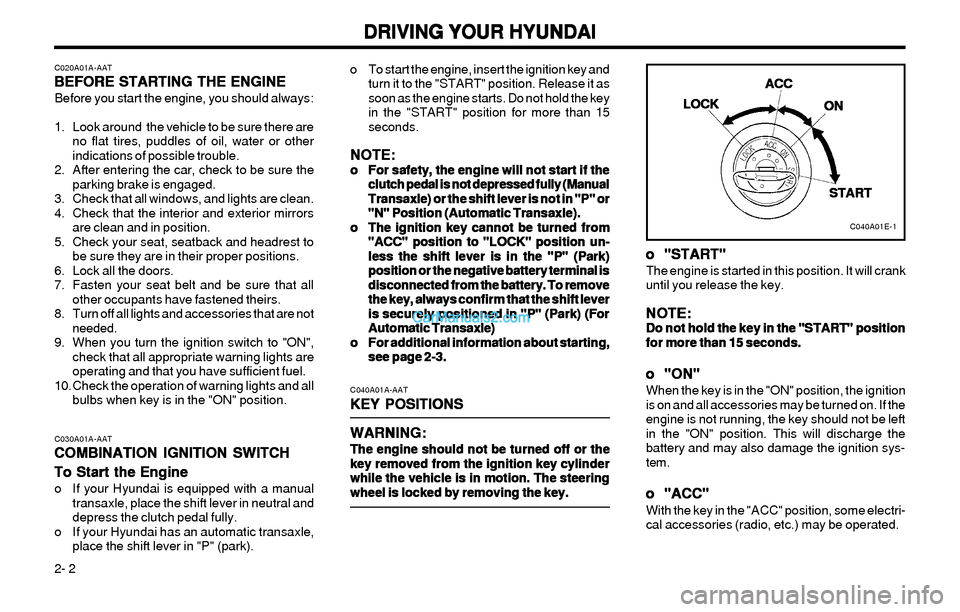
bulbs when key is in the "ON" position.o To start the engine, insert the ignition key and
turn it to the "START" position. Release it as
soon as the engine starts. Do not hold the key
in the "START" position for more than 15
seconds.
NOTE: NOTE:NOTE: NOTE:
NOTE:o oo o
o
For safety, the engine will not start if the For safety, the engine will not start if theFor safety, the engine will not start if the For safety, the engine will not start if the
For safety, the engine will not start if the
clutch pedal is not depressed fully (Manual clutch pedal is not depressed fully (Manualclutch pedal is not depressed fully (Manual clutch pedal is not depressed fully (Manual
clutch pedal is not depressed fully (Manual
Transaxle) or the shift lever is not in "P" or Transaxle) or the shift lever is not in "P" orTransaxle) or the shift lever is not in "P" or Transaxle) or the shift lever is not in "P" or
Transaxle) or the shift lever is not in "P" or
"N" Position (Automatic Transaxle). "N" Position (Automatic Transaxle)."N" Position (Automatic Transaxle). "N" Position (Automatic Transaxle).
"N" Position (Automatic Transaxle).
o oo o
o
The ignition key cannot be turned from The ignition key cannot be turned fromThe ignition key cannot be turned from The ignition key cannot be turned from
The ignition key cannot be turned from
"ACC" position to "LOCK" position un- "ACC" position to "LOCK" position un-"ACC" position to "LOCK" position un- "ACC" position to "LOCK" position un-
"ACC" position to "LOCK" position un-
less the shift lever is in the "P" (Park) less the shift lever is in the "P" (Park)less the shift lever is in the "P" (Park) less the shift lever is in the "P" (Park)
less the shift lever is in the "P" (Park)
position or the negative battery terminal is position or the negative battery terminal isposition or the negative battery terminal is position or the negative battery terminal is
position or the negative battery terminal is
disconnected from the battery. To remove disconnected from the battery. To removedisconnected from the battery. To remove disconnected from the battery. To remove
disconnected from the battery. To remove
the key, always confirm that the shift lever the key, always confirm that the shift leverthe key, always confirm that the shift lever the key, always confirm that the shift lever
the key, always confirm that the shift lever
is securely positioned in "P" (Park) (For is securely positioned in "P" (Park) (Foris securely positioned in "P" (Park) (For is securely positioned in "P" (Park) (For
is securely positioned in "P" (Park) (For
Automatic Transaxle) Automatic Transaxle)Automatic Transaxle) Automatic Transaxle)
Automatic Transaxle)
o oo o
o
For additional information about starting, For additional information about starting,For additional information about starting, For additional information about starting,
For additional information about starting,
see page 2-3. see page 2-3.see page 2-3. see page 2-3.
see page 2-3.
C040A01A-AAT
KEY POSITIONS KEY POSITIONSKEY POSITIONS KEY POSITIONS
KEY POSITIONS
WARNING: WARNING:WARNING: WARNING:
WARNING:
The engine should not be turned off or the The engine should not be turned off or theThe engine should not be turned off or the The engine should not be turned off or the
The engine should not be turned off or the
key removed from the ignition key cylinder key removed from the ignition key cylinderkey removed from the ignition key cylinder key removed from the ignition key cylinder
key removed from the ignition key cylinder
while the vehicle is in motion. The steering while the vehicle is in motion. The steeringwhile the vehicle is in motion. The steering while the vehicle is in motion. The steering
while the vehicle is in motion. The steering
wheel is locked by removing the key. wheel is locked by removing the key.wheel is locked by removing the key. wheel is locked by removing the key.
wheel is locked by removing the key.C030A01A-AAT
COMBINATION IGNITION SWITCH COMBINATION IGNITION SWITCHCOMBINATION IGNITION SWITCH COMBINATION IGNITION SWITCH
COMBINATION IGNITION SWITCH
To Start the Engine To Start the EngineTo Start the Engine To Start the Engine
To Start the Engine
o If your Hyundai is equipped with a manual
transaxle, place the shift lever in neutral and
depress the clutch pedal fully.
o If your Hyundai has an automatic transaxle,
place the shift lever in "P" (park).
C040A01E-1
LOCK LOCKLOCK LOCK
LOCKACC ACCACC ACC
ACC
ON ONON ON
ON
START STARTSTART START
START
o oo o
o
"START" "START""START" "START"
"START"The engine is started in this position. It will crank
until you release the key.
NOTE: NOTE:NOTE: NOTE:
NOTE:Do not hold the key in the "START" position Do not hold the key in the "START" positionDo not hold the key in the "START" position Do not hold the key in the "START" position
Do not hold the key in the "START" position
for more than 15 seconds. for more than 15 seconds.for more than 15 seconds. for more than 15 seconds.
for more than 15 seconds.
o oo o
o
"ON" "ON""ON" "ON"
"ON"When the key is in the "ON" position, the ignition
is on and all accessories may be turned on. If the
engine is not running, the key should not be left
in the "ON" position. This will discharge the
battery and may also damage the ignition sys-
tem.
o oo o
o
"ACC" "ACC""ACC" "ACC"
"ACC"With the key in the "ACC" position, some electri-
cal accessories (radio, etc.) may be operated.
Page 104 of 172

DRIVING YOUR HYUNDAI DRIVING YOUR HYUNDAIDRIVING YOUR HYUNDAI DRIVING YOUR HYUNDAI
DRIVING YOUR HYUNDAI
2- 3
C070C01E-1
o oo o
o
"LOCK" "LOCK""LOCK" "LOCK"
"LOCK"The key can be removed or inserted in this
position. To protect against theft, the steering
wheel locks by removing the key.
NOTE: NOTE:NOTE: NOTE:
NOTE:To unlock the steering wheel, insert the key, To unlock the steering wheel, insert the key,To unlock the steering wheel, insert the key, To unlock the steering wheel, insert the key,
To unlock the steering wheel, insert the key,
and then turn the steering wheel and key and then turn the steering wheel and keyand then turn the steering wheel and key and then turn the steering wheel and key
and then turn the steering wheel and key
simultaneously. simultaneously.simultaneously. simultaneously.
simultaneously.
C070C01A-AAT
To Remove the Ignition Key To Remove the Ignition KeyTo Remove the Ignition Key To Remove the Ignition Key
To Remove the Ignition Key
1. Turn the ignition key to the "ACC" position.
2. Simultaneously push and turn the ignition key
counterclockwise from the "ACC" position to
the "LOCK" position.
3. The key can be removed in the "LOCK"
position.
C050A01A-AATSTARTING STARTINGSTARTING STARTING
STARTING
WARNING: WARNING:WARNING: WARNING:
WARNING:
Never run the engine in a closed or poorly Never run the engine in a closed or poorlyNever run the engine in a closed or poorly Never run the engine in a closed or poorly
Never run the engine in a closed or poorly
ventilated area any longer than is needed to ventilated area any longer than is needed toventilated area any longer than is needed to ventilated area any longer than is needed to
ventilated area any longer than is needed to
move your car in or out of the area. The move your car in or out of the area. Themove your car in or out of the area. The move your car in or out of the area. The
move your car in or out of the area. The
carbon monoxide gas emitted is odorless carbon monoxide gas emitted is odorlesscarbon monoxide gas emitted is odorless carbon monoxide gas emitted is odorless
carbon monoxide gas emitted is odorless
and can cause serious injury or death. and can cause serious injury or death.and can cause serious injury or death. and can cause serious injury or death.
and can cause serious injury or death.
WARNING: WARNING:WARNING: WARNING:
WARNING:Be sure that the clutch is fully depressed Be sure that the clutch is fully depressedBe sure that the clutch is fully depressed Be sure that the clutch is fully depressed
Be sure that the clutch is fully depressed
when starting a manual transaxle vehicle. when starting a manual transaxle vehicle.when starting a manual transaxle vehicle. when starting a manual transaxle vehicle.
when starting a manual transaxle vehicle.
Your manual transaxle equipped vehicle will Your manual transaxle equipped vehicle willYour manual transaxle equipped vehicle will Your manual transaxle equipped vehicle will
Your manual transaxle equipped vehicle will
not start unless the clutch pedal is fully de- not start unless the clutch pedal is fully de-not start unless the clutch pedal is fully de- not start unless the clutch pedal is fully de-
not start unless the clutch pedal is fully de-
pressed. On a manual transaxle equipped pressed. On a manual transaxle equippedpressed. On a manual transaxle equipped pressed. On a manual transaxle equipped
pressed. On a manual transaxle equipped
vehicle that can be started without depress- vehicle that can be started without depress-vehicle that can be started without depress- vehicle that can be started without depress-
vehicle that can be started without depress-
ing the clutch, there is the potential to cause ing the clutch, there is the potential to causeing the clutch, there is the potential to cause ing the clutch, there is the potential to cause
ing the clutch, there is the potential to cause
damage to the vehicle or injury to someone damage to the vehicle or injury to someonedamage to the vehicle or injury to someone damage to the vehicle or injury to someone
damage to the vehicle or injury to someone
inside or outside the vehicle as a result of the inside or outside the vehicle as a result of theinside or outside the vehicle as a result of the inside or outside the vehicle as a result of the
inside or outside the vehicle as a result of the
forward or backward movement of the ve- forward or backward movement of the ve-forward or backward movement of the ve- forward or backward movement of the ve-
forward or backward movement of the ve-
hicle that will occur if the clutch is not de- hicle that will occur if the clutch is not de-hicle that will occur if the clutch is not de- hicle that will occur if the clutch is not de-
hicle that will occur if the clutch is not de-
pressed when the vehicle is started. pressed when the vehicle is started.pressed when the vehicle is started. pressed when the vehicle is started.
pressed when the vehicle is started.
4. Turn the ignition key to the "Start" position
and release it when the engine starts.
After the engine has started, allow the engine
to run for 10 to 20 seconds prior to placing the
vehicle in gear.
The starter should not be operated for more
than 15 seconds at a time. Wait 15-30 sec-
onds between starting attempts to protect the
starter from overheating.
C050A01E-1
C050B01A-AAT
Normal Conditions: Normal Conditions:Normal Conditions: Normal Conditions:
Normal Conditions:The Starting Procedure:
1. Insert key, and fasten the seat belt.
2. Depress the clutch pedal fully and place the
gearshift lever (manual transaxle) in neutral
or the selector lever (automatic transaxle) in
"P" (park) position.
3. After turning the ignition key to the "ON"
position, make certain all warning lights and
gauges are functioning properly before start-
ing the engine.
LOCK LOCKLOCK LOCK
LOCKACC ACCACC ACC
ACC
ON ONON ON
ON
START STARTSTART START
START
Page 107 of 172

DRIVING YOUR HYUNDAI DRIVING YOUR HYUNDAIDRIVING YOUR HYUNDAI DRIVING YOUR HYUNDAI
DRIVING YOUR HYUNDAI
2- 6
C090G01A-AAT
o L (Low gear): o L (Low gear):o L (Low gear): o L (Low gear):
o L (Low gear):Use for driving up a very steep grade or for
engine braking when descending steep hills.
When downshifting to "L", the transaxle will tem-
porarily remain in second gear until the vehicle
has slowed enough for low gear to engage. Do
not exceed 31 mph (50 km/h) in low gear.
C090I02Y-AAT
CAUTION: CAUTION:CAUTION: CAUTION:
CAUTION:o oo o
o
Shift into "R" and "P" position only when Shift into "R" and "P" position only whenShift into "R" and "P" position only when Shift into "R" and "P" position only when
Shift into "R" and "P" position only when
the vehicle has completely stopped. the vehicle has completely stopped.the vehicle has completely stopped. the vehicle has completely stopped.
the vehicle has completely stopped.
o oo o
o
Do not accelerate the engine in reverse or Do not accelerate the engine in reverse orDo not accelerate the engine in reverse or Do not accelerate the engine in reverse or
Do not accelerate the engine in reverse or
any of the forward positions with the any of the forward positions with theany of the forward positions with the any of the forward positions with the
any of the forward positions with the
brakes applied. brakes applied.brakes applied. brakes applied.
brakes applied.
o oo o
o
Always apply the footbrake when shifting Always apply the footbrake when shiftingAlways apply the footbrake when shifting Always apply the footbrake when shifting
Always apply the footbrake when shifting
from "P" or "N", to "R", "D", "3", "2" or "L" from "P" or "N", to "R", "D", "3", "2" or "L"from "P" or "N", to "R", "D", "3", "2" or "L" from "P" or "N", to "R", "D", "3", "2" or "L"
from "P" or "N", to "R", "D", "3", "2" or "L"
position. position.position. position.
position.
o oo o
o
Do not use the "P" (Park) position in place Do not use the "P" (Park) position in placeDo not use the "P" (Park) position in place Do not use the "P" (Park) position in place
Do not use the "P" (Park) position in place
of the parking brake. Always set the park- of the parking brake. Always set the park-of the parking brake. Always set the park- of the parking brake. Always set the park-
of the parking brake. Always set the park-
ing brake, shift the transaxle into "P" (Park) ing brake, shift the transaxle into "P" (Park)ing brake, shift the transaxle into "P" (Park) ing brake, shift the transaxle into "P" (Park)
ing brake, shift the transaxle into "P" (Park)
position and turn off the ignition when position and turn off the ignition whenposition and turn off the ignition when position and turn off the ignition when
position and turn off the ignition when
you leave the vehicle, even momentarily. you leave the vehicle, even momentarily.you leave the vehicle, even momentarily. you leave the vehicle, even momentarily.
you leave the vehicle, even momentarily.
Never leave the vehicle unattended while Never leave the vehicle unattended whileNever leave the vehicle unattended while Never leave the vehicle unattended while
Never leave the vehicle unattended while
the engine is running. the engine is running.the engine is running. the engine is running.
the engine is running.
o oo o
o
Check the automatic transaxle fluid level Check the automatic transaxle fluid levelCheck the automatic transaxle fluid level Check the automatic transaxle fluid level
Check the automatic transaxle fluid level
regularly, and add fluid as necessary. regularly, and add fluid as necessary.regularly, and add fluid as necessary. regularly, and add fluid as necessary.
regularly, and add fluid as necessary.
See the maintenance schedule for the See the maintenance schedule for theSee the maintenance schedule for the See the maintenance schedule for the
See the maintenance schedule for the
proper fluid recommendation. proper fluid recommendation.proper fluid recommendation. proper fluid recommendation.
proper fluid recommendation.
C090H01Y-AAT
NOTE: NOTE:NOTE: NOTE:
NOTE:o oo o
o
For smooth and safe operation, depress For smooth and safe operation, depressFor smooth and safe operation, depress For smooth and safe operation, depress
For smooth and safe operation, depress
the brake pedal when shifting from "Neu- the brake pedal when shifting from "Neu-the brake pedal when shifting from "Neu- the brake pedal when shifting from "Neu-
the brake pedal when shifting from "Neu-
tral" position or "Park" position to a for- tral" position or "Park" position to a for-tral" position or "Park" position to a for- tral" position or "Park" position to a for-
tral" position or "Park" position to a for-
ward or reverse gear. ward or reverse gear.ward or reverse gear. ward or reverse gear.
ward or reverse gear.
o oo o
o
The ignition key must be in the "ON" The ignition key must be in the "ON"The ignition key must be in the "ON" The ignition key must be in the "ON"
The ignition key must be in the "ON"
position and the brake pedal fully de- position and the brake pedal fully de-position and the brake pedal fully de- position and the brake pedal fully de-
position and the brake pedal fully de-
pressed in order to move the shift lever pressed in order to move the shift leverpressed in order to move the shift lever pressed in order to move the shift lever
pressed in order to move the shift lever
from the "P" (Park) position to any of the from the "P" (Park) position to any of thefrom the "P" (Park) position to any of the from the "P" (Park) position to any of the
from the "P" (Park) position to any of the
other positions. other positions.other positions. other positions.
other positions.
C090F01A-AAT
o 2 (Second gear): o 2 (Second gear):o 2 (Second gear): o 2 (Second gear):
o 2 (Second gear):Use for driving on a slippery road, hill climbing or
engine braking downhill. "2" automatically shifts
between first and second gears.
This means that no shift-up to 3rd gear is per-
formed. However, the shift-up to third gear is
done when the car speed exceeds a certain
value to prevent the engine from over-revving.
Manually move the selector to "D" returning to
normal driving condition.
C090D02A-AAT
o N (Neutral): o N (Neutral):o N (Neutral): o N (Neutral):
o N (Neutral):In the "N" position, the transaxle is in neutral,
which means that no gears are engaged. The
engine can be started with the shift lever in "N"
position, although this is not recommended ex-
cept if the engine stalls while the car is moving.
C090E01A-AAT
o D (Drive): o D (Drive):o D (Drive): o D (Drive):
o D (Drive):Use for normal driving. The transaxle will auto-
matically shift through a four-gear sequence.
Never downshift manually to "2" position or "L"
position when vehicle speed is more than 60 mph
(96 km/h).
C090Q01A-GAT
o 3 (Third gear): o 3 (Third gear):o 3 (Third gear): o 3 (Third gear):
o 3 (Third gear):Use for towing a trailer during hill climbing or to
use engine braking downhill.
"3" automatically shifts between 1st, 2nd and 3rd
gears. This means that no shift-up to 4th gear is
performed. However, the shift-up to 4th gear is
done when the car speed exceeds a certain
value to prevent the engine from over-revving.
Manually move the selector to "D" when return-
ing to normal driving condition.o oo o
o
It is always possible to shift from "R", "N", It is always possible to shift from "R", "N",It is always possible to shift from "R", "N", It is always possible to shift from "R", "N",
It is always possible to shift from "R", "N",
"D", "3", "2", "L" position to "P" position. "D", "3", "2", "L" position to "P" position."D", "3", "2", "L" position to "P" position. "D", "3", "2", "L" position to "P" position.
"D", "3", "2", "L" position to "P" position.
The vehicle must be fully stopped to avoid The vehicle must be fully stopped to avoidThe vehicle must be fully stopped to avoid The vehicle must be fully stopped to avoid
The vehicle must be fully stopped to avoid
transaxle damage. transaxle damage.transaxle damage. transaxle damage.
transaxle damage.
Page 110 of 172

DRIVING YOUR HYUNDAI DRIVING YOUR HYUNDAIDRIVING YOUR HYUNDAI DRIVING YOUR HYUNDAI
DRIVING YOUR HYUNDAI
2- 9
C300B01E-GAT
TCS ON/OFF Mode TCS ON/OFF ModeTCS ON/OFF Mode TCS ON/OFF Mode
TCS ON/OFF ModeIn the TCS ON mode, the indicator in the instru-
ment cluster will not be illuminated.
To switch the TCS OFF mode, press the TCS
switch . And the SLIP control will be deactivated
and the TCS indicator in the instrument cluster
will be illuminated.
SLIP Control SLIP ControlSLIP Control SLIP Control
SLIP ControlLimits the drive wheels from spinning exces-
sively during starting or while making accelerat-
ed turns on slippery roads to avoid losing the
driving force of the front wheels.
Driving hints Driving hintsDriving hints Driving hints
Driving hintsTCS does not actively apply brakes. Be sure to
decelerate the car sufficiently before entering
curves.
CAUTION: CAUTION:CAUTION: CAUTION:
CAUTION:When the TCS indicator blinks, SLIP control When the TCS indicator blinks, SLIP controlWhen the TCS indicator blinks, SLIP control When the TCS indicator blinks, SLIP control
When the TCS indicator blinks, SLIP control
has been activated. It also means that the has been activated. It also means that thehas been activated. It also means that the has been activated. It also means that the
has been activated. It also means that the
road is slippery or your car is accelerating road is slippery or your car is acceleratingroad is slippery or your car is accelerating road is slippery or your car is accelerating
road is slippery or your car is accelerating
excessively. In this situation, release foot excessively. In this situation, release footexcessively. In this situation, release foot excessively. In this situation, release foot
excessively. In this situation, release foot
pressure from the accelerator pedal and main- pressure from the accelerator pedal and main-pressure from the accelerator pedal and main- pressure from the accelerator pedal and main-
pressure from the accelerator pedal and main-
tain moderate speed. tain moderate speed.tain moderate speed. tain moderate speed.
tain moderate speed.
WARNING: WARNING:WARNING: WARNING:
WARNING:Traction control is only a driving aid; all Traction control is only a driving aid; allTraction control is only a driving aid; all Traction control is only a driving aid; all
Traction control is only a driving aid; all
normal precautions for driving in inclement normal precautions for driving in inclementnormal precautions for driving in inclement normal precautions for driving in inclement
normal precautions for driving in inclement
weather and on slippery driving surfaces weather and on slippery driving surfacesweather and on slippery driving surfaces weather and on slippery driving surfaces
weather and on slippery driving surfaces
should be observed. should be observed.should be observed. should be observed.
should be observed.
C300D02L-GAT
Indicator and Warning Indicator and WarningIndicator and Warning Indicator and Warning
Indicator and WarningThe indicator should illuminate when the ignition
key is turned to "ON" or "START", but should go
out after three seconds.
If the indicator does not illuminate, have it checked
by an authorized Hyundai dealer.
Should there be any unusual conditions in the
device, TCS illuminates as a warning.
If TCS illuminates, pull your car to a safe place
and stop the engine.
Then, start the engine again to check if the TCS
indicator goes out.
If the indicator remains lit even after the engine
has been started, have your car checked by an
authorized Hyundai dealer.
NOTE: NOTE:NOTE: NOTE:
NOTE:1) 1)1) 1)
1)
Turn off the engine. Then restart the en- Turn off the engine. Then restart the en-Turn off the engine. Then restart the en- Turn off the engine. Then restart the en-
Turn off the engine. Then restart the en-
gine, and the TCS mode will automatically gine, and the TCS mode will automaticallygine, and the TCS mode will automatically gine, and the TCS mode will automatically
gine, and the TCS mode will automatically
turn "ON". turn "ON".turn "ON". turn "ON".
turn "ON".
2) 2)2) 2)
2)
When the traction control is operating When the traction control is operatingWhen the traction control is operating When the traction control is operating
When the traction control is operating
properly, you can feel a slight pulsation in properly, you can feel a slight pulsation inproperly, you can feel a slight pulsation in properly, you can feel a slight pulsation in
properly, you can feel a slight pulsation in
the vehicle. This is only the effect of brake the vehicle. This is only the effect of brakethe vehicle. This is only the effect of brake the vehicle. This is only the effect of brake
the vehicle. This is only the effect of brake
control and indicates nothing unusual. control and indicates nothing unusual.control and indicates nothing unusual. control and indicates nothing unusual.
control and indicates nothing unusual.
3) 3)3) 3)
3)
When the engine starts, a click is heard When the engine starts, a click is heardWhen the engine starts, a click is heard When the engine starts, a click is heard
When the engine starts, a click is heard
from the engine compartment; however, from the engine compartment; however,from the engine compartment; however, from the engine compartment; however,
from the engine compartment; however,
this is only the sound of traction control this is only the sound of traction controlthis is only the sound of traction control this is only the sound of traction control
this is only the sound of traction control
being checked. being checked.being checked. being checked.
being checked.
4) 4)4) 4)
4)
When moving out of the mud or fresh When moving out of the mud or freshWhen moving out of the mud or fresh When moving out of the mud or fresh
When moving out of the mud or fresh
snow, pressing the accelerator pedal may snow, pressing the accelerator pedal maysnow, pressing the accelerator pedal may snow, pressing the accelerator pedal may
snow, pressing the accelerator pedal may
not cause the engine speed to increase. not cause the engine speed to increase.not cause the engine speed to increase. not cause the engine speed to increase.
not cause the engine speed to increase.NOTE: NOTE:NOTE: NOTE:
NOTE:1) 1)1) 1)
1)
When TCS illuminates, traction control is When TCS illuminates, traction control isWhen TCS illuminates, traction control is When TCS illuminates, traction control is
When TCS illuminates, traction control is
automatically deactivated for safety. automatically deactivated for safety.automatically deactivated for safety. automatically deactivated for safety.
automatically deactivated for safety.
2) 2)2) 2)
2)
This warning function is not provided when This warning function is not provided whenThis warning function is not provided when This warning function is not provided when
This warning function is not provided when
the driver selects the TCS-OFF mode. the driver selects the TCS-OFF mode.the driver selects the TCS-OFF mode. the driver selects the TCS-OFF mode.
the driver selects the TCS-OFF mode.
C140A01A-AAT
DRIVING FOR ECONOMY DRIVING FOR ECONOMYDRIVING FOR ECONOMY DRIVING FOR ECONOMY
DRIVING FOR ECONOMYYou can save fuel and get more miles from your
car if you follow these suggestions:
o Drive smoothly. Accelerate at a moderate
rate. Don't make "jack-rabbit" starts or full-
throttle shifts and maintain a steady cruising
speed. Don't race between stoplights. Try to
adjust your speed to that of the other traffic so
you don't have to change speeds unneces-
sarily. Avoid heavy traffic whenever possible.
Always maintain a safe distance from other
vehicles so you can avoid unnecessary brak-
ing. This also reduces brake wear.
o Drive at a moderate speed. The faster you
drive, the more fuel your car uses. Driving at
a moderate speed, especially on the high-
way, is one of the most effective ways to
reduce fuel consumption.
o Don't "ride" the brake or clutch pedal. This
can increase fuel consumption and also in-
crease wear on these components. In addi-
tion, driving with your foot resting on the brake
pedal may cause the brakes to overheat,
which reduces their effectiveness and may
lead to more serious consequences.
Page 112 of 172

DRIVING YOUR HYUNDAI DRIVING YOUR HYUNDAIDRIVING YOUR HYUNDAI DRIVING YOUR HYUNDAI
DRIVING YOUR HYUNDAI
2- 11 accordance with the maintenance schedule in
Section 5. Before winter, have your coolant test-
ed to assure that its freezing point is sufficient for
the temperatures anticipated during the winter.
C160D01A-AAT
Check Battery and Cables Check Battery and CablesCheck Battery and Cables Check Battery and Cables
Check Battery and CablesWinter puts additional burdens on the battery
system. Visually inspect the battery and cables
as described in Section 6. The level of charge in
your battery can be checked by your Hyundai
dealer or a service station.
C160E01A-AATChange to "Winter Weight" Oil if Change to "Winter Weight" Oil ifChange to "Winter Weight" Oil if Change to "Winter Weight" Oil if
Change to "Winter Weight" Oil if
Necessary NecessaryNecessary Necessary
Necessary
In some climates it is recommended that a lower
viscosity "winter weight" oil be used during cold
weather. See Section 9 for recommendations. If
you aren't sure what weight oil you should use,
consult your Hyundai dealer.
C160F01A-AATCheck Spark Plugs and Ignition Check Spark Plugs and IgnitionCheck Spark Plugs and Ignition Check Spark Plugs and Ignition
Check Spark Plugs and Ignition
System SystemSystem System
System
Inspect your spark plugs as described in Section
6 and replace them if necessary. Also check all
ignition wiring and components to be sure they
are not cracked, worn or damaged in any way.
C160G01A-AAT
To Keep Locks from Freezing To Keep Locks from FreezingTo Keep Locks from Freezing To Keep Locks from Freezing
To Keep Locks from FreezingTo keep the locks from freezing, squirt an ap-
proved de-icer fluid or glycerine into the key
opening. If a lock is covered with ice, squirt it with
an approved de-icing fluid to remove the ice. If
the lock is frozen internally, you may be able to
thaw it out by using a heated key. Handle the
heated key with care to avoid burning the fingers.
C160H01A-AATUse Approved Anti-Freeze in Window Use Approved Anti-Freeze in WindowUse Approved Anti-Freeze in Window Use Approved Anti-Freeze in Window
Use Approved Anti-Freeze in Window
Washer System Washer SystemWasher System Washer System
Washer System
To keep the water in the window washer system
from freezing, add an approved anti-freeze solu-
tion in accordance with instructions on the con-
tainer. Window washer anti-freeze is available
from Hyundai dealers and most auto parts out-
lets. Do not use engine coolant or other types of
anti-freeze as these may damage the finish.
C160I01A-AAT
Don't Let Your Parking Brake Freeze Don't Let Your Parking Brake FreezeDon't Let Your Parking Brake Freeze Don't Let Your Parking Brake Freeze
Don't Let Your Parking Brake FreezeUnder some conditions your parking brake can
freeze in the engaged position. This is most likely
to happen when there is an accumulation of snow
or ice around or near the rear brakes or if the
brakes are wet. If there is a risk the parking brake
may freeze, apply it only temporarily while you
put the gear selector lever in "P" (automatic) or in
first or reverse gear (manual transaxle) and
block the rear wheels so the car cannot roll. Then
release the parking brake.
C160K01A-AAT
Carry Emergency Equipment Carry Emergency EquipmentCarry Emergency Equipment Carry Emergency Equipment
Carry Emergency EquipmentDepending on the severity of the weather where
you drive your car, you should carry appropriate
emergency equipment. Some of the items you
may want to carry include tire chains, tow straps
or chains, flashlight, emergency flares, sand, a
shovel, jumper cables, a window scraper, gloves,
ground cloth, coveralls, a blanket, etc.
C160J01A-AAT
Don't Let Ice and Snow Accumulate Don't Let Ice and Snow AccumulateDon't Let Ice and Snow Accumulate Don't Let Ice and Snow Accumulate
Don't Let Ice and Snow Accumulate
Underneath UnderneathUnderneath Underneath
Underneath
Under some conditions, snow and ice can build
up under the fenders and interfere with the steer-
ing. When driving in severe winter conditions
where this may happen, you should periodically
check underneath the car to be sure the move-
ment of the front wheels and the steering compo-
nents is not obstructed.
C170A01A-AAT
HIGHER SPEED MOTORING HIGHER SPEED MOTORINGHIGHER SPEED MOTORING HIGHER SPEED MOTORING
HIGHER SPEED MOTORING
Pre-Trip Inspections Pre-Trip InspectionsPre-Trip Inspections Pre-Trip Inspections
Pre-Trip Inspections
1. Tires:
Adjust the tire inflation pressures to specifica-
tion. Low tire inflation pressures will result in
overheating and possible failure of the tires.
Avoid using worn or damaged tires which may
result in reduced traction or tire failure.