2003 Hyundai Accent engine
[x] Cancel search: enginePage 156 of 186
6- 20 DO-IT-YOURSELF MAINTENANCE
G220A01A-AATCHECKING ELECTRIC COOLING
FANSG230A03A-AATPOWER STEERING FLUID LEVEL
G220B01A-AATChecking Engine Cooling Fan
The engine cooling fan should come on auto-
matically if the engine coolant temperature is
high.
WARNING:The radiator fan is controlled by engine cool-
ant temperature and may sometimes operate
even when the engine is not running. Use
extreme caution when working near the
blades of the cooling fan, so that you are not
injured by a rotating fan blade. As the cool-
ant temperature decreases the fan will auto-
matically shut off. This is a normal condition.
!
G220C01A-AATChecking Condenser Cooling Fan
The condenser cooling fan should come on
automatically whenever the air conditioner is in
operation.
HLC5006
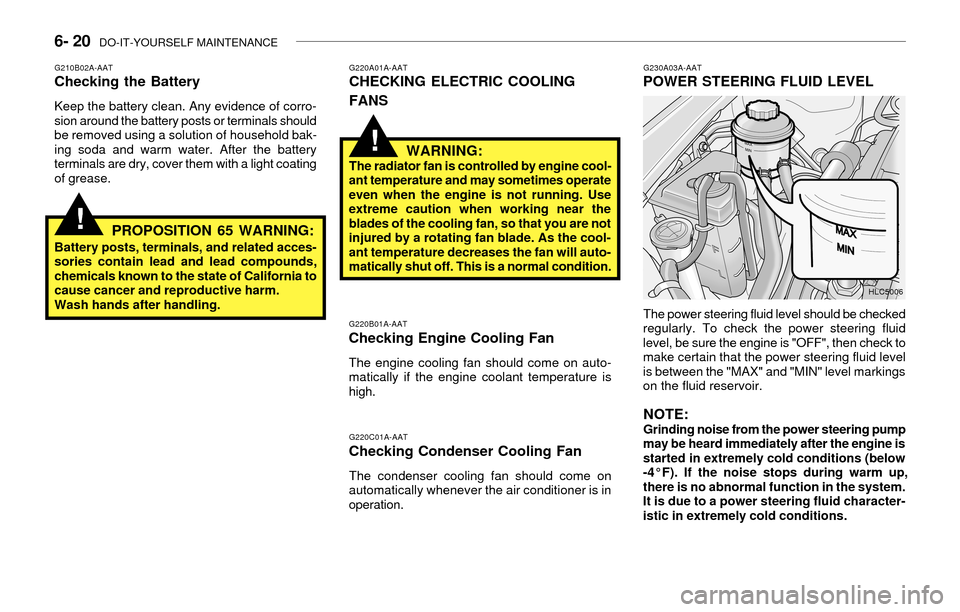
The power steering fluid level should be checked
regularly. To check the power steering fluid
level, be sure the engine is "OFF", then check to
make certain that the power steering fluid level
is between the "MAX" and "MIN" level markings
on the fluid reservoir.
NOTE:Grinding noise from the power steering pump
may be heard immediately after the engine is
started in extremely cold conditions (below
-4°F). If the noise stops during warm up,
there is no abnormal function in the system.
It is due to a power steering fluid character-
istic in extremely cold conditions.
G210B02A-AATChecking the Battery
Keep the battery clean. Any evidence of corro-
sion around the battery posts or terminals should
be removed using a solution of household bak-
ing soda and warm water. After the battery
terminals are dry, cover them with a light coating
of grease.
PROPOSITION 65 WARNING:
Battery posts, terminals, and related acces-
sories contain lead and lead compounds,
chemicals known to the state of California to
cause cancer and reproductive harm.
Wash hands after handling.
!
Page 157 of 186

DO-IT-YOURSELF MAINTENANCE 6- 21
G240A01A-AATPOWER STEERING HOSES
It is suggested that you check the power steer-
ing hose connections for fluid leakage at those
intervals specified in the vehicle maintenance
schedule in Section 5.
The power steering hoses should be replaced if
there is severe surface cracking, pulling, scuff-
ing or worn spots. Deterioration of the hose
could cause premature failure.
Recommended Fluid
Use PSF-3 type fluid
NOTE:Do not start the engine when the power
steering oil reservoir is empty.
G250A01A-AAT
FOR MORE INFORMATION ABOUT
YOUR HYUNDAI
If you desire additional information about main-
taining and servicing your Hyundai, you may
purchase a factory Shop Manual at your Hyundai
dealer's parts department. This is the same
manual used by dealership technicians and while
it is highly technical it can be useful in obtaining
a better understanding of your car and how it
works.
G290A04A-AATHEADLIGHT AIMING ADJUSTMENT
Before performing aiming adjustment, make sure
of the following.
1. Keep all tires inflated to the correct pressure.
2. Place the vehicle on level ground and press
the front bumper & rear bumper down sever-
al times. Place vehicle at a distance of 118
in. (3m) from the test wall.
3. See that the vehicle is unloaded (except for
full levels of coolant, engine oil and fuel, and
spare tire, jack, and tools). Have the driver or
equivalent weight placed in driver's seat.
4. Clean the headlight lenses and turn on the
headlights (Low beam).5. Open the hood.
6. Draw the vertical line (through the center of
each headlight) and the horizontal line
(through the center of each headlight) on the
aiming screen.
And then, draw the parallel line at 0.8 in.(21
mm) place under the horizontal line.
7. Adjust each cut-off line of the low beam to
the parallel line with a phillips screwdriver
- VERTICAL AIMING
G290A01A-1
Vertical
Aiming
WARNING:Horizontal aiming should be adjusted by an
authorized Hyundai dealer.
!
Page 159 of 186

DO-IT-YOURSELF MAINTENANCE 6- 23
HLC5033 G270A03A-AAT
Headlight Bulb
1. Allow the bulb to cool. Wear eye protection.
2. Open the engine hood.
3. Always grasp the bulb by its plastic base,
avoid touching the glass.
4. Using a socket wrench of the correct size,
remove the headlight assembly mounting
bolts.
6. Remove the dust cover.
HLC5011
HLC5009
5. Disconnect the power cord from the bulb
base in the back of the headlight.7. Push the bulb spring to remove the headlight
bulb.
HLC5010HLC5034-1
Page 164 of 186

6- 28 DO-IT-YOURSELF MAINTENANCE
G200C02A-GATFUSE PANEL DESCRIPTION
Engine Compartment
HLC5027
NOTE:Not all fuse panel descriptions in this manual may be applicable to your vehicle. It is accurate at the time of printing. When you inspect the fuse
box on your vehicle, refer to the fuse box label.
FUSE RATING
120A
50A
50A
20A
30A
20A
30A
30A
30A
30A
20A
10A
10A
10A
10A
10A
10A
10A
15A
10A
15A
15A
10A
25APROTECTED COMPONENTS
Charging (Generator)
Fuse 6, 7, 8, 9, Horn fuse, Room lamp fuse
Head lamp fuse, Front fog lamp fuse, Tail lamp relay, H/LP washer fuse
Engine control relay, Generator, Fuel pump relay, ECU #3 fuse
Ignition power source, Star t relay
Radiator fan control
Blower control
ABS control, ABS bleeding connector
ABS control, ABS bleeding connector
Power window
Condenser fan control
Radiator fan, Condenser fan, ECM, Oxygen sensor, Purge control valve,
SMATRA, Glow plug relay, Heater relay, Stop lamp switch
A/C relay
Horn relay
Illumination lamps, Left rear combination lamp, License lamp, DRL control,
Position lamp, H/LP washer relay
Right rear combination lamp, License lamp, Position lamp
Left head lamp, DRL control, Instrument cluster
Right head lamp
Front fog lamp relay
Instrument cluster, Courtesy lamp, Trunk room lamp, ETACM, DLC,
Door warning, Multipurpose check connector
Audio, Digital clock, Power antenna, A/C switch, Rear fog lamp switch
Idle speed actuator, ECM, Camshaft position sensor, EGR actuator,
Throttle plate actuator
ECM
Head lamp washer motor
Fuel pump relay, Fuel pump motor
ALT
BATTERY
LAMP
ECU
IGN
RAD FAN
BLOWER
ABS
ABS
P/WDW
COND FAN
ECU #1
A/CON COMP
HORN
TAIL LH
TAIL RH
H/LP LH
H/LP RH
FRONT FOG
ROOM LP
AUDIO
ECU #2
ECU#3
H/L WASHER FUSIBLE
LINK
FUSEDESCRIPTION
F/PUMP CHK (E50)
Page 167 of 186
7- 2 EMISSION CONTROL SYSTEMS
H010C01S-AAT2. Evaporative Emission Control (In-
cluding ORVR: Onboard Refueling Va-
por Recovery) System
The Evaporative Emission Control System is
designed to prevent fuel vapors from escaping
into the atmosphere.
(The ORVR system is designed to allow the
vapors from the fuel tank to be loaded into a
canister while refueling at the gas station, pre-
venting the escape of fuel vapors into the atmo-
sphere.)
Canister
Fuel vapors generated inside the fuel tank are
absorbed and stored in the onboard canister.
When the engine is running, the fuel vapors
absorbed in the canister are drawn into the
induction system through the purge control so-
lenoid valve.
Purge Control Solenoid Valve (PCSV)
The purge control solenoid valve is controlled by
the Engine Control Module (ECM); when the
engine coolant temperature is low during idling,
the PCSV closes so that evaporated fuel is not
taken into the engine. After the engine warms-
up during ordinary driving, the PCSV opens to
introduce evaporated fuel to the engine.
H010B01A-AAT
1. CRANKCASE EMISSION CONTROL
SYSTEM
The positive crankcase ventilation system is
employed to prevent air pollution caused by
blow-by gases being emitted from the crank-
case. This system supplies filtered fresh air to
the crankcase through the air intake hose. In-
side the crankcase, the fresh air mixes with
blow-by gases, then passes through the PCV
valve into the induction system.
H010A01A-AATEMISSION CONTROL SYSTEM
Your Hyundai is equipped with an emission
control system to meet all requirements of the
U.S. Environmental Protection Agency or Cali-
fornia Air Resources Board.
There are three emission control systems which
are as follows.
1) Crankcase Emission Control System
2) Evaporative Emission Control System
3) Exhaust Emission Control System
In order to ensure the proper function of the
emission control systems, it is recommended
that you have your car inspected and main-
tained by an authorized Hyundai dealer in ac-
cordance with the maintenance schedule in this
manual.
H010D01A-AAT3. EXHAUST EMISSION
CONTROL SYSTEM
The Exhaust Emission Control System is a
highly effective system which controls exhaust
emissions while maintaining good vehicle
performace.
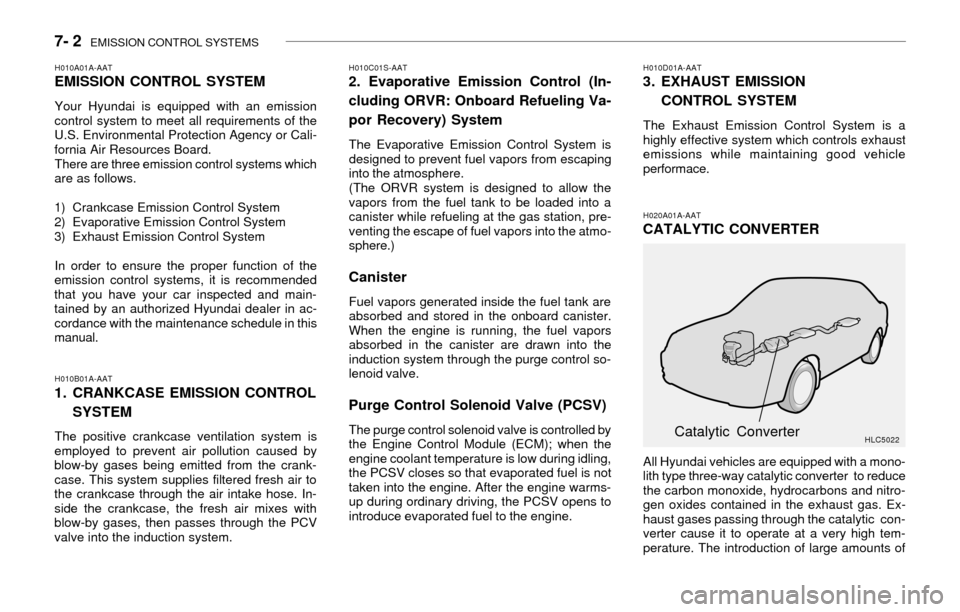
H020A01A-AATCATALYTIC CONVERTER
All Hyundai vehicles are equipped with a mono-
lith type three-way catalytic converter to reduce
the carbon monoxide, hydrocarbons and nitro-
gen oxides contained in the exhaust gas. Ex-
haust gases passing through the catalytic con-
verter cause it to operate at a very high tem-
perature. The introduction of large amounts of
HLC5022Catalytic Converter
Page 168 of 186
EMISSION CONTROL SYSTEMS 7- 3
unburned gasoline into the exhaust may cause
the catalytic converter to overheat and create a
fire hazard. This risk may be reduced by ob-
serving the following:
WARNING:o Remember that your Hyundai dealer is
your best source of assistance.
o Do not stop your Hyundai over any com-
bustible material such as grass, paper,
leaves or rags. These materials might
contact the hot catalytic converter and a
fire might result.
WARNING:o Use unleaded fuel only.
o Maintain the engine in good operating
condition. Extremely high catalytic con-
verter temperatures can result from im-
proper operation of the electrical, ignition
or multiport electronic fuel injection.
o If your engine stalls, pings, knocks, or is
hard to start, have your Hyundai dealer
inspect and repair the problem as soon
as possible.
o Avoid driving with a very low fuel level.
Running out of gasoline may cause the
engine to misfire and result in damage to
the catalytic converter.
o Avoid idling the engine for periods longer
than 10 minutes.
o The vehicle should not be pushed or
pulled to get started. This may cause the
catalytic converter to overheat and create
a fire hazard.
o Do not touch the catalytic converter or
any other part of the exhaust system
while the catalytic converter is hot. Shut
off the engine, wait for at least one hour
before touching the catalytic converter or
any other part of the exhaust system.
!
!
Page 169 of 186
8. CONSUMER INFORMATION &
REPORTING SAFETY DEFECTS
Vehicle Identification Number (VIN) .............................................. 8-2
Engine Number .............................................................................. 8-2
Recommended Inflation Pressures ................................................ 8-2
Snow Tires ...................................................................................... 8-3
Tire Chains ..................................................................................... 8-3
Tire Rotation ................................................................................... 8-4
Tire Balancing ................................................................................. 8-4
Tire Traction ................................................................................... 8-4
When to Replace Tires .................................................................. 8-4
Spare Tire and Tools ..................................................................... 8-5
Warranties for Your Hyundai Vehicle .............................................. 8-5
Consumer Information ..................................................................... 8-6
Reporting Safety Defects ................................................................ 8-7
8
Page 170 of 186
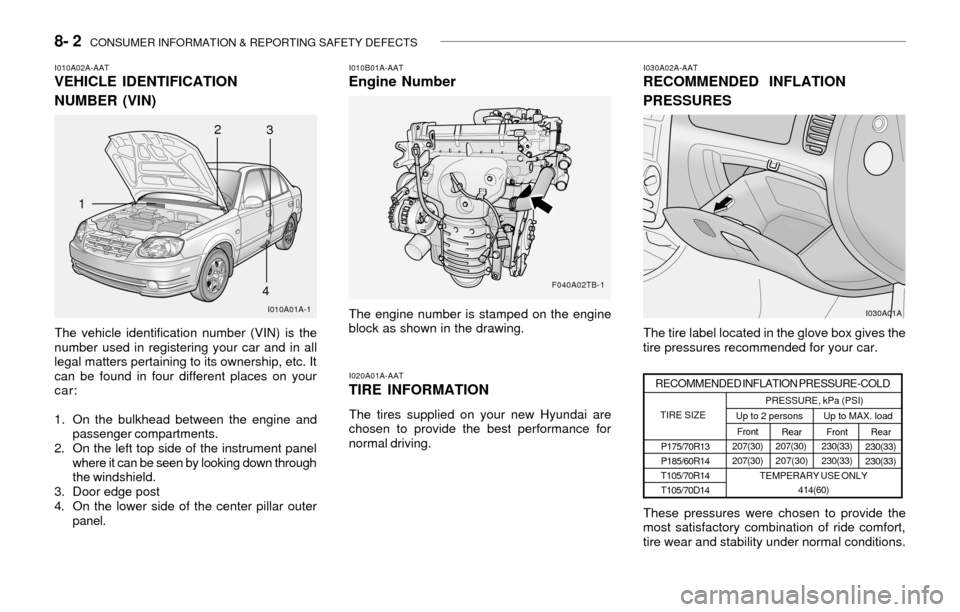
8- 2 CONSUMER INFORMATION & REPORTING SAFETY DEFECTS
Up to 2 persons TIRE SIZE
RECOMMENDED INFLATION PRESSURE-COLD
P175/70R13
P185/60R14
T105/70R14
T105/70D14Rear
207(30)
207(30)Front
230(33)
230(33)Up to MAX. load
Rear
230(33)
230(33) Front
207(30)
207(30)
PRESSURE, kPa (PSI)
TEMPERARY USE ONLY
414(60)
I010A02A-AATVEHICLE IDENTIFICATION
NUMBER (VIN)
The vehicle identification number (VIN) is the
number used in registering your car and in all
legal matters pertaining to its ownership, etc. It
can be found in four different places on your
car:
1. On the bulkhead between the engine and
passenger compartments.
2. On the left top side of the instrument panel
where it can be seen by looking down through
the windshield.
3. Door edge post
4. On the lower side of the center pillar outer
panel.
I010B01A-AATEngine Number
The engine number is stamped on the engine
block as shown in the drawing.
I020A01A-AAT
TIRE INFORMATION
The tires supplied on your new Hyundai are
chosen to provide the best performance for
normal driving.
I030A02A-AATRECOMMENDED INFLATION
PRESSURES
The tire label located in the glove box gives the
tire pressures recommended for your car.
These pressures were chosen to provide the
most satisfactory combination of ride comfort,
tire wear and stability under normal conditions.
I010A01A-1
12
3
4
F040A02TB-1
I030A01A