2003 Hyundai Accent wheel
[x] Cancel search: wheelPage 125 of 186
CORROSION PREVENTION AND APPEARANCE CARE 4- 3
E030A01A-AATWASHING AND WAXING
Washing Your Hyundai
Never wash your car when the surface is hot
from being in the sun. Always wash your car in
the shade.
Wash your car frequently. Dirt is abrasive and
can scratch the paint if it is not removed. Air
pollution or acid rain may damage the paint and
trim through chemical action if pollutants are
allowed to remain in contact with the surface. If
you live near the ocean or in an area where road
salts or dust control chemicals are used, you
should pay particular attention to the underside
of the car. Start by rinsing the car to remove
dust and loose dirt. In winter, or if you have
driven through mud or muddy water, be sure to
thoroughly clean the underside as well. Use a
hard direct stream of water to remove accumu-
lations of mud or corrosive materials. Use a
good quality car-washing solution and follow the
manufacturer's directions on the package. These
are available at your Hyundai dealer or auto
parts outlet. Don't use strong household deter-
gents, gasoline, strong solvents or abrasive
cleaning powders as these may damage the
finish.
Use a clean sponge or cloth, rinse it frequently
and don't damage the finish by rubbing too hard.
For stubborn spots, dampen them frequently
and remove them a little at a time.To clean whitewall tires, use a stiff brush or
soap-impregnated steel-wool scouring pad.
To clean plastic wheel covers, use a clean
sponge or soft cloth and water.
To clean cast aluminum alloy wheels, use a mild
soap or neutral detergent. Do not use abrasive
cleaners. Protect the bare-metal surfaces by
cleaning, polishing and waxing. Because alumi-
num is subject to corrosion, be sure to give
aluminum alloy wheels special attention in win-
ter. If you drive on salted roads, clean the
wheels thoroughly afterwards.
After washing, be sure to rinse thoroughly. If
soapy water dries on the finish, streaking will
result.
When the weather is warm and the humidity low,
you may find it necessary to rinse each section
immediately after washing to avoid streaking.
After rinsing, dry the car using a damp chamois
or soft, absorbent cloth. The reason for drying
the car is to remove water from the car so it will
dry without water spots. Don't rub, this can
damage the finish.
If you find any nicks or scratches in the paint,
use touch-up paint to cover them to prevent
corrosion. To protect the paintwork of the car
against corrosion, you must clean your Hyundai
(at least once a month). Give special attention
E020C01A-AATKeep Your Garage Dry
Don't park your car in a damp, poorly ventilated
garage. This creates a favorable environment
for corrosion. This is particularly true if you wash
your car in the garage or drive it into the garage
when it is still wet or covered with snow, ice or
mud. Even a heated garage can contribute to
corrosion unless it is well ventilated so moisture
is dispersed.
E020D01A-AAT
Keep Paint and Trim in Good Condition
Scratches or chips in the finish should be cov-
ered with "touch-up" paint as soon as possible
to reduce the possibility of corrosion. If bare
metal is showing through, the attention of a
qualified body and paint shop is recommended.
E020E01A-AAT
Don't Neglect the Interior
Moisture can collect under the floor mats and
carpeting to cause corrosion. Check under the
mats periodically to be sure the carpeting is dry.
Use particular care if you carry fertilizers, clean-
ing materials or chemicals in the car.
These should be carried only in proper contain-
ers and any spills or leaks should be cleaned
up, flushed with clear water and thoroughly
dried.
Page 136 of 186
VEHICLE MAINTENANCE REQUIREMENTS 5- 9
F070M01A-AAT
o Steering gear box, linkage &
boots/lower arm ball joint
With the vehicle stopped and engine off, check
for excessive free-play in the steering wheel.
Check the linkage for bends or damage. Check
the dust boots and ball joints for deterioration,
cracks, or damage. Replace any damaged parts.
F070L01A-AATo Suspension mounting bolts
Check the suspension connections for loose-
ness or damage. Retighten to the specified
torque.
F070Q01A-AAT
o Air conditioning refrigerant
Check the air conditioning lines and connec-
tions for leakage and damage. Check air condi-
tioning performance according to the relevant
shop manual if necessary.
F070P01A-AATo Driveshafts and boots
Check the drive shafts, boots and clamps for
cracks, deterioration, or damage. Replace any
damaged parts and, if necessary, repack the
grease.
F070N01A-AAT
o Power steering pump, belt and
hoses
Check the power steering pump and hoses for
leakage and damage. Replace any damaged or
leaking parts immediately. Inspect the power
steering belt for evidence of cuts, cracks, ex-
cessive wear, oiliness and proper tension. Re-
place or adjust it if necessary.
Page 139 of 186
DO-IT-YOURSELF MAINTENANCE 6- 3
G020C01A-AATVehicle Interior
The following should be checked each time
when the vehicle is driven:
o Light operation
o Windshield wiper operation
o Horn operation
o Defroster, heater system operation (and air
conditioning, if installed)
o Steering operation and condition
o Mirror condition and operation
o Turn signal operation
o Accelerator pedal operation
o Brake operation, including parking brake
o Manual transaxle operation, including clutch
operation
o Automatic transaxle operation, including
"Park" mechanism operation
o Seat control condition and operation
o Seat belt condition and operation
o Sun visor operation
If you notice anything that does not operate
correctly or appear to be functioning correctly,
inspect it carefully and seek assistance from
your Hyundai dealer if service is needed.
G020A01A-AATGENERAL CHECKS
Engine Compartment
The following should be checked regularly:
o Engine oil level and condition
o Transaxle fluid level and condition
o Brake fluid level
o Clutch fluid level
o Engine coolant level
o Windshield washer fluid level
o Accessory drive belt condition
o Engine coolant hose condition
o Fluid leaks (on or below components)
o Power steering fluid level and condition
o Battery Condition
o Air filter condition
G020B01A-AATVehicle Exterior
The following should be checked monthly:
o Overall appearance and condition
o Wheel condition and wheel nut tightness
o Exhaust system condition
o Light condition and operation
o Windshield glass condition
o Wiper blade condition
o Paint condition and body corrosion
o Fluid leaks
o Door and hood lock condition
o Tire pressure and condition
(including spare tire)
Page 152 of 186
6- 16 DO-IT-YOURSELF MAINTENANCE
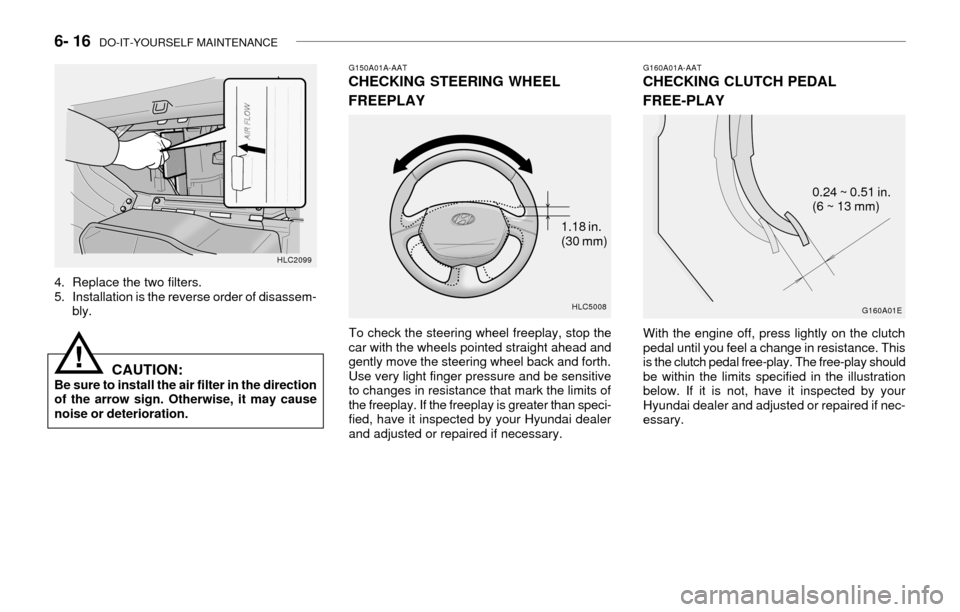
G150A01A-AATCHECKING STEERING WHEEL
FREEPLAY
To check the steering wheel freeplay, stop the
car with the wheels pointed straight ahead and
gently move the steering wheel back and forth.
Use very light finger pressure and be sensitive
to changes in resistance that mark the limits of
the freeplay. If the freeplay is greater than speci-
fied, have it inspected by your Hyundai dealer
and adjusted or repaired if necessary.
G160A01A-AATCHECKING CLUTCH PEDAL
FREE-PLAY
With the engine off, press lightly on the clutch
pedal until you feel a change in resistance. This
is the clutch pedal free-play. The free-play should
be within the limits specified in the illustration
below. If it is not, have it inspected by your
Hyundai dealer and adjusted or repaired if nec-
essary.
HLC5008
1.18 in.
(30 mm)
G160A01E
0.24 ~ 0.51 in.
(6 ~ 13 mm)
HLC2099
4. Replace the two filters.
5. Installation is the reverse order of disassem-
bly.
CAUTION:Be sure to install the air filter in the direction
of the arrow sign. Otherwise, it may cause
noise or deterioration.
!
Page 171 of 186

CONSUMER INFORMATION & REPORTING SAFETY DEFECTS 8- 3
!CAUTION:Always observe the following:
o Check pressures when the tires are
cold. That is, after the car has been
parked for at least three hours and
hasn't been driven more than one mile
or 1.6 km since starting up.
o Check the pressure of your spare tire
each time you check the pressure of
other tires.
I040A01A-AATSNOW TIRES
If you equip your car with snow tires, they
should be the same size and have the same
load capacity as the original tires. Snow tires
should be installed on all four wheels; otherwise,
poor handling may result.
Snow tires should carry 4 psi (28 kPa) more air
pressure than the pressure recommended for
the standard tires on the tire label on the glove
box, or up to the maximum pressure shown on
the tire sidewall whichever is less.
Do not drive faster than the speed limit when
your car is equipped with snow tires.
I050A03A-AATTIRE CHAINS
Tire chains, if necessary, should be installed on
the front wheels. Be sure that the chains are
installed in accordance with the manufacturer's
instructions.
To minimize tire and chain wear, do not con-
tinue to use tire chains when they are no
longer needed.
WARNING:o When driving on roads covered with snow
or ice, drive at less than 20 mph (30 km/h).
o Use the SAE "S" class or wire & plastic
chains.
o If you have noise caused by chains
contacting the body, retighten the chain
to avoid contact with the vehicle body.
o To prevent body damage, retighten the
chains after driving 0.3~0.6 miles.
!
Tire pressures should be checked at least
monthly. Proper tire inflation pressures should
be maintained for these reasons:
o Lower-than-recommended tire pressures
cause uneven tread wear and poor handling.
o Higher-than-recommended tire pressures in-
crease the chance of damage from impacts
and cause uneven tread wear.
Page 172 of 186
8- 4 CONSUMER INFORMATION & REPORTING SAFETY DEFECTS
I070A01A-AAT
TIRE BALANCING
A tire that is out of balance may affect handling
and tire wear. The tires on your Hyundai were
balanced before the car was delivered but may
need balancing again during the years you own
the car.
Whenever a tire is dismounted for repair, it
should be rebalanced before being reinstalled
on the car.
I080A01A-AAT
TIRE TRACTION
Tire traction can be reduced if you drive on worn
tires, tires that are improperly inflated or on
slippery road surfaces. Tires should be replaced
when tread wear indicators appear. To reduce
the possibility of losing control, slow down when-
ever there is rain, snow or ice on the road.
I090A01A-AATWHEN TO REPLACE TIRESI060A02A-AATTIRE ROTATION
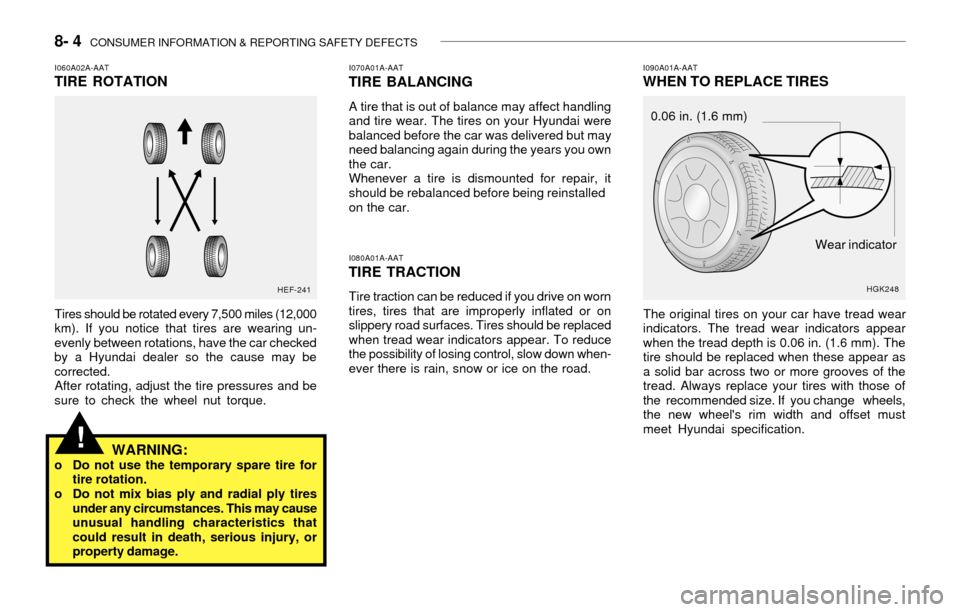
Tires should be rotated every 7,500 miles (12,000
km). If you notice that tires are wearing un-
evenly between rotations, have the car checked
by a Hyundai dealer so the cause may be
corrected.
After rotating, adjust the tire pressures and be
sure to check the wheel nut torque.
HEF-241
WARNING:o Do not use the temporary spare tire for
tire rotation.
o Do not mix bias ply and radial ply tires
under any circumstances. This may cause
unusual handling characteristics that
could result in death, serious injury, or
property damage.
!
Wear indicator 0.06 in. (1.6 mm)
HGK248
The original tires on your car have tread wear
indicators. The tread wear indicators appear
when the tread depth is 0.06 in. (1.6 mm). The
tire should be replaced when these appear as
a solid bar across two or more grooves of the
tread. Always replace your tires with those of
the recommended size. If you change wheels,
the new wheel's rim width and offset must
meet Hyundai specification.
Page 173 of 186
CONSUMER INFORMATION & REPORTING SAFETY DEFECTS 8- 5
WARNING:o Driving on worn-out tires is dangerous!
Worn-out tires can cause loss of brak-
ing effectiveness, steering control and
traction. When replacing tires, never
mix radial and bias ply tires on the same
car. If you replace radial tires with bias-
ply tires, they must be installed in sets
of four.
o Using tires and wheels of other than
the recommended sizes could cause
unusual handling characteristics that
could cause death, serious injury, or
property damage.
o Wheels that do not meet Hyundai's
dimensional specifications may fit
poorly and result in damage to the
vehicle, including broken wheel studs.
I100A02E-AAT
SPARE TIRE AND TOOLS
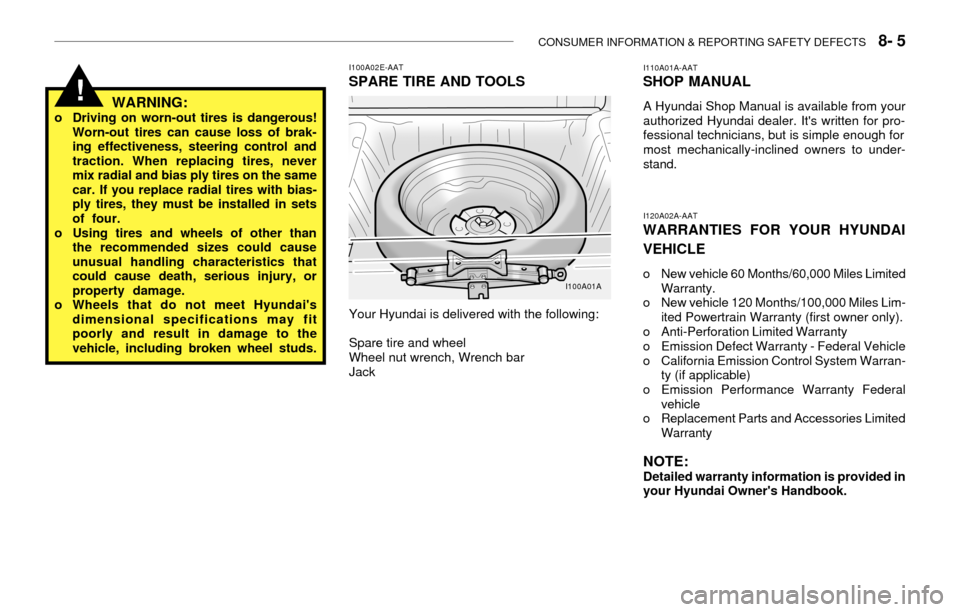
Your Hyundai is delivered with the following:
Spare tire and wheel
Wheel nut wrench, Wrench bar
Jack
!
I100A01AI110A01A-AAT
SHOP MANUAL
A Hyundai Shop Manual is available from your
authorized Hyundai dealer. It's written for pro-
fessional technicians, but is simple enough for
most mechanically-inclined owners to under-
stand.
I120A02A-AAT
WARRANTIES FOR YOUR HYUNDAI
VEHICLE
o New vehicle 60 Months/60,000 Miles Limited
Warranty.
o New vehicle 120 Months/100,000 Miles Lim-
ited Powertrain Warranty (first owner only).
o Anti-Perforation Limited Warranty
o Emission Defect Warranty - Federal Vehicle
o California Emission Control System Warran-
ty (if applicable)
o Emission Performance Warranty Federal
vehicle
o Replacement Parts and Accessories Limited
Warranty
NOTE:Detailed warranty information is provided in
your Hyundai Owner's Handbook.
Page 174 of 186
8- 6 CONSUMER INFORMATION & REPORTING SAFETY DEFECTS
WARNING:The temperature grade for this tire is es-
tablished for a tire that is properly inflated
and not overloaded. Excessive speed,
underinflation, or excessive loading, either
separately or in combination, can cause heat
buildup and possible tire failure. Traction AA, A, B, C - The traction grades,
from highest to lowest, are AA, A, B, and C.
Those grades represent the tire's ability to stop
on wet pavement as measured under controlled
conditions on specified government test surfac-
es of asphalt and concrete. A tire marked C may
have poor traction performance.
I130A01A-AATCONSUMER INFORMATION
This consumer information has been prepared
in accordance with regulations issued by the
National Highway Traffic Safety Administration
of the U.S. Department of Transportation. It
provides the purchasers and/or prospective
purchasers of Hyundai automobiles with infor-
mation on uniform tire quality grading. Your
Hyundai dealer will help answer any questions
you may have as you read this information.
I130B03A-AAT
Tire Grading
Department of Transportation quality grades -
All passenger vehicle tires must conform to
Federal Safety Standards in addition to these
grades. These quality grades are molded on the
sidewall.
Treadwear - The treadwear grade is a com-
parative rating based on the wear rate of the
tire when tested under controlled conditions on
a specified government test course. For ex-
ample, a tire graded 150 would wear one and
a half (1 - 1/2) times as well on the government
course as a tire graded 100. The relative
performance of tires depends upon the actual
conditions of their use, however, and may
depart significantly from the norm due to varia-
tions in driving habits, service practices and
differences in road characteristics and cli-
mate.
WARNING:The traction grade assigned to this tire is
based on straight-ahead braking traction
tests, and does not include acceleration,
cornering, hydroplaning, or peak traction
characteristics.
Temperature A, B, C - The temperature
grades are A (the highest), B, and C, repre-
senting the tire's resistance to the generation
of heat and
its ability to dissipate heat when tested under
controlled conditions on a specified indoor labo-
ratory test wheel. Sustained high temperature
can cause the material of the tire to degenerate
and reduce tire life, and excessive temperature
can lead to sudden tire failure. The grade C
corresponds to a level of performance which all
passenger car tires must meet under the Feder-
al Motor Vehicle Safety Standard No. 109.
Grades B and A represent higher levels of
performance on the laboratory test wheel than
the minimum required by law.
!
!
Uniform Tire Quality Grading - Quality
grades can be found on the tire sidewall
between tread shoulder and maximum section
width.
For example:
Treadwear 200 Traction AA
Temperature A