2003 Hyundai Accent ignition
[x] Cancel search: ignitionPage 109 of 186

DRIVING YOUR HYUNDAI 2- 13
C160H01A-AAT
Use Approved Anti-Freeze in Window
Washer System
To keep the water in the window washer system
from freezing, add an approved anti-freeze so-
lution in accordance with instructions on the
container. Window washer anti-freeze is avail-
able from Hyundai dealers and most auto parts
outlets. Do not use engine coolant or other types
of anti-freeze as these may damage the finish.
C160F01A-AATCheck Spark Plugs and Ignition
System
Inspect your spark plugs as described in Sec-
tion 6 and replace them if necessary. Also
check all ignition wiring and components to be
sure they are not cracked, worn or damaged in
any way.
C160G01A-AAT
To Keep Locks from Freezing
To keep the locks from freezing, squirt an ap-
proved de-icer fluid or glycerine into the key
opening. If a lock is covered with ice, squirt it
with an approved de-icing fluid to remove the
ice. If the lock is frozen internally, you may be
able to thaw it out by using a heated key. Handle
the heated key with care to avoid burning the
fingers.
C160I01A-AATDon't Let Your Parking Brake Freeze
Under some conditions your parking brake can
freeze in the engaged position. This is most
likely to happen when there is an accumulation
of snow or ice around or near the rear brakes or
if the brakes are wet. If you think the parking
brake may freeze, apply it only temporarily while
you put the gear selector lever in "P" (automatic)
or in first or reverse gear (manual transaxle) and
block the rear wheels so the car cannot roll.
Then release the parking brake.
C160K01A-AATCarry Emergency Equipment
Depending on the severity of the weather where
you drive your car, you should carry appropriate
emergency equipment. Some of the items you
may want to carry include tire chains, tow straps
or chains, flashlight, emergency flares, sand, a
shovel, jumper cables, a window scraper, gloves,
ground cloth, coveralls, a blanket, etc.
C160J01A-AAT
Don't Let Ice and Snow Accumulate
Underneath
Under some conditions, snow and ice can build
up under the fenders and interfere with the
steering. When driving in severe winter condi-
tions where this may happen, you should peri-
odically check underneath the car to be sure the
movement of the front wheels and the steering
components is not obstructed.
C170A01A-AAT
HIGHER SPEED MOTORING
Pre-Trip Inspections
1. Tires:
Adjust the tire inflation pressures for highway
driving. Low tire inflation pressures will result in
overheating and possible failure of the tires.
Avoid using worn or damaged tires which may
result in reduced traction or tire failure.
NOTE:Never exceed the maximum tire inflation pres-
sure shown on the tires.
2. Fuel, engine coolant and engine oil:
High speed travel consumes 1.5 times more fuel
than urban motoring. Do not forget to check both
engine coolant and engine oil.
3. Drive belt:
A loose or damaged drive belt may result in
overheating of the engine.
Page 112 of 186
3- 2 WHAT TO DO IN AN EMERGENCY
!
D010B02A-AAT
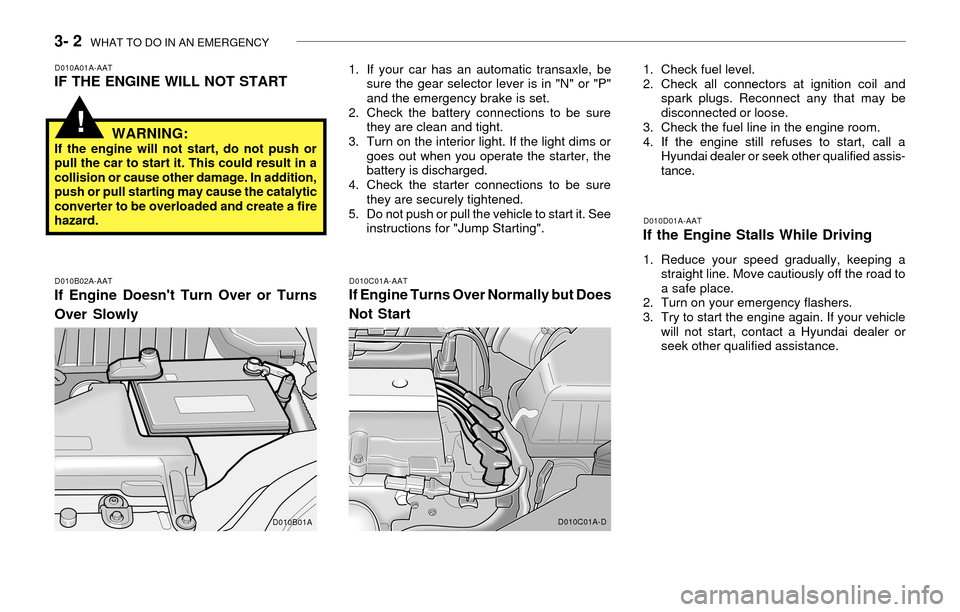
If Engine Doesn't Turn Over or Turns
Over Slowly
D010A01A-AATIF THE ENGINE WILL NOT START
D010C01A-AATIf Engine Turns Over Normally but Does
Not Start
1. Check fuel level.
2. Check all connectors at ignition coil and
spark plugs. Reconnect any that may be
disconnected or loose.
3. Check the fuel line in the engine room.
4. If the engine still refuses to start, call a
Hyundai dealer or seek other qualified assis-
tance.
D010D01A-AAT
If the Engine Stalls While Driving
1. Reduce your speed gradually, keeping a
straight line. Move cautiously off the road to
a safe place.
2. Turn on your emergency flashers.
3. Try to start the engine again. If your vehicle
will not start, contact a Hyundai dealer or
seek other qualified assistance.
WARNING:If the engine will not start, do not push or
pull the car to start it. This could result in a
collision or cause other damage. In addition,
push or pull starting may cause the catalytic
converter to be overloaded and create a fire
hazard.
D010B01AD010C01A-D
1. If your car has an automatic transaxle, be
sure the gear selector lever is in "N" or "P"
and the emergency brake is set.
2. Check the battery connections to be sure
they are clean and tight.
3. Turn on the interior light. If the light dims or
goes out when you operate the starter, the
battery is discharged.
4. Check the starter connections to be sure
they are securely tightened.
5. Do not push or pull the vehicle to start it. See
instructions for "Jump Starting".
Page 121 of 186

WHAT TO DO IN AN EMERGENCY 3- 11
NOTE:Before towing, check the level of the tran-
saxle fluid. If it is below the "HOT" range on
the dipstick, add fluid. If you cannot add
fluid, a towing dolly must be used as de-
scribed above.
D080B01A-AATTOWING A CAR WITH MANUAL
TRANSAXLE
o If the car is being towed with the rear wheels
on the ground, be sure the parking brake is
released.
o If the car is being towed with the front wheels
on the ground, be sure that the transaxle is
in neutral. Also, be sure that the ignition key
is in the "ACC" position. This is necessary to
prevent damage to the steering lock mecha-
nism, which is not designed to hold the front
wheels straight while the car is being towed.
o If any of the loaded wheels or suspension
components are damaged, a towing dolly
must be used.
D080C02A-AATTOWING A CAR WITH AUTOMATIC
TRANSAXLE
CAUTION:
A car with an automatic transaxle should
never be towed from the rear with the front
wheels on the ground. This can cause seri-
ous damage to the transaxle. If the car must
be towed from the rear, a towing dolly must
be used under the front wheels.
D080B01A
o OK FOR AUTOMATIC OR MANUAL
TRANSAXLE EQUIPPED VEHICLE
WITH NO DAMAGE o NOT OK FOR AUTOMATIC
TRANSAXLE EQUIPPED VEHICLE
o OK FOR MANUAL TRANSAXLE
D080C01A
o If the car is being towed with the rear wheels
on the ground, be sure the parking brake is
released.
!
D080C02A
o OK FOR AUTOMATIC OR MANUAL
TRANSAXLE EQUIPPED VEHICLE
Page 154 of 186

6- 18 DO-IT-YOURSELF MAINTENANCE
G200B01A-AATReplacing Accessory Fuse
The fuse box for the lights and other electrical
accessories will be found low on the dashboard
on the driver's side. Inside the box you will find
a list showing the circuits protected by each
fuse.
CAUTION:When replacing a fusible link, never use
anything but a new fusible link with the same
or lower amperage rating. Never use a piece
of wire or a higher-rated fusible link. This
could result in serious damage and create a
fire hazard.
!
HLC4002
If any of your car's lights or other electrical
accessories stop working, a blown fuse could
be the reason. If the fuse has burned out, you
will see that the metal strip inside the fuse has
burned through. If you suspect a blown fuse,
follow this procedure:
1. Turn off the ignition and all other switches.
2. Open the fuse box and examine each fuse.
Remove each fuse by pulling it toward you (a
small "fuse puller" tool is contained in the
fuse box to simplify this operation).
3. Be sure to check all other fuses even if you
find one that appears to have burned out.
HLC4003
4. Replace the blown fuse by pressing a new
fuse of the same rating into place. The fuse
should be a snug fit. If it is not, have the fuse
clip repaired or replaced by a Hyundai deal-
G200A01A-AATCHECKING AND REPLACING
FUSES
Replacing a Fusible Link
A fusible link will melt if the electrical circuits
from the battery are ever overloaded, thus pre-
venting damage to the entire wiring harness.
(This could be caused by a short in the system
drawing too much current.) If this ever happens,
have a Hyundai dealer determine the cause,
repair the system and replace the fusible link.
The fusible links are located in a relay box for
easy inspection.
G200A01A
Bad
Good
Page 164 of 186

6- 28 DO-IT-YOURSELF MAINTENANCE
G200C02A-GATFUSE PANEL DESCRIPTION
Engine Compartment
HLC5027
NOTE:Not all fuse panel descriptions in this manual may be applicable to your vehicle. It is accurate at the time of printing. When you inspect the fuse
box on your vehicle, refer to the fuse box label.
FUSE RATING
120A
50A
50A
20A
30A
20A
30A
30A
30A
30A
20A
10A
10A
10A
10A
10A
10A
10A
15A
10A
15A
15A
10A
25APROTECTED COMPONENTS
Charging (Generator)
Fuse 6, 7, 8, 9, Horn fuse, Room lamp fuse
Head lamp fuse, Front fog lamp fuse, Tail lamp relay, H/LP washer fuse
Engine control relay, Generator, Fuel pump relay, ECU #3 fuse
Ignition power source, Star t relay
Radiator fan control
Blower control
ABS control, ABS bleeding connector
ABS control, ABS bleeding connector
Power window
Condenser fan control
Radiator fan, Condenser fan, ECM, Oxygen sensor, Purge control valve,
SMATRA, Glow plug relay, Heater relay, Stop lamp switch
A/C relay
Horn relay
Illumination lamps, Left rear combination lamp, License lamp, DRL control,
Position lamp, H/LP washer relay
Right rear combination lamp, License lamp, Position lamp
Left head lamp, DRL control, Instrument cluster
Right head lamp
Front fog lamp relay
Instrument cluster, Courtesy lamp, Trunk room lamp, ETACM, DLC,
Door warning, Multipurpose check connector
Audio, Digital clock, Power antenna, A/C switch, Rear fog lamp switch
Idle speed actuator, ECM, Camshaft position sensor, EGR actuator,
Throttle plate actuator
ECM
Head lamp washer motor
Fuel pump relay, Fuel pump motor
ALT
BATTERY
LAMP
ECU
IGN
RAD FAN
BLOWER
ABS
ABS
P/WDW
COND FAN
ECU #1
A/CON COMP
HORN
TAIL LH
TAIL RH
H/LP LH
H/LP RH
FRONT FOG
ROOM LP
AUDIO
ECU #2
ECU#3
H/L WASHER FUSIBLE
LINK
FUSEDESCRIPTION
F/PUMP CHK (E50)
Page 168 of 186
EMISSION CONTROL SYSTEMS 7- 3
unburned gasoline into the exhaust may cause
the catalytic converter to overheat and create a
fire hazard. This risk may be reduced by ob-
serving the following:
WARNING:o Remember that your Hyundai dealer is
your best source of assistance.
o Do not stop your Hyundai over any com-
bustible material such as grass, paper,
leaves or rags. These materials might
contact the hot catalytic converter and a
fire might result.
WARNING:o Use unleaded fuel only.
o Maintain the engine in good operating
condition. Extremely high catalytic con-
verter temperatures can result from im-
proper operation of the electrical, ignition
or multiport electronic fuel injection.
o If your engine stalls, pings, knocks, or is
hard to start, have your Hyundai dealer
inspect and repair the problem as soon
as possible.
o Avoid driving with a very low fuel level.
Running out of gasoline may cause the
engine to misfire and result in damage to
the catalytic converter.
o Avoid idling the engine for periods longer
than 10 minutes.
o The vehicle should not be pushed or
pulled to get started. This may cause the
catalytic converter to overheat and create
a fire hazard.
o Do not touch the catalytic converter or
any other part of the exhaust system
while the catalytic converter is hot. Shut
off the engine, wait for at least one hour
before touching the catalytic converter or
any other part of the exhaust system.
!
!
Page 179 of 186

VEHICLE SPECIFICATIONS 9- 3
SPECIFICATIONS
1.6 MPI
4-Cylinder in-line DOHC
76.5 x 87
1,599
800 ± 100
BKR5ES-11
RC10YC4
0.039 to 0.043 in. (1.0 to 1.1 mm)
Auto lash
Auto lash
BTDC 10° ± 5°
1 - 3 - 4 - 2
SH, SG or SG/CD and ABOVE multigrade and fuel-efficient oil
J070A04A-AATENGINE
ITEMS
Engine Type
Bore x Stroke
Displacement (cc)
Idle Speed (RPM)
Spark plug
Spark plug gap
Valve Clearance
(warm engine)
Ignition timing (Base)
Firing order
Oil grade (API)
NGK
CHAMPION
Intake valve
Exhaust valve
Page 184 of 186

10- 4 INDEX
P
Parking Brake ...................................................................................1-51
Power Steering Fluid Level ...............................................................6-20
Pretensioner Seat Belt ......................................................................1-25
R
Rear Seats
Fold down ....................................................................................1-12
Rear seat entry ............................................................................1-12
Rear Window Defroster Switch .........................................................1-43
Rear Window Wiper and Washer .....................................................1-43
Replacement of Bulbs .......................................................................6-22
S
Seat Belts
2-Point static type ........................................................................1-18
3-Point type ..................................................................................1-16
Adjusting your seat belt ...............................................................1-18
Adjutable height ...........................................................................1-16
Care of seat belts ........................................................................1-15
Precautions ..................................................................................1-14
Spark Plugs ........................................................................................ 6-8
Speedometer.....................................................................................1-37
Starting Procedures ............................................................................ 2-4
Steering Wheel
Free-play ......................................................................................6-16
Stereo Sound System .......................................................................1-66
Sun Visor ..........................................................................................1-55 I
Ignition Switch ..................................................................................... 2-3
Instrument Cluster and Indicator .......................................................1-33
Instrument Panel Light Control (Rheostat) .......................................1-45
Interior Light ......................................................................................1-47
J
Jump Starting ...................................................................................... 3-3
K
Keys .................................................................................................. 1-3
If you lose your keys ...................................................................3-12
Positions ........................................................................................ 2-3
M
Maintenance Intervals
Explanation of scheduled maintenance items .............................. 5-7
Maintenance under severe usage conditions ................................ 5-6
Scheduled maintenance ................................................................. 5-4
Service requirements ..................................................................... 5-2
Mirrors
Day/night inside rearview .............................................................1-50
Outside rear view ........................................................................1-48
O
Odometer/Trip Odometer ..................................................................1-38