2003 Hyundai Accent warning light
[x] Cancel search: warning lightPage 67 of 186

1- 54 FEATURES OF YOUR HYUNDAI
B540C01A-AAT
To Unlock Using the Key.
To open the trunk lid, insert the key and turn it
clockwise to unlock. The luggage compartment
light illuminates when the trunk lid is opened.
B450E01AB540F01A-AAT
Tailgate (3 DOOR)
To open the tailgate, unlock it by turning the key
clockwise, then pull the outside handle toward
you.
To close, lower the tailgate and shut firmly to
engage the latch. Lock the tailgate by turning the
key counterclockwise.
B540B02E-AAT
Trunk Lid Emergency Latch Release
Your vehicle is equipped with a glow-in-the dark
emergency trunk release lever located inside
the trunk. It will glow after the trunk is closed.
When pulled, this lever will release the trunk
latch mechanism and open the trunk.
NOTE:o If a person is locked in the trunk by one's
own will or by another person or by acci-
dent, pull the emergency trunk release
lever on the driver's side of the inside
panel of the trunk. This will open the
trunk lid.
o HYUNDAI recommends that cars be kept
locked and keys be kept out of the reach
of children, and that parents teach their
children about the dangers of playing in
trunks.
WARNING:Parents should teach children about the emer-
gency trunk release lever in their vehicle and
how to open the trunk lid if they are acciden-
tally locked in the trunk.
B540B02A
!
B540F01A
Page 99 of 186
DRIVING YOUR HYUNDAI 2- 3
C020A01A-AATBEFORE STARTING THE ENGINE
Before you start the engine, you should always:
1. Look around the vehicle to be sure there are
no flat tires, puddles of oil or water or other
indications of possible trouble.
2. After entering the car, check to be sure the
parking brake is engaged.
3. Check that all windows, and lights are clean.
4. Check that the interior and exterior mirrors
are clean and in position.
5. Check your seat, seatback and headrest to
be sure they are in their proper positions.
6. Lock all the doors.
7. Fasten your seat belt and be sure that all
other occupants have fastened theirs.
8. Turn off all lights and accessories that are
not needed.
9. When you turn the ignition switch to "ON",
check that all appropriate warning lights are
operating and that you have sufficient fuel.
10. Check the operation of warning lights and all
bulbs when key is in the "ON" position.
C030A01A-AATCOMBINATION IGNITION SWITCH
To Start the Engine
o If your Hyundai is equipped with a manual
transaxle, place the shift lever in neutral and
depress the clutch pedal fully.
o If your Hyundai has an automatic transaxle,
place the shift lever in "P" (park).
o To start the engine, insert the ignition key
and turn it to the "START" position. Release
it as soon as the engine starts. Do not hold
the key in the "START" position for more
than 15 seconds.
NOTE:o For safety, the engine will not start if the
clutch pedal is not depressed fully (Manual
Transaxle) or the shift lever is not in "P"
or "N" Position (Automatic Transaxle).
o The ignition key cannot be turned from
"ACC" position to "LOCK" position un-
less the shift lever is in the "P" (Park)
position or the negative battery terminal
is disconnected from the battery. (For
Automatic Transaxle)
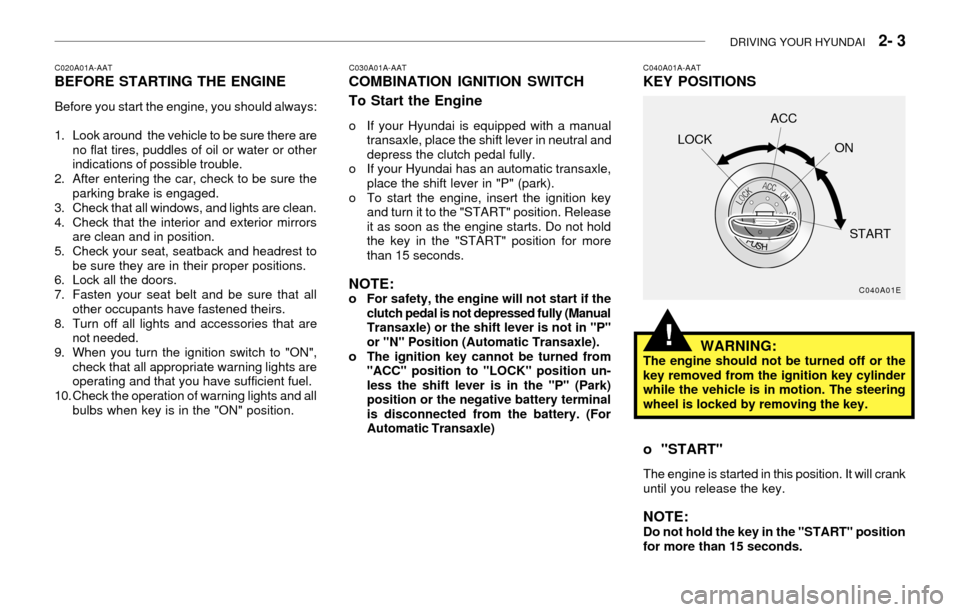
C040A01A-AATKEY POSITIONS
C040A01E
LOCKACC
ON
START
WARNING:The engine should not be turned off or the
key removed from the ignition key cylinder
while the vehicle is in motion. The steering
wheel is locked by removing the key.
o "START"
The engine is started in this position. It will crank
until you release the key.
NOTE:Do not hold the key in the "START" position
for more than 15 seconds.
!
Page 101 of 186
DRIVING YOUR HYUNDAI 2- 5
The starter should not be operated for more
than 15 seconds at a time. Wait 15-30 sec-
onds between starting attempts to protect
the starter from overheating.C050B01A-AATNormal Conditions:
The Starting Procedure:
1. Insert key, and fasten the seat belt.
2. Depress the clutch pedal fully and place the
gearshift lever (manual transaxle) in neutral
or the selector lever (automatic transaxle) in
"P" (park) position.
3. After turning the ignition key to the "ON"
position, make certain all warning lights and
gauges are functioning properly before start-
ing the engine.
WARNING:Be sure that the clutch is fully depressed
when starting a manual transaxle vehicle.
Your manual transaxle equipped vehicle will
not start unless the clutch pedal is fully
depressed. On a manual transaxle equipped
vehicle that can be started without depress-
ing the clutch, there is the potential to cause
damage to the vehicle or injury to someone
inside or outside the vehicle as a result of
the forward or backward movement of the
vehicle that will occur if the clutch is not
depressed when the vehicle is started.
!
4. Turn the ignition key to the "Start" position
and release it when the engine starts.
After the engine has started, allow the engine
to run for 10 to 20 seconds prior to placing
the vehicle in gear.
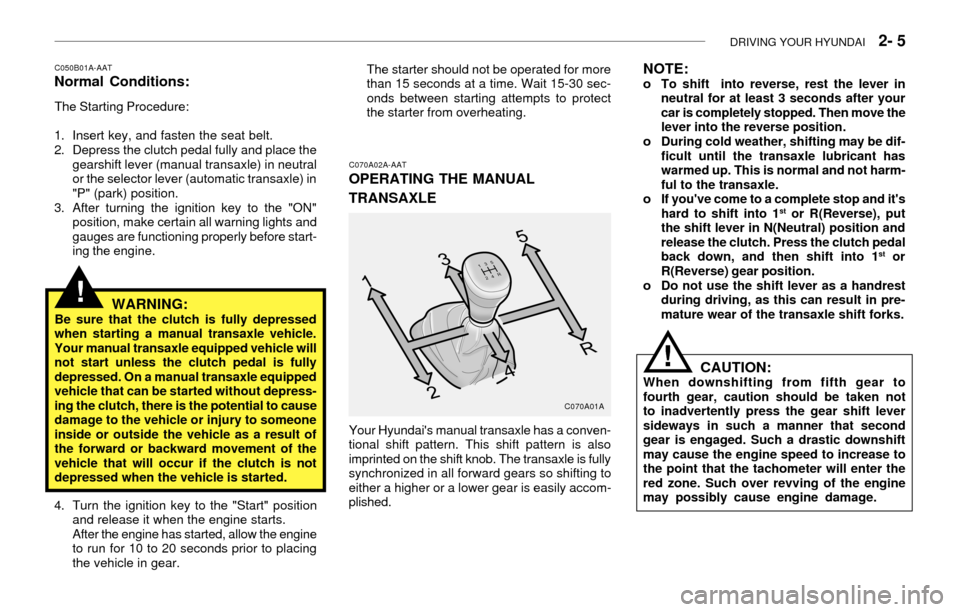
C070A02A-AAT
OPERATING THE MANUAL
TRANSAXLE
Your Hyundai's manual transaxle has a conven-
tional shift pattern. This shift pattern is also
imprinted on the shift knob. The transaxle is fully
synchronized in all forward gears so shifting to
either a higher or a lower gear is easily accom-
plished.
C070A01A
NOTE:o To shift into reverse, rest the lever in
neutral for at least 3 seconds after your
car is completely stopped. Then move the
lever into the reverse position.
o During cold weather, shifting may be dif-
ficult until the transaxle lubricant has
warmed up. This is normal and not harm-
ful to the transaxle.
o If you've come to a complete stop and it's
hard to shift into 1
st or R(Reverse), put
the shift lever in N(Neutral) position and
release the clutch. Press the clutch pedal
back down, and then shift into 1
st or
R(Reverse) gear position.
o Do not use the shift lever as a handrest
during driving, as this can result in pre-
mature wear of the transaxle shift forks.
CAUTION:When downshifting from fifth gear to
fourth gear, caution should be taken not
to inadvertently press the gear shift lever
sideways in such a manner that second
gear is engaged. Such a drastic downshift
may cause the engine speed to increase to
the point that the tachometer will enter the
red zone. Such over revving of the engine
may possibly cause engine damage.
!
Page 106 of 186
2- 10 DRIVING YOUR HYUNDAI
C130A01A-AATGOOD BRAKING PRACTICES
WARNING:
Nothing should be carried on top of the shelf
panel behind the rear seat. If there were an
accident or a sudden stop, such objects
could move forward and cause damage to
the vehicle or injure the occupants.
!
o After being parked, check to be sure the
parking brake is not engaged and that the
parking brake indicator light is out before
driving away.
o Driving through water may get the brakes
wet. They can also get wet when the car is
washed. Wet brakes can be dangerous! Your
car will not stop as quickly if the brakes are
wet. Wet brakes may cause the car to pull to
one side. To dry the brakes, apply the brakes
lightly until the braking action returns to nor-
mal, taking care to keep the car under con-
trol at all times. If the braking action does not
return to normal, stop as soon as it is safe to
do so and call your Hyundai dealer for assis-
tance.
o Don't coast down hills with the car out of
gear. This is extremely hazardous. Keep the
car in gear at all times, use the brakes to
slow down, then shift to a lower gear so that
engine braking will help you maintain a safe
speed.o Don't "ride" the brake pedal. Resting your
foot on the brake pedal while driving can be
dangerous because it can result in the brakes
overheating and losing their effectiveness. It
also increases the wear of the brake compo-
nents.
o If a tire goes flat while you are driving, apply
the brakes gently and keep the car pointed
straight ahead while you slow down. When
you are moving slowly enough for it to be
safe to do so, pull off the road and stop in a
safe place.
o If your car is equipped with an automatic
transaxle, don't let your car creep forward.
To avoid creeping forward, keep your foot on
the brake pedal when the car is stopped.
o Use caution when parking on a hill. Engage
the parking brake and place the gear selec-
tor lever in "P" (automatic transaxle) or in
first or reverse gear (manual transaxle). If
your car is facing downhill, turn the front
wheels into the curb to help keep the car
from rolling. If your car is facing uphill, turn
the front wheels away from the curb to help
keep the car from rolling. If there is no curb
or if it is required by other conditions to keep
the car from rolling, block the wheels.
o Under some conditions your parking brake
can freeze in the engaged position. This is
most likely to happen when there is an accu-
mulation of snow or ice around or near the
rear brakes or if the brakes are wet. If there
is a risk that the parking brake may freeze,apply it only temporarily while you put the
gear selector lever in "P" (automatic) or in
first or reverse gear (manual transaxle) and
block the rear wheels so the car cannot roll.
Then release the parking brake.
o Do not hold the vehicle on the upgrade with
the accelerator pedal. This can cause the
transmission to overheat. Always use the
brake pedal or parking brake.C120A02A-AAT
ANTI-LOCK BRAKE SYSTEM
(If Installed)
The Anti-Lock Brake System (ABS) is designed
to prevent wheel lock-up during sudden braking
or on hazardous road surfaces. The ABS con-
trol module monitors the wheel speed and con-
trols the pressure applied to each brake. Thus,
in emergency situations or on slick roads, ABS
will increase vehicle control during braking.
NOTE:During ABS operation, a slight pulsation
may be felt in the brake pedal when the
brakes are applied. Also, a noise may be
heard in the engine compartment while brak-
ing. These conditions are normal and indi-
cate that the anti-lock brake system is func-
tioning properly.
Page 107 of 186
DRIVING YOUR HYUNDAI 2- 11
WARNING:ABS will not prevent accidents due to
improper or dangerous driving maneu-
vers. Even though vehicle control is im-
proved during emergency braking, always
maintain a safe distance between you and
objects ahead. Vehicle speeds should al-
ways be reduced during extreme road
conditions.
The braking distance for cars equipped
with an anti-lock braking system may be
longer than for those without it in the
following road conditions.
o Driving on rough, gravel or snow-cov-
ered roads.
o Driving with tire chains installed.
o Driving on roads where the road surface
is pitted or has different surface height.
These roads should be driven at reduced
speeds. The safety features of an ABS
equipped vehicle should not be tested by
high speed driving or cornering. This could
endanger the safety of yourself or others.
!
C140A01A-AATDRIVING FOR ECONOMY
You can save fuel and get more miles from your
car if you follow these suggestions:
o Drive smoothly. Accelerate at a moderate
rate. Don't make "jack-rabbit" starts or full-
throttle shifts and maintain a steady cruising
speed. Don't race between stoplights. Try to
adjust your speed to that of the other traffic
so you don't have to change speeds unnec-
essarily. Avoid heavy traffic whenever possi-
ble. Always maintain a safe distance from
other vehicles so you can avoid unneces-
sary braking. This also reduces brake wear.
o Drive at a moderate speed. The faster you
drive, the more fuel your car uses. Driving at
a moderate speed, especially on the high-
way, is one of the most effective ways to
reduce fuel consumption.
o Don't "ride" the brake or clutch pedal. This
can increase fuel consumption and also in-
crease wear on these components. In addi-
tion, driving with your foot resting on the
brake pedal may cause the brakes to over-
heat, which reduces their effectiveness and
may lead to more serious consequences.
o Take care of your tires. Keep them inflated to
the recommended pressure. Incorrect infla-
tion, either too much or too little, results in
unnecessary tire wear. Check the tire pres-
sures at least once a month.o Be sure that the wheels are aligned correct-
ly. Improper alignment can result from hitting
curbs or driving too fast over irregular surfac-
es. Poor alignment causes faster tire wear
and may also result in other problems as well
as greater fuel consumption.
o Keep your car in good condition. For better
fuel economy and reduced maintenance
costs, maintain your car in accordance with
the maintenance schedule in Section 5. If
you drive your car in severe conditions, more
frequent maintenance is required (see Sec-
tion 5 for details).
o Keep your car clean. For maximum service,
your Hyundai should be kept clean and free
of corrosive materials. It is especially impor-
tant that mud, dirt, ice, etc. not be allowed to
accumulate on the underside of the car. This
extra weight can result in increased fuel
consumption and also contribute to corro-
sion.
o Travel lightly. Don't carry unnecessary weight
in your car. Weight reduces fuel economy.
o Don't let the engine idle longer than neces-
sary. If you are waiting (and not in traffic),
turn off your engine and restart only when
you're ready to go.
o Remember, your Hyundai does not require
extended warm-up. As soon as the engine is
running smoothly, you can drive away. In
very cold weather, however, give your en-
gine a slightly longer warm-up period.
Page 112 of 186
3- 2 WHAT TO DO IN AN EMERGENCY
!
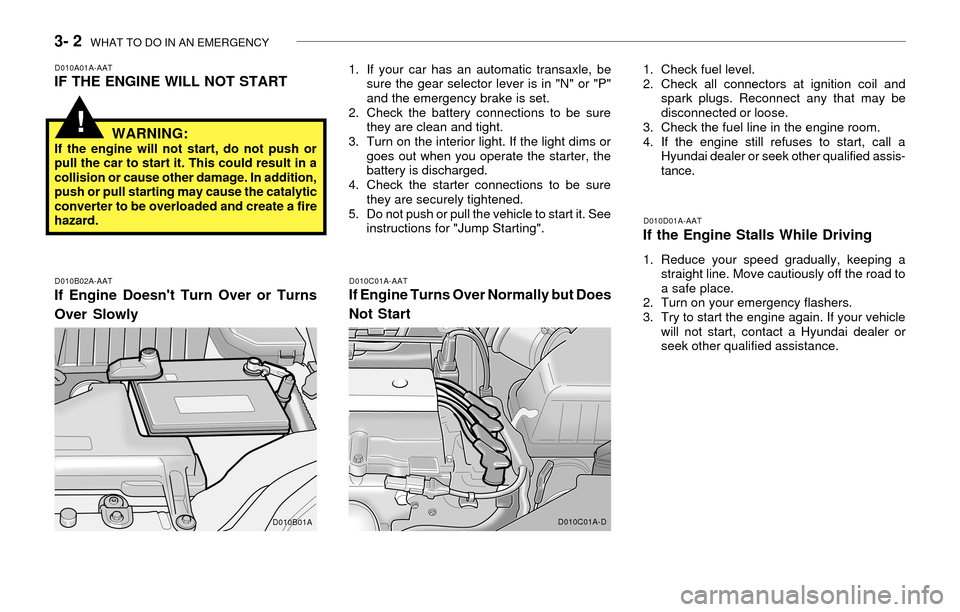
D010B02A-AAT
If Engine Doesn't Turn Over or Turns
Over Slowly
D010A01A-AATIF THE ENGINE WILL NOT START
D010C01A-AATIf Engine Turns Over Normally but Does
Not Start
1. Check fuel level.
2. Check all connectors at ignition coil and
spark plugs. Reconnect any that may be
disconnected or loose.
3. Check the fuel line in the engine room.
4. If the engine still refuses to start, call a
Hyundai dealer or seek other qualified assis-
tance.
D010D01A-AAT
If the Engine Stalls While Driving
1. Reduce your speed gradually, keeping a
straight line. Move cautiously off the road to
a safe place.
2. Turn on your emergency flashers.
3. Try to start the engine again. If your vehicle
will not start, contact a Hyundai dealer or
seek other qualified assistance.
WARNING:If the engine will not start, do not push or
pull the car to start it. This could result in a
collision or cause other damage. In addition,
push or pull starting may cause the catalytic
converter to be overloaded and create a fire
hazard.
D010B01AD010C01A-D
1. If your car has an automatic transaxle, be
sure the gear selector lever is in "N" or "P"
and the emergency brake is set.
2. Check the battery connections to be sure
they are clean and tight.
3. Turn on the interior light. If the light dims or
goes out when you operate the starter, the
battery is discharged.
4. Check the starter connections to be sure
they are securely tightened.
5. Do not push or pull the vehicle to start it. See
instructions for "Jump Starting".
Page 113 of 186
WHAT TO DO IN AN EMERGENCY 3- 3
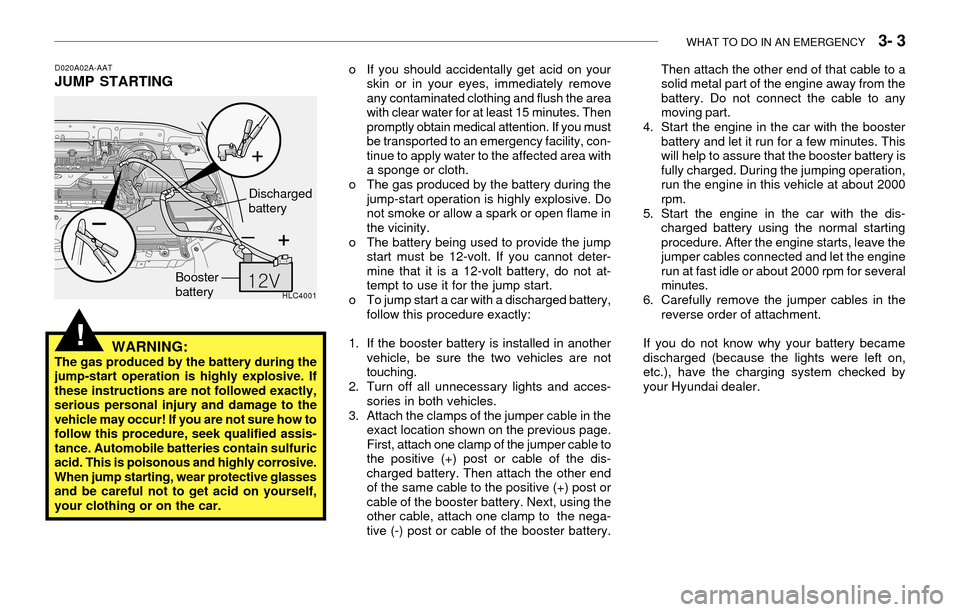
D020A02A-AATJUMP STARTING
WARNING:
The gas produced by the battery during the
jump-start operation is highly explosive. If
these instructions are not followed exactly,
serious personal injury and damage to the
vehicle may occur! If you are not sure how to
follow this procedure, seek qualified assis-
tance. Automobile batteries contain sulfuric
acid. This is poisonous and highly corrosive.
When jump starting, wear protective glasses
and be careful not to get acid on yourself,
your clothing or on the car.Discharged
battery
Booster
battery
HLC4001
!
o If you should accidentally get acid on your
skin or in your eyes, immediately remove
any contaminated clothing and flush the area
with clear water for at least 15 minutes. Then
promptly obtain medical attention. If you must
be transported to an emergency facility, con-
tinue to apply water to the affected area with
a sponge or cloth.
o The gas produced by the battery during the
jump-start operation is highly explosive. Do
not smoke or allow a spark or open flame in
the vicinity.
o The battery being used to provide the jump
start must be 12-volt. If you cannot deter-
mine that it is a 12-volt battery, do not at-
tempt to use it for the jump start.
o To jump start a car with a discharged battery,
follow this procedure exactly:
1. If the booster battery is installed in another
vehicle, be sure the two vehicles are not
touching.
2. Turn off all unnecessary lights and acces-
sories in both vehicles.
3. Attach the clamps of the jumper cable in the
exact location shown on the previous page.
First, attach one clamp of the jumper cable to
the positive (+) post or cable of the dis-
charged battery. Then attach the other end
of the same cable to the positive (+) post or
cable of the booster battery. Next, using the
other cable, attach one clamp to the nega-
tive (-) post or cable of the booster battery.Then attach the other end of that cable to a
solid metal part of the engine away from the
battery. Do not connect the cable to any
moving part.
4. Start the engine in the car with the booster
battery and let it run for a few minutes. This
will help to assure that the booster battery is
fully charged. During the jumping operation,
run the engine in this vehicle at about 2000
rpm.
5. Start the engine in the car with the dis-
charged battery using the normal starting
procedure. After the engine starts, leave the
jumper cables connected and let the engine
run at fast idle or about 2000 rpm for several
minutes.
6. Carefully remove the jumper cables in the
reverse order of attachment.
If you do not know why your battery became
discharged (because the lights were left on,
etc.), have the charging system checked by
your Hyundai dealer.
Page 119 of 186
WHAT TO DO IN AN EMERGENCY 3- 9
WARNING:Wheels and wheel covers may have sharp
edges. Handle them carefully to avoid pos-
sible severe injury.
Before putting the wheel into place, be sure
that there is nothing on the hub or wheel
(such as mud, tar, gravel, etc.) that interferes
with the wheel fitting solidly against the hub.
If there is, remove it. If there is not good
contact on the mounting surface between
the wheel and hub, the wheel nuts could
loosen and cause the loss of a wheel. Loss
of a wheel may result in loss of control of the
vehicle. This may cause serious injury or
death.
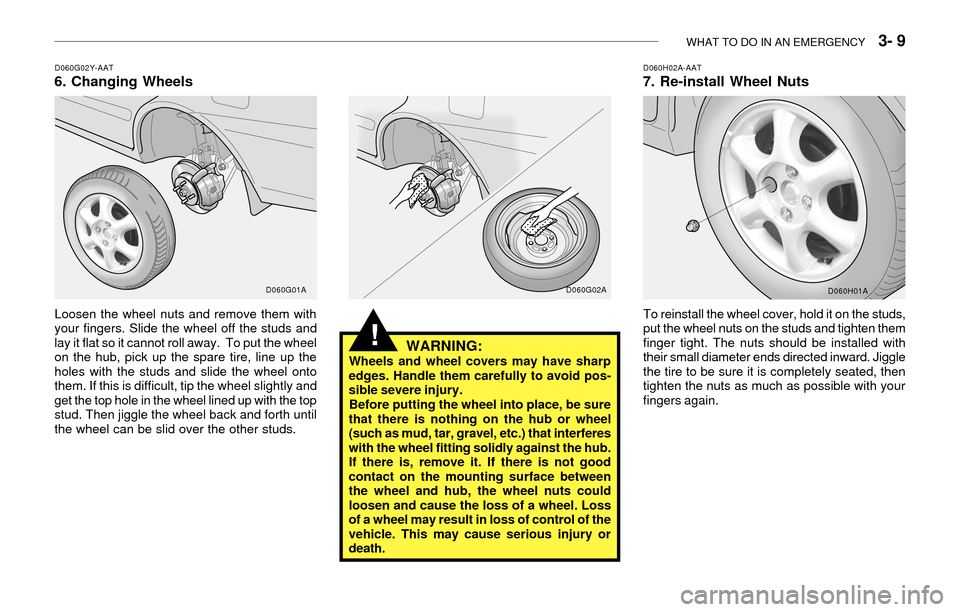
D060G02Y-AAT6. Changing Wheels
Loosen the wheel nuts and remove them with
your fingers. Slide the wheel off the studs and
lay it flat so it cannot roll away. To put the wheel
on the hub, pick up the spare tire, line up the
holes with the studs and slide the wheel onto
them. If this is difficult, tip the wheel slightly and
get the top hole in the wheel lined up with the top
stud. Then jiggle the wheel back and forth until
the wheel can be slid over the other studs.
D060H02A-AAT7. Re-install Wheel Nuts
To reinstall the wheel cover, hold it on the studs,
put the wheel nuts on the studs and tighten them
finger tight. The nuts should be installed with
their small diameter ends directed inward. Jiggle
the tire to be sure it is completely seated, then
tighten the nuts as much as possible with your
fingers again.
D060G02A
!
D060H01A D060G01A