2003 Hyundai Accent air condition
[x] Cancel search: air conditionPage 124 of 186
4- 2 CORROSION PREVENTION AND APPEARANCE CARE
E010B01A-AATCommon Causes of Corrosion
The most common causes of corrosion on your
car are:
o Road salt, dirt and moisture that is allowed to
accumulate underneath the car.
o Removal of paint or protective coatings by
stones, gravel, abrasion or minor scrapes
and dents which leave unprotected metal
exposed to corrosion.
E010A01A-AATCORROSION PROTECTION
Protecting Your Hyundai from Corro-
sion
By using the most advanced design and con-
struction practices to combat corrosion, Hyundai
produces cars of the highest quality. However,
this is only part of the job. To achieve the long
term corrosion resistance your Hyundai can
deliver, the owner's cooperation and assistance
is also required.
E010C01A-AAT
High-Corrosion Areas
If you live in an area where your car is regularly
exposed to corrosive materials, corrosion pro-
tection is particularly important. Some of the
common causes of accelerated corrosion are
road salts, dust control chemicals, ocean air
and industrial pollution.
E010D01A-AATMoisture Breeds Corrosion
Moisture creates the conditions in which corro-
sion is most likely to occur. For example, corro-
sion is accelerated by high humidity, particularly
when temperatures are just above freezing. In
such conditions, the corrosive material is kept in
contact with the car surfaces by moisture that is
slow to evaporate.
Mud is a particular enemy of corrosion protec-
tion because it is slow to dry and holds moisture
in contact with the vehicle. Even though the mud
appears to be dry, it can still retain moisture and
promote corrosion.
High temperatures can also accelerate corro-
sion of parts that are not properly ventilated so
the moisture can be dispersed. For all these
reasons, it is particularly important to keep your
car clean and free of mud or accumulations of
other materials. This applies not only on the
visible surfaces but particularly to the underside
of the car.
E020A01A-AAT
TO HELP PREVENT CORROSION
You can help prevent corrosion from getting
started by observing the following:
E020B01A-AATKeep Your Car Clean
The best way to prevent corrosion is to keep
your car clean and free of corrosive materials.
Attention to the underside of the car is particu-
larly important.
o If you live in a high-corrosion area — where
road salts are used, near the ocean, areas
with industrial pollution, acid rain, etc.— you
should take extra care to prevent corrosion.
In winter, hose off the underside of your car
at least once a month and be sure to clean
the underside thoroughly when winter is over.
o When cleaning underneath the car, give par-
ticular attention to the components under the
fenders and other areas that are hidden from
view. Do a thorough job; just dampening the
accumulated mud rather than washing it away
will accelerate corrosion rather than prevent
it. Water under high pressure and steam are
particularly effective in removing accumulat-
ed mud and corrosive materials.
o When cleaning lower door panels, rocker
panels and frame members, be sure that
drain holes are kept open so that moisture
can escape and not be trapped inside to ac-
celerate corrosion.
Page 125 of 186
CORROSION PREVENTION AND APPEARANCE CARE 4- 3
E030A01A-AATWASHING AND WAXING
Washing Your Hyundai
Never wash your car when the surface is hot
from being in the sun. Always wash your car in
the shade.
Wash your car frequently. Dirt is abrasive and
can scratch the paint if it is not removed. Air
pollution or acid rain may damage the paint and
trim through chemical action if pollutants are
allowed to remain in contact with the surface. If
you live near the ocean or in an area where road
salts or dust control chemicals are used, you
should pay particular attention to the underside
of the car. Start by rinsing the car to remove
dust and loose dirt. In winter, or if you have
driven through mud or muddy water, be sure to
thoroughly clean the underside as well. Use a
hard direct stream of water to remove accumu-
lations of mud or corrosive materials. Use a
good quality car-washing solution and follow the
manufacturer's directions on the package. These
are available at your Hyundai dealer or auto
parts outlet. Don't use strong household deter-
gents, gasoline, strong solvents or abrasive
cleaning powders as these may damage the
finish.
Use a clean sponge or cloth, rinse it frequently
and don't damage the finish by rubbing too hard.
For stubborn spots, dampen them frequently
and remove them a little at a time.To clean whitewall tires, use a stiff brush or
soap-impregnated steel-wool scouring pad.
To clean plastic wheel covers, use a clean
sponge or soft cloth and water.
To clean cast aluminum alloy wheels, use a mild
soap or neutral detergent. Do not use abrasive
cleaners. Protect the bare-metal surfaces by
cleaning, polishing and waxing. Because alumi-
num is subject to corrosion, be sure to give
aluminum alloy wheels special attention in win-
ter. If you drive on salted roads, clean the
wheels thoroughly afterwards.
After washing, be sure to rinse thoroughly. If
soapy water dries on the finish, streaking will
result.
When the weather is warm and the humidity low,
you may find it necessary to rinse each section
immediately after washing to avoid streaking.
After rinsing, dry the car using a damp chamois
or soft, absorbent cloth. The reason for drying
the car is to remove water from the car so it will
dry without water spots. Don't rub, this can
damage the finish.
If you find any nicks or scratches in the paint,
use touch-up paint to cover them to prevent
corrosion. To protect the paintwork of the car
against corrosion, you must clean your Hyundai
(at least once a month). Give special attention
E020C01A-AATKeep Your Garage Dry
Don't park your car in a damp, poorly ventilated
garage. This creates a favorable environment
for corrosion. This is particularly true if you wash
your car in the garage or drive it into the garage
when it is still wet or covered with snow, ice or
mud. Even a heated garage can contribute to
corrosion unless it is well ventilated so moisture
is dispersed.
E020D01A-AAT
Keep Paint and Trim in Good Condition
Scratches or chips in the finish should be cov-
ered with "touch-up" paint as soon as possible
to reduce the possibility of corrosion. If bare
metal is showing through, the attention of a
qualified body and paint shop is recommended.
E020E01A-AAT
Don't Neglect the Interior
Moisture can collect under the floor mats and
carpeting to cause corrosion. Check under the
mats periodically to be sure the carpeting is dry.
Use particular care if you carry fertilizers, clean-
ing materials or chemicals in the car.
These should be carried only in proper contain-
ers and any spills or leaks should be cleaned
up, flushed with clear water and thoroughly
dried.
Page 132 of 186
VEHICLE MAINTENANCE REQUIREMENTS 5- 5
GENERAL ITEMS
DRIVE BELT (WATER PUMP, ALTERNATOR AND A/CON)
COOLANT
TIMING BELT
MANUAL TRANSAXLE OIL
AUTOMATIC TRANSAXLE FLUID
BRAKE FLUID
BRAKE HOSES AND LINES
REAR BRAKE DRUMS/LININGS, PARKING BRAKE
BRAKE PADS, CALIPERS AND ROTORS
EXHAUST PIPE AND MUFFLER
SUSPENSION MOUNTING BOLTS
STEERING GEAR BOX, LINKAGE & BOOTS/LOWER ARM
BALL JOINT
POWER STEERING PUMP, BELT AND HOSES
DRIVESHAFTS AND BOOTS
AIR CONDITIONING REFRIGERANT
AIR FILTER (For Evaporator and Blower unit) 1
2
3
4
5
6
7
8
9
10
11
12
13
14
15
16 No.DESCRIPTIONMILES X 1000
KILOMETERS X 1000
MONTHS7.5
12
615
24
12
I
I
I
I
I
I
I
I22.5
36
1830
48
24
I
I
I
I
I
I
I
I
I
I
I
I
I
I37.5
60
3045
72
36
I
I
I
I
I
I
I
I52.5
84
4260
96
48
I
R*
2
I
I
I
I
I
I
I
I
I
I
I
I67.5
108
5475
120
60
I
I
I
I
I
I
I
I82.5
132
6690
144
72
I
I
I
I
I
I
I
I
I
I
I
I
I
I97.5
156
78105
168
84
R
I
I
I
I
I
I
I112.5
180
90120
192
96
I
R*
2
I
I
I
I
I
I
I
I
I
I
I
I127.5
204
102135
216
108
I
I
I
I
I
I
I
I142.5
228
114150
240
120
I
I
I
I
I
I
I
I
I
I
I
I
I
I
See Note *
3
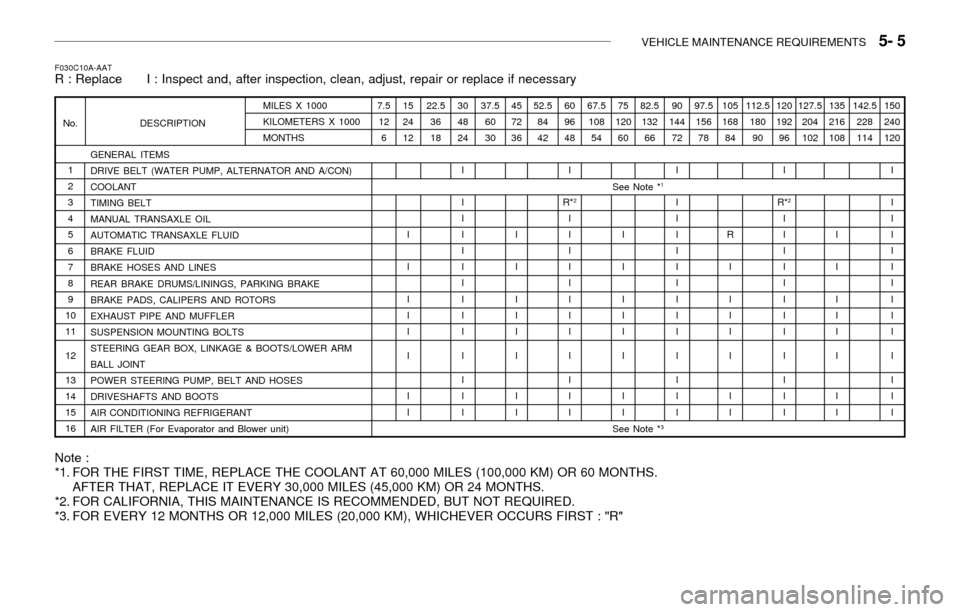
Note :
*1. FOR THE FIRST TIME, REPLACE THE COOLANT AT 60,000 MILES (100,000 KM) OR 60 MONTHS.
AFTER THAT, REPLACE IT EVERY 30,000 MILES (45,000 KM) OR 24 MONTHS.
*2. FOR CALIFORNIA, THIS MAINTENANCE IS RECOMMENDED, BUT NOT REQUIRED.
*3. FOR EVERY 12 MONTHS OR 12,000 MILES (20,000 KM), WHICHEVER OCCURS FIRST : "R"
F030C10A-AATR : Replace I : Inspect and, after inspection, clean, adjust, repair or replace if necessary
See Note *1
Page 133 of 186
5- 6 VEHICLE MAINTENANCE REQUIREMENTS
DRIVING
CONDITION MAINTENANCE
INTERVALS
ENGINE OIL AND FILTER
AIR CLEANER FILTER
SPARK PLUGS
BRAKE PADS, CALIPERS AND ROTORS
REAR BRAKE DRUMS/LININGS,
PARKING BRAKE
STEERING GEAR BOX, LINKAGE
& BOOTS/LOWER ARM BALL JOINT
DRIVESHAFTS AND BOOTS
MANUAL TRANSAXLE OIL
AUTOMATIC TRANSAXLE FLUID
AIR FILTER (For Evaporator and Blower unit)R
R
R
I
I
I
I
R
R
R MAINTENANCE
OPERATION MAINTENANCE ITEM
EVERY 3,000 MILES (4,800 KM) OR 3 MONTHS
MORE FREQUENTLY
MORE FREQUENTLY
MORE FREQUENTLY
MORE FREQUENTLY
MORE FREQUENTLY
EVERY 7,500 MILES (12,000 KM) OR 6 MONTHS
EVERY 60,000 MILES (96,000 KM)
EVERY 30,000 MILES (48,000 KM)
MORE FREQUENTLY
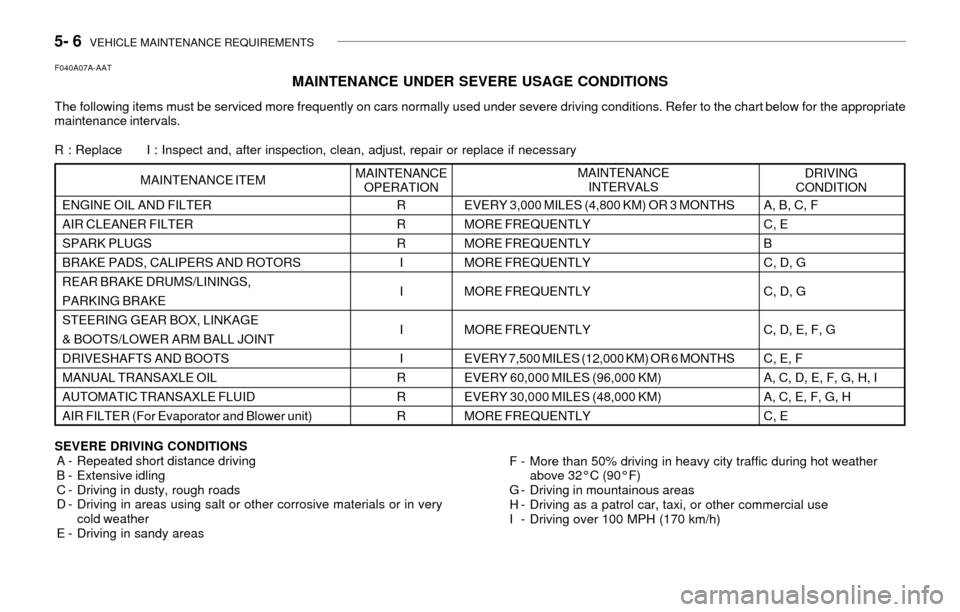
SEVERE DRIVING CONDITIONS
A - Repeated short distance driving
B - Extensive idling
C - Driving in dusty, rough roads
D - Driving in areas using salt or other corrosive materials or in very
cold weather
E - Driving in sandy areasF - More than 50% driving in heavy city traffic during hot weather
above 32°C (90°F)
G - Driving in mountainous areas
H - Driving as a patrol car, taxi, or other commercial use
I - Driving over 100 MPH (170 km/h)
F040A07A-AATMAINTENANCE UNDER SEVERE USAGE CONDITIONS
The following items must be serviced more frequently on cars normally used under severe driving conditions. Refer to the chart below for the appropriate
maintenance intervals.
R : Replace I : Inspect and, after inspection, clean, adjust, repair or replace if necessary
A, B, C, F
C, E
B
C, D, G
C, D, G
C, D, E, F, G
C, E, F
A, C, D, E, F, G, H, I
A, C, E, F, G, H
C, E
Page 136 of 186
VEHICLE MAINTENANCE REQUIREMENTS 5- 9
F070M01A-AAT
o Steering gear box, linkage &
boots/lower arm ball joint
With the vehicle stopped and engine off, check
for excessive free-play in the steering wheel.
Check the linkage for bends or damage. Check
the dust boots and ball joints for deterioration,
cracks, or damage. Replace any damaged parts.
F070L01A-AATo Suspension mounting bolts
Check the suspension connections for loose-
ness or damage. Retighten to the specified
torque.
F070Q01A-AAT
o Air conditioning refrigerant
Check the air conditioning lines and connec-
tions for leakage and damage. Check air condi-
tioning performance according to the relevant
shop manual if necessary.
F070P01A-AATo Driveshafts and boots
Check the drive shafts, boots and clamps for
cracks, deterioration, or damage. Replace any
damaged parts and, if necessary, repack the
grease.
F070N01A-AAT
o Power steering pump, belt and
hoses
Check the power steering pump and hoses for
leakage and damage. Replace any damaged or
leaking parts immediately. Inspect the power
steering belt for evidence of cuts, cracks, ex-
cessive wear, oiliness and proper tension. Re-
place or adjust it if necessary.
Page 137 of 186

6. Do-It-Yourself Maintenance
Engine Compartment ...................................................................... 6-2
General Checks .............................................................................. 6-3
Checking the Engine Oil ................................................................. 6-4
Changing the Oil and Filter ............................................................. 6-5
Checking and Changing the Engine Coolant ................................. 6-6
Spark Plugs .................................................................................... 6-8
Changing the Air Cleaner Filter ...................................................... 6-9
Checking the Transaxle Oil (Manual) ...........................................6-10
Checking the Transaxle Fluid (Automatic) ................................... 6-11
Checking the Brakes ..................................................................... 6-13
Checking the Clutch Fluid ............................................................. 6-14
Air Conditioning Care .................................................................... 6-14
Changing the Air Filter (For Evaporator and Blower Unit) ........... 6-15
Checking Drive Belts .................................................................... 6-17
Checking and Replacing Fuses .................................................... 6-18
Power Steering Fluid Level ........................................................... 6-20
Replacement of Bulbs .................................................................. 6-22
Fuse Panel Description ................................................................ 6-28
6
Page 139 of 186
DO-IT-YOURSELF MAINTENANCE 6- 3
G020C01A-AATVehicle Interior
The following should be checked each time
when the vehicle is driven:
o Light operation
o Windshield wiper operation
o Horn operation
o Defroster, heater system operation (and air
conditioning, if installed)
o Steering operation and condition
o Mirror condition and operation
o Turn signal operation
o Accelerator pedal operation
o Brake operation, including parking brake
o Manual transaxle operation, including clutch
operation
o Automatic transaxle operation, including
"Park" mechanism operation
o Seat control condition and operation
o Seat belt condition and operation
o Sun visor operation
If you notice anything that does not operate
correctly or appear to be functioning correctly,
inspect it carefully and seek assistance from
your Hyundai dealer if service is needed.
G020A01A-AATGENERAL CHECKS
Engine Compartment
The following should be checked regularly:
o Engine oil level and condition
o Transaxle fluid level and condition
o Brake fluid level
o Clutch fluid level
o Engine coolant level
o Windshield washer fluid level
o Accessory drive belt condition
o Engine coolant hose condition
o Fluid leaks (on or below components)
o Power steering fluid level and condition
o Battery Condition
o Air filter condition
G020B01A-AATVehicle Exterior
The following should be checked monthly:
o Overall appearance and condition
o Wheel condition and wheel nut tightness
o Exhaust system condition
o Light condition and operation
o Windshield glass condition
o Wiper blade condition
o Paint condition and body corrosion
o Fluid leaks
o Door and hood lock condition
o Tire pressure and condition
(including spare tire)
Page 150 of 186
6- 14 DO-IT-YOURSELF MAINTENANCE
G130B02A-AATTo Replace the Fluid
Recommended brake fluid conforming to DOT 3
or DOT 4 specification should be used. The
reservoir cap must be fully tightened to avoid
contamination from foreign matter or moisture.
NOTE:Do not allow any other liquids to contami-
nate the brake fluid. Seal damage will result.
G140A01A-AAT
AIR CONDITIONER CARE
Keeping the Condenser Clean
The air conditioner condenser (and engine ra-
diator) should be checked periodically for accu-
mulation of dirt, dead insects, leaves, etc. These
can interfere with maximum cooling efficiency.
When removing such accumulations, brush or
hose them away carefully to avoid bending the
cooling fans.
G140C01A-AAT
Lubrication
To lubricate the compressor and the seals in the
system, the air conditioner should be run for at
least 10 minutes each week. This is particularly
important during cool weather when the air con-
ditioning system is not otherwise in use.
G140B01A-AATChecking the Air Conditioner Opera-
tion
1. Start the engine and let it run at fast idle for
several minutes with the air conditioner set
at the maximum cold setting.
2. If the air coming out of the in-dash vents is
not cold, have the air conditioning system
inspected by your Hyundai dealer.
WARNING:Use caution when handling brake fluid. It
can damage your vision if you get it in your
eyes. It will also damage your vehicles paint
if spilled on it and not removed immediately.
!CAUTION:Running the air conditioning system for ex-
tended periods of time with a low refrigerant
level may damage the compressor.
!
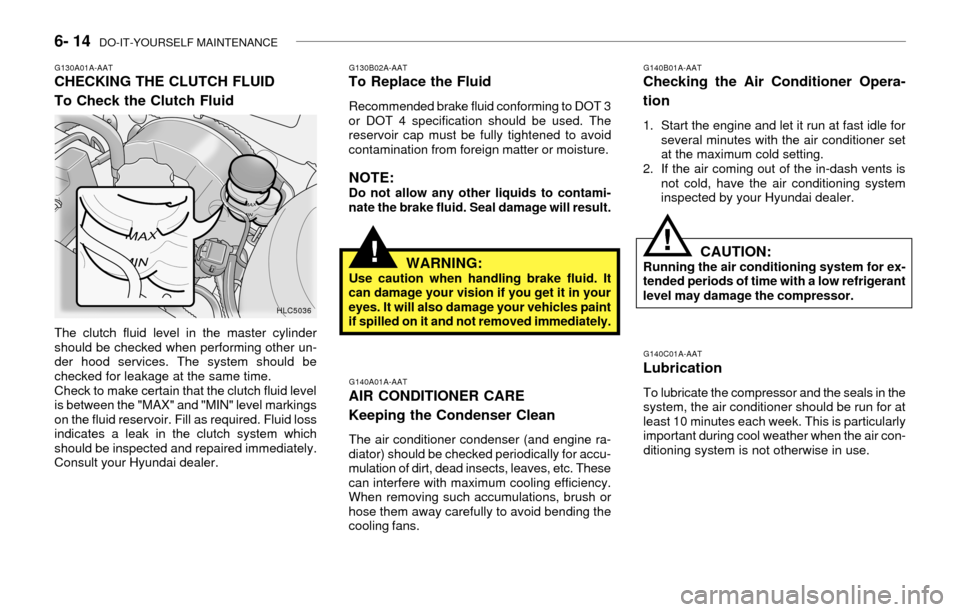
G130A01A-AATCHECKING THE CLUTCH FLUID
To Check the Clutch Fluid
The clutch fluid level in the master cylinder
should be checked when performing other un-
der hood services. The system should be
checked for leakage at the same time.
Check to make certain that the clutch fluid level
is between the "MAX" and "MIN" level markings
on the fluid reservoir. Fill as required. Fluid loss
indicates a leak in the clutch system which
should be inspected and repaired immediately.
Consult your Hyundai dealer.
HLC5036