2003 Hyundai Accent Fluid
[x] Cancel search: FluidPage 137 of 186

6. Do-It-Yourself Maintenance
Engine Compartment ...................................................................... 6-2
General Checks .............................................................................. 6-3
Checking the Engine Oil ................................................................. 6-4
Changing the Oil and Filter ............................................................. 6-5
Checking and Changing the Engine Coolant ................................. 6-6
Spark Plugs .................................................................................... 6-8
Changing the Air Cleaner Filter ...................................................... 6-9
Checking the Transaxle Oil (Manual) ...........................................6-10
Checking the Transaxle Fluid (Automatic) ................................... 6-11
Checking the Brakes ..................................................................... 6-13
Checking the Clutch Fluid ............................................................. 6-14
Air Conditioning Care .................................................................... 6-14
Changing the Air Filter (For Evaporator and Blower Unit) ........... 6-15
Checking Drive Belts .................................................................... 6-17
Checking and Replacing Fuses .................................................... 6-18
Power Steering Fluid Level ........................................................... 6-20
Replacement of Bulbs .................................................................. 6-22
Fuse Panel Description ................................................................ 6-28
6
Page 138 of 186

6- 2 DO-IT-YOURSELF MAINTENANCE
G010C01A-GATENGINE COMPARTMENT (1.6 DOHC)
G010D01A-1
1. Engine coolant reservoir
2. Power steering fluid reservoir (If Installed)
3. Rocker cover
4. Engine oil filler cap
5. Brake booster6. Brake fluid reservoir
7. Clutch fluid reservoir
8. Air filter element
9. Relay box
10. Windshield washer fluid reservoir cap11. Engine oil level dipstick
12. Radiator cap
13. Automatic transaxle fluid level dipstick
(If Installed)
14. Battery 1
CAUTION:When inspecting or ser-
vicing the engine, you
should handle tools and
other heavy objects care-
fully so that the plastic
rocker cover of the engine
is not damaged.
!
23456789
10 1112
13 14
Page 139 of 186
DO-IT-YOURSELF MAINTENANCE 6- 3
G020C01A-AATVehicle Interior
The following should be checked each time
when the vehicle is driven:
o Light operation
o Windshield wiper operation
o Horn operation
o Defroster, heater system operation (and air
conditioning, if installed)
o Steering operation and condition
o Mirror condition and operation
o Turn signal operation
o Accelerator pedal operation
o Brake operation, including parking brake
o Manual transaxle operation, including clutch
operation
o Automatic transaxle operation, including
"Park" mechanism operation
o Seat control condition and operation
o Seat belt condition and operation
o Sun visor operation
If you notice anything that does not operate
correctly or appear to be functioning correctly,
inspect it carefully and seek assistance from
your Hyundai dealer if service is needed.
G020A01A-AATGENERAL CHECKS
Engine Compartment
The following should be checked regularly:
o Engine oil level and condition
o Transaxle fluid level and condition
o Brake fluid level
o Clutch fluid level
o Engine coolant level
o Windshield washer fluid level
o Accessory drive belt condition
o Engine coolant hose condition
o Fluid leaks (on or below components)
o Power steering fluid level and condition
o Battery Condition
o Air filter condition
G020B01A-AATVehicle Exterior
The following should be checked monthly:
o Overall appearance and condition
o Wheel condition and wheel nut tightness
o Exhaust system condition
o Light condition and operation
o Windshield glass condition
o Wiper blade condition
o Paint condition and body corrosion
o Fluid leaks
o Door and hood lock condition
o Tire pressure and condition
(including spare tire)
Page 142 of 186
6- 6 DO-IT-YOURSELF MAINTENANCE
G050A01A-AATCHECKING AND CHANGING THE EN-
GINE COOLANTG050B01A-AATRecommended Engine Coolant
Use a high quality ethylene-glycol coolant in a
50/50 mix with water. The engine coolant should
be compatible with aluminum engine parts. Ad-
ditional corrosion inhibitors or additives should
not be used. The cooling system must be main-
tained with the correct concentration and type of
engine coolant to prevent freezing and corro-
sion.
Never allow the concentration of antifreeze to
exceed the 60% level or go below the 35% level
or damage to the coolant system may result. For
proper concentration when adding or replacing
the coolant, refer to the following table.
WARNING:Do not remove the radiator cap when the
engine is hot. When the engine is hot, the
engine coolant is under pressure and may
erupt through the opening if the cap is re-
moved. You could be seriously burned if you
do not observe this precaution. Do not re-
move the radiator cap until the radiator is
cool to the touch.
!
Water
65%
60%
50%
40% Antifreeze
solution
35%
40%
50%
60% Ambient
temperature
°F (°C)
5 (-15)
-13 (-25)
-31 (-35)
-49 (-45)Engine coolant
concentration
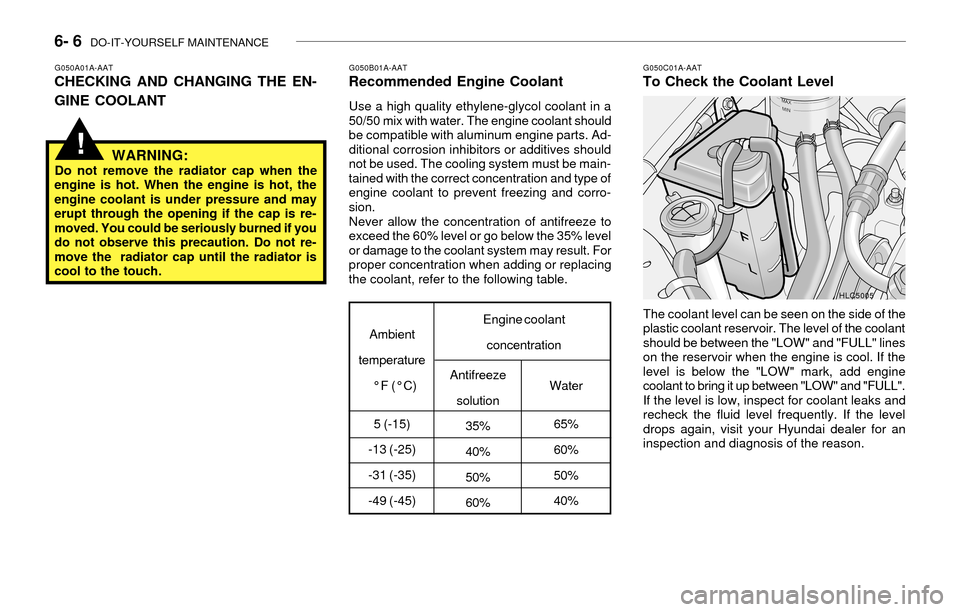
G050C01A-AATTo Check the Coolant Level
The coolant level can be seen on the side of the
plastic coolant reservoir. The level of the coolant
should be between the "LOW" and "FULL" lines
on the reservoir when the engine is cool. If the
level is below the "LOW" mark, add engine
coolant to bring it up between "LOW" and "FULL".
If the level is low, inspect for coolant leaks and
recheck the fluid level frequently. If the level
drops again, visit your Hyundai dealer for an
inspection and diagnosis of the reason.
HLC5005
Page 143 of 186
DO-IT-YOURSELF MAINTENANCE 6- 7
G050D02A-AATTo Change the Coolant
The coolant should be changed at those inter-
vals specified in the vehicle maintenance sched-
ule in Section 5.
CAUTION:Engine coolant can damage the finish of
your car. If you spill engine coolant on the
car, wash it off thoroughly with clean water.
1. Park the car on level ground, set the parking
brake and remove the radiator cap when
cool.
2. Be sure your drain receptacle is in place.
Open the drain cock on the radiator. Allow all
the engine coolant to drain from the cooling
system, then securely close the drain cock.
3. Check Section 9 for the capacity of the
cooling system in your car. Then, following
the manufacturer's directions on the engine
coolant container, add the appropriate quan-
tity of coolant to the radiator.
!
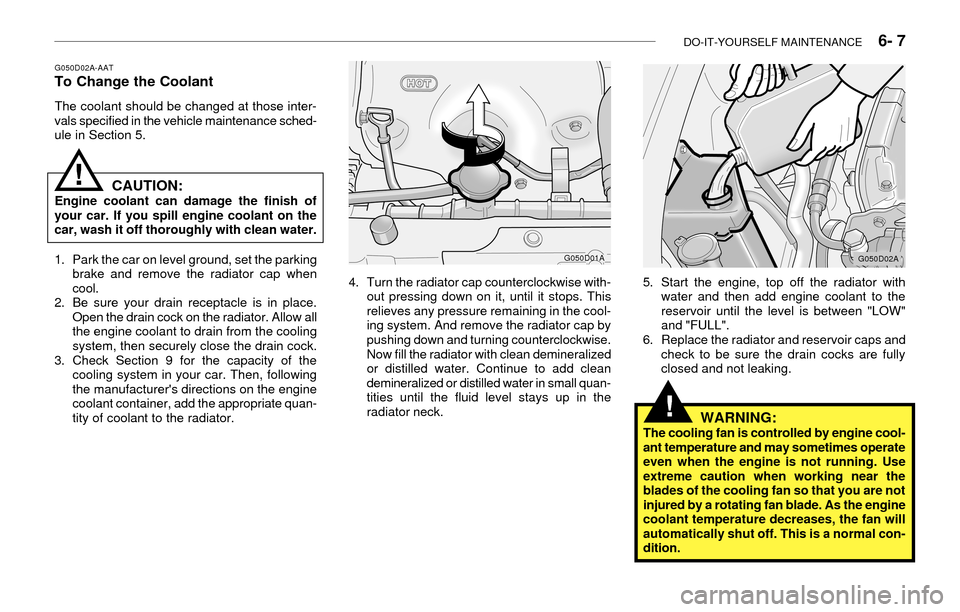
4. Turn the radiator cap counterclockwise with-
out pressing down on it, until it stops. This
relieves any pressure remaining in the cool-
ing system. And remove the radiator cap by
pushing down and turning counterclockwise.
Now fill the radiator with clean demineralized
or distilled water. Continue to add clean
demineralized or distilled water in small quan-
tities until the fluid level stays up in the
radiator neck.
G050D01A
G050D02A
5. Start the engine, top off the radiator with
water and then add engine coolant to the
reservoir until the level is between "LOW"
and "FULL".
6. Replace the radiator and reservoir caps and
check to be sure the drain cocks are fully
closed and not leaking.
WARNING:The cooling fan is controlled by engine cool-
ant temperature and may sometimes operate
even when the engine is not running. Use
extreme caution when working near the
blades of the cooling fan so that you are not
injured by a rotating fan blade. As the engine
coolant temperature decreases, the fan will
automatically shut off. This is a normal con-
dition.
!
Page 146 of 186
6- 10 DO-IT-YOURSELF MAINTENANCE
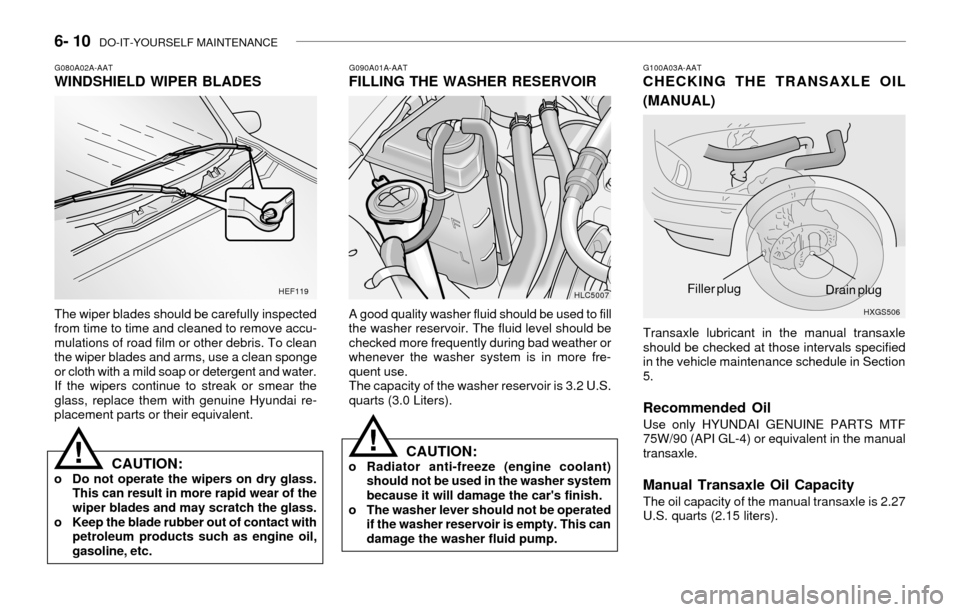
G090A01A-AATFILLING THE WASHER RESERVOIR
A good quality washer fluid should be used to fill
the washer reservoir. The fluid level should be
checked more frequently during bad weather or
whenever the washer system is in more fre-
quent use.
The capacity of the washer reservoir is 3.2 U.S.
quarts (3.0 Liters).
CAUTION:o Radiator anti-freeze (engine coolant)
should not be used in the washer system
because it will damage the car's finish.
o The washer lever should not be operated
if the washer reservoir is empty. This can
damage the washer fluid pump.
!
G100A03A-AATCHECKING THE TRANSAXLE OIL
(MANUAL)
Transaxle lubricant in the manual transaxle
should be checked at those intervals specified
in the vehicle maintenance schedule in Section
5.
Recommended OilUse only HYUNDAI GENUINE PARTS MTF
75W/90 (API GL-4) or equivalent in the manual
transaxle.
Manual Transaxle Oil Capacity
The oil capacity of the manual transaxle is 2.27
U.S. quarts (2.15 liters).
HXGS506
Drain plug Filler plug
G080A02A-AATWINDSHIELD WIPER BLADES
The wiper blades should be carefully inspected
from time to time and cleaned to remove accu-
mulations of road film or other debris. To clean
the wiper blades and arms, use a clean sponge
or cloth with a mild soap or detergent and water.
If the wipers continue to streak or smear the
glass, replace them with genuine Hyundai re-
placement parts or their equivalent.
HEF119
CAUTION:o Do not operate the wipers on dry glass.
This can result in more rapid wear of the
wiper blades and may scratch the glass.
o Keep the blade rubber out of contact with
petroleum products such as engine oil,
gasoline, etc.
!
HLC5007
Page 147 of 186
DO-IT-YOURSELF MAINTENANCE 6- 11
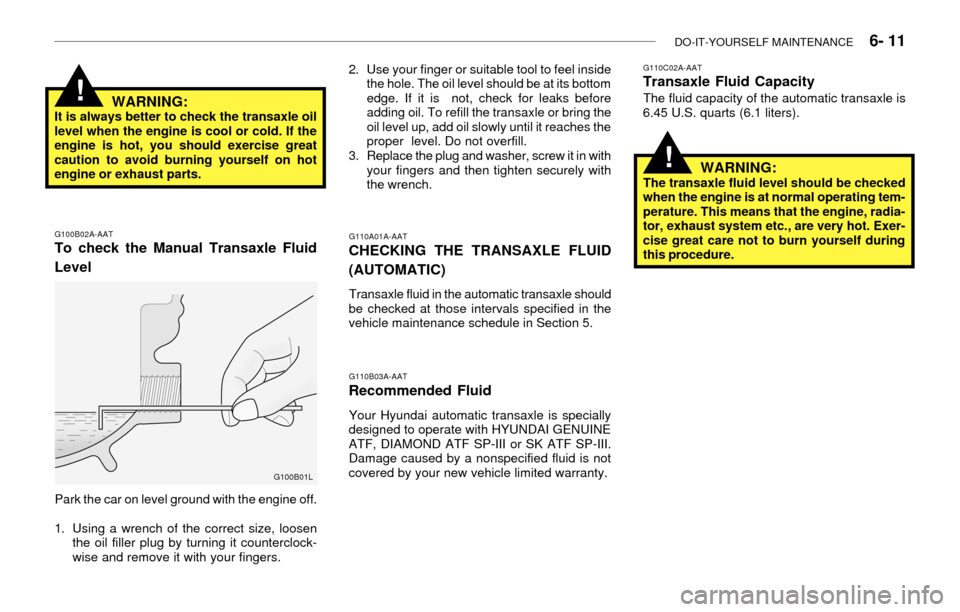
G100B02A-AATTo check the Manual Transaxle Fluid
Level
Park the car on level ground with the engine off.
1. Using a wrench of the correct size, loosen
the oil filler plug by turning it counterclock-
wise and remove it with your fingers.
WARNING:It is always better to check the transaxle oil
level when the engine is cool or cold. If the
engine is hot, you should exercise great
caution to avoid burning yourself on hot
engine or exhaust parts.
!
G100B01L
G110A01A-AAT
CHECKING THE TRANSAXLE FLUID
(AUTOMATIC)
Transaxle fluid in the automatic transaxle should
be checked at those intervals specified in the
vehicle maintenance schedule in Section 5.
G110B03A-AAT
Recommended Fluid
Your Hyundai automatic transaxle is specially
designed to operate with HYUNDAI GENUINE
ATF, DIAMOND ATF SP-III or SK ATF SP-III.
Damage caused by a nonspecified fluid is not
covered by your new vehicle limited warranty.
G110C02A-AATTransaxle Fluid Capacity
The fluid capacity of the automatic transaxle is
6.45 U.S. quarts (6.1 liters). 2. Use your finger or suitable tool to feel inside
the hole. The oil level should be at its bottom
edge. If it is not, check for leaks before
adding oil. To refill the transaxle or bring the
oil level up, add oil slowly until it reaches the
proper level. Do not overfill.
3. Replace the plug and washer, screw it in with
your fingers and then tighten securely with
the wrench.
WARNING:The transaxle fluid level should be checked
when the engine is at normal operating tem-
perature. This means that the engine, radia-
tor, exhaust system etc., are very hot. Exer-
cise great care not to burn yourself during
this procedure.
!
Page 148 of 186
6- 12 DO-IT-YOURSELF MAINTENANCE
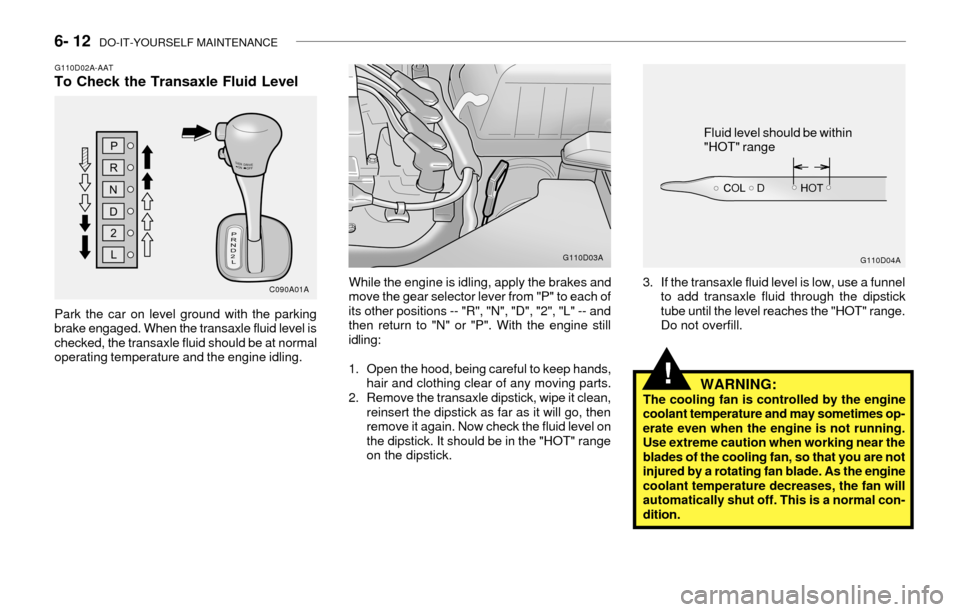
While the engine is idling, apply the brakes and
move the gear selector lever from "P" to each of
its other positions -- "R", "N", "D", "2", "L" -- and
then return to "N" or "P". With the engine still
idling:
1. Open the hood, being careful to keep hands,
hair and clothing clear of any moving parts.
2. Remove the transaxle dipstick, wipe it clean,
reinsert the dipstick as far as it will go, then
remove it again. Now check the fluid level on
the dipstick. It should be in the "HOT" range
on the dipstick.3. If the transaxle fluid level is low, use a funnel
to add transaxle fluid through the dipstick
tube until the level reaches the "HOT" range.
Do not overfill.
G110D03A
G110D04A
Fluid level should be within
"HOT" range
WARNING:The cooling fan is controlled by the engine
coolant temperature and may sometimes op-
erate even when the engine is not running.
Use extreme caution when working near the
blades of the cooling fan, so that you are not
injured by a rotating fan blade. As the engine
coolant temperature decreases, the fan will
automatically shut off. This is a normal con-
dition.
!
G110D02A-AATTo Check the Transaxle Fluid Level
Park the car on level ground with the parking
brake engaged. When the transaxle fluid level is
checked, the transaxle fluid should be at normal
operating temperature and the engine idling.
C090A01A