2003 Hyundai Accent cooling
[x] Cancel search: coolingPage 114 of 186
3- 4 WHAT TO DO IN AN EMERGENCY
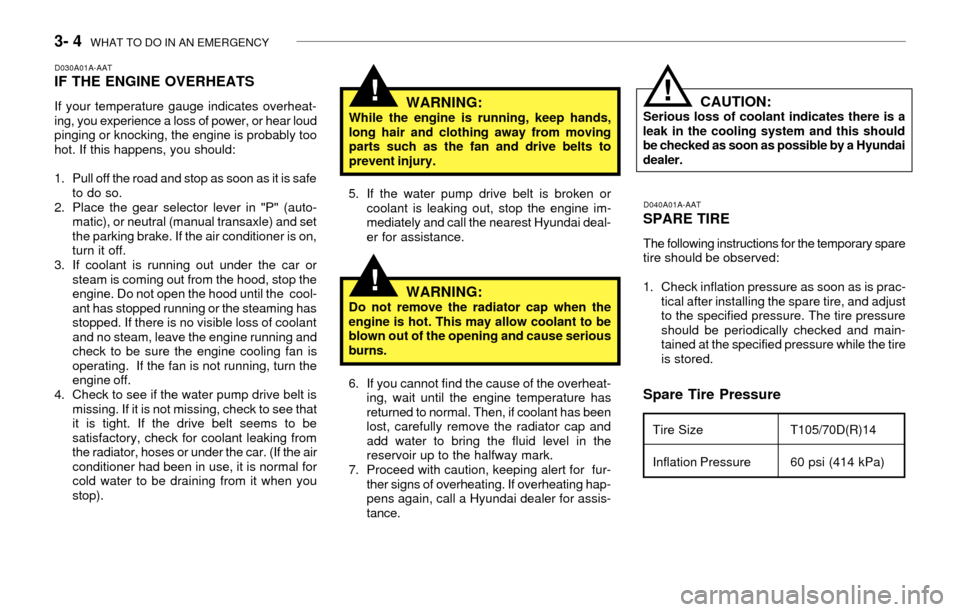
WARNING:While the engine is running, keep hands,
long hair and clothing away from moving
parts such as the fan and drive belts to
prevent injury.
Spare Tire Pressure
D040A01A-AAT
SPARE TIRE
The following instructions for the temporary spare
tire should be observed:
1. Check inflation pressure as soon as is prac-
tical after installing the spare tire, and adjust
to the specified pressure. The tire pressure
should be periodically checked and main-
tained at the specified pressure while the tire
is stored.
D030A01A-AATIF THE ENGINE OVERHEATS
If your temperature gauge indicates overheat-
ing, you experience a loss of power, or hear loud
pinging or knocking, the engine is probably too
hot. If this happens, you should:
1. Pull off the road and stop as soon as it is safe
to do so.
2. Place the gear selector lever in "P" (auto-
matic), or neutral (manual transaxle) and set
the parking brake. If the air conditioner is on,
turn it off.
3. If coolant is running out under the car or
steam is coming out from the hood, stop the
engine. Do not open the hood until the cool-
ant has stopped running or the steaming has
stopped. If there is no visible loss of coolant
and no steam, leave the engine running and
check to be sure the engine cooling fan is
operating. If the fan is not running, turn the
engine off.
4. Check to see if the water pump drive belt is
missing. If it is not missing, check to see that
it is tight. If the drive belt seems to be
satisfactory, check for coolant leaking from
the radiator, hoses or under the car. (If the air
conditioner had been in use, it is normal for
cold water to be draining from it when you
stop).5. If the water pump drive belt is broken or
coolant is leaking out, stop the engine im-
mediately and call the nearest Hyundai deal-
er for assistance.
WARNING:Do not remove the radiator cap when the
engine is hot. This may allow coolant to be
blown out of the opening and cause serious
burns.
6. If you cannot find the cause of the overheat-
ing, wait until the engine temperature has
returned to normal. Then, if coolant has been
lost, carefully remove the radiator cap and
add water to bring the fluid level in the
reservoir up to the halfway mark.
7. Proceed with caution, keeping alert for fur-
ther signs of overheating. If overheating hap-
pens again, call a Hyundai dealer for assis-
tance.
CAUTION:Serious loss of coolant indicates there is a
leak in the cooling system and this should
be checked as soon as possible by a Hyundai
dealer.
!
!
!
Tire Size
Inflation PressureT105/70D(R)14
60 psi (414 kPa)
Page 142 of 186
6- 6 DO-IT-YOURSELF MAINTENANCE
G050A01A-AATCHECKING AND CHANGING THE EN-
GINE COOLANTG050B01A-AATRecommended Engine Coolant
Use a high quality ethylene-glycol coolant in a
50/50 mix with water. The engine coolant should
be compatible with aluminum engine parts. Ad-
ditional corrosion inhibitors or additives should
not be used. The cooling system must be main-
tained with the correct concentration and type of
engine coolant to prevent freezing and corro-
sion.
Never allow the concentration of antifreeze to
exceed the 60% level or go below the 35% level
or damage to the coolant system may result. For
proper concentration when adding or replacing
the coolant, refer to the following table.
WARNING:Do not remove the radiator cap when the
engine is hot. When the engine is hot, the
engine coolant is under pressure and may
erupt through the opening if the cap is re-
moved. You could be seriously burned if you
do not observe this precaution. Do not re-
move the radiator cap until the radiator is
cool to the touch.
!
Water
65%
60%
50%
40% Antifreeze
solution
35%
40%
50%
60% Ambient
temperature
°F (°C)
5 (-15)
-13 (-25)
-31 (-35)
-49 (-45)Engine coolant
concentration
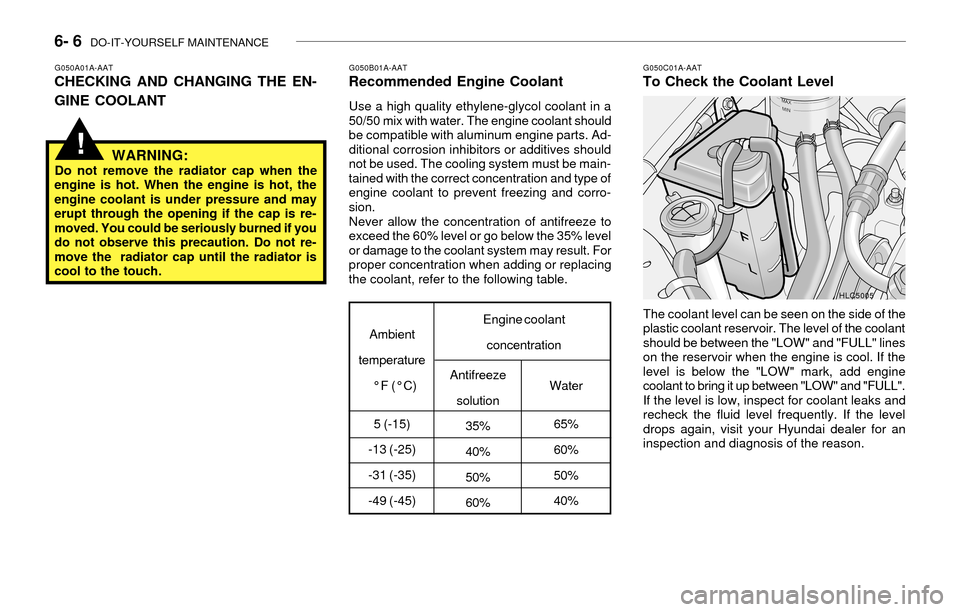
G050C01A-AATTo Check the Coolant Level
The coolant level can be seen on the side of the
plastic coolant reservoir. The level of the coolant
should be between the "LOW" and "FULL" lines
on the reservoir when the engine is cool. If the
level is below the "LOW" mark, add engine
coolant to bring it up between "LOW" and "FULL".
If the level is low, inspect for coolant leaks and
recheck the fluid level frequently. If the level
drops again, visit your Hyundai dealer for an
inspection and diagnosis of the reason.
HLC5005
Page 143 of 186
DO-IT-YOURSELF MAINTENANCE 6- 7
G050D02A-AATTo Change the Coolant
The coolant should be changed at those inter-
vals specified in the vehicle maintenance sched-
ule in Section 5.
CAUTION:Engine coolant can damage the finish of
your car. If you spill engine coolant on the
car, wash it off thoroughly with clean water.
1. Park the car on level ground, set the parking
brake and remove the radiator cap when
cool.
2. Be sure your drain receptacle is in place.
Open the drain cock on the radiator. Allow all
the engine coolant to drain from the cooling
system, then securely close the drain cock.
3. Check Section 9 for the capacity of the
cooling system in your car. Then, following
the manufacturer's directions on the engine
coolant container, add the appropriate quan-
tity of coolant to the radiator.
!
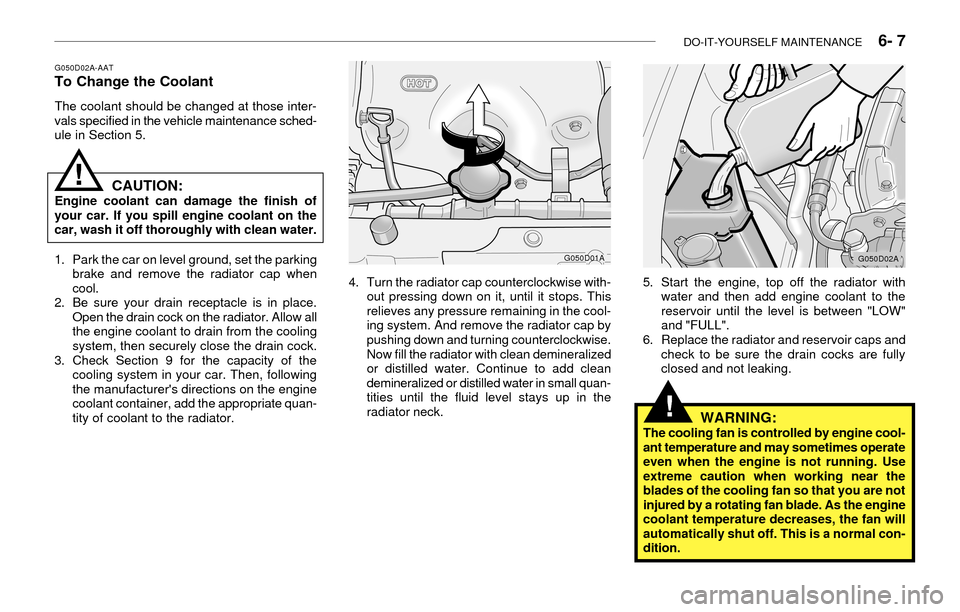
4. Turn the radiator cap counterclockwise with-
out pressing down on it, until it stops. This
relieves any pressure remaining in the cool-
ing system. And remove the radiator cap by
pushing down and turning counterclockwise.
Now fill the radiator with clean demineralized
or distilled water. Continue to add clean
demineralized or distilled water in small quan-
tities until the fluid level stays up in the
radiator neck.
G050D01A
G050D02A
5. Start the engine, top off the radiator with
water and then add engine coolant to the
reservoir until the level is between "LOW"
and "FULL".
6. Replace the radiator and reservoir caps and
check to be sure the drain cocks are fully
closed and not leaking.
WARNING:The cooling fan is controlled by engine cool-
ant temperature and may sometimes operate
even when the engine is not running. Use
extreme caution when working near the
blades of the cooling fan so that you are not
injured by a rotating fan blade. As the engine
coolant temperature decreases, the fan will
automatically shut off. This is a normal con-
dition.
!
Page 148 of 186
6- 12 DO-IT-YOURSELF MAINTENANCE
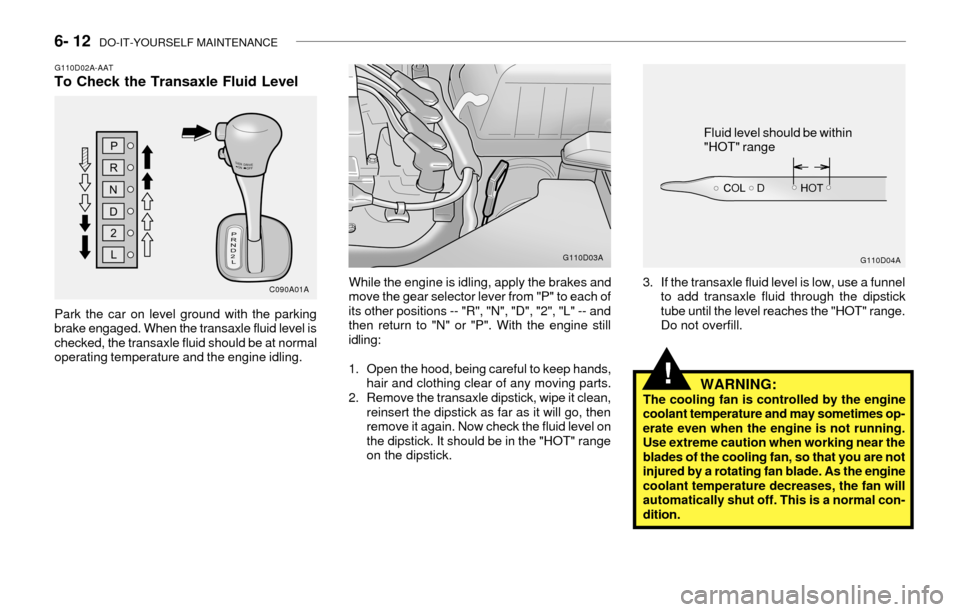
While the engine is idling, apply the brakes and
move the gear selector lever from "P" to each of
its other positions -- "R", "N", "D", "2", "L" -- and
then return to "N" or "P". With the engine still
idling:
1. Open the hood, being careful to keep hands,
hair and clothing clear of any moving parts.
2. Remove the transaxle dipstick, wipe it clean,
reinsert the dipstick as far as it will go, then
remove it again. Now check the fluid level on
the dipstick. It should be in the "HOT" range
on the dipstick.3. If the transaxle fluid level is low, use a funnel
to add transaxle fluid through the dipstick
tube until the level reaches the "HOT" range.
Do not overfill.
G110D03A
G110D04A
Fluid level should be within
"HOT" range
WARNING:The cooling fan is controlled by the engine
coolant temperature and may sometimes op-
erate even when the engine is not running.
Use extreme caution when working near the
blades of the cooling fan, so that you are not
injured by a rotating fan blade. As the engine
coolant temperature decreases, the fan will
automatically shut off. This is a normal con-
dition.
!
G110D02A-AATTo Check the Transaxle Fluid Level
Park the car on level ground with the parking
brake engaged. When the transaxle fluid level is
checked, the transaxle fluid should be at normal
operating temperature and the engine idling.
C090A01A
Page 150 of 186
6- 14 DO-IT-YOURSELF MAINTENANCE
G130B02A-AATTo Replace the Fluid
Recommended brake fluid conforming to DOT 3
or DOT 4 specification should be used. The
reservoir cap must be fully tightened to avoid
contamination from foreign matter or moisture.
NOTE:Do not allow any other liquids to contami-
nate the brake fluid. Seal damage will result.
G140A01A-AAT
AIR CONDITIONER CARE
Keeping the Condenser Clean
The air conditioner condenser (and engine ra-
diator) should be checked periodically for accu-
mulation of dirt, dead insects, leaves, etc. These
can interfere with maximum cooling efficiency.
When removing such accumulations, brush or
hose them away carefully to avoid bending the
cooling fans.
G140C01A-AAT
Lubrication
To lubricate the compressor and the seals in the
system, the air conditioner should be run for at
least 10 minutes each week. This is particularly
important during cool weather when the air con-
ditioning system is not otherwise in use.
G140B01A-AATChecking the Air Conditioner Opera-
tion
1. Start the engine and let it run at fast idle for
several minutes with the air conditioner set
at the maximum cold setting.
2. If the air coming out of the in-dash vents is
not cold, have the air conditioning system
inspected by your Hyundai dealer.
WARNING:Use caution when handling brake fluid. It
can damage your vision if you get it in your
eyes. It will also damage your vehicles paint
if spilled on it and not removed immediately.
!CAUTION:Running the air conditioning system for ex-
tended periods of time with a low refrigerant
level may damage the compressor.
!
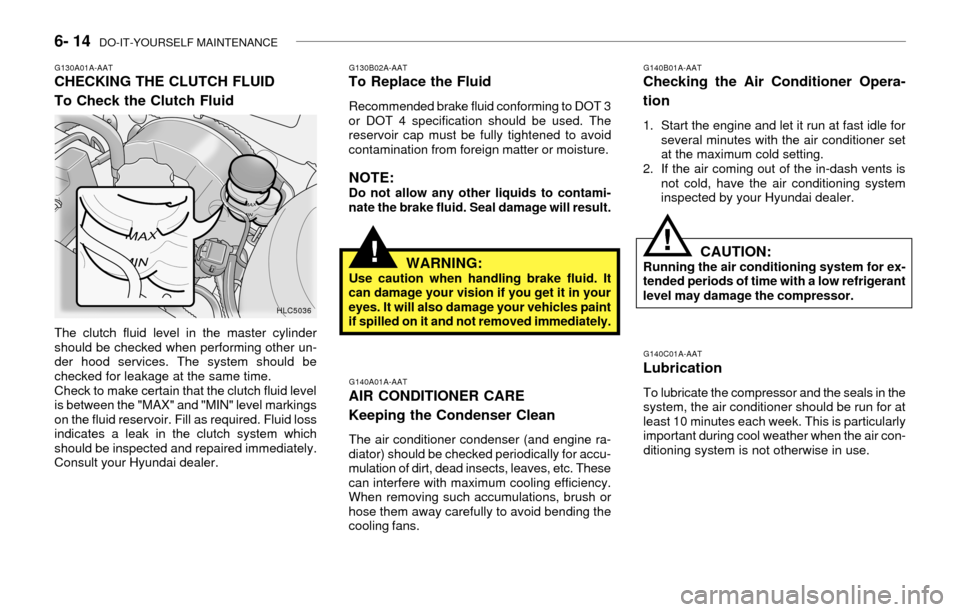
G130A01A-AATCHECKING THE CLUTCH FLUID
To Check the Clutch Fluid
The clutch fluid level in the master cylinder
should be checked when performing other un-
der hood services. The system should be
checked for leakage at the same time.
Check to make certain that the clutch fluid level
is between the "MAX" and "MIN" level markings
on the fluid reservoir. Fill as required. Fluid loss
indicates a leak in the clutch system which
should be inspected and repaired immediately.
Consult your Hyundai dealer.
HLC5036
Page 156 of 186
6- 20 DO-IT-YOURSELF MAINTENANCE
G220A01A-AATCHECKING ELECTRIC COOLING
FANSG230A03A-AATPOWER STEERING FLUID LEVEL
G220B01A-AATChecking Engine Cooling Fan
The engine cooling fan should come on auto-
matically if the engine coolant temperature is
high.
WARNING:The radiator fan is controlled by engine cool-
ant temperature and may sometimes operate
even when the engine is not running. Use
extreme caution when working near the
blades of the cooling fan, so that you are not
injured by a rotating fan blade. As the cool-
ant temperature decreases the fan will auto-
matically shut off. This is a normal condition.
!
G220C01A-AATChecking Condenser Cooling Fan
The condenser cooling fan should come on
automatically whenever the air conditioner is in
operation.
HLC5006
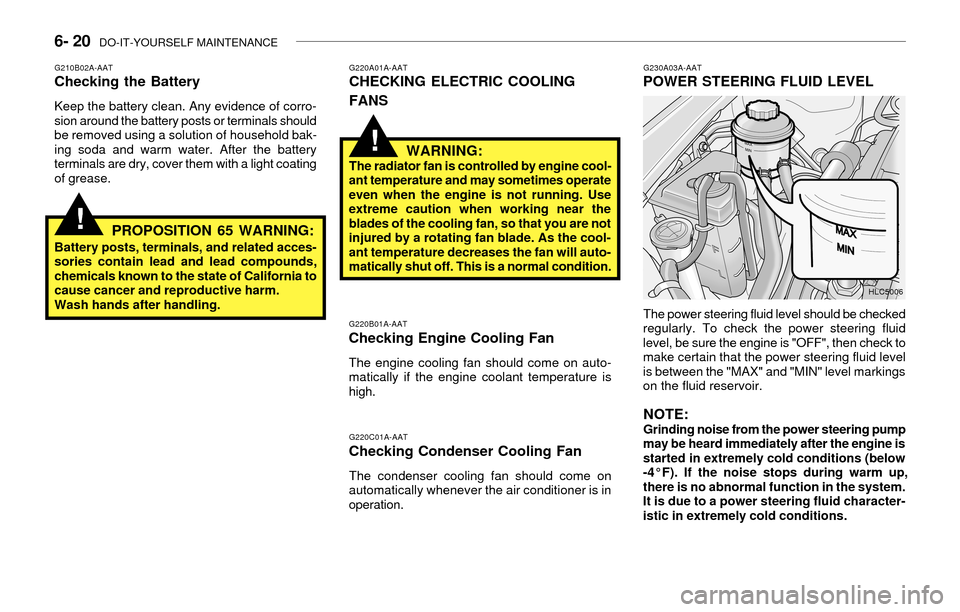
The power steering fluid level should be checked
regularly. To check the power steering fluid
level, be sure the engine is "OFF", then check to
make certain that the power steering fluid level
is between the "MAX" and "MIN" level markings
on the fluid reservoir.
NOTE:Grinding noise from the power steering pump
may be heard immediately after the engine is
started in extremely cold conditions (below
-4°F). If the noise stops during warm up,
there is no abnormal function in the system.
It is due to a power steering fluid character-
istic in extremely cold conditions.
G210B02A-AATChecking the Battery
Keep the battery clean. Any evidence of corro-
sion around the battery posts or terminals should
be removed using a solution of household bak-
ing soda and warm water. After the battery
terminals are dry, cover them with a light coating
of grease.
PROPOSITION 65 WARNING:
Battery posts, terminals, and related acces-
sories contain lead and lead compounds,
chemicals known to the state of California to
cause cancer and reproductive harm.
Wash hands after handling.
!
Page 182 of 186
10- 2 INDEX
Cargo Area Cover .............................................................................1-55
Catalytic Converter ............................................................................. 7-2
Changing a flat tire .............................................................................. 3-6
Child-Protector Rear Door Look ......................................................... 1-5
Child Restraint System .....................................................................1-19
Installing a child restraint seat with the
"Tether Anchorage" system ......................................................1-21
Securing the child restraint seat with the "ISOFIX" system ........1-22
Cigarette Lighter ................................................................................1-45
Clock ................................................................................................1-44
Clutch
Checking fluid ..............................................................................6-14
Pedal free-play .............................................................................6-16
Combination Light
Headlight flasher ..........................................................................1-41
Headlight switch ...........................................................................1-41
High-beam switch ........................................................................1-41
Lane change signal ......................................................................1-40
Turn signal operation ...................................................................1-40
Cooling Fans .....................................................................................6-20
Corrosion Protection
Cleaning the interior ....................................................................... 4-4
Protecting your Hyundai from corrosion ........................................ 4-2
Washing and waxing ...................................................................... 4-3
D
Defrosting/Defogging .........................................................................1-65
Door
Central door lock ........................................................................... 1-6
Door locks ...................................................................................... 1-4
Locking, unlocking front door with a key ....................................... 1-4 A
Airbag................................................................................................1-26
Air Conditioner
Care .............................................................................................6-14
Operation.....................................................................................1-63
Air Filter (For Evaporator and Blower Unit) .....................................1-64
Antenna.............................................................................................1-83
Ashtray ..............................................................................................1-45
Audio Fault Code ..............................................................................1-80
Audio System
Cassette tape player operation (H245) ........................................1-73
Compact disk player operation (H265) ........................................1-78
Stereo radio operation (H215, H245, H265) .............. 1-68, 1-70, 1-75
Automatic Transaxle ........................................................................... 2-7
Overdrive switch ............................................................................ 2-8
Shift lock release ........................................................................... 2-9
B
Battery ...............................................................................................6-19
Bi-Level Heating ................................................................................1-61
Brake
Anti-lock system ..........................................................................2-10
Checking the brakes ....................................................................6-13
Fluid.............................................................................................6-13
Pedal clearance ...........................................................................6-17
Pedal free-play .............................................................................6-17
Practices ......................................................................................2-10
Breaking-In your new Hyundai ........................................................... 1-3
C
Care of Cassette tapes .....................................................................1-81
Care of Disk ......................................................................................1-81