2003 Hyundai Accent check engine light
[x] Cancel search: check engine lightPage 113 of 186
WHAT TO DO IN AN EMERGENCY 3- 3
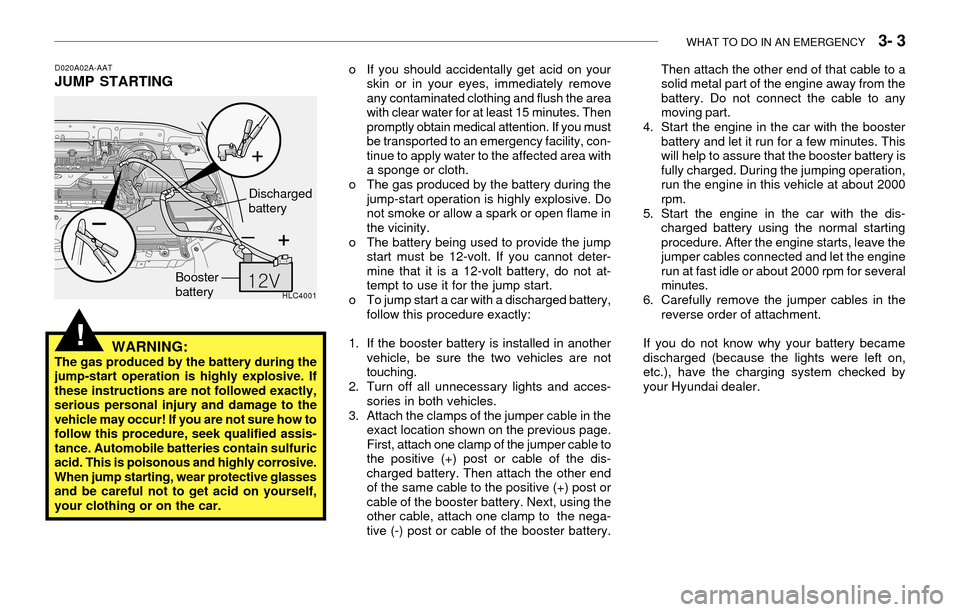
D020A02A-AATJUMP STARTING
WARNING:
The gas produced by the battery during the
jump-start operation is highly explosive. If
these instructions are not followed exactly,
serious personal injury and damage to the
vehicle may occur! If you are not sure how to
follow this procedure, seek qualified assis-
tance. Automobile batteries contain sulfuric
acid. This is poisonous and highly corrosive.
When jump starting, wear protective glasses
and be careful not to get acid on yourself,
your clothing or on the car.Discharged
battery
Booster
battery
HLC4001
!
o If you should accidentally get acid on your
skin or in your eyes, immediately remove
any contaminated clothing and flush the area
with clear water for at least 15 minutes. Then
promptly obtain medical attention. If you must
be transported to an emergency facility, con-
tinue to apply water to the affected area with
a sponge or cloth.
o The gas produced by the battery during the
jump-start operation is highly explosive. Do
not smoke or allow a spark or open flame in
the vicinity.
o The battery being used to provide the jump
start must be 12-volt. If you cannot deter-
mine that it is a 12-volt battery, do not at-
tempt to use it for the jump start.
o To jump start a car with a discharged battery,
follow this procedure exactly:
1. If the booster battery is installed in another
vehicle, be sure the two vehicles are not
touching.
2. Turn off all unnecessary lights and acces-
sories in both vehicles.
3. Attach the clamps of the jumper cable in the
exact location shown on the previous page.
First, attach one clamp of the jumper cable to
the positive (+) post or cable of the dis-
charged battery. Then attach the other end
of the same cable to the positive (+) post or
cable of the booster battery. Next, using the
other cable, attach one clamp to the nega-
tive (-) post or cable of the booster battery.Then attach the other end of that cable to a
solid metal part of the engine away from the
battery. Do not connect the cable to any
moving part.
4. Start the engine in the car with the booster
battery and let it run for a few minutes. This
will help to assure that the booster battery is
fully charged. During the jumping operation,
run the engine in this vehicle at about 2000
rpm.
5. Start the engine in the car with the dis-
charged battery using the normal starting
procedure. After the engine starts, leave the
jumper cables connected and let the engine
run at fast idle or about 2000 rpm for several
minutes.
6. Carefully remove the jumper cables in the
reverse order of attachment.
If you do not know why your battery became
discharged (because the lights were left on,
etc.), have the charging system checked by
your Hyundai dealer.
Page 139 of 186
DO-IT-YOURSELF MAINTENANCE 6- 3
G020C01A-AATVehicle Interior
The following should be checked each time
when the vehicle is driven:
o Light operation
o Windshield wiper operation
o Horn operation
o Defroster, heater system operation (and air
conditioning, if installed)
o Steering operation and condition
o Mirror condition and operation
o Turn signal operation
o Accelerator pedal operation
o Brake operation, including parking brake
o Manual transaxle operation, including clutch
operation
o Automatic transaxle operation, including
"Park" mechanism operation
o Seat control condition and operation
o Seat belt condition and operation
o Sun visor operation
If you notice anything that does not operate
correctly or appear to be functioning correctly,
inspect it carefully and seek assistance from
your Hyundai dealer if service is needed.
G020A01A-AATGENERAL CHECKS
Engine Compartment
The following should be checked regularly:
o Engine oil level and condition
o Transaxle fluid level and condition
o Brake fluid level
o Clutch fluid level
o Engine coolant level
o Windshield washer fluid level
o Accessory drive belt condition
o Engine coolant hose condition
o Fluid leaks (on or below components)
o Power steering fluid level and condition
o Battery Condition
o Air filter condition
G020B01A-AATVehicle Exterior
The following should be checked monthly:
o Overall appearance and condition
o Wheel condition and wheel nut tightness
o Exhaust system condition
o Light condition and operation
o Windshield glass condition
o Wiper blade condition
o Paint condition and body corrosion
o Fluid leaks
o Door and hood lock condition
o Tire pressure and condition
(including spare tire)
Page 152 of 186
6- 16 DO-IT-YOURSELF MAINTENANCE
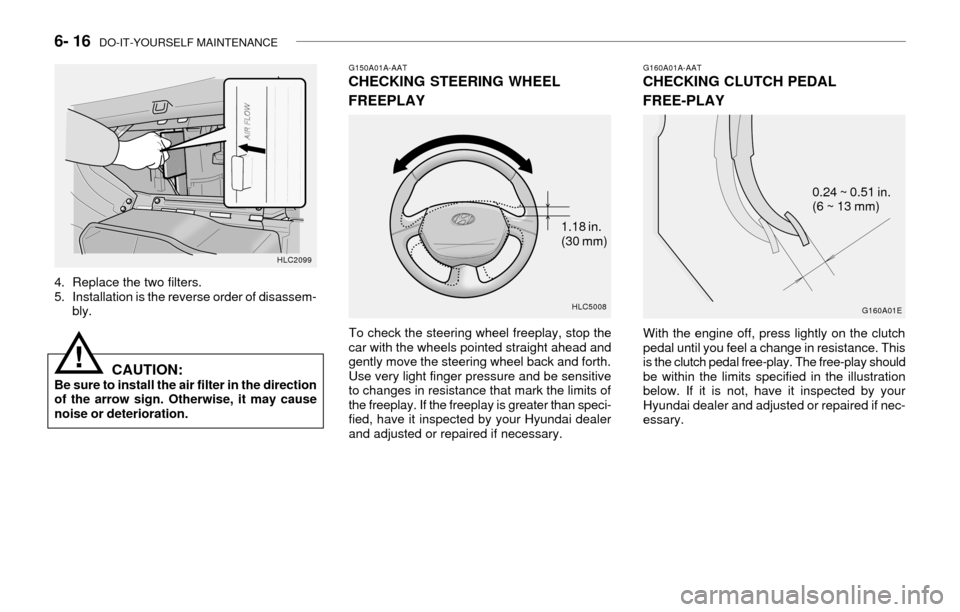
G150A01A-AATCHECKING STEERING WHEEL
FREEPLAY
To check the steering wheel freeplay, stop the
car with the wheels pointed straight ahead and
gently move the steering wheel back and forth.
Use very light finger pressure and be sensitive
to changes in resistance that mark the limits of
the freeplay. If the freeplay is greater than speci-
fied, have it inspected by your Hyundai dealer
and adjusted or repaired if necessary.
G160A01A-AATCHECKING CLUTCH PEDAL
FREE-PLAY
With the engine off, press lightly on the clutch
pedal until you feel a change in resistance. This
is the clutch pedal free-play. The free-play should
be within the limits specified in the illustration
below. If it is not, have it inspected by your
Hyundai dealer and adjusted or repaired if nec-
essary.
HLC5008
1.18 in.
(30 mm)
G160A01E
0.24 ~ 0.51 in.
(6 ~ 13 mm)
HLC2099
4. Replace the two filters.
5. Installation is the reverse order of disassem-
bly.
CAUTION:Be sure to install the air filter in the direction
of the arrow sign. Otherwise, it may cause
noise or deterioration.
!
Page 156 of 186
6- 20 DO-IT-YOURSELF MAINTENANCE
G220A01A-AATCHECKING ELECTRIC COOLING
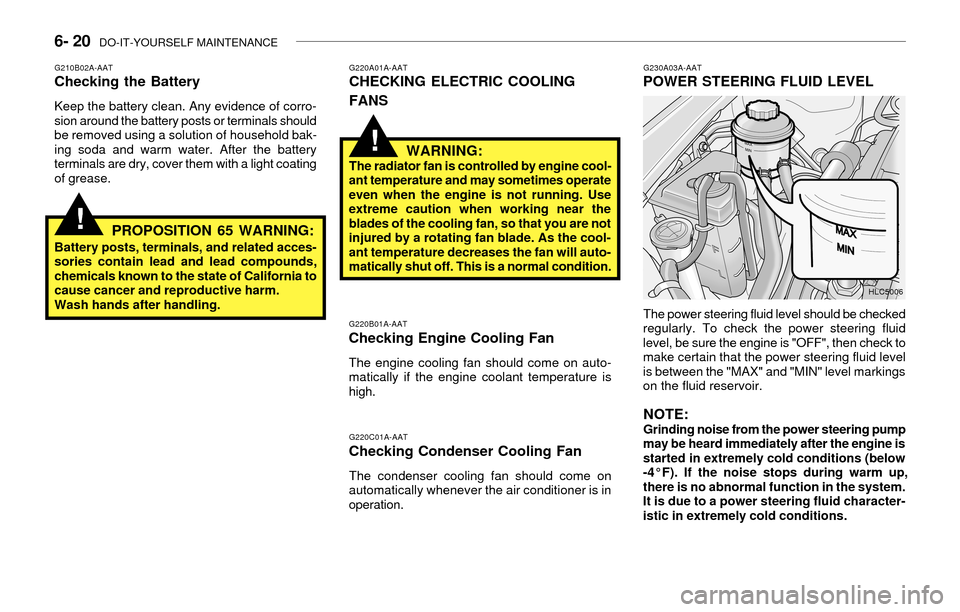
FANSG230A03A-AATPOWER STEERING FLUID LEVEL
G220B01A-AATChecking Engine Cooling Fan
The engine cooling fan should come on auto-
matically if the engine coolant temperature is
high.
WARNING:The radiator fan is controlled by engine cool-
ant temperature and may sometimes operate
even when the engine is not running. Use
extreme caution when working near the
blades of the cooling fan, so that you are not
injured by a rotating fan blade. As the cool-
ant temperature decreases the fan will auto-
matically shut off. This is a normal condition.
!
G220C01A-AATChecking Condenser Cooling Fan
The condenser cooling fan should come on
automatically whenever the air conditioner is in
operation.
HLC5006
The power steering fluid level should be checked
regularly. To check the power steering fluid
level, be sure the engine is "OFF", then check to
make certain that the power steering fluid level
is between the "MAX" and "MIN" level markings
on the fluid reservoir.
NOTE:Grinding noise from the power steering pump
may be heard immediately after the engine is
started in extremely cold conditions (below
-4°F). If the noise stops during warm up,
there is no abnormal function in the system.
It is due to a power steering fluid character-
istic in extremely cold conditions.
G210B02A-AATChecking the Battery
Keep the battery clean. Any evidence of corro-
sion around the battery posts or terminals should
be removed using a solution of household bak-
ing soda and warm water. After the battery
terminals are dry, cover them with a light coating
of grease.
PROPOSITION 65 WARNING:
Battery posts, terminals, and related acces-
sories contain lead and lead compounds,
chemicals known to the state of California to
cause cancer and reproductive harm.
Wash hands after handling.
!
Page 157 of 186

DO-IT-YOURSELF MAINTENANCE 6- 21
G240A01A-AATPOWER STEERING HOSES
It is suggested that you check the power steer-
ing hose connections for fluid leakage at those
intervals specified in the vehicle maintenance
schedule in Section 5.
The power steering hoses should be replaced if
there is severe surface cracking, pulling, scuff-
ing or worn spots. Deterioration of the hose
could cause premature failure.
Recommended Fluid
Use PSF-3 type fluid
NOTE:Do not start the engine when the power
steering oil reservoir is empty.
G250A01A-AAT
FOR MORE INFORMATION ABOUT
YOUR HYUNDAI
If you desire additional information about main-
taining and servicing your Hyundai, you may
purchase a factory Shop Manual at your Hyundai
dealer's parts department. This is the same
manual used by dealership technicians and while
it is highly technical it can be useful in obtaining
a better understanding of your car and how it
works.
G290A04A-AATHEADLIGHT AIMING ADJUSTMENT
Before performing aiming adjustment, make sure
of the following.
1. Keep all tires inflated to the correct pressure.
2. Place the vehicle on level ground and press
the front bumper & rear bumper down sever-
al times. Place vehicle at a distance of 118
in. (3m) from the test wall.
3. See that the vehicle is unloaded (except for
full levels of coolant, engine oil and fuel, and
spare tire, jack, and tools). Have the driver or
equivalent weight placed in driver's seat.
4. Clean the headlight lenses and turn on the
headlights (Low beam).5. Open the hood.
6. Draw the vertical line (through the center of
each headlight) and the horizontal line
(through the center of each headlight) on the
aiming screen.
And then, draw the parallel line at 0.8 in.(21
mm) place under the horizontal line.
7. Adjust each cut-off line of the low beam to
the parallel line with a phillips screwdriver
- VERTICAL AIMING
G290A01A-1
Vertical
Aiming
WARNING:Horizontal aiming should be adjusted by an
authorized Hyundai dealer.
!
Page 183 of 186

INDEX 10- 3
Drink Holder ......................................................................................1-46
Drive Belts ........................................................................................6-17
Driving
Economical driving .......................................................................2-11
Smooth cornering .........................................................................2-12
Winter driving ...............................................................................2-12
Dual-Stage Supplemental Restraint (AIRBAG) System ...................1-26
E
Emissions Control Systems ................................................................ 7-2
Engine
Before starting the engine .............................................................. 2-3
Compartment (For 1.6 DOHC) ...................................................... 6-2
Coolant........................................................................................... 6-6
Coolant temperature gauge .........................................................1-37
If the engine overheats .................................................................. 3-4
Number.......................................................................................... 8-2
Oil .................................................................................................. 6-4
Starting ........................................................................................... 2-4
Engine Exhaust Can Be Dangerous ................................................... 2-2
F
Fan Speed Control (Blower Control) ................................................1-58
Fog Light
Front .............................................................................................1-44
Front Seats
Adjustable front seats ..................................................................1-10
Adjustable headrests ...................................................................1-10
Adjusting seatback angle .............................................................1-10
Adjusting seatback forward and rearward ...................................1-10Lumbar support control ................................................................1-11
Seat cushion height adjustment ...................................................1-11
Seat pocket ..................................................................................1-48
Fuel
Capacity ......................................................................................... 9-2
Gauge..........................................................................................1-36
Recommendations......................................................................... 1-2
Fuel Filler Lid
Remote release ............................................................................1-52
Fuses ................................................................................................6-18
G
General Checks .................................................................................. 6-3
Glove box ..........................................................................................1-47
H
Hazard Warning System ...................................................................1-43
Headlight Bulb ...................................................................................6-23
Heating and Ventilation
Air flow control .............................................................................1-59
Air intake control ..........................................................................1-58
Bi-level heating ............................................................................1-61
Defrosting/Defogging ....................................................................1-65
Fan seed control (Blower control) ...............................................1-58
Temperature control .....................................................................1-61
High-Mounted Rear Stop Light .........................................................1-51
Hood Release ...................................................................................1-51
Horn ................................................................................................1-56
Page 185 of 186

INDEX 10- 5
T
Tachometer.......................................................................................1-37
Tailgate..............................................................................................1-54
Theft-Alarm System ............................................................................ 1-6
Tires
Balancing ....................................................................................... 8-4
Chains ............................................................................................ 8-3
Changing a flat tire ........................................................................ 3-6
If you have a flat tire ...................................................................... 3-5
Information..................................................................................... 8-2
Pressure (see glove box) .............................................................. 8-2
Replacement.................................................................................. 8-4
Rotation.......................................................................................... 8-4
Snow tires ...................................................................................... 8-3
Spare tire ....................................................................................... 3-4
Traction .......................................................................................... 8-4
Towing
Emergency ...................................................................................3-12
If your car must be towed ...........................................................3-10
Trailer towing ...............................................................................2-14
Transaxle
Automatic ....................................................................................... 2-7
Automatic transaxle fluid checking ..............................................6-11
Manual........................................................................................... 2-5
Manual transaxle oil checking .....................................................6-10
Trip Computer ...................................................................................1-38
Trunk
Emergency latch release .............................................................1-54
Remote release ............................................................................1-53V
Vehicle Identification Number (VIN) .................................................... 8-2
Vehicle Specifications
Engine............................................................................................ 9-3
Lubrication Chart ............................................................................ 9-4
Measurement................................................................................. 9-2
W
Warning Lights and Indicatior ...........................................................1-34
Windows
Manual........................................................................................... 1-8
Power ............................................................................................. 1-9
Windshield Wiper and Washer .........................................................1-41
Adjustable intermittent wiper operation ........................................1-42
Windshield Wiper Blades .............................................................6-10
Page 186 of 186

Seoul KoreaPrinting: JAN. 08, 2003
Publication No.: A25O-EU31C
Printed in Korea
SERVICE STATION INFORMATION SERVICE STATION INFORMATIONSERVICE STATION INFORMATION SERVICE STATION INFORMATION
SERVICE STATION INFORMATION
FUEL: FUEL:FUEL: FUEL:
FUEL:
UNLEADED gasoline only
Pump Octane Rating of 87 (Research Octane Number 91) or higher.
FUEL TANK CAPACITY FUEL TANK CAPACITYFUEL TANK CAPACITY FUEL TANK CAPACITY
FUEL TANK CAPACITY
Original, US.gal (Imp.gal., liter) 11.9 (9.9, 45)
TIRE PRESSURE: TIRE PRESSURE:TIRE PRESSURE: TIRE PRESSURE:
TIRE PRESSURE:
See the label in the glove box.
OTHER TIRE INFORMATION: OTHER TIRE INFORMATION:OTHER TIRE INFORMATION: OTHER TIRE INFORMATION:
OTHER TIRE INFORMATION:
See pages 8-1 through 8-6
HOOD RELEASE: HOOD RELEASE:HOOD RELEASE: HOOD RELEASE:
HOOD RELEASE:
Pull handle under left side of dash.
ENGINE OIL: ENGINE OIL:ENGINE OIL: ENGINE OIL:
ENGINE OIL:
SH, SG or SG/CD multigrade and fuel efficient oil. Use SAE 10W-
30, 10W-40 or 10W-50 if normal temperatures are above -10°F (-
23°C). For other viscosity recommendations, see page 6-4.MANUAL TRANSAXLE: MANUAL TRANSAXLE:MANUAL TRANSAXLE: MANUAL TRANSAXLE:
MANUAL TRANSAXLE:
HYUNDAI GENUINE PARTS MTF 75W/90 (API GL-4) Oil level
should be up to filler-bolt hole in housing beside differential.
AUTOMATIC TRANSAXLE: AUTOMATIC TRANSAXLE:AUTOMATIC TRANSAXLE: AUTOMATIC TRANSAXLE:
AUTOMATIC TRANSAXLE:
Apply the parking brake, with the engine running, shift the selector
lever through all ranges and return to "N" (Neutral) position. Then
check the level of fluid on the dipstick. Use only HYUNDAI GENU-
INE ATF available at your dealer, DIAMOND ATF SP-III or SK ATF
SP-III.
QUICK INDEX QUICK INDEXQUICK INDEX QUICK INDEX
QUICK INDEX
o Car will not start .................................................................... 3-2
o Flat tire ................................................................................. 3-5
o Warning light/chime comes on .................................... 1-34 ~ 1-36
o Engine overheats ................................................................... 3-4
o Towing of your vehicle ......................................................... 3-10
o Starting the engine ................................................................. 2-4
o Driving tips for first 1,200 miles (2,000 km) .......................... 1-3
o Scheduled maintenance ......................................................... 5-4
o Reporting safety defects ......................................................... 8-8