2003 Hyundai Accent CV AXLE
[x] Cancel search: CV AXLEPage 104 of 186

2- 8 DRIVING YOUR HYUNDAI
C090P01A-AATOverdrive Switch
When the overdrive switch is turned on, the
transaxle will automatically upshift to the sec-
ond, third and overdrive gears. When the over-
drive switch is turned off, the transaxle will not
upshift to the overdrive gear. For normal driving,
the selector lever should be left in the "D"
position and the overdrive switch turned on.
If you need to accelerate rapidly, press the
accelerator pedal all the way to the floor. The
transaxle will automatically shift to a lower gear,
depending on the vehicle speed and load.
C090G01A-AAT
o L (Low gear):
Use for driving up a very steep grade or for
engine braking when descending steep hills.
When downshifting to "L", the transaxle will
temporarily remain in second gear until the ve-
hicle has slowed enough for low gear to engage.
Do not exceed 31 mph (50 km/h) in low gear.
C090I01A-AAT C090F01A-AAT
o 2 (Second gear):
Use for driving on a slippery road, hill climbing
or engine braking downhill. "2" automatically
shifts between first and second gears.
This means that no shift-up to 3rd gear is per-
formed. However, the shift-up to third gear is
done when the car speed exceeds a certain
value to prevent the engine from over-revving.
Manually move the selector to "D" returning to
normal driving condition.
C090H01A-AATNOTE:
o For smooth and safe operation, depress
the brake pedal when shifting from "Neu-
tral" position or "Park" position to a for-
ward or reverse gear.
o The ignition key must be in the "ON"
position and the brake pedal fully de-
pressed in order to move the shift lever
from the "P" (Park) position to any of the
other positions.o It is always possible to shift from "R",
"N", "D", "2", "L" position to "P" posi-
tion.
CAUTION:o Shift into "R" and "P" position only when
the vehicle has completely stopped.
o Do not accelerate the engine in reverse or
any of the forward positions with the
brakes applied.
o Always apply the footbrake when shifting
from "P" or "N", to "R", "D", "2" or "L"
position.
o Do not use the "P" (Park) position in
place of the parking brake. Always set
the parking brake, shift the transaxle into
"P" (Park) position and turn off the igni-
tion when you leave the vehicle, even
momentarily. Never leave the vehicle un-
attended while the engine is running.
o Check the automatic transaxle fluid level
regularly, and add fluid as necessary.
!
C090P01A
Page 105 of 186
DRIVING YOUR HYUNDAI 2- 9
o Turn the overdrive switch on for good fuel
economy and smooth driving. If engine brak-
ing is needed in the "D" range or if repeated
upshifting and downshifting between the 3rd
and 4th gear is needed when climbing a
gentle slope, it is recommended that the
overdrive switch be turned off. Turn the over-
drive switch back on immediately afterward.C090N02A-AATGood Driving Practices
o Never move the gear selector lever from "P"
or "N" to any other position with the acceler-
ator pedal depressed.
o Never move the gear selector lever into "P"
when the vehicle is in motion.
o Be sure the car is completely stopped before
you attempt to shift into "R".
o Never take the car out of gear and coast
down a hill. This may be extremely hazard-
ous. Always leave the car in gear when
moving.
o Do not "ride" the brakes. This can cause
them to overheat and malfunction. Instead,
when you are driving down a long hill, slow
down and shift to a lower gear. When you do
this, engine braking will help slow the car.
o Slow down before shifting to a lower gear.
Otherwise, the lower gear may not be en-
gaged.
o Always use the parking brake. Do not de-
pend on placing the transaxle in "P" to keep
the car from moving.
o Exercise extreme caution when driving on a
slippery surface. Be especially careful when
braking, accelerating or shifting gears. On a
slippery surface, an abrupt change in vehicle
speed can cause the drive wheels to lose
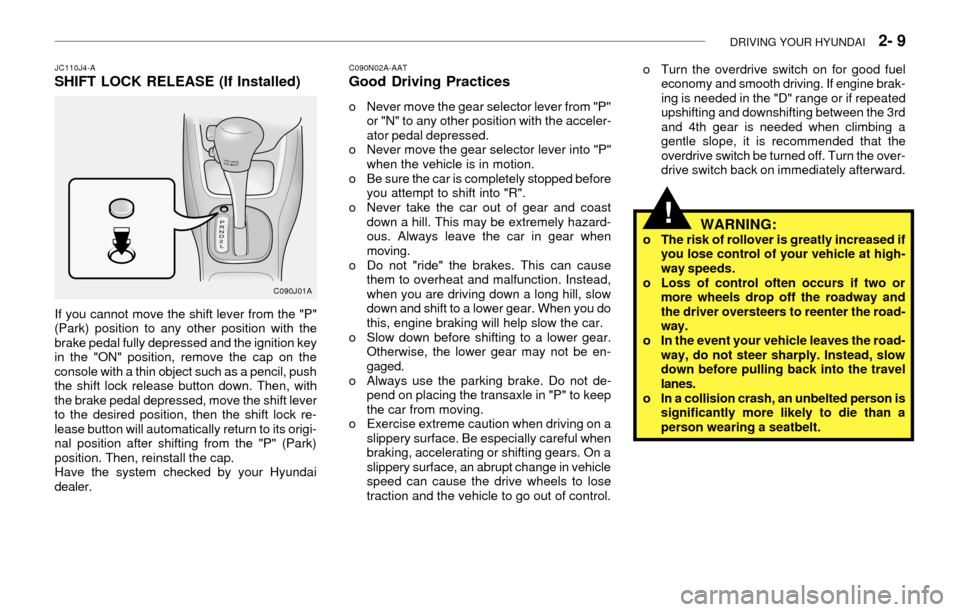
traction and the vehicle to go out of control. If you cannot move the shift lever from the "P"
(Park) position to any other position with the
brake pedal fully depressed and the ignition key
in the "ON" position, remove the cap on the
console with a thin object such as a pencil, push
the shift lock release button down. Then, with
the brake pedal depressed, move the shift lever
to the desired position, then the shift lock re-
lease button will automatically return to its origi-
nal position after shifting from the "P" (Park)
position. Then, reinstall the cap.
Have the system checked by your Hyundai
dealer.
JC110J4-ASHIFT LOCK RELEASE (If Installed)
C090J01A
WARNING:o The risk of rollover is greatly increased if
you lose control of your vehicle at high-
way speeds.
o Loss of control often occurs if two or
more wheels drop off the roadway and
the driver oversteers to reenter the road-
way.
o In the event your vehicle leaves the road-
way, do not steer sharply. Instead, slow
down before pulling back into the travel
lanes.
o In a collision crash, an unbelted person is
significantly more likely to die than a
person wearing a seatbelt.
!
Page 106 of 186
2- 10 DRIVING YOUR HYUNDAI
C130A01A-AATGOOD BRAKING PRACTICES
WARNING:
Nothing should be carried on top of the shelf
panel behind the rear seat. If there were an
accident or a sudden stop, such objects
could move forward and cause damage to
the vehicle or injure the occupants.
!
o After being parked, check to be sure the
parking brake is not engaged and that the
parking brake indicator light is out before
driving away.
o Driving through water may get the brakes
wet. They can also get wet when the car is
washed. Wet brakes can be dangerous! Your
car will not stop as quickly if the brakes are
wet. Wet brakes may cause the car to pull to
one side. To dry the brakes, apply the brakes
lightly until the braking action returns to nor-
mal, taking care to keep the car under con-
trol at all times. If the braking action does not
return to normal, stop as soon as it is safe to
do so and call your Hyundai dealer for assis-
tance.
o Don't coast down hills with the car out of
gear. This is extremely hazardous. Keep the
car in gear at all times, use the brakes to
slow down, then shift to a lower gear so that
engine braking will help you maintain a safe
speed.o Don't "ride" the brake pedal. Resting your
foot on the brake pedal while driving can be
dangerous because it can result in the brakes
overheating and losing their effectiveness. It
also increases the wear of the brake compo-
nents.
o If a tire goes flat while you are driving, apply
the brakes gently and keep the car pointed
straight ahead while you slow down. When
you are moving slowly enough for it to be
safe to do so, pull off the road and stop in a
safe place.
o If your car is equipped with an automatic
transaxle, don't let your car creep forward.
To avoid creeping forward, keep your foot on
the brake pedal when the car is stopped.
o Use caution when parking on a hill. Engage
the parking brake and place the gear selec-
tor lever in "P" (automatic transaxle) or in
first or reverse gear (manual transaxle). If
your car is facing downhill, turn the front
wheels into the curb to help keep the car
from rolling. If your car is facing uphill, turn
the front wheels away from the curb to help
keep the car from rolling. If there is no curb
or if it is required by other conditions to keep
the car from rolling, block the wheels.
o Under some conditions your parking brake
can freeze in the engaged position. This is
most likely to happen when there is an accu-
mulation of snow or ice around or near the
rear brakes or if the brakes are wet. If there
is a risk that the parking brake may freeze,apply it only temporarily while you put the
gear selector lever in "P" (automatic) or in
first or reverse gear (manual transaxle) and
block the rear wheels so the car cannot roll.
Then release the parking brake.
o Do not hold the vehicle on the upgrade with
the accelerator pedal. This can cause the
transmission to overheat. Always use the
brake pedal or parking brake.C120A02A-AAT
ANTI-LOCK BRAKE SYSTEM
(If Installed)
The Anti-Lock Brake System (ABS) is designed
to prevent wheel lock-up during sudden braking
or on hazardous road surfaces. The ABS con-
trol module monitors the wheel speed and con-
trols the pressure applied to each brake. Thus,
in emergency situations or on slick roads, ABS
will increase vehicle control during braking.
NOTE:During ABS operation, a slight pulsation
may be felt in the brake pedal when the
brakes are applied. Also, a noise may be
heard in the engine compartment while brak-
ing. These conditions are normal and indi-
cate that the anti-lock brake system is func-
tioning properly.
Page 109 of 186

DRIVING YOUR HYUNDAI 2- 13
C160H01A-AAT
Use Approved Anti-Freeze in Window
Washer System
To keep the water in the window washer system
from freezing, add an approved anti-freeze so-
lution in accordance with instructions on the
container. Window washer anti-freeze is avail-
able from Hyundai dealers and most auto parts
outlets. Do not use engine coolant or other types
of anti-freeze as these may damage the finish.
C160F01A-AATCheck Spark Plugs and Ignition
System
Inspect your spark plugs as described in Sec-
tion 6 and replace them if necessary. Also
check all ignition wiring and components to be
sure they are not cracked, worn or damaged in
any way.
C160G01A-AAT
To Keep Locks from Freezing
To keep the locks from freezing, squirt an ap-
proved de-icer fluid or glycerine into the key
opening. If a lock is covered with ice, squirt it
with an approved de-icing fluid to remove the
ice. If the lock is frozen internally, you may be
able to thaw it out by using a heated key. Handle
the heated key with care to avoid burning the
fingers.
C160I01A-AATDon't Let Your Parking Brake Freeze
Under some conditions your parking brake can
freeze in the engaged position. This is most
likely to happen when there is an accumulation
of snow or ice around or near the rear brakes or
if the brakes are wet. If you think the parking
brake may freeze, apply it only temporarily while
you put the gear selector lever in "P" (automatic)
or in first or reverse gear (manual transaxle) and
block the rear wheels so the car cannot roll.
Then release the parking brake.
C160K01A-AATCarry Emergency Equipment
Depending on the severity of the weather where
you drive your car, you should carry appropriate
emergency equipment. Some of the items you
may want to carry include tire chains, tow straps
or chains, flashlight, emergency flares, sand, a
shovel, jumper cables, a window scraper, gloves,
ground cloth, coveralls, a blanket, etc.
C160J01A-AAT
Don't Let Ice and Snow Accumulate
Underneath
Under some conditions, snow and ice can build
up under the fenders and interfere with the
steering. When driving in severe winter condi-
tions where this may happen, you should peri-
odically check underneath the car to be sure the
movement of the front wheels and the steering
components is not obstructed.
C170A01A-AAT
HIGHER SPEED MOTORING
Pre-Trip Inspections
1. Tires:
Adjust the tire inflation pressures for highway
driving. Low tire inflation pressures will result in
overheating and possible failure of the tires.
Avoid using worn or damaged tires which may
result in reduced traction or tire failure.
NOTE:Never exceed the maximum tire inflation pres-
sure shown on the tires.
2. Fuel, engine coolant and engine oil:
High speed travel consumes 1.5 times more fuel
than urban motoring. Do not forget to check both
engine coolant and engine oil.
3. Drive belt:
A loose or damaged drive belt may result in
overheating of the engine.
Page 112 of 186
3- 2 WHAT TO DO IN AN EMERGENCY
!
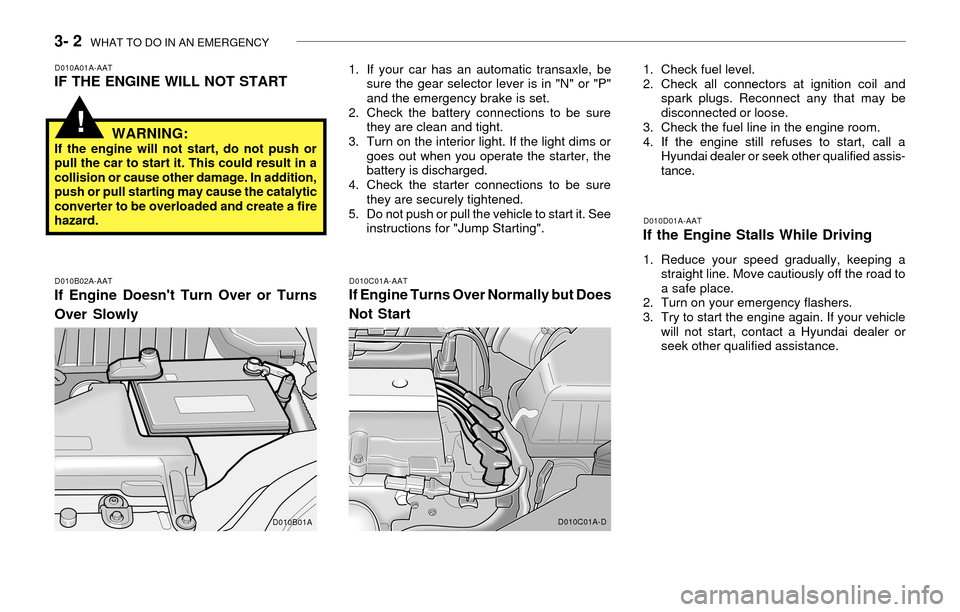
D010B02A-AAT
If Engine Doesn't Turn Over or Turns
Over Slowly
D010A01A-AATIF THE ENGINE WILL NOT START
D010C01A-AATIf Engine Turns Over Normally but Does
Not Start
1. Check fuel level.
2. Check all connectors at ignition coil and
spark plugs. Reconnect any that may be
disconnected or loose.
3. Check the fuel line in the engine room.
4. If the engine still refuses to start, call a
Hyundai dealer or seek other qualified assis-
tance.
D010D01A-AAT
If the Engine Stalls While Driving
1. Reduce your speed gradually, keeping a
straight line. Move cautiously off the road to
a safe place.
2. Turn on your emergency flashers.
3. Try to start the engine again. If your vehicle
will not start, contact a Hyundai dealer or
seek other qualified assistance.
WARNING:If the engine will not start, do not push or
pull the car to start it. This could result in a
collision or cause other damage. In addition,
push or pull starting may cause the catalytic
converter to be overloaded and create a fire
hazard.
D010B01AD010C01A-D
1. If your car has an automatic transaxle, be
sure the gear selector lever is in "N" or "P"
and the emergency brake is set.
2. Check the battery connections to be sure
they are clean and tight.
3. Turn on the interior light. If the light dims or
goes out when you operate the starter, the
battery is discharged.
4. Check the starter connections to be sure
they are securely tightened.
5. Do not push or pull the vehicle to start it. See
instructions for "Jump Starting".
Page 114 of 186
3- 4 WHAT TO DO IN AN EMERGENCY
WARNING:While the engine is running, keep hands,
long hair and clothing away from moving
parts such as the fan and drive belts to
prevent injury.
Spare Tire Pressure
D040A01A-AAT
SPARE TIRE
The following instructions for the temporary spare
tire should be observed:
1. Check inflation pressure as soon as is prac-
tical after installing the spare tire, and adjust
to the specified pressure. The tire pressure
should be periodically checked and main-
tained at the specified pressure while the tire
is stored.
D030A01A-AATIF THE ENGINE OVERHEATS
If your temperature gauge indicates overheat-
ing, you experience a loss of power, or hear loud
pinging or knocking, the engine is probably too
hot. If this happens, you should:
1. Pull off the road and stop as soon as it is safe
to do so.
2. Place the gear selector lever in "P" (auto-
matic), or neutral (manual transaxle) and set
the parking brake. If the air conditioner is on,
turn it off.
3. If coolant is running out under the car or
steam is coming out from the hood, stop the
engine. Do not open the hood until the cool-
ant has stopped running or the steaming has
stopped. If there is no visible loss of coolant
and no steam, leave the engine running and
check to be sure the engine cooling fan is
operating. If the fan is not running, turn the
engine off.
4. Check to see if the water pump drive belt is
missing. If it is not missing, check to see that
it is tight. If the drive belt seems to be
satisfactory, check for coolant leaking from
the radiator, hoses or under the car. (If the air
conditioner had been in use, it is normal for
cold water to be draining from it when you
stop).5. If the water pump drive belt is broken or
coolant is leaking out, stop the engine im-
mediately and call the nearest Hyundai deal-
er for assistance.
WARNING:Do not remove the radiator cap when the
engine is hot. This may allow coolant to be
blown out of the opening and cause serious
burns.
6. If you cannot find the cause of the overheat-
ing, wait until the engine temperature has
returned to normal. Then, if coolant has been
lost, carefully remove the radiator cap and
add water to bring the fluid level in the
reservoir up to the halfway mark.
7. Proceed with caution, keeping alert for fur-
ther signs of overheating. If overheating hap-
pens again, call a Hyundai dealer for assis-
tance.
CAUTION:Serious loss of coolant indicates there is a
leak in the cooling system and this should
be checked as soon as possible by a Hyundai
dealer.
!
!
!
Tire Size
Inflation PressureT105/70D(R)14
60 psi (414 kPa)
Page 115 of 186
WHAT TO DO IN AN EMERGENCY 3- 5
2. The spare tire should only be used tempo-
rarily and should be returned to the luggage
compartment as soon as the original tire can
be repaired or replaced.
3. Continuous use at speeds of over 50 mph
(80 km/h) is not recommended.
4. As the temporary spare tire is specifically
designed for your car, it should not be used
on any other vehicle.
5. The temporary spare tire should not be used
on any other wheels, nor should standard
tires, snow tires, wheel covers or trim rings
be used with the temporary spare wheel. If
such use is attempted, damage to these
items or other car components may occur.
6. The temporary spare tire pressure should be
checked once a month while the tire is stored.D040B01A-AAT
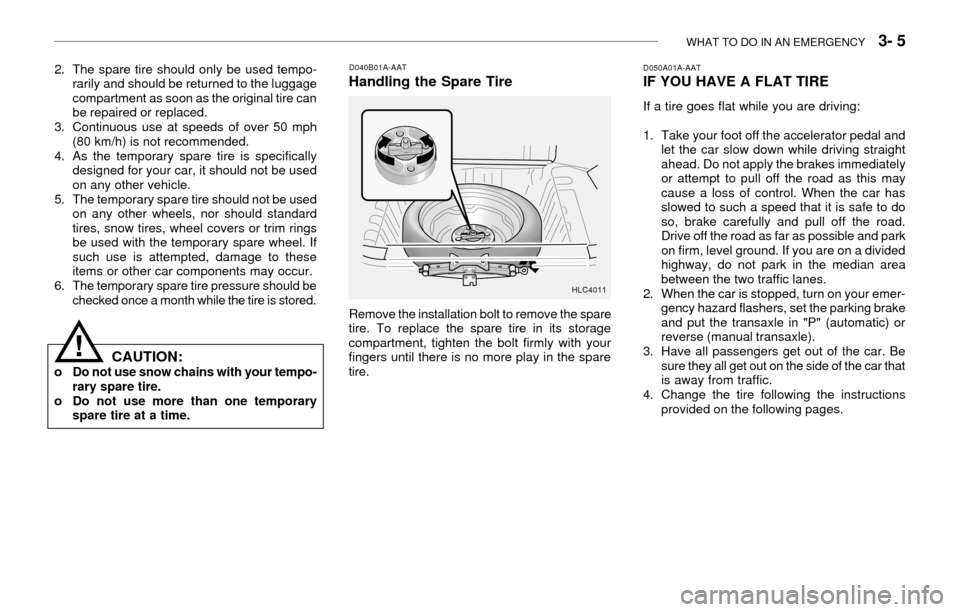
Handling the Spare Tire
Remove the installation bolt to remove the spare
tire. To replace the spare tire in its storage
compartment, tighten the bolt firmly with your
fingers until there is no more play in the spare
tire.
CAUTION:o Do not use snow chains with your tempo-
rary spare tire.
o Do not use more than one temporary
spare tire at a time.
!
HLC4011D050A01A-AAT
IF YOU HAVE A FLAT TIRE
If a tire goes flat while you are driving:
1. Take your foot off the accelerator pedal and
let the car slow down while driving straight
ahead. Do not apply the brakes immediately
or attempt to pull off the road as this may
cause a loss of control. When the car has
slowed to such a speed that it is safe to do
so, brake carefully and pull off the road.
Drive off the road as far as possible and park
on firm, level ground. If you are on a divided
highway, do not park in the median area
between the two traffic lanes.
2. When the car is stopped, turn on your emer-
gency hazard flashers, set the parking brake
and put the transaxle in "P" (automatic) or
reverse (manual transaxle).
3. Have all passengers get out of the car. Be
sure they all get out on the side of the car that
is away from traffic.
4. Change the tire following the instructions
provided on the following pages.
Page 116 of 186

3- 6 WHAT TO DO IN AN EMERGENCY
D060A01A-AATCHANGING A FLAT TIRE
The procedure described on the following pages
can be used to rotate tires as well as to change
a flat tire. When preparing to change a flat tire,
check to be sure the gear selector lever is in "P"
(automatic) or reverse gear (manual transaxle)
and that the parking brake is set, then:
D060A01AD060K02Y-AAT
Wheel Cap (If Installed)
1. Wrap a piece of cloth around the tip of the
wrench bar to avoid scratching.
2. Insert the wrench bar into the groove of the
wheel cap and pry gently to remove the
wheel cap.
3. Change the flat tire.4. Reinstall the wheel cap by fitting the boss of
the wheel cap in the groove of the wheel,
hitting the center of the wheel cap with your
hand.
HLC4009-1HLC4010
Groove