Page 262 of 392

When climbing hills, closely watch
your temperature gauge. If it nears
the red (Hot) mark, turn the air
conditioning of f , reduce speed and, if
necessary, pull to the side of the
road to let the engine cool.
If the transmission shif ts f requently
while going up a hill, shif t down one
gear.
If you must stop when f acing uphill,
use the f oot brake or parking brake.
Do not try to hold the vehicle in
placebypressingontheaccelerator,
as this can cause the automatic
transmission to overheat.
When driving down hills, reduce
your speed and shif t down to D . Do
not ‘‘ride’’ the brakes, and remember
it will take longer to slow down and
stop when towing a trailer.Crosswinds and air turbulence
caused by passing trucks can disrupt
your steering and cause your trailer
to sway. When being passed by a
truck or other large vehicle, keep a
constant speed and steer straight
ahead. Do not try to make quick
steering or braking corrections.
Always drive slowly and have
someone guide you when backing up.
Grip the of the steering
wheel; then turn the wheel to the lef t
to get the trailer to move to the lef t,
andturnthewheelrighttomovethe
trailer to the right.
Follow all normal precautions when
parking, including putting the
transmission in PARK and f irmly
setting the parking brake when you
have f inished parking.
Donotparkonaninclineunlessitis
unavoidable. If you must park on an
incline, turn the vehicle wheels
toward the curb on a downhill and
awayfromthecurbonanuphill.
After parking, place wheel chocks at
each trailer tire, on the downhill side.
If the vehicle wheels slip when
retrieving a boat f rom the water,
shifttofirstgearandturnonVTM-4
Lock (see page ).
Disengage VTM-4 Lock as soon as
the boat is out of the water to
prevent damage to the VTM-4
system.
238
3
bottom
Driving on Hills
Handling Crosswinds and
T urbulence
Backing Up Parking
Ret rieving a Boat
Towing a Trailer
Driving258
Page 263 of 392

When purchasing a tow bar, make
sure you select a reputable
manuf acturer and installer. Follow
the manufacturer’s attachment
instructions caref ully.If you tow more than 8 hours in one
day, you should repeat the above
procedure at least every 8 hours.
(when you stop f or f uel, etc.)
Check the transmission f luid level
(see page ). Maintaining the correct f luid level
is very important.
Start the engine.
Leave the ignition switch in
ACCESSORY (I) so the steering
wheel does not lock. Make sure
the radio and any items plugged
into the accessory power sockets
are turned of f so you do not run
down the battery. Release the parking brake.
Your Pilot can be towed behind a
motorhome at legal highway speeds
up to 65 mph (100 km/h). Do not
exceed 65 mph (100 km/h).
Otherwise, severe transmission
damage will occur. To avoid damage
to the 4WD system, it must be towed
with all f our wheels on the ground
(f lat towing).
Press on the brake pedal. Shif t the
lever through all the positions (P,
R, N, D, D , 2, 1)
ShifttoD,thentoN.Letthe
engine run f or three minutes, then
turn of f the engine.
Do the f ollowing to prepare your
Pilot f or ‘‘f lat towing.’’ Perf orm this
procedure every day immediately
bef ore you begin towing, and f ollow
this procedure exactly; otherwise,
severe automatic transmission
damage will occur. 293
Do not overf ill.
CONT INUED
3
Ext ended T owing
Towing Your Vehicle Behind a Motorhome
Driving259
Page 264 of 392
Replace the transmission fluid every
two years or 30,000 miles (48,000
km), whichever comes f irst.
Towing Your Vehicle Behind a Motorhome
Driving260
The steering system can be damaged if
the steering wheel is locked. Leave the
ignition switch in Accessory (I), and
make sure the steering wheel turns
f reely bef ore you begin towing.
Improper towing preparation will
damage the transmission. Follow the
above procedure exactly. If you cannot
shif t the transmission or start the
engine, your vehicle must be
transported on a f lat-bed or trailer.
Page 280 of 392

�µ
�µ
�Î
�Î
�Î�Ì
�Ì �Ì
�Ì�Î
�Ì
�Î
�Î
Follow the Maintenance
Schedule f or Severe Conditions.
Driving less than 5 miles (8 km)
per trip or, in f reezing
temperatures, driving less than
10 miles (16 km) per trip.
Driving in extremely hot [over
90°F (32°C)] conditions.
Extensive idling or long periods
of stop-and-go driving.
Trailer towing, driving with a
roof top carrier, or driving in
mountainous conditions.
Driving on muddy, dusty, or de-
iced roads.
Follow the Severe Conditions
Maintenance Schedule if you drive
your vehicle
MAINLYunder one or
more of the f ollowing conditions:
Maint enance
U.S. Owners
Canadian Owners
276
Visually inspect the following items: Replace every 3,750 miles (6,000 km) or 6 months
Service at the indicated
distance or time whichever
comes first.
miles x 1,000
km x 1,000
months
Inspect every 7,500 miles (12,000 km) or 6 monthsCheck oil and coolant at each fuel stop
Rotate tires every 7,500 miles (12,000 km)
Tie rod ends, steering gear box, and boots
Suspension components
Driveshaft boots
Brake hoses and lines (including ABS)
All fluid levels and conditions of fluids
Cooling system hoses and connections
Exhaust system
Fuel lines and connections
Lights and controls
Vehicle underbody Every 7,500 miles (12,000 km) or 6 months
15
24
12
30
48
2445
72
3660
96
4875
120 60 90
144 72 105
168
84 120
192
96
Follow this schedule for rear differential
fluid replacement if you use your vehicle
for off-highway driving, trailer towing,
or mainly in stop-and go driving.
Otherwise, use the fluid replacement
schedule in the Maintenance Schedule
for Normal Conditions.
Every 3 years (independent of mileage)
120,000 miles (192,000 km) or 10 years, then every
60,000 miles (96,000 km) or 5 years
Replace engine oil and oil filter
Check engine oil and coolant
Replace air cleaner element
Use normal schedule except in dusty
conditions
Inspect valve clearance
Replace spark plugs
Replace timing belt and inspect water pump
Inspect and adjust drive belts
Inspect idle speed
Replace engine coolant
Replace transmission fluid
Replace VTM-4 rear differential fluid
Inspect front and rear brakes
Replace brake fluid
Check parking brake adjustment
Replace dust and pollen filter
Lubricate all hinges, locks and latches
Rotate tires (Check tire inflation and condition at
least once per month) 7.5
12 6
Adjust only if noisy
Refer to page308for replacement
information under special driving
conditions.
Refer to page 307for replacement
information under special driving
conditions.
1:
2:
3:
: See page 273.
,1
3
2
Maintenance Schedule for Severe Conditions
Page 282 of 392

�Ø
�Ø
�Ø�Ø
�Ø
�Ø
�Ø
�Î�Ì
�Ì
�Ì
�Î
�Î
�Î
�Î
Maint enance278
See information on maintenance and emissions warranty, last
column, page .
See timing belt on page to determine need for replacement.
See dust and pollen filter on page for replacement
information under special driving conditions.
Follow this schedule for rear differential fluid replacement if you
use your vehicle for off-highway driving, trailer towing, or
mainly in stop-and go driving. Otherwise, use the fluid
replacement schedule in the Maintenance Schedule for Normal
Conditions.
Necessary for proper break-in of the VTM-4 rear differential.
Check engine oil and coolant at each fuel stop.
Check and adjust valve clearance, cold engine, only if noisy.
NOTE: :
1:
2:
3:
4:
273
308 307DoitemsinA,B,C,E.
Do items in A.
Do items in A, B.
Do items in A.Replace brake fluid (independent of mileage)
DoitemsinA,B,C,D,E.
Do items in A.
Do items in A, B.
Do items in A. Replace timing belt , and inspect water
pump. Inspect valve clearance. Replace spark plugs.
Inspect idle speed . Do items in A, B, C, E.
Do items in A.
Do items in A, B.
Do items in A.
DoitemsinA,B,C,D,E. Replace brake fluid (independent of mileage)
Replace engine coolant.
75,000 mi/120,000 km/5 yrs
78,750 mi/126,000 km
82,500 mi/132,000 km
86,250 mi/138,000 km
6yrs
90,000 mi/144,000 km/6 yrs
93,750 mi/150,000 km
97,500 mi/156,000 km
101,250 mi/162,000 km
105,000 mi/168,000 km/7 yrs
108,750 mi/174,000 km
112,500 mi/180,000 km
116,250 mi/186,000 km
120,000 mi/192,000 km/8 yrs
9yrs
120,000 mi/ 192,000 km/10 yrs
then every 60,000 mi/
96,000 km/5 yrs
1,
Maintenance Schedule for Severe Conditions (listed by distance/time)
Page 337 of 392

This section covers the more-
common problems that motorists
experience with their vehicles. It
gives you inf ormation about how to
safely evaluate the problem and what
to do to correct it. If the problem has
stranded you on the side of the road,
you may be able to get going again.
If not, you will also f ind instructions
on getting your vehicle towed.......................
Compact Spare Tire .334
....................
Changing a Flat Tire .335
..........
If Your Engine Won’t Start . 342
Nothing Happens or the Starter Motor Operates ........................
Very Slowly .342
The Starter Operates ................................
Normally .342
................................
Jump Starting .343
............
If Your Engine Overheats . 345
.........
Low Oil Pressure Indicator . 347
..........
Charging System Indicator . 348
.......
Malf unction Indicator Lamp . 349
...............
Brake System Indicator . 351
..............................................
Fuses .352
..........
Checking and Replacing . 353
......................
Emergency Towing .358
Taking Care of the Unexpected
T aking Care of t he Unexpect ed333
Page 338 of 392
Your vehicle has a compact spare
tire that takes up less space. Use this
sparetireasatemporaryreplace-
ment only. Get your regular tire
repaired or replaced and put it back
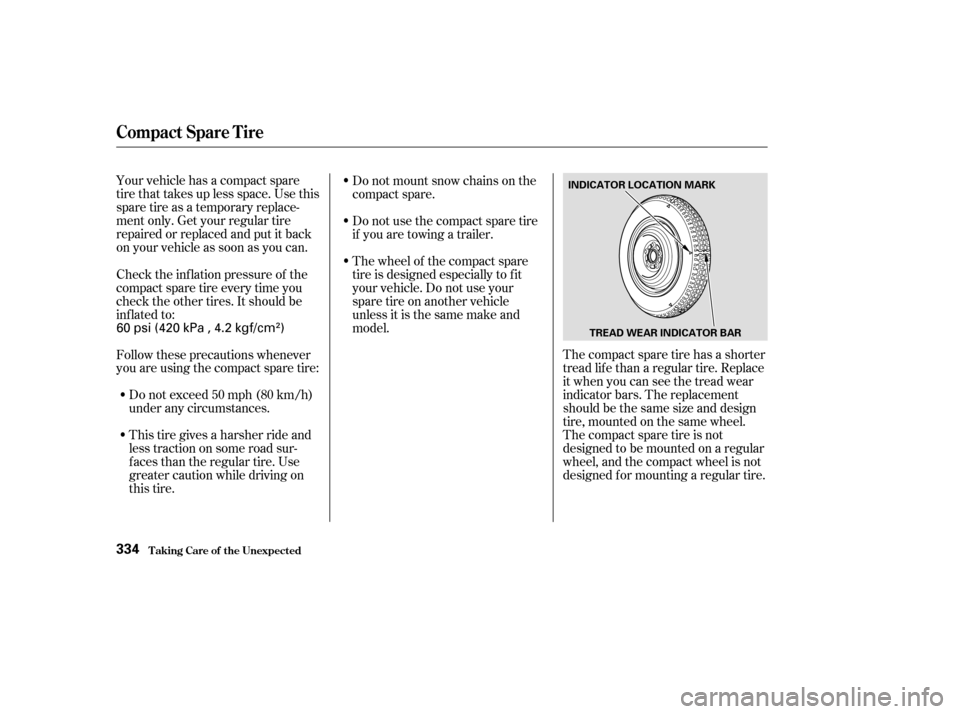
on your vehicle as soon as you can.Thecompactsparetirehasashorter
tread lif e than a regular tire. Replace
it when you can see the tread wear
indicator bars. The replacement
should be the same size and design
tire, mounted on the same wheel.
Thecompactsparetireisnot
designed to be mounted on a regular
wheel, and the compact wheel is not
designed f or mounting a regular tire.
Check the inf lation pressure of the
compact spare tire every time you
check the other tires. It should be
inf lated to:
This tire gives a harsher ride and
less traction on some road sur-
f aces than the regular tire. Use
greater caution while driving on
this tire. Do not exceed 50 mph (80 km/h)
under any circumstances.
Follow these precautions whenever
you are using the compact spare tire: Do not mount snow chains on the
compact spare.
Do not use the compact spare tire
if you are towing a trailer.
The wheel of the compact spare
tire is designed especially to f it
your vehicle. Do not use your
sparetireonanothervehicle
unlessitisthesamemakeand
model.
Compact Spare Tire
T aking Care of t he Unexpect ed334
INDICATOR LOCATION MARK
TREAD WEAR INDICATOR BAR
60 psi (420 kPa , 4.2 kgf/cm)
Page 345 of 392
Store the jack in its holder. Turn
the jack’s end bracket to lock it in
place. Store the tools, and install
the cover.
24.
Changing a Flat T ire
T aking Care of t he Unexpect ed341
Loose items can fly around the
interior in a crash and could
seriously injure the occupants.
Store the wheel, jack, and tools
securely before driving.
Always raise the spare tire hoist, even
if you are not stowing a tire. If the
hoist is lef t down, it will be damaged
during driving and need to be replaced.