Page 241 of 392
If you need to use the Shif t Lock
Release, it means your vehicle is
developing a problem. Have the
vehicle checked by your Honda
dealer.
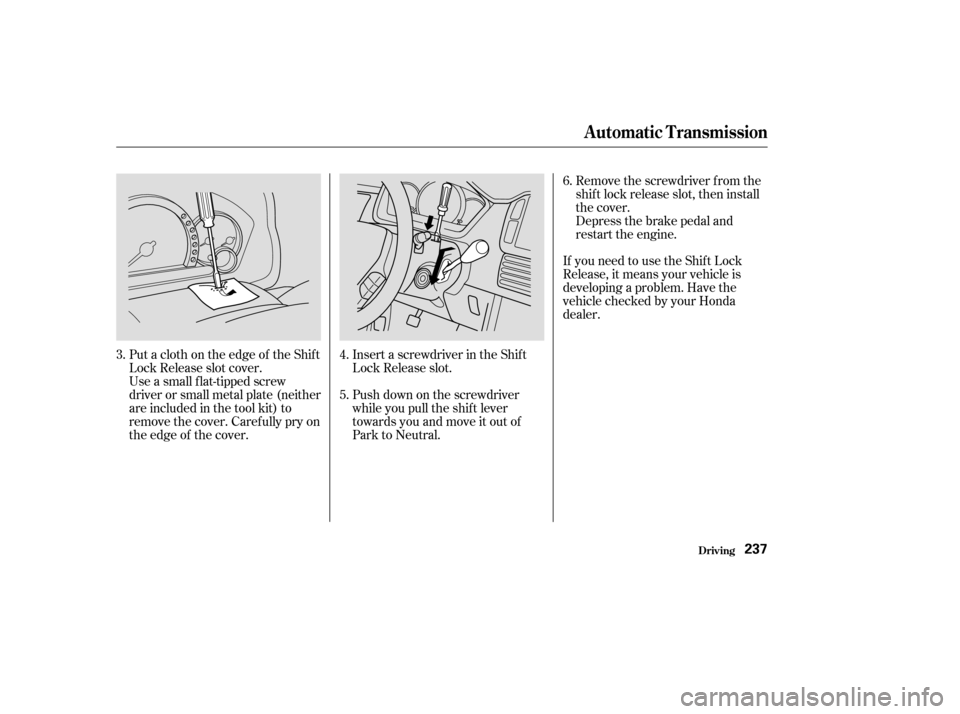
Put a cloth on the edge of the Shif t
Lock Release slot cover.
Use a small flat-tipped screw
driver or small metal plate (neither
are included in the tool kit) to
remove the cover. Caref ully pry on
the edge of the cover. Insert a screwdriver in the Shif t
Lock Release slot.
Push down on the screwdriver
while you pull the shif t lever
towards you and move it out of
Park to Neutral.Remove the screwdriver f rom the
shif t lock release slot, then install
the cover.
Depress the brake pedal and
restart the engine.
3. 4.
5.6.
Driving
Automatic Transmission
237
Page 243 of 392

To engage the VTM-4 Lock:To disengage the VTM-4 Lock, do
one of the f ollowing:
The VTM-4 Lock will temporarily
disengage when the vehicle speed
exceeds 18 mph (30 km/h). It will
automatically engage again as the
speed slows below 18 mph (30
km/h). The light in the VTM-4 Lock
button will remain on the whole time.
The vehicle must be stopped with
the engine running.
Move the shift lever to first (1),
second (2) or reverse (R) gear.
Press the VTM-4 Lock button.
The light in the button will come
on.
To get unstuck, apply light pressure
to the accelerator pedal. Do not spin
the f ront tires f or more than a f ew
seconds. Because of the amount of
torque applied to the rear tires, they
should not spin. This is normal. If
you are not able to get the vehicle to
move, apply the brakes to stop the
wheels, then reverse direction. Press the VTM-4 Lock button.
Move the shift lever to D, or D .
Turn the ignition to OFF (0).
When you restart your Pilot, the
VTM-4 Lock f eature will be of f .
1.
2.
3.
3
Variable Torque Management 4WD System
Driving239
Do not continuously spin the f ront tires
of your PILOT. Continuously spinning
the f ront tires can cause transmission
or rear dif f erential damage.
Page 244 of 392

�µ
Always use the parking brake when
you park your vehicle. The indicator
on the instrument panel shows that
the parking brake is not f ully
released; it does not indicate that the
parking brake is f irmly set. Make
sure the parking brake is set f irmly
or your vehicle may roll if it is
parked on an incline.
Set the parking brake bef ore you put
the transmission in Park. This keeps
the vehicle from moving and putting
pressure on the parking mechanism
in the transmission making it
easier to move the shif t lever out of
Park when you want to drive away. If the vehicle is f acing uphill, turn
the f ront wheels away f rom the curb.
If the vehicle is f acing downhill, turn
the f ront wheels toward the curb.
Make sure the parking brake is f ully
released bef ore driving away.
Driving with the parking brake
partially set can overheat or damage
the rear brakes.
Make sure the windows are closed.
Turn of f the lights.
Place any packages, valuables, etc.,
in the cargo area or take them
with you.
Lockthedoorswiththekeyorthe
remote transmitter.
Never park over dry leaves, tall
grass, or other f lammable
materials. The three way catalytic
converter gets very hot, and could
cause these materials to catch on
fire.
Parking T ips
Parking
Driving240
Page 253 of 392

�Î
�Î
�ÎEquipped with transmission cooler and power steering f luid cooler.
Equipped with transmission cooler and power steering f luid cooler.
Number of
Occupants 2
3
4
5
6
7
8
Number of
Occupants 2
3
4
5
6
7
8 Max. T railer Weight
T owing is Not Recommended Max. T ongue Load
Max. T railer Weight Max. T ongue Load
T owing is Not Recommended
Towing a Trailer
Driving249
The corresponding weight limits assume occupants fill seats from the front of the vehicle to the back, each occupant weighs 150 lbs (70 kg) and each has 1 5lbs(7
kg) of luggage in the cargo area.
Total Trailer Weight and Tongue Load Limits: BOAT TRAILERS
OTHER TYPES OF TRAILERS
4500 lbs (2045 kg)
4500 lbs (2045 kg)
4500 lbs (2045 kg)
4300 lbs (1945 kg)
4100 lbs (1855 kg) 2000 lbs (905 kg) 450 lbs (205 kg)
450 lbs (205 kg)
450 lbs (205 kg)
350 lbs (160 kg)
220 lbs (100 kg)
100 lbs (45 kg)
3500 lbs (1590 kg)
3500 lbs (1590 kg)
3300 lbs (1490 kg)
3100 lbs (1400 kg)
2700 lbs (1220 kg) 1200 lbs (540 kg) 450 lbs (205 kg)
450 lbs (205 kg)
450 lbs (205 kg)
350 lbs (160 kg)
220 lbs (100 kg)
100 lbs (45 kg)
Page 257 of 392

Discuss any additional needs with
your trailer sales or rental agency,
and make sure all equipment is
properly installed and maintained.
Since local requirements may vary,
check with appropriate state
authorities to be sure that your
equipment will meet all regulations
in the areas where you plan to tow.Always use saf ety chains when you
tow a trailer. Make sure the chains
are secured to the trailer and hitch,
and that they cross under the tongue
so they can catch the trailer if it
becomes unhitched. Leave enough
slack to allow the trailer to turn
corners easily, but to do not let the
chains drag on the ground.This device is recommended if your
trailer tends to sway. Your trailer
maker can tell you what kind of sway
control you need and how to install it.
Towing generally requires a variety
of supplemental equipment. To
ensure the best quality, we
recommend that you purchase
Honda equipment whenever possible.
Your dealer of f ers a trailer package
that includes a hitch, a ball mount, a
wiring harness, a transmission f luid
cooler, and a heavy-duty power
steering f luid cooler. We strongly recommend that you
have your Honda dealer install a
genuine Honda hitch and the
required f luid coolers. Using non-
Honda equipment may result in
serious damage to your vehicle.
A weight distributing hitch is not
recommended f or use with your Pilot
as an improperly adjusted weight
distributing hitch may reduce
handling stability and braking
perf ormance.
To help prevent overheating, a
heavy-duty transmission f luid cooler
and a heavy-duty power steering
f luid cooler are required f or trailer
towing. These coolers are available
only f rom your Honda dealer.
CONT INUED
T owing Equipment and
A ccessoriesHitch
Weight Distributing HitchSaf et y Chains Sway Cont rol
T ransmission Fluid Cooler andPower St eering Fluid Cooler
Towing a Trailer
Driving253
Page 261 of 392

The added weight, length, and
height of a trailer will af f ect your
vehicle’s handling and perf ormance,
so driving with a trailer requires
some special driving skills and
techniques.
Foryoursafetyandthesafetyof
others,taketimetopracticedriving
maneuvers bef ore heading f or the
open road, and f ollow the guidelines
discussed below.
Avoid towing a trailer during your
vehicle’s f irst 500 miles (800
kilometers) (see page ).Drive slower than normal in all
driving situations. Obey all local
speed limits f or vehicles with trailers.
To keep the transmission f rom
f requently upshif ting and
downshif ting, drive in D. When
driving with a f ix-sided (e.g, camper,
utility) trailer, do not exceed 55 mph
(88 km/h). At higher speeds, the
trailer may sway or affect vehicle
handling.
Maketurnsmoreslowlyandwider
than normal. The trailer tracks a
smaller arc than your vehicle, and it
canhitorrunoversomethingthe
vehicle misses. Allow more time and
distance f or braking. When you need
to slow down, slowly lif t your f oot of f
the throttle and gradually apply the
brakes. Do not brake or turn
suddenly as this could cause the
trailer to jackknif e or turn over.
216
CONT INUED
Driving Saf ely With a T railer
Break-In Period T owing Speed
Making T urns and Braking
Towing a Trailer
Driving257
Page 262 of 392

When climbing hills, closely watch
your temperature gauge. If it nears
the red (Hot) mark, turn the air
conditioning of f , reduce speed and, if
necessary, pull to the side of the
road to let the engine cool.
If the transmission shif ts f requently
while going up a hill, shif t down one
gear.
If you must stop when f acing uphill,
use the f oot brake or parking brake.
Do not try to hold the vehicle in
placebypressingontheaccelerator,
as this can cause the automatic
transmission to overheat.
When driving down hills, reduce
your speed and shif t down to D . Do
not ‘‘ride’’ the brakes, and remember
it will take longer to slow down and
stop when towing a trailer.Crosswinds and air turbulence
caused by passing trucks can disrupt
your steering and cause your trailer
to sway. When being passed by a
truck or other large vehicle, keep a
constant speed and steer straight
ahead. Do not try to make quick
steering or braking corrections.
Always drive slowly and have
someone guide you when backing up.
Grip the of the steering
wheel; then turn the wheel to the lef t
to get the trailer to move to the lef t,
andturnthewheelrighttomovethe
trailer to the right.
Follow all normal precautions when
parking, including putting the
transmission in PARK and f irmly
setting the parking brake when you
have f inished parking.
Donotparkonaninclineunlessitis
unavoidable. If you must park on an
incline, turn the vehicle wheels
toward the curb on a downhill and
awayfromthecurbonanuphill.
After parking, place wheel chocks at
each trailer tire, on the downhill side.
If the vehicle wheels slip when
retrieving a boat f rom the water,
shifttofirstgearandturnonVTM-4
Lock (see page ).
Disengage VTM-4 Lock as soon as
the boat is out of the water to
prevent damage to the VTM-4
system.
238
3
bottom
Driving on Hills
Handling Crosswinds and
T urbulence
Backing Up Parking
Ret rieving a Boat
Towing a Trailer
Driving258
Page 263 of 392

When purchasing a tow bar, make
sure you select a reputable
manuf acturer and installer. Follow
the manufacturer’s attachment
instructions caref ully.If you tow more than 8 hours in one
day, you should repeat the above
procedure at least every 8 hours.
(when you stop f or f uel, etc.)
Check the transmission f luid level
(see page ). Maintaining the correct f luid level
is very important.
Start the engine.
Leave the ignition switch in
ACCESSORY (I) so the steering
wheel does not lock. Make sure
the radio and any items plugged
into the accessory power sockets
are turned of f so you do not run
down the battery. Release the parking brake.
Your Pilot can be towed behind a
motorhome at legal highway speeds
up to 65 mph (100 km/h). Do not
exceed 65 mph (100 km/h).
Otherwise, severe transmission
damage will occur. To avoid damage
to the 4WD system, it must be towed
with all f our wheels on the ground
(f lat towing).
Press on the brake pedal. Shif t the
lever through all the positions (P,
R, N, D, D , 2, 1)
ShifttoD,thentoN.Letthe
engine run f or three minutes, then
turn of f the engine.
Do the f ollowing to prepare your
Pilot f or ‘‘f lat towing.’’ Perf orm this
procedure every day immediately
bef ore you begin towing, and f ollow
this procedure exactly; otherwise,
severe automatic transmission
damage will occur. 293
Do not overf ill.
CONT INUED
3
Ext ended T owing
Towing Your Vehicle Behind a Motorhome
Driving259