2003 HONDA PILOT seats
[x] Cancel search: seatsPage 22 of 392
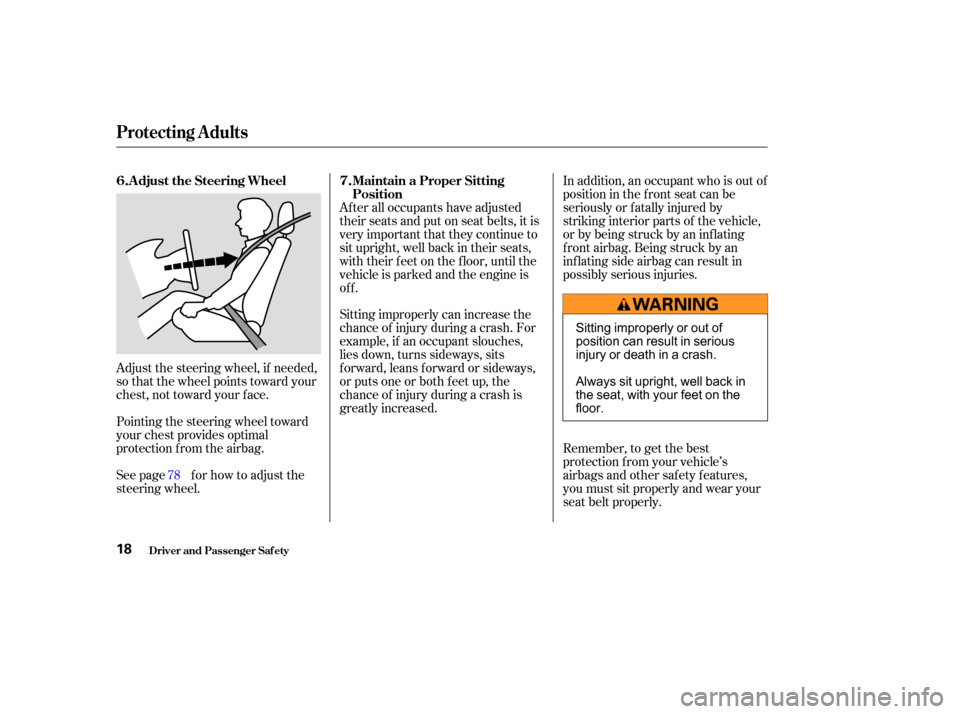
Adjust the steering wheel, if needed,
so that the wheel points toward your
chest, not toward your f ace.
Pointing the steering wheel toward
your chest provides optimal
protection f rom the airbag.
See page f or how to adjust the
steering wheel.Sitting improperly can increase the
chance of injury during a crash. For
example, if an occupant slouches,
lies down, turns sideways, sits
forward, leans forward or sideways,
or puts one or both f eet up, the
chance of injury during a crash is
greatly increased. After all occupants have adjusted
their seats and put on seat belts, it is
very important that they continue to
sit upright, well back in their seats,
with their feet on the floor, until the
vehicle is parked and the engine is
off.
In addition, an occupant who is out of
position in the f ront seat can be
seriously or f atally injured by
striking interior parts of the vehicle,
or by being struck by an inf lating
f ront airbag. Being struck by an
inf lating side airbag can result in
possibly serious injuries.
Remember, to get the best
protection f rom your vehicle’s
airbags and other safety features,
you must sit properly and wear your
seat belt properly.
78
Adjust the Steering Wheel
Maintain a Proper Sitting
Position
6.
7.
Protecting Adults
Driver and Passenger Saf ety18
Sitting improperly or out of
position can result in serious
injury or death in a crash.
Always sit upright, well back in
the seat, with your feet on the
floor.
Page 23 of 392
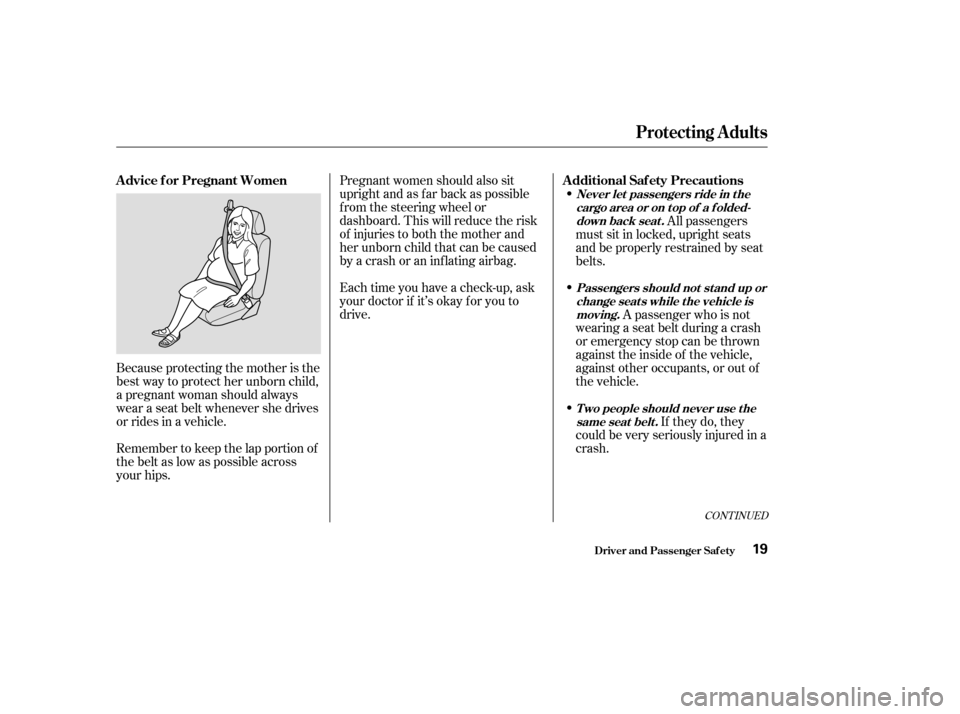
Pregnant women should also sit
upright and as f ar back as possible
f rom the steering wheel or
dashboard. This will reduce the risk
of injuries to both the mother and
her unborn child that can be caused
by a crash or an inf lating airbag.
Each time you have a check-up, ask
your doctor if it’s okay f or you to
drive.
Because protecting the mother is the
best way to protect her unborn child,
a pregnant woman should always
wear a seat belt whenever she drives
or rides in a vehicle.
Remember to keep the lap portion of
the belt as low as possible across
your hips. All passengers
must sit in locked, upright seats
andbeproperlyrestrainedbyseat
belts.
A passenger who is not
wearing a seat belt during a crash
or emergency stop can be thrown
against the inside of the vehicle,
against other occupants, or out of
the vehicle.
If they do, they
could be very seriously injured in a
crash.
CONT INUED
Advice f or Pregnant Women Additional Saf ety Precautions
Never let passengers ride in t he
cargo area or on t op of a f olded-down back seat .
Passengers should not st and up orchange seats while the vehicle ismoving.
T wo people should never use t hesame seat belt .
Protecting Adults
Driver and Passenger Saf ety19
Page 29 of 392

Using this f eature will
prevent children f rom opening the
doors and accidentally f alling out
(see page ).
Many parents say they pref er to put
an inf ant or small child in the f ront
passenger seat so they can watch the
child, or because the child requires
attention.
Your vehicle has two rows of back
seats where children can be properly
restrained.
Place the largest child in the f ront
seat, provided the child is large
enough to wear a seat belt
properly (see page ).
Move the vehicle seat as far to the
rear as possible (see page ).
Have the child sit upright and well
backintheseat(seepage ).
Make sure the seat belt is properly
positioned and secured (see page ).
If you ever have to carry a group of
children (when carpooling f or
example), and a child must ride in
front:
Using
this f eature will prevent children
f rom playing with the windows,
which could expose them to
hazards or distract the driver (see
page ).
Placing a child in the f ront seat
exposes the child to hazards f rom
the passenger’s f ront airbag, and
paying close attention to a child
distracts the driver f rom the
important tasks of driving, placing
both of you at risk.
If a child requires physical attention
or f requent visual contact, we
strongly recommend that another
adult ride with the child in a back
seat. The back seat is far safer for a
child than the front.
Even very young
children learn how to unlock
vehicle doors, turn on the ignition,
and open the tailgate, which can
lead to accidental injury or death.
12
15 38
18 87
99
CONT INUED
Additional Saf ety Precautions
If a Child Requires Close
Attention
If You Must Drive with Several
Children
Use childproof door locks t o
prevent children f rom opening t hedoors.
Use t he main power windowswit ch t o prevent children f romopening t he rear windows.
K eep vehicle keys and remot etransmitters out of the reach ofchildren.
Protecting Children
Driver and Passenger Saf ety25
Page 30 of 392
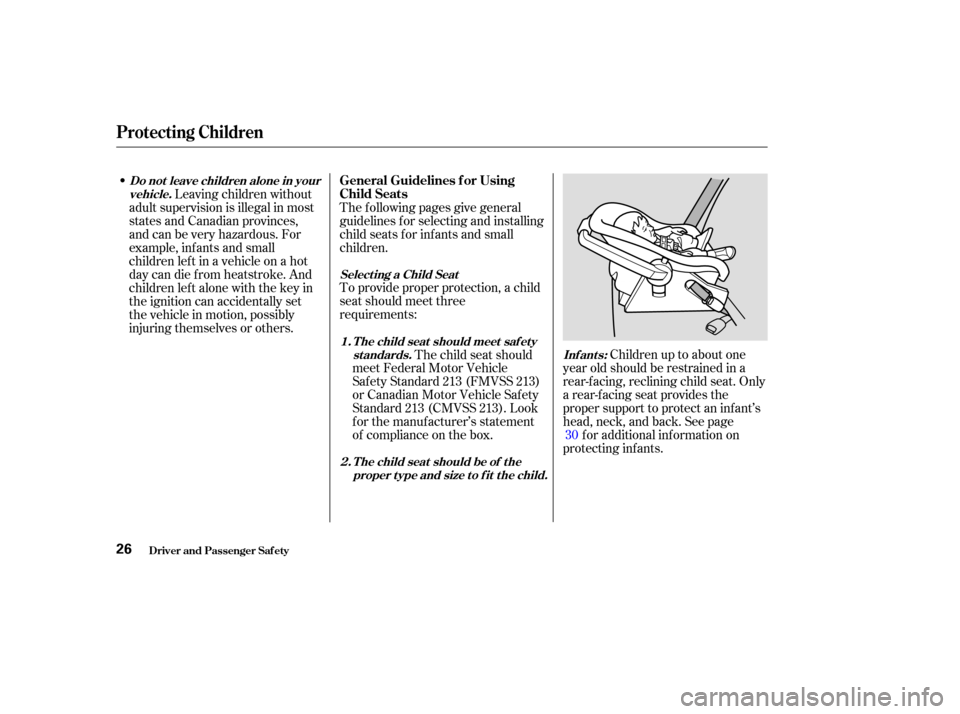
Childrenuptoaboutone
year old should be restrained in a
rear-f acing, reclining child seat. Only
a rear-f acing seat provides the
proper support to protect an inf ant’s
head, neck, and back. See page for additional information on
protecting inf ants.
The f ollowing pages give general
guidelines f or selecting and installing
child seats f or inf ants and small
children.
To provide proper protection, a child
seat should meet three
requirements:
Leaving children without
adult supervision is illegal in most
states and Canadian provinces,
and can be very hazardous. For
example, inf ants and small
childrenleftinavehicleonahot
day can die f rom heatstroke. And
children lef t alone with the key in
the ignition can accidentally set
the vehicle in motion, possibly
injuring themselves or others.
The child seat should
meet Federal Motor Vehicle
Saf ety Standard 213 (FMVSS 213)
or Canadian Motor Vehicle Saf ety
Standard 213 (CMVSS 213). Look
for the manufacturer’s statement
of compliance on the box. 30Inf ant s:
Select ing a Child Seat
T he child seat should be of theproper t ype and size t o f it t he child.
Do not leave children alone in your
vehicle.
T he child seat should meet saf et yst andards.
1.
2.
General Guidelines f or Using
Child Seats
Protecting Children
Driver and Passenger Saf ety26
Page 31 of 392
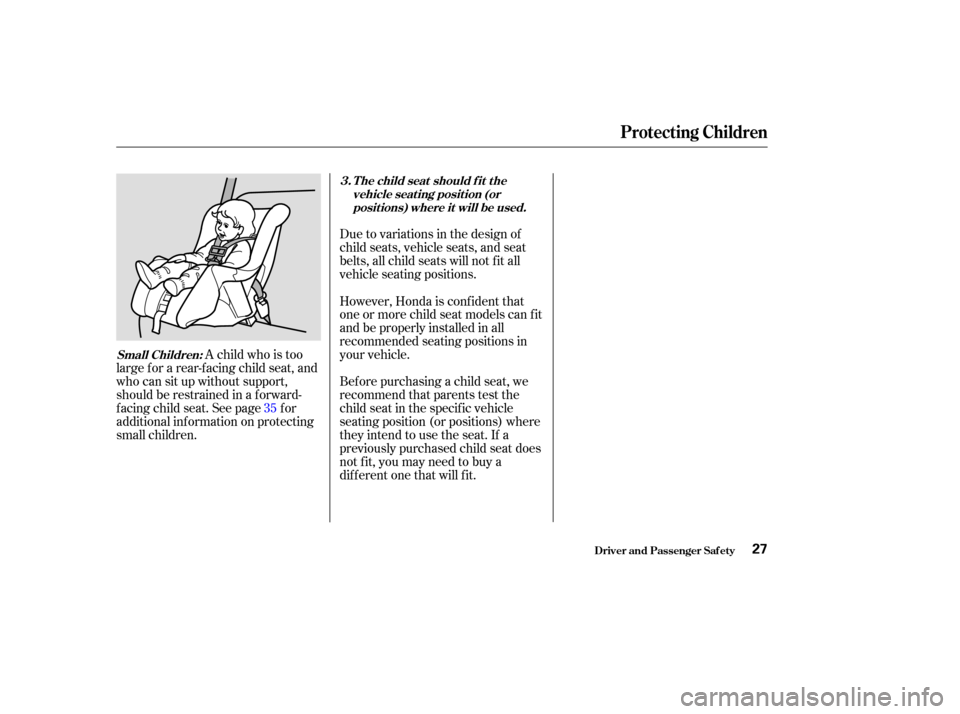
A child who is too
large f or a rear-f acing child seat, and
who can sit up without support,
should be restrained in a f orward-
f acing child seat. See page f or
additional inf ormation on protecting
small children. Due to variations in the design of
child seats, vehicle seats, and seat
belts, all child seats will not f it all
vehicle seating positions.
Bef ore purchasing a child seat, we
recommend that parents test the
child seat in the specif ic vehicle
seating position (or positions) where
they intend to use the seat. If a
previously purchased child seat does
not f it, you may need to buy a
different one that will fit. However, Honda is conf ident that
one or more child seat models can f it
andbeproperlyinstalledinall
recommended seating positions in
your vehicle.
35Small Children: T he child seat should f it the
vehicle seat ing posit ion (orposit ions) where it will be used.
3.
Protecting Children
Driver and Passenger Saf ety27
Page 32 of 392

A small child in a f orward-f acing
child seat is also at risk. If the
vehicle seat is too f ar f orward,
or the child’s head is thrown
f orward during a collision, an
inf lating airbag can kill or
seriously injure the child.
If a small child must ride in the
f ront, f ollow the instructions
provided in this section. The passenger’s f ront airbag
inf lates with enough f orce to kill
or seriously injure an inf ant in a
rear-facing child seat.Recommended positions.
Properlysecurearear-facingchild
seat (see page ).
Recommended
positions. Properly secure a f ront-
f acing child seat (see page ). Never in the f ront seat, due
to the f ront airbag hazard.
Not recommended,
due to the f ront airbag hazard. If a
small child must ride in f ront,
move the vehicle seat to the rear-
most position and secure a f ront-
f acing child seat with the seat belt
(see page ).
This page brief ly summarizes
Honda’s recommendations on where
to place rear-facing and forward-
f acing child seats in your vehicle.
36
31
36
Placing a Child Seat
Front Passenger’s Seat
Back Seat sInf ant s:
Small children:
Inf ant s:
Small children:
Airbags Pose SeriousRisks to Children
Protecting Children
Driver and Passenger Saf ety28
Page 33 of 392

Af ter selecting a proper child seat,
and a good position to install the seat,
there are three main steps in
installing the seat:Make sure the child is properly
strappedinthechildseat
according to the child seat maker’s
instructions. A child who is not
properly secured in a child seat
canbethrownoutof theseatina
crash and be seriously injured.
However, a child seat does not need
to be ‘‘rock solid.’’ In some vehicles
or seating positions, it may be
dif f icult to install a child seat so that
it does not move at all. Some side-to-
side or back-and-f orth movement can
be expected and should not reduce
the child seat’s ef f ectiveness. When you are not using a child seat,
either remove it and store it in a saf e
place, or make sure it is properly
secured. An unsecured child seat can
be thrown around the vehicle during
a crash or sudden stop and injure
someone.
If the child seat is not secure, try
installing it in a dif f erent seating
position, or use a dif f erent style of
child seat that can be f irmly secured
in the desired seating position. To provide security during normal
driving maneuvers as well as during
a collision, we recommend that
parents secure a child seat as f irmly
as possible.
All child seats are
designed to be secured to the
vehicle with the lap part of a lap/
shoulder belt. Some child seats
can be secured to the vehicle’s
LATCH anchorage system instead.
A child whose seat is not properly
secured to the vehicle can be
endangered in a crash. See pages , and f or instructions on
howtoproperlysecurechildseats
in this vehicle.
Af ter installing a child
seat, push and pull the seat
f orward and f rom side to side to
verif y that it is secure. 31 4436
Inst alling a Child Seat
Secure t he child in t he child seat .
Storing a Child Seat
Properly secure t he child seat t o
the vehicle.
Make sure t he child seat is f irmlysecured.
1.
2. 3.
Protecting Children
Driver and Passenger Saf ety29
Page 34 of 392
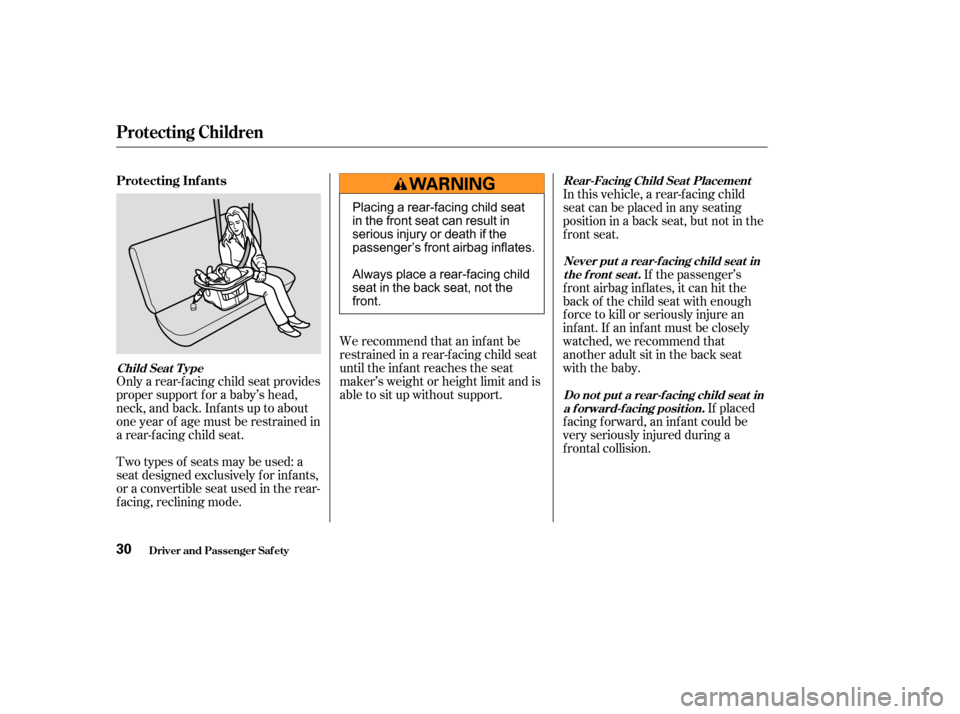
Only a rear-f acing child seat provides
proper support f or a baby’s head,
neck, and back. Inf ants up to about
one year of age must be restrained in
a rear-f acing child seat.We recommend that an inf ant be
restrained in a rear-f acing child seat
until the inf ant reaches the seat
maker’s weight or height limit and is
able to sit up without support.
Two types of seats may be used: a
seat designed exclusively f or inf ants,
or a convertible seat used in the rear-
f acing, reclining mode. In this vehicle, a rear-f acing child
seatcanbeplacedinanyseating
positioninabackseat,butnotinthe
front seat.
If the passenger’s
f ront airbag inf lates, it can hit the
back of the child seat with enough
f orce to kill or seriously injure an
inf ant. If an inf ant must be closely
watched, we recommend that
another adult sit in the back seat
with the baby.
If placed
f acing f orward, an inf ant could be
very seriously injured during a
f rontal collision.
Protecting Inf ants
Child Seat T ype
Rear-Facing Child Seat Placement
Never put a rear-f acing child seat inthe front seat.
Do not put a rear-f acing child seat ina f orward-f acing position.
Protecting Children
Driver and Passenger Saf ety30
Placing a rear-facing child seat
in the front seat can result in
serious injury or death if the
passenger’s front airbag inflates.
Always place a rear-facing child
seat in the back seat, not the
front.