Page 352 of 392
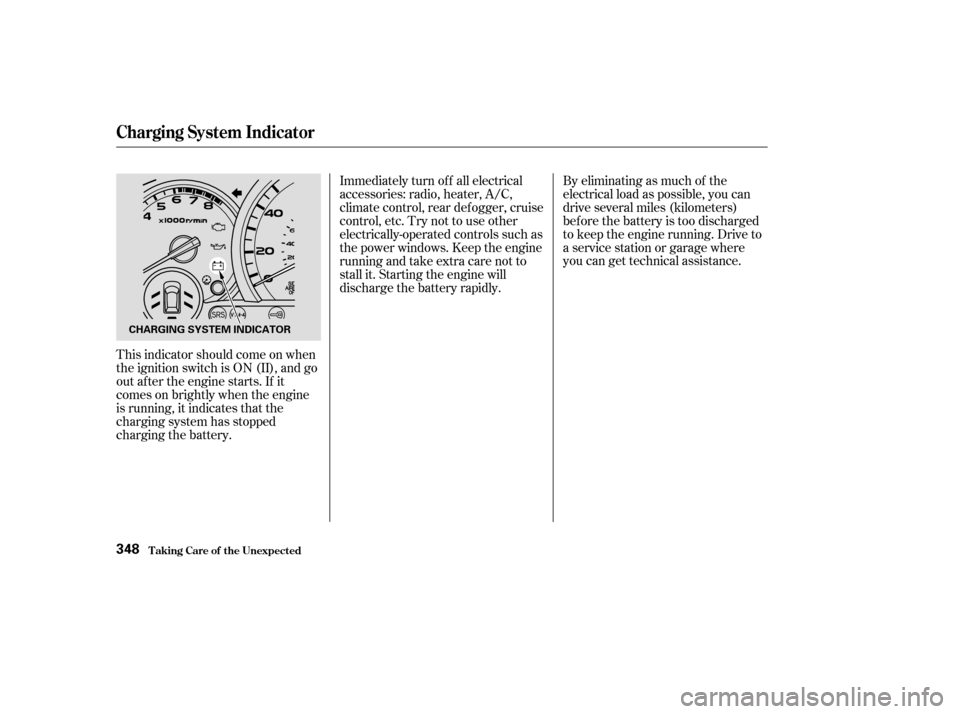
This indicator should come on when
the ignition switch is ON (II), and go
out af ter the engine starts. If it
comes on brightly when the engine
is running, it indicates that the
charging system has stopped
charging the battery.By eliminating as much of the
electrical load as possible, you can
drive several miles (kilometers)
before the battery is too discharged
to keep the engine running. Drive to
a service station or garage where
you can get technical assistance.
Immediately turn of f all electrical
accessories:radio,heater,A/C,
climate control, rear def ogger, cruise
control, etc. Try not to use other
electrically-operated controls such as
the power windows. Keep the engine
running and take extra care not to
stall it. Starting the engine will
discharge the battery rapidly.
T aking Care of t he Unexpect ed
Charging System Indicator
348
CHARGING SYSTEM INDICATOR
Page 353 of 392
If the indicator remains on past three
driving trips, or the f uel cap was not
loose or missing, have the vehicle
checked by the dealer as soon as
possible. Drive moderately until the
dealer has inspected the problem.
Avoid full-throttle acceleration and
driving at high speed.
Youshouldalsohavethedealer
inspect your vehicle if this indicator
comes on repeatedly, even though it
may turn of f as you continue driving.
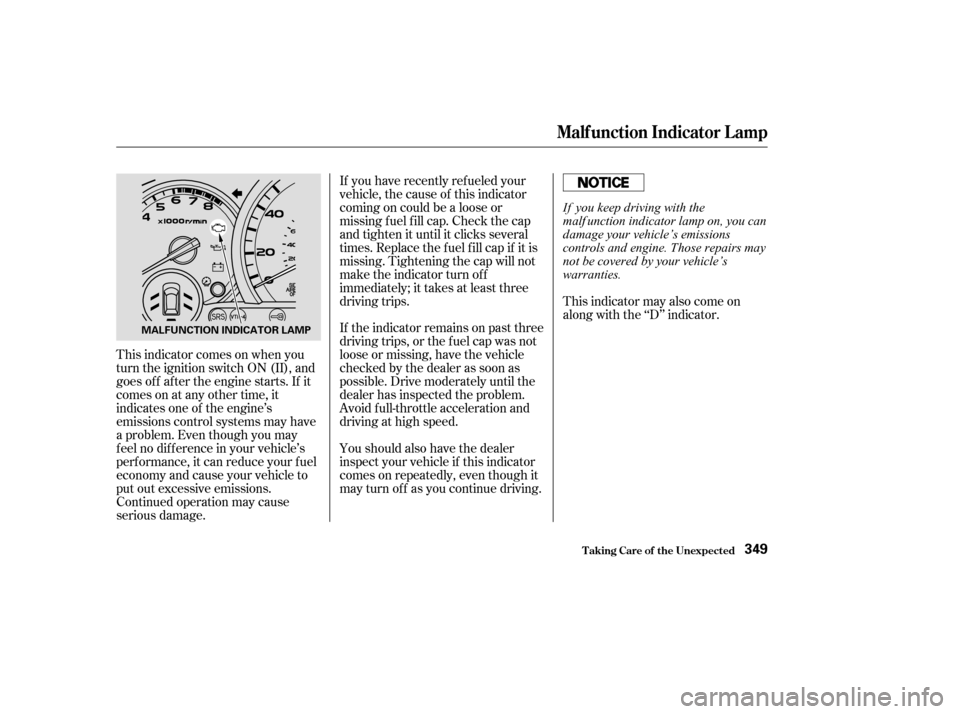
This indicator comes on when you
turn the ignition switch ON (II), and
goes of f af ter the engine starts. If it
comes on at any other time, it
indicates one of the engine’s
emissions control systems may have
a problem. Even though you may
f eel no dif f erence in your vehicle’s
perf ormance, it can reduce your f uel
economy and cause your vehicle to
put out excessive emissions.
Continued operation may cause
serious damage. If you have recently ref ueled your
vehicle, the cause of this indicator
coming on could be a loose or
missing f uel f ill cap. Check the cap
and tighten it until it clicks several
times. Replace the f uel f ill cap if it is
missing. Tightening the cap will not
make the indicator turn of f
immediately; it takes at least three
driving trips.
This indicator may also come on
along with the ‘‘D’’ indicator.
Malf unction Indicator L amp
T aking Care of t he Unexpect ed349
MALFUNCTION INDICATOR LAMP
If you keep driving with the
malf unction indicator lamp on, you can
damage your vehicle’s emissions
controls and engine. Those repairs may
not be covered by your vehicle’s
warranties.
Page 354 of 392
If possible, do not take your vehicle
f or a state emissions test until the
readiness codes are set. To check if
they are set, turn the ignition ON (II),
but do not start the engine. The
Malf unction Indicator Lamp will
come on f or 20 seconds. If it then
goes of f , the readiness codes are set.
If it blinks 5 times, the readiness
codes are not set. Ref er to State
Emissions Testing f or more
inf ormation.(See page .)
Your vehicle has certain ‘‘readiness
codes’’ that are part of the on-board
diagnostics f or the emissions
systems. In some states, part of the
emissions testing is to make sure
these codes are set. If they are not
set, the test cannot be completed.
If your vehicle’s battery has been
disconnected or gone dead, these
codes are erased. It takes several
days of driving under various
conditions to set the codes again.
371
T aking Care of t he Unexpect ed
Malf unction Indicator L amp
Readiness Codes
350
Page 355 of 392
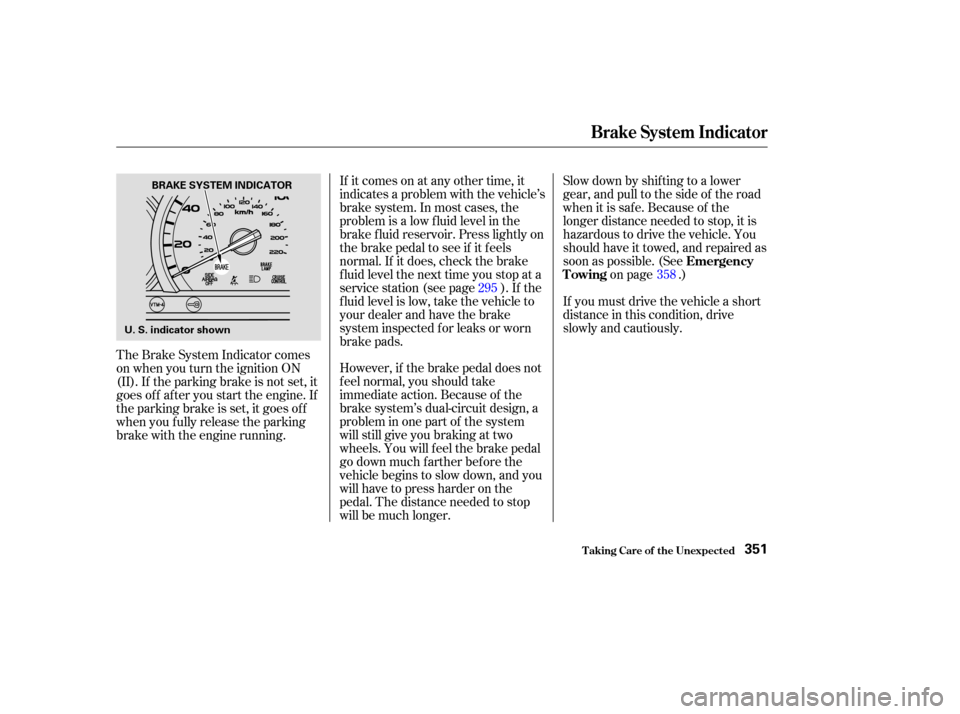
However, if the brake pedal does not
f eel normal, you should take
immediate action. Because of the
brake system’s dual-circuit design, a
problem in one part of the system
will still give you braking at two
wheels. You will f eel the brake pedal
go down much f arther bef ore the
vehicle begins to slow down, and you
will have to press harder on the
pedal. The distance needed to stop
will be much longer. If it comes on at any other time, it
indicates a problem with the vehicle’s
brake system. In most cases, the
problem is a low f luid level in the
brake f luid reservoir. Press lightly on
the brake pedal to see if it f eels
normal. If it does, check the brake
f luid level the next time you stop at a
service station (see page ). If the
f luid level is low, take the vehicle to
your dealer and have the brake
system inspected f or leaks or worn
brake pads.Slow down by shif ting to a lower
gear, and pull to the side of the road
when it is saf e. Because of the
longer distance needed to stop, it is
hazardous to drive the vehicle. You
should have it towed, and repaired as
soon as possible. (See
on page .)
If you must drive the vehicle a short
distance in this condition, drive
slowly and cautiously.
The Brake System Indicator comes
on when you turn the ignition ON
(II). If the parking brake is not set, it
goes of f af ter you start the engine. If
the parking brake is set, it goes of f
when you f ully release the parking
brake with the engine running. 295
358Emergency
Towing
Brake System Indicator
T aking Care of t he Unexpect ed351
BRAKE SYSTEM INDICATOR
U. S. indicator shown
Page 357 of 392
If something electrical in your
vehicle stops working, the first thing
youshouldcheckforisablownfuse.
Determine f rom the chart on pagesand , or the diagram on the
f use box lid (the diagram f or the
driver’s side interior f use box is on
the kick panel below the f use box),
which f use or f uses control that
component. Check those f uses f irst,
but check all the f uses bef ore
deciding that a blown f use is not the
cause. Replace any blown f uses and
check the component’s operation.
Turn the ignition switch to LOCK
(0). Make sure the headlights and
all other accessories are off.
Remove the cover f rom the f use
box.
The secondary f use box is in the
engine compartment next to the
battery.
The primary under-hood f use box is
locatedonthepassenger’ssideof
the engine compartment. To open it,
pushthetabsasshown.
1.
2.356 357
CONT INUED
Checking and Replacing Fuses
Fuses
T aking Care of t he Unexpect ed353
UNDER-HOOD
UNDER-HOOD
Page 364 of 392
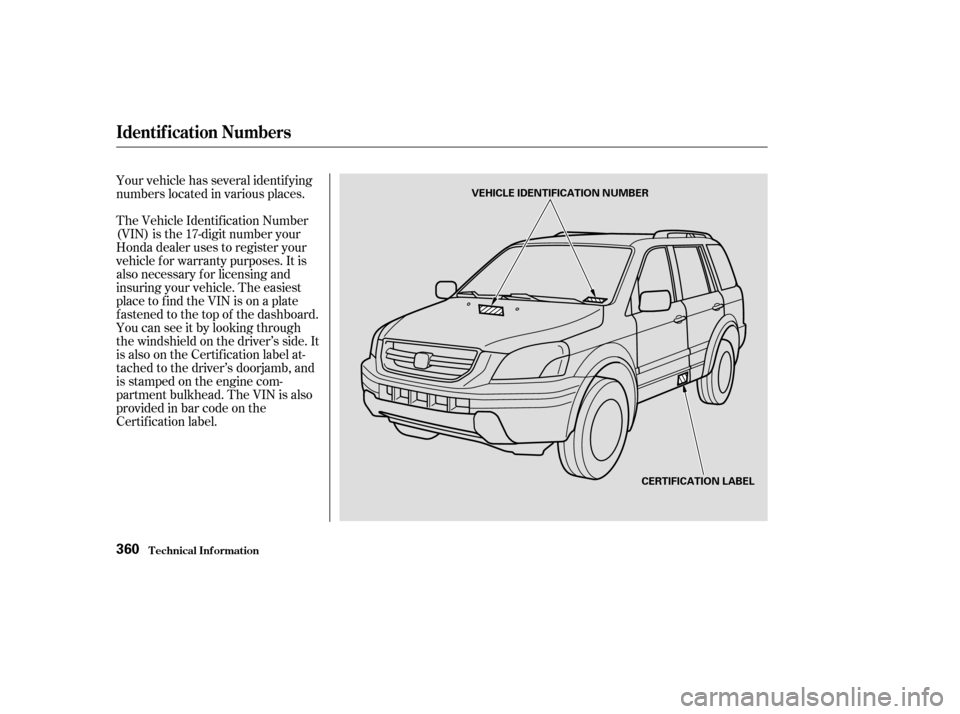
Your vehicle has several identif ying
numbers located in various places.
The Vehicle Identif ication Number
(VIN) is the 17-digit number your
Honda dealer uses to register your
vehicle f or warranty purposes. It is
also necessary f or licensing and
insuring your vehicle. The easiest
placetofindtheVINisonaplate
fastened to the top of the dashboard.
Youcanseeitbylookingthrough
the windshield on the driver’s side. It
is also on the Certification label at-
tached to the driver’s doorjamb, and
is stamped on the engine com-
partment bulkhead. The VIN is also
provided in bar code on the
Certif ication label.
Identif ication Numbers
T echnical Inf ormation360
VEHICLE IDENTIFICATION NUMBERCERTIFICATION LABEL
Page 365 of 392
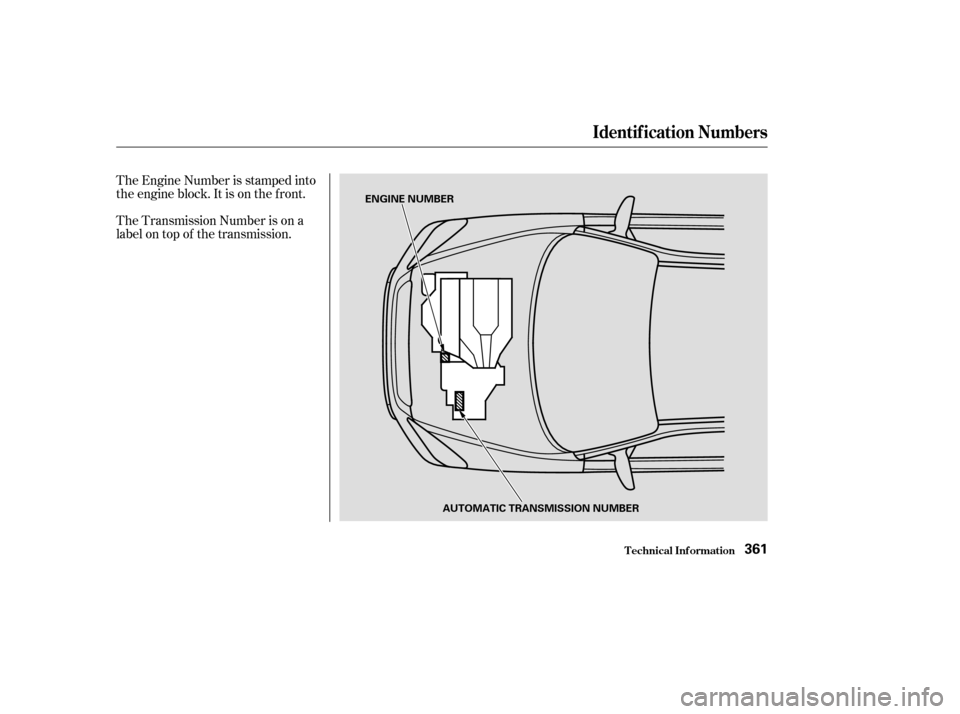
The Transmission Number is on a
label on top of the transmission. The Engine Number is stamped into
the engine block. It is on the f ront.
Identif ication Numbers
T echnical Inf ormation361
ENGINE NUMBERAUTOMATIC TRANSMISSION NUMBER
Page 366 of 392

�Î�Î
�Î
�Î
�µ�µ �Î �Î
�Î
�Î
Specif ications
T echnical Inf ormation362
Capacities
Dimensions
Weights
Air Conditioning Fuel tank
Engine
coolant
Engine oil
Automatic
transmission
fluid
Rear
differential
fluid
Windshield
washer
reservoir
1.74 US gal (6.6
, 1.45 Imp gal)
2.25 US gal (8.5, 1.87 Imp gal)
5.1 US qt (4.8
, 4.2 Imp qt)
4.5 US qt (4.3
, 3.8 Imp qt)
5.8 US qt (5.5
, 4.8 Imp qt)
3.2 US qt (3.0, 2.6 Imp qt)
8.2 US qt (7.8, 6.9 Imp qt)
Including the coolant in the reserve tank and that remaining in the
engine.
Reserve tank capacity:
0.16 US gal (0.6
, 0.13 Imp gal)
Excluding the oil remaining in the engine. 19.3 US gal (73
, 16.1 Imp gal)
2.79 US qt (2.64
,2.32Impqt)
188.0 in (4,775 mm)
76.3 in (1,938 mm)
70.6 in (1,793 mm)
4.8 US qt (4.5
, 4.0 Imp qt)
66.3 in (1,685 mm)
66.5 in (1,690 mm)
Length
Width
Height
Wheelbase
Track
Gross vehicle weight rating
Gross combined weight
rating (GCWR)
See the tire information label atta-
ched to the driver’s doorjamb.
9,700 lbs (4,400 kg)
Refrigerant type
Charge quantity
Lubricant type HFC-134a (R-134a)
24.7 26.5 oz (700 750 g) ND-OIL8
106.3 in (2,700 mm)
Approx.
Front
Rear
1:
2:
Equipped with transmission fluid cooler and power steering fluid
cooler. Change
Total
Change
Including
filter
Without
filter
Total
Change
Total
Change
The GCWR must be reduced 2 percent for every 1,000 feet (305
meters) of elevation.
1:
2:
2 1
2
1