Page 273 of 415
When starting out or driving at low
speeds on a loose or slippery road
surface, you may notice that the
vehicle does not respond to the
accelerator in the same way it does
at other times. This is a sign TCS is
activating. You will see the TCS
indicator light f lash.
You should still install winter tires on
your vehicle during the winter. Make
sure to use the same size originally
supplied with vehicle. Exercise the
samecautioninwinterdrivingasyou
would if your vehicle was not
equipped with TCS.
Driving with the compact spare tire
installed (see page ) may
activate the TCS. You should turn of f
the system.If the brakes overheat while TCS is
activating, the TCS indicator will
stop flashing and stay on temporarily.
This indicates that TCS has turned
off. After the brakes have cooled
down (usually f or about 10 minutes),
TCSwillturnbackonandthe
indicator will turn of f .
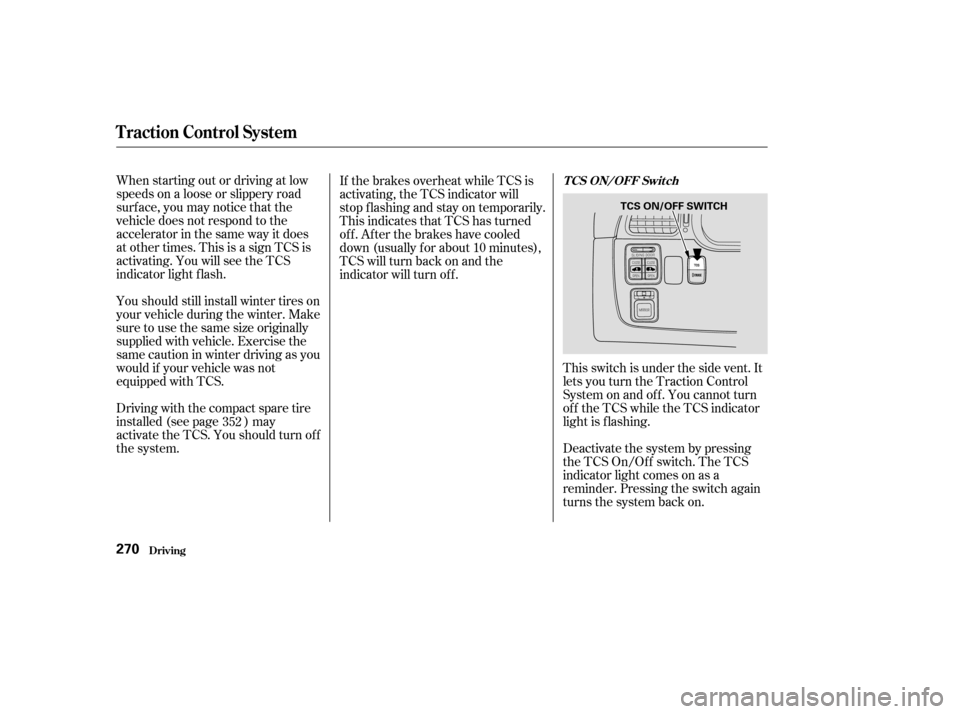
This switch is under the side vent. It
letsyouturntheTractionControl
System on and of f . You cannot turn
of f the TCS while the TCS indicator
light is f lashing.
Deactivate the system by pressing
the TCS On/Off switch. The TCS
indicator light comes on as a
reminder. Pressing the switch again
turns the system back on.
352
Traction Control System
Driving
TCS ON/OFF Switch
270
TCS ON/OFF SWITCH
Page 276 of 415
�µCheck your tires
f requently f or wear and proper
pressure. Both are important in
preventing ‘‘hydroplaning’’ (loss of
traction on a wet surface). In the
winter, mount snow tires on all f our
wheels f or the best handling.
Watch road conditions caref ully,
they can change f rom moment to
moment. Wet leaves can be as slip-
pery as ice. ‘‘Clear’’ roads can have
patches of ice. Driving conditions
can be very hazardous when the
outside temperature is near f reezing.
The road surf ace can become
covered with areas of water puddles
mixed with areas of ice, so your
traction can change without warning.
Be caref ul when downshif ting. If
traction is low, you can lock up the
drive wheels f or a moment and cause
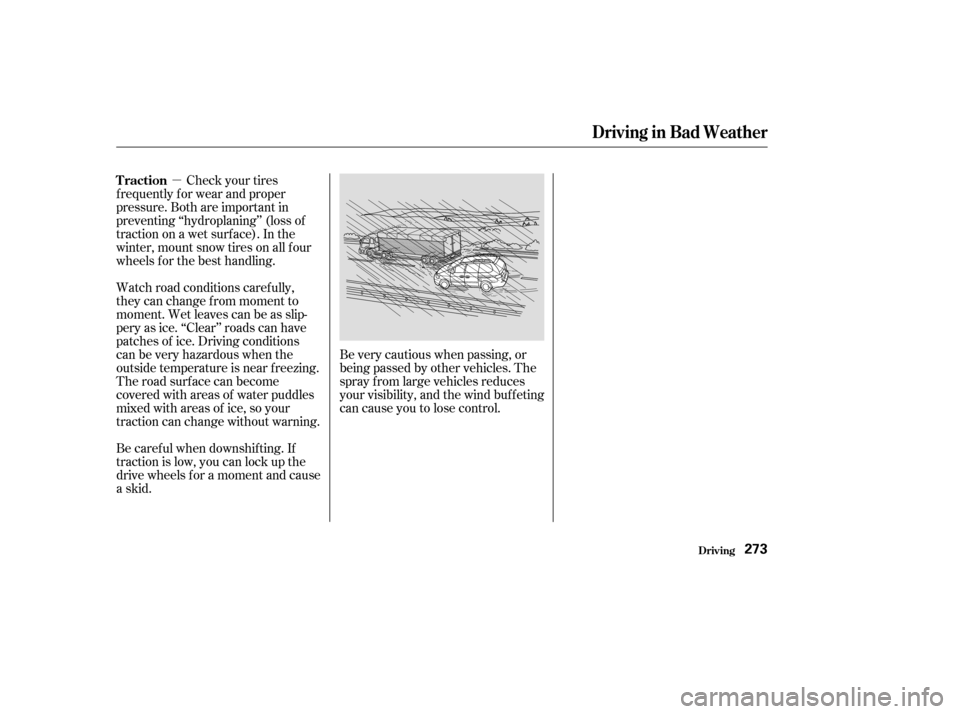
askid. Be very cautious when passing, or
beingpassedbyothervehicles.The
spray f rom large vehicles reduces
your visibility, and the wind buf f eting
can cause you to lose control.
Driving in Bad Weather
Driving
Traction
273
Page 286 of 415

This section explains the importance
of keeping your vehicle well
maintained and why you should
f ollow basic maintenance saf ety
precautions.
If you have the skills and tools to per-
f orm more complex maintenance
tasks on your Honda, you may want
to purchase the Service Manual. See
page f or inf ormation on how to
obtain a copy, or see your Honda
dealer. This section also includes
Maintenance Schedules f or normal
driving and severe driving conditions,
a Maintenance Record, and instruc-
tions f or simple maintenance tasks
you may want to take care of
yourself .......................
Maintenance Saf ety .284
.
Important Safety Precautions . 285
.................
Maintenance Schedule . 286
...
Required Maintenance Record . 293
.......
Owner Maintenance Checks . 295
..............................
Fluid Locations .296
......................................
Engine Oil .297
..................................
Adding Oil .297
....................
Recommended Oil .297
..............................
Synthetic Oil .298
....................................
Additives .299
.....
Changing the Oil and Filter . 299
.............................
Cooling System .301
............
Adding Engine Coolant . 301
.......
Replacing Engine Coolant . 303
....................
Windshield Washers .306
....
Automatic Transmission Fluid . 307
....................................
Brake Fluid .309
............................
Brake System .309
..............................
Power Steering .310
.....................
Air Cleaner Element .311
....................................
Hood Latch .313
....................................
Spark Plugs .313
..............................
Replacement .313
............................
Specif ications .316
...........................................
Battery .317 .................................
Wiper Blades .319
..............
Air Conditioning System . 321
..................
Dust and Pollen Filter . 322
.....................................
Drive Belts .322
....................................
Timing Belt .323
...............................................
Tires .323
......................................
Inf lation .323
..................................
Inspection .325
..............................
Maintenance .326
.............................
Tire Rotation .326
...
Replacing Tires and Wheels . 327
......................
Wheels and Tires .328
..........................
Winter Driving .328
.............................
Snow Tires .329
............................
Tire Chains .329
.............................................
Lights .330
.....................
Headlight Aiming .332
........................
Replacing Bulbs .332
....................
Storing Your Vehicle .341
401
Maintenance
Maint enance283
Page 331 of 415

�´
Tires that are marked ‘‘M S’’ or
‘‘All Season’’ on the sidewall have an
all-weather tread design. They
should be suitable f or most winter
driving conditions. Tires without
these markings are designed f or
optimum traction in dry conditions.
They may not provide adequate
perf ormance in winter driving.
For the best perf ormance in snowy
or icy conditions, you should install
snow tires or tire chains. They may
be required by local laws under
certain conditions.
TheABSworksbycomparingthe
speed of the wheels. When replacing
tires, use the same size originally
supplied with the vehicle. Tire size
and construction can affect wheel
speed and may cause the system to
work inconsistently.
If you ever need to replace a wheel,
make sure the wheel’s specif ications
match those of the original wheel
that came on your vehicle. Re-
placement wheels are available at
your Honda dealer.
Wheel:
Tire:
See page f or inf ormation about
DOT Tire Quality Grading.
388 Winter Driving
Wheels and T ires
Tires
Maint enance328
16x61/2JJ
225/60R16 98T