2003 HONDA ODYSSEY check
[x] Cancel search: checkPage 8 of 415
This section gives you important
inf ormation about how to protect
yourself and your passengers. It
shows you how to use seat belts
properly. It explains your Supple-
mental Restraint System. And it tells
you how to properly restrain inf ants
and children in your vehicle..........
Important Safety Precautions . 6
.......
Your Vehicle’s Saf ety Features . 7
.......................................
Seat Belts .8
.........................................
Airbags .10
.....................
Seats & Seat-Backs .11
..........................
Head Restraints .11
..................................
Door Locks .11
........
Pre-Drive Saf ety Checklist . 12
............................
Protecting Adults .13
.....
1. Close and Lock the Doors . 13
...........
2. Adjust the Front Seats . 13
............
3. Adjust the Seat-Backs . 15
...
4. Adjust the Head Restraints . 165. Fasten and Position the Seat
.....................................
Belts .17
....
6. Adjust the Steering Wheel . 20
7. Maintain a Proper Sitting ................................
Position .21
.....
Advice f or Pregnant Women . 22
...
Additional Safety Precautions . 22
........................
Protecting Children .24
All Children Must Be ...............................
Restrained .24
Children Should Sit in the Back ...........................................
Seat .25
The Passenger’s Front Airbag .........
Can Pose Serious Risks . 26
If You Must Drive with Several ...................................
Children .28
If a Child Requires Close ..................................
Attention .28
...
Additional Safety Precautions . 29
General Guidelines f or Using ...............................
Child Seats .30
.......................
Protecting Inf ants .34
.........
Protecting Small Children . 38
.......
Protecting Larger Children . 42
Using Child Seats with .....................................
Tethers .46 .............................
Using LATCH .48
Additional Inf ormation About Your .................................
Seat Belts .50
..
Seat Belt System Components . 50
......................
Lap/Shoulder Belt .50
Automatic Seat Belt .............................
Tensionners .52
...............
Seat Belt Maintenance . 53
Additional Inf ormation About Your .....................................
Airbags .54
........................
SRS Components .54
How Your Front Airbags .........................................
Work .55
How Your Side Airbags .........................................
Work .59
How the SRS Indicator Light .......................................
Works .59
How the Side Airbag Cutof f ...........
Indicator Light Works . 60
How the Passenger Airbag ..........
Cutoff Indicator Works . 62
.............................
Airbag Service .64
...
Additional Safety Precautions . 65
.............
Carbon Monoxide Hazard . 66
...................................
Saf ety Labels .67
Driver and Passenger Saf ety
Driver and Passenger Saf ety5
Page 9 of 415
You’ll f ind many saf ety
recommendations throughout this
section, and throughout this manual.
Therecommendationsonthispage
are the ones we consider to be the
most important.Excessive speed is a major f actor in
crash injuries and deaths. Generally,
the higher the speed the greater the
risk, but serious accidents can also
occur at lower speeds. Never drive
f aster than is saf e f or current
conditions, regardless of the
maximum speed posted.
While airbags can save lives, they
can cause serious or fatal injuries to
occupants who sit too close to them,
or are not properly restrained.
Inf ants, young children, and short
adults are at the greatest risk. Be
sure to f ollow all instructions and
warnings in this manual. (See page
.)
Having a tire blowout or a
mechanical f ailure can be extremely
hazardous. To reduce the possibility
of such problems, check your tire
pressures and condition f requently,
and perform all regularly scheduled
maintenance. (See page .)
Children are saf est when they are
properly restrained in a back seat,
notthefrontseat.Achildwhoistoo
smallforaseatbeltmustbeproperly
restrained in a child saf ety seat. (See
page .) Alcohol and driving don’t mix. Even
one drink can reduce your ability to
respond to changing conditions, and
your reaction time gets worse with
every additional drink. So don’t drink
and drive, and don’t let your f riends
drink and drive, either.
A seat belt is your best protection in
all types of collisions. Airbags
supplement seat belts, but airbags
are designed to inf late only in a
moderate to severe f rontal collision.
So even though your vehicle is
equipped with airbags, make sure
you and your passengers always
wear your seat belts, and wear them
properly. (See page .)
17
24 10
288
Driver and Passenger Saf ety
Important Saf ety Precautions
Always Wear Your Seat BeltBe Aware of Airbag Hazards Control Your Speed
K eep Your Vehicle in Saf e
Condition
Restrain All Children Don’t Drink and Drive
6
Page 15 of 415
To make sure you and your
passengers get the maximum
protection f rom your vehicle’s saf ety
f eatures, check the f ollowing each
time before you drive away:Any inf ant or small child is
properly restrained in a child seat
in a back seat (see page ). The rest of this section gives more
detailed inf ormation about how you
can maximize your saf ety.
Remember, however, that no saf ety
system can prevent all injuries or
deaths that can occur in severe
crashes, even when seat belts are
properly worn and the airbags deploy.
Frontseatoccupantsaresitting
upright and as f ar back as possible
f rom the steering wheel and
dashboard (see page ).
Seat-backs are upright (see page
).
Head restraints are properly
adjusted (see page ).
Alldoorsandthetailgateare
closed and locked (see page ).
All cargo is properly stored or
secured (see page ).
All adults, and children who have
outgrown child saf ety seats, are
wearing their seat belts and
wearingthemproperly(seepage
).
24 13
15 1613
253
17
Pre-Drive Saf ety Checklist
Your Vehicle’s Saf ety Features
Driver and Passenger Saf ety12
Page 20 of 415
CONT INUED
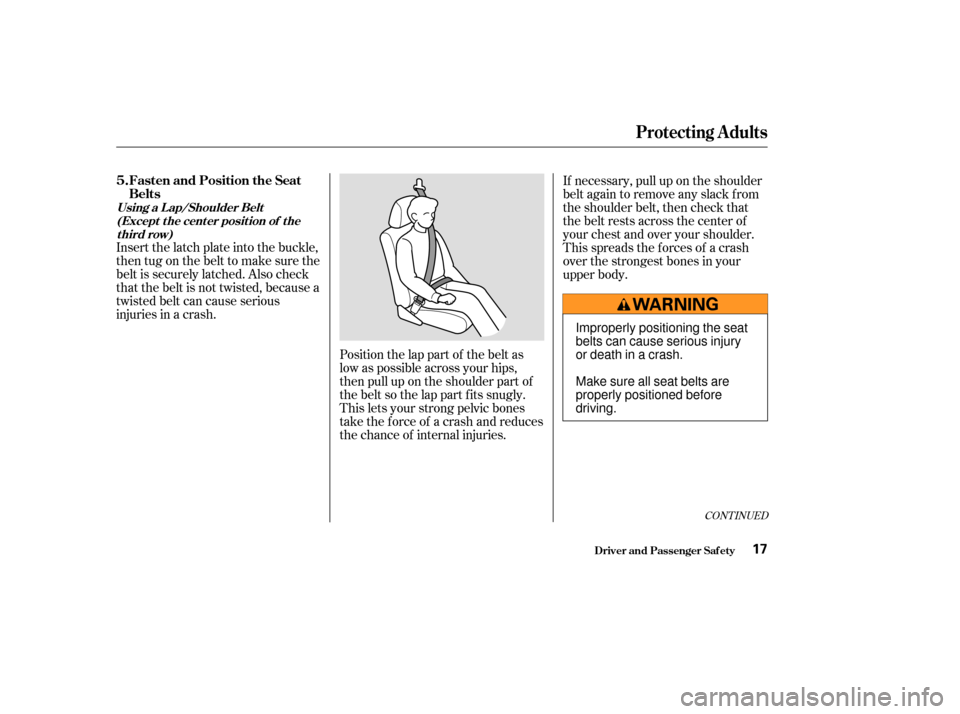
Insert the latch plate into the buckle,
then tug on the belt to make sure the
belt is securely latched. Also check
that the belt is not twisted, because a
twisted belt can cause serious
injuries in a crash.Position the lap part of the belt as
low as possible across your hips,
then pull up on the shoulder part of
the belt so the lap part f its snugly.
This lets your strong pelvic bones
take the force of a crash and reduces
the chance of internal injuries.If necessary, pull up on the shoulder
belt again to remove any slack from
the shoulder belt, then check that
the belt rests across the center of
your chest and over your shoulder.
This spreads the f orces of a crash
over the strongest bones in your
upper body.
Driver and Passenger Saf ety
Protecting Adults
Fasten and Position the Seat
Belts
5.
Using a L ap/Shoulder Belt
(Except t he cent er posit ion of t hethird row)
17
Improperly positioning the seat
belts can cause serious injury
or death in a crash.
Make sure all seat belts are
properly positioned before
driving.
Page 23 of 415
If necessary, pull up on the shoulder
belt again to remove any slack from
the shoulder belt, then check that
the belt rests across the center of
your chest and over your shoulder.
This spreads the f orces of a crash
over the strongest bones in your
upper body.This could cause
very serious injuries in a crash. If a seat belt does not seem to work
as it should, it may not protect the
occupant in a crash.
Anyone using a seat belt that is
not working properly can be
seriously injured or killed. Have your
Honda dealer check the belt as soon
as possible.
See page f or additional
inf ormation about your seat belt
system and how to take care of your
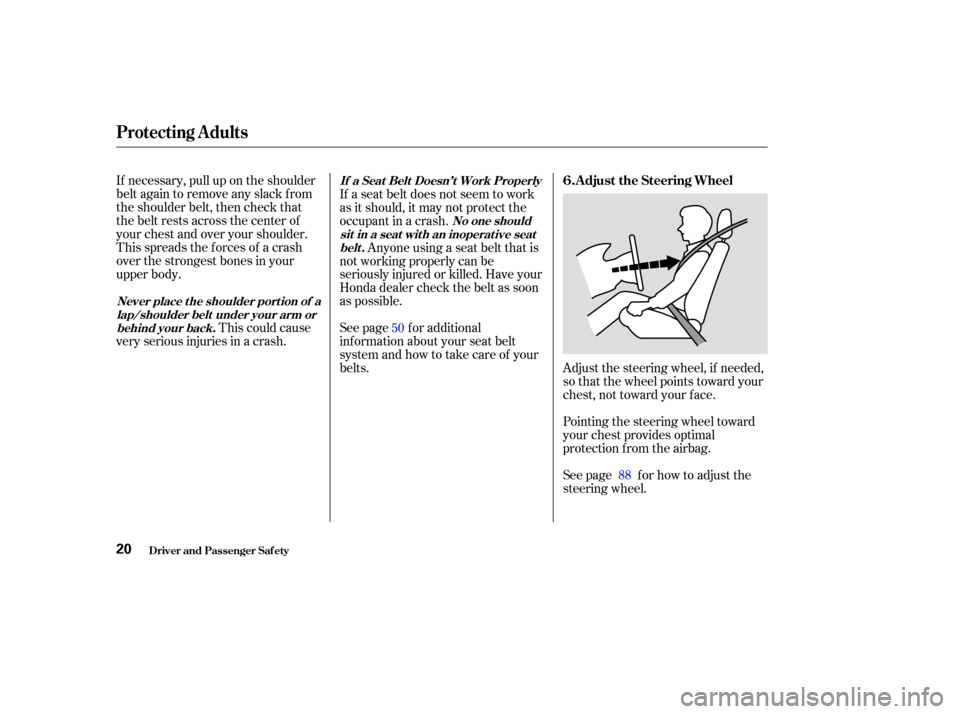
belts. Adjust the steering wheel, if needed,
so that the wheel points toward your
chest, not toward your f ace.
Pointing the steering wheel toward
your chest provides optimal
protection f rom the airbag.
See page f or how to adjust the
steering wheel.
50
88
Protecting Adults
Driver and Passenger Saf ety
Never place t he shoulder port ion of alap/shoulder belt under your arm orbehind your back. If a Seat Belt Doesn’t Work Properly
No one should
sit in a seat wit h an inoperat ive seat belt.
A djust the Steering Wheel
6.
20
Page 25 of 415
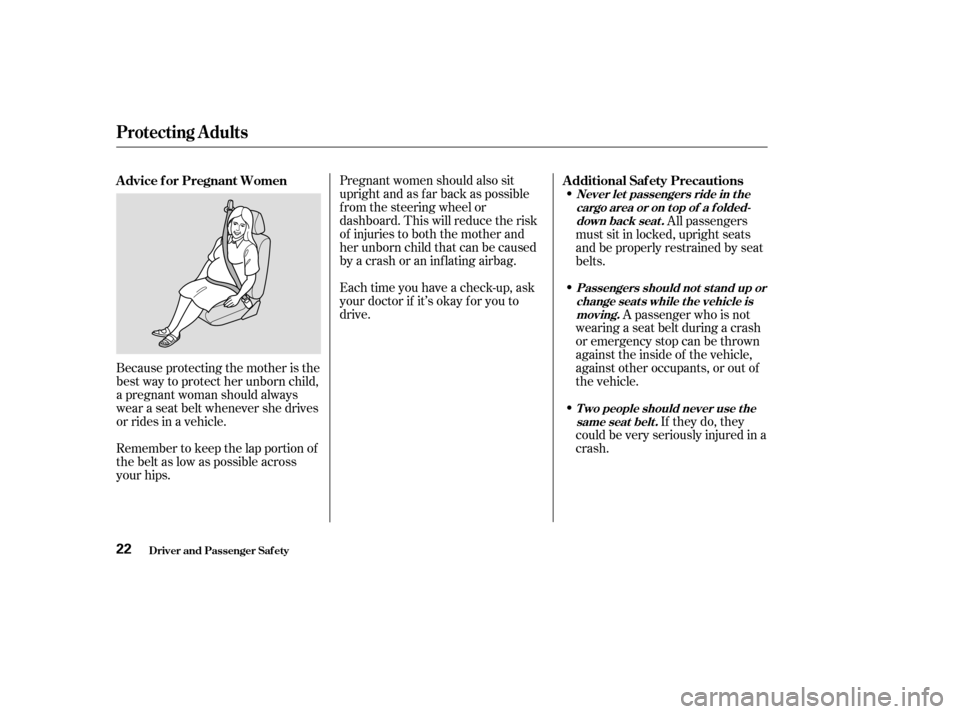
Pregnant women should also sit
upright and as f ar back as possible
f rom the steering wheel or
dashboard. This will reduce the risk
of injuries to both the mother and
her unborn child that can be caused
by a crash or an inf lating airbag.
Each time you have a check-up, ask
your doctor if it’s okay f or you to
drive.
Because protecting the mother is the
best way to protect her unborn child,
a pregnant woman should always
wear a seat belt whenever she drives
or rides in a vehicle.
Remember to keep the lap portion of
the belt as low as possible across
your hips. All passengers
must sit in locked, upright seats
andbeproperlyrestrainedbyseat
belts.
A passenger who is not
wearing a seat belt during a crash
or emergency stop can be thrown
against the inside of the vehicle,
against other occupants, or out of
the vehicle.
If they do, they
could be very seriously injured in a
crash.
Advice f or Pregnant Women
Additional Saf ety Precautions
Protecting Adults
Driver and Passenger Saf ety
Never let passengers ride in t he
cargo area or on t op of a f olded-down back seat .
Passengers should not st and up orchange seats while the vehicle ismoving.
T wo people should never use t hesame seat belt .
22
Page 40 of 415
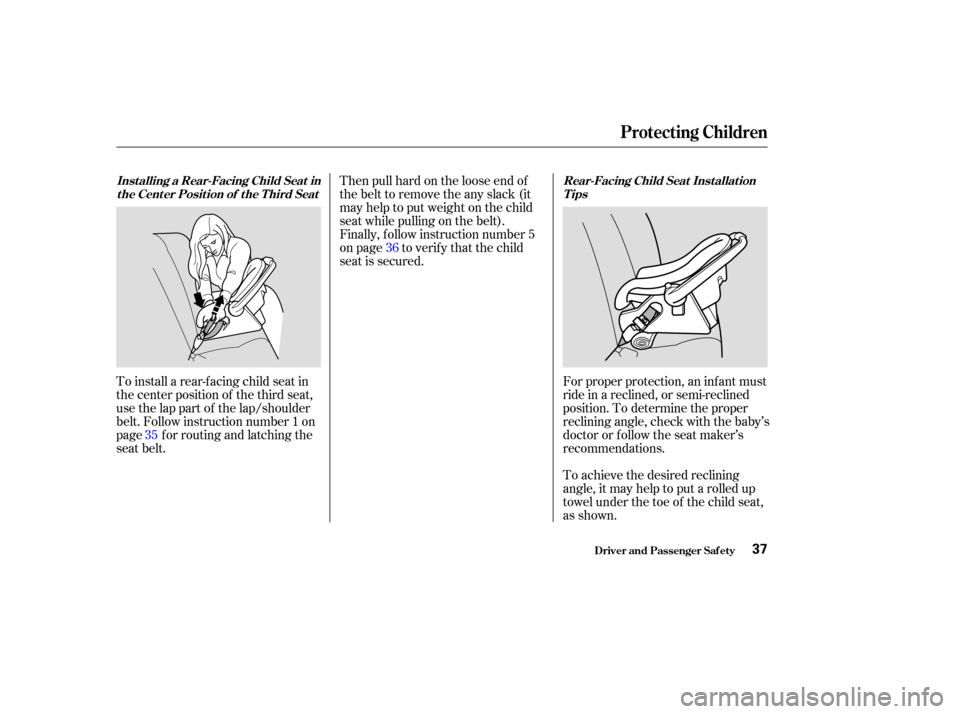
Forproperprotection,aninfantmust
ride in a reclined, or semi-reclined
position. To determine the proper
reclining angle, check with the baby’s
doctor or f ollow the seat maker’s
recommendations.
To achieve the desired reclining
angle, it may help to put a rolled up
towel under the toe of the child seat,
as shown.
Then pull hard on the loose end of
thebelttoremovetheanyslack(it
may help to put weight on the child
seat while pulling on the belt).
Finally, f ollow instruction number 5
on page to verify that the child
seat is secured.
To install a rear-f acing child seat in
the center position of the third seat,
use the lap part of the lap/shoulder
belt. Follow instruction number 1 on
page f or routing and latching the
seat belt. 35 36
Protecting Children
Driver and Passenger Saf ety
Rear-Facing Child Seat Inst allat ion
Tips
Inst alling a Rear-Facing Child Seat in
t he Cent er Posit ion of t he T hird Seat
37
Page 45 of 415
Then pull hard on the loose end of
thebelttoremovetheanyslack(it
may help to put weight on the child
seat while pulling on the belt).
Finally, f ollow instruction number 5
on page to verify that the child
seat is secured.When a child reaches the
recommended weight or height limit
for a forward-facing child seat, the
child should sit in the back seat on a
booster and wear a lap/shoulder belt.
We recommend that the child use a
booster seat until the child is tall
enough to use the seat belt without a
booster.
The f ollowing pages give
instructions on how to check proper
seat belt f it, what kind of booster
seat to use if one is needed, and
important precautions f or a child
who must sit in the f ront seat.
41
Protecting L arger Children
Protecting Children
Driver and Passenger Saf ety42
Allowing a larger child to sit
improperly in the front seat can
result in injury or death if the
passenger’s front airbag inflates.
If a larger child must sit in front,
make sure the child moves the
seat as far back as possible,
uses a booster seat if needed,
and wears the seat belt properly.