Page 293 of 415

�µ
�µ�Î
�Î
�Ì
�Ì �Ì�Î
�Ì�Î
Follow the Severe Conditions
Maintenance Schedule if you
drive your vehicle
under one or more of the
f ollowing conditions:
Driving less than 5 miles (8
km) per trip or, in f reezing
temperatures, driving less
than 10 miles (16 km) per trip.
Driving in extremely hot
[over 90°F (32°C)] conditions.
Extensive idling or long
periods of stop-and-go driving,
such as a taxi or a commercial
delivery vehicle.
Trailer towing, driving with a
roof rack, or driving in
mountainous conditions.
Driving on muddy, dusty, or
de-iced roads.
Follow the Maintenance
Schedule f or Severe Conditions.
MAINLY
Maint enance
U.S. Owners
Canadian Owners
290
Visually inspect the following items: Replace every 3,750 miles (6,000 km) or 6 months
Check oil and coolant at each fuel stop
Service at the indicated
distance or time whichever
comes first.
miles x 1,000
km x 1,000
months
120,000 miles (192,000 km) or 10 years, then every 60,000 miles (96,000 km) or 5 years
Tie rod ends, steering gear box, and boots
Suspension components
Driveshaft boots
Brake hoses and lines (including ABS)
All fluid levels and conditions of fluids
Cooling system hoses and connections
Exhaust system
Fuel lines and connections
Lights and controls
Vehicle underbody Every 7,500 miles (12,000 km) or 6 months
Rotate tires every 7,500 miles (12,000 km)
Inspect every 7,500 miles (12,000 km) or 6 months 30
48
24
60
96
4890
144 72 120
192
96
Every 3 years (independent of mileage)
15
24
12
45
72
3675
120 60 105
168
84
See information on maintenance and emissions warranty, last column, page . Refer to page for replacement
information under special driving
conditions. Refer to page for replacement
information under special driving
conditions.
Replace engine oil and oil filter
Check engine oil and coolant
Replace air cleaner element
Use normal schedule except in dusty
conditions
Inspect valve clearance
Replace spark plugs
Inspect and adjust drive belts
Inspect idle speed
Replace engine coolant
Replace transmission fluid
Inspect front and rear brakes
Replace brake fluid
Check parking brake adjustment
Replace dust and pollen filter
Lubricate all hinges, locks and latches
Rotate tires (Check tire inflation and condition
at least once per month) Adjust only if noisy
1:
2:
: 287322
323
Replace timing belt and inspect water pump,1
2
Maintenance Schedule for Severe Conditions
Page 294 of 415

�µ�µ
�Ø
�Ø
�Ø
�Ø
�Ø
�Ø
�Ø
�Ø
�Ø
�Ø
�Ø
�Ø
�Ø
�Ø
�Ø
�Ø
�Ø
�Ø
�Ø
�Ø
�Ø
�Ì
�Ì
�Î
�Î�Ì
�Ì
�Î
�Î
CONT INUED
Maint enance291
A, B, C, D
U.S. Owners
Canadian Owners
A
B
C
D
Service at the indicated distance or time, whichever comes first. Do the items in as required for each distance/time interval.
Refer to page to determine which schedule to use.Use the Maintenance Schedule for Severe Conditions.
3,750 mi/6,000 km
7,500 mi/12,000 km/6 mos
11,250 mi/18,000 km
15,000 mi/24,000 km/1 yr
18,750 mi/30,000 km
22,500 mi/36,000 km
26,250 mi/42,000 km
30,000 mi/48,000 km/2 yrs
33,750 mi/54,000 km
37,500 mi/60,000 km
41,250 mi/66,000 km
3yrs
45,000 mi/72,000 km/3 yrs
48,750 mi/78,000 km
52,500 mi/84,000 km
60,000 mi/96,000 km/4 yrs
63,750 mi/102,000 km Replace engine oil and filter.
Inspect front and rear brakes.
Rotate tires (follow pattern on page
326).
Inspect tie rod ends, steering gearbox and boots.
Inspect suspension components.
Inspect driveshaft boots.
Check parking brake adjustment.
Replace air cleaner element.
Lubricate all hinges, locks and latches with
multipurpose grease.
Inspect brake hoses and lines (including ABS).
Check all fluid levels, condition of fluids, and check
for leaks.
Inspect cooling system hoses and connections.
Inspect exhaust system.
Inspect fuel lines and connections.
Check all lights.
Inspect the underbody.
Replace transmission fluid.
Inspect and adjust drive belts.
Replace dust and pollen filter.
Do item in A.
Do items in A, B.
Do item in A.
DoitemsinA,B,C.
Do item in A.
Do items in A, B.
Do item in A.
DoitemsinA,B,C,D.
Do item in A.
Do items in A, B.
Do item in A.
Replace brake fluid (independent of mileage)
DoitemsinA,B,C.
Do item in A.
Do items in A, B. Replace timing belt.
DoitemsinA,B,C,D.
Do item in A.
290
See information on maintenance and emissions warranty, last
column, page .
Check engine oil and coolant at each fuel stop.
Check and adjust valve clearance, cold engine, only if noisy.
See timing belt on page to determine need for replacement.
See dust and pollen filter on page for replacement information under special driving
conditions.
:
NOTE:
1:
2:
323
322
287
2
1,
Maintenance Schedule for Severe Conditions (listed by distance/time)
Page 304 of 415
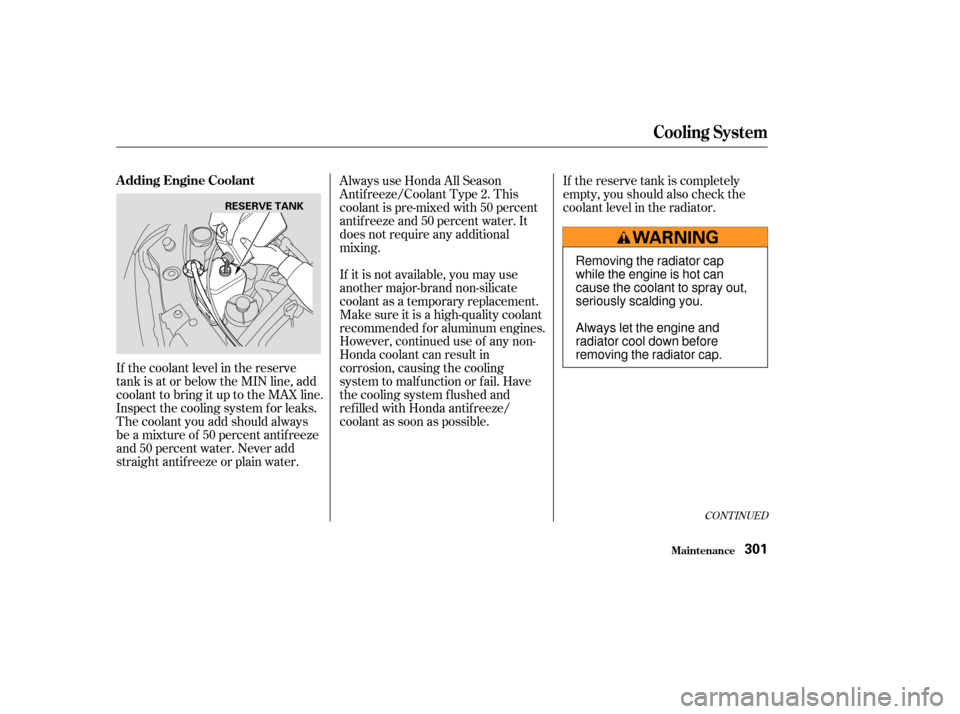
If the coolant level in the reserve
tank is at or below the MIN line, add
coolant to bring it up to the MAX line.
Inspect the cooling system f or leaks.
The coolant you add should always
be a mixture of 50 percent antif reeze
and 50 percent water. Never add
straight antif reeze or plain water.If the reserve tank is completely
empty, you should also check the
coolant level in the radiator.
Always use Honda All Season
Antif reeze/Coolant Type 2. This
coolant is pre-mixed with 50 percent
antif reeze and 50 percent water. It
does not require any additional
mixing.
If it is not available, you may use
another major-brand non-silicate
coolant as a temporary replacement.
Make sure it is a high-quality coolant
recommended f or aluminum engines.
However, continued use of any non-
Honda coolant can result in
corrosion, causing the cooling
system to malf unction or f ail. Have
the cooling system f lushed and
ref illed with Honda antif reeze/
coolant as soon as possible.
CONT INUED
A dding Engine Coolant
Cooling Syst em
Maint enance301
RESERVE TANK
Removing the radiator cap
while the engine is hot can
cause the coolant to spray out,
seriously scalding you.
Always let the engine and
radiator cool down before
removing the radiator cap.
Page 305 of 415
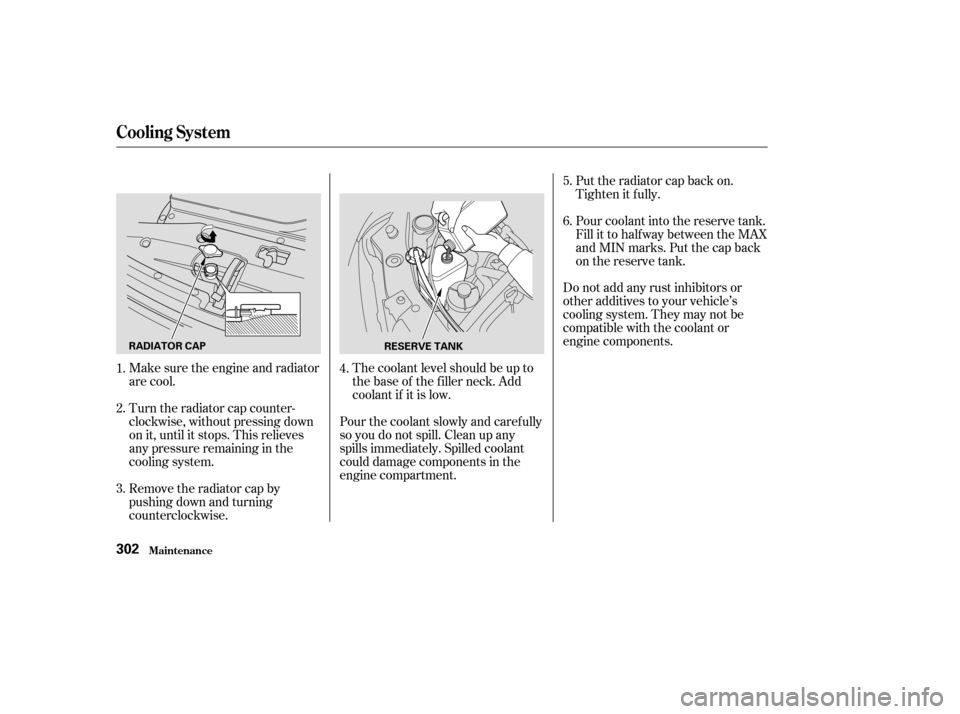
Make sure the engine and radiator
are cool.
Turn the radiator cap counter-
clockwise, without pressing down
on it, until it stops. This relieves
any pressure remaining in the
cooling system.
Remove the radiator cap by
pushing down and turning
counterclockwise.The coolant level should be up to
the base of the f iller neck. Add
coolant if it is low.Put the radiator cap back on.
Tighten it f ully.
Pour coolant into the reserve tank.
Fill it to half way between the MAX
and MIN marks. Put the cap back
on the reserve tank.
Do not add any rust inhibitors or
other additives to your vehicle’s
cooling system. They may not be
compatible with the coolant or
engine components.
Pour the coolant slowly and caref ully
so you do not spill. Clean up any
spills immediately. Spilled coolant
could damage components in the
engine compartment.
3. 4.5.
6.
1.
2.
Cooling Syst em
Maint enance302
RADIATOR CAP RESERVE TANK
Page 306 of 415
CONT INUED
Thecoolingsystemshouldbe
completely drained and ref illed with
new coolant according to the time
and distance recommendations in
the maintenance schedule. Only use
Honda All Season Antif reeze/
Coolant Type 2.
Draining the coolant requires access
to the underside of the vehicle.
Unless you have the tools and
knowledge, you should have this
maintenance done by a skilled
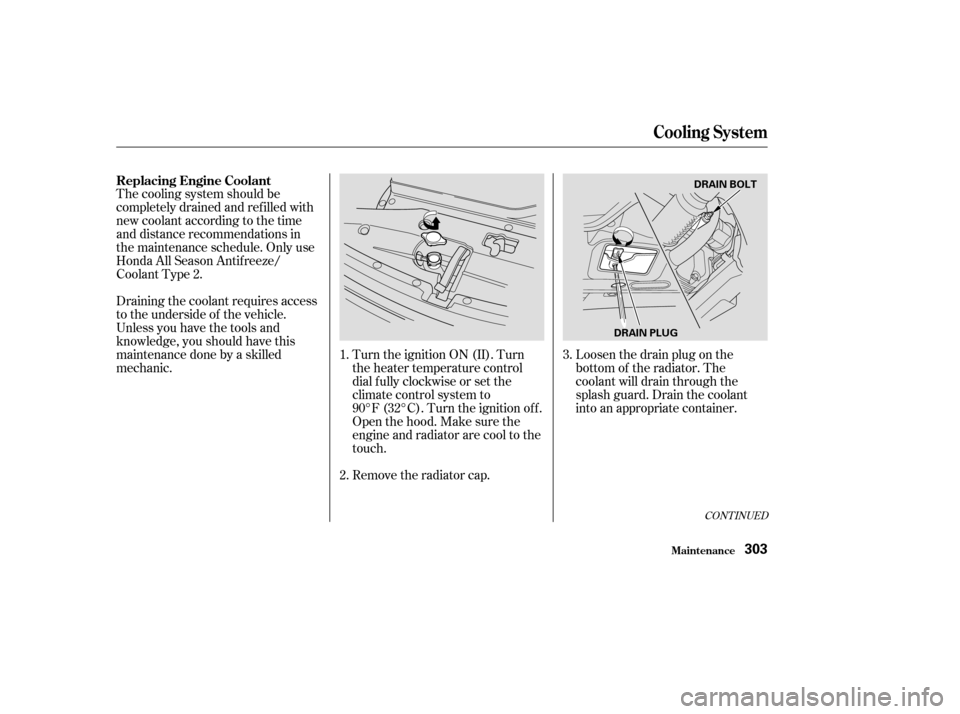
mechanic.Turn the ignition ON (II). Turn
the heater temperature control
dial f ully clockwise or set the
climate control system to
90°F (32°C). Turn the ignition of f .
Openthehood.Makesurethe
engine and radiator are cool to the
touch.
Remove the radiator cap.Loosen the drain plug on the
bottom of the radiator. The
coolant will drain through the
splash guard. Drain the coolant
into an appropriate container.
1.
3.
2.
Replacing Engine Coolant
Cooling Syst em
Maint enance303
DRAIN PLUG
DRAIN BOLT
Page 307 of 415
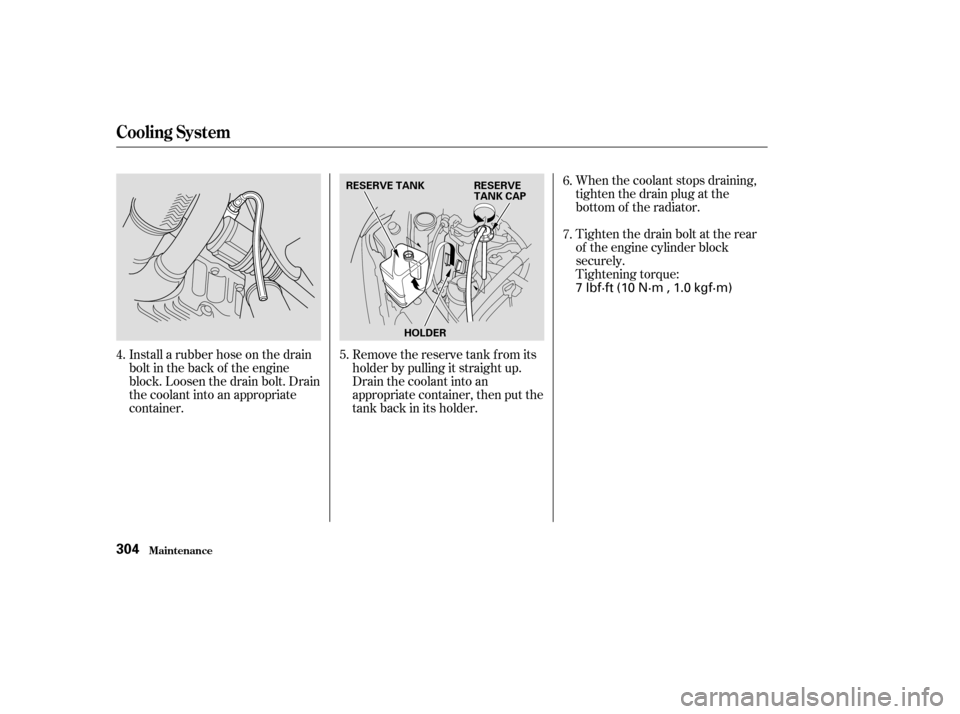
When the coolant stops draining,
tightenthedrainplugatthe
bottom of the radiator.
Tighten the drain bolt at the rear
of the engine cylinder block
securely.
Tightening torque:
Remove the reserve tank f rom its
holder by pulling it straight up.
Drain the coolant into an
appropriate container, then put the
tank back in its holder.
Install a rubber hose on the drain
bolt in the back of the engine
block. Loosen the drain bolt. Drain
the coolant into an appropriate
container. 6.
4. 5. 7.
Cooling Syst em
Maint enance304
RESERVE TANK RESERVE
TANK CAP
HOLDER
7 lbf·ft (10 N·m , 1.0 kgf·m)
Page 308 of 415
Fill the reserve tank to the MAX
mark. Install the reserve tank cap.
Install the radiator cap, and
tighten it to the first stop.
Start the engine and let it run until
the radiator cooling f an comes on
at least twice. Then stop the
engine.
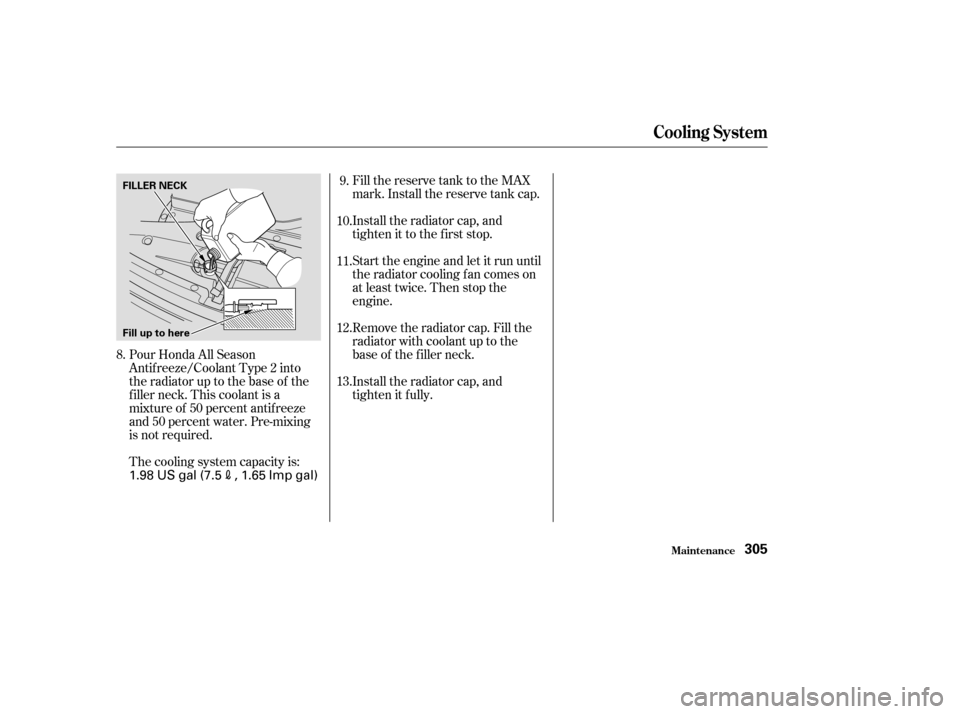
Remove the radiator cap. Fill the
radiator with coolant up to the
base of the f iller neck.
Install the radiator cap, and
tighten it fully.
Pour Honda All Season
Antif reeze/Coolant Type 2 into
the radiator up to the base of the
f iller neck. This coolant is a
mixture of 50 percent antif reeze
and 50 percent water. Pre-mixing
is not required.
The cooling system capacity is:
8. 10.
11.
12.
13.9.
Cooling Syst em
Maint enance305
FILLER NECK
Fill up to here
1.98 US gal (7.5, 1.65 Imp gal)
Page 324 of 415
Run the air conditioning at least once
a week during the cold weather
months. Run it f or at least ten
minutes while you are driving at a
steady speed with the engine at
normal operating temperature. This
circulates the lubricating oil con-
tained in the ref rigerant.If the air conditioning does not get as
cold as before, have your dealer
check the system. Recharge the
system with Ref rigerant HFC-134a
(R-134a). (See Specif ications on page
.)
Your vehicle’s air conditioning is a
sealed system. Any major mainte-
nance, such as recharging, should be
done by a qualif ied mechanic. You
can do a couple of things to make
sure the air conditioning works
ef f iciently.
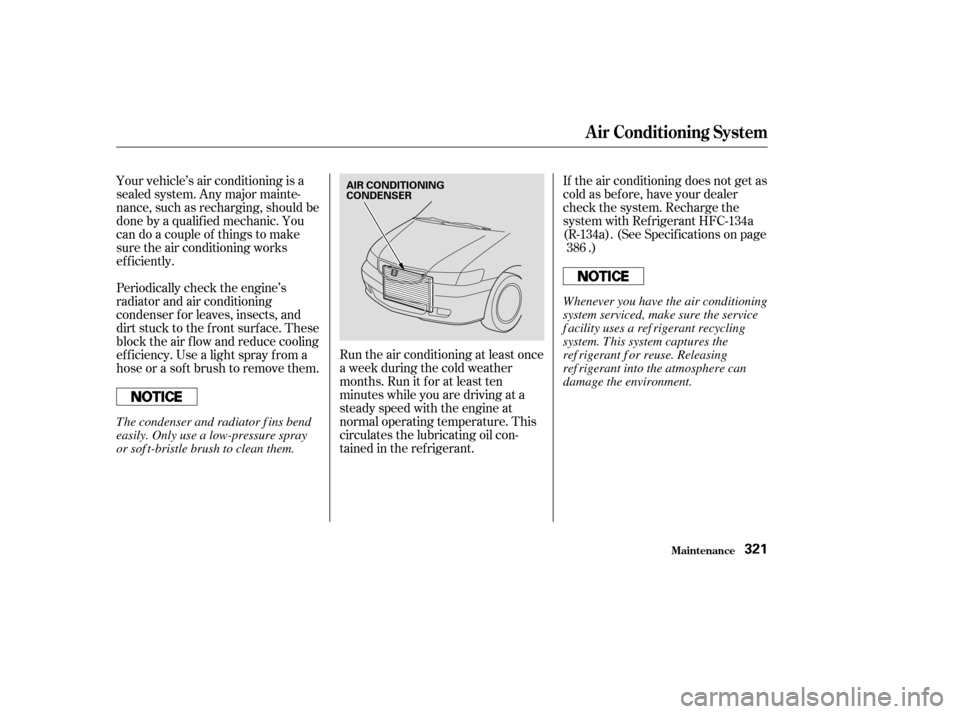
Periodically check the engine’s
radiator and air conditioning
condenser f or leaves, insects, and
dirt stuck to the f ront surf ace. These
block the air f low and reduce cooling
ef f iciency. Use a light spray f rom a
hose or a sof t brush to remove them. 386
Maint enance
A ir Condit ioning Syst em
321
AIR CONDITIONING
CONDENSER
Whenever you have the air conditioning
system serviced, make sure the service
f acility uses a ref rigerant recycling
system. This system captures the
ref rigerant f or reuse. Releasing
ref rigerant into the atmosphere can
damage the environment.
The condenser and radiator f ins bend
easily. Only use a low-pressure spray
or sof t-bristle brush to clean them.