Page 380 of 415
�µ�Î
�Î
�Î
CONT INUED
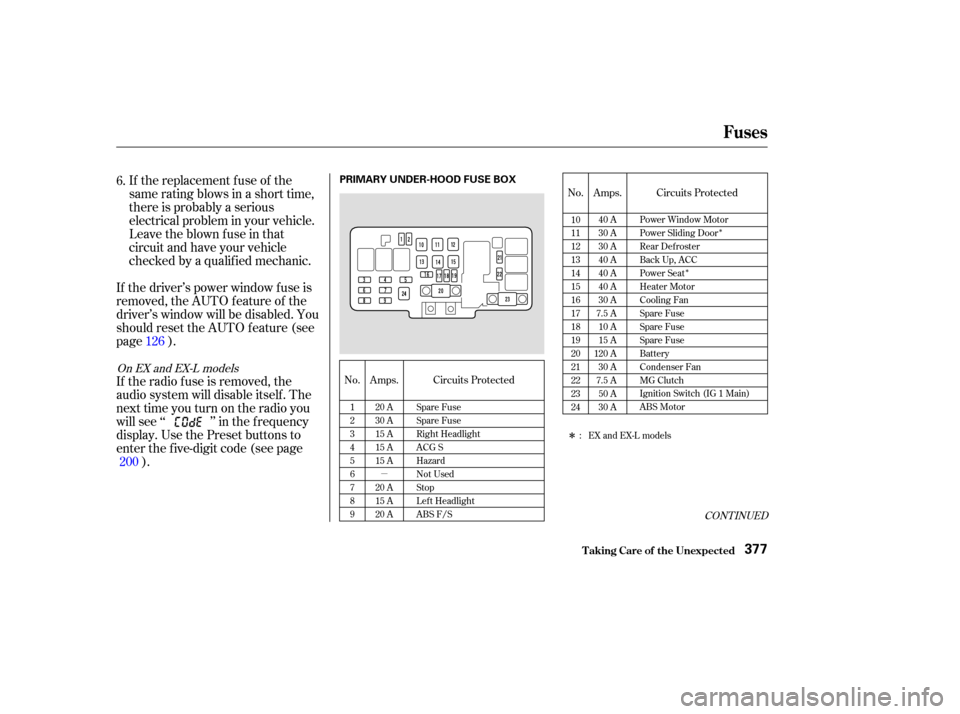
Amps.
No. Circuits Protected No. Amps. Circuits Protected
If the replacement fuse of the
same rating blows in a short time,
there is probably a serious
electrical problem in your vehicle.
Leave the blown fuse in that
circuit and have your vehicle
checked by a qualif ied mechanic.
If the driver’s power window f use is
removed, the AUTO feature of the
driver’s window will be disabled. You
should reset the AUTO f eature (see
page ).
If the radio f use is removed, the
audio system will disable itself . The
nexttimeyouturnontheradioyou
will see ‘‘ ’’ in the f requency
display. Use the Preset buttons to
enter the f ive-digit code (see page ).
6.
126
200
20 A
30 A
15 A
15 A
15 A
20 A
15 A
20 A
1
2
3
4
5
6
7
8
9 Spare Fuse
Spare Fuse
Right Headlight
ACG S
Hazard
Not Used
Stop
Lef t Headlight
ABS F/S 10
11
12
13
14
15
16
17
18
19
20
21
22
23
24
40 A
30 A
30 A
40 A
40 A
40 A
30 A
7.5 A 10 A
15 A
120 A 30 A
7.5 A 50 A
30 A Power Window Motor
Power Sliding Door
Rear Defroster
Back Up, ACC
Power Seat
Heater Motor
Cooling Fan
Spare Fuse
Spare Fuse
Spare Fuse
Battery
Condenser Fan
MG Clutch
Ignition Switch (IG 1 Main)
ABS Motor
: EX and EX-L models
On EX and EX-L models
Fuses
T aking Care of t he Unexpect ed377
PRIMARY UNDER-HOOD FUSE BOX
Page 381 of 415
�µ�µ
�Î
�Î
�Î
�Î
�Î
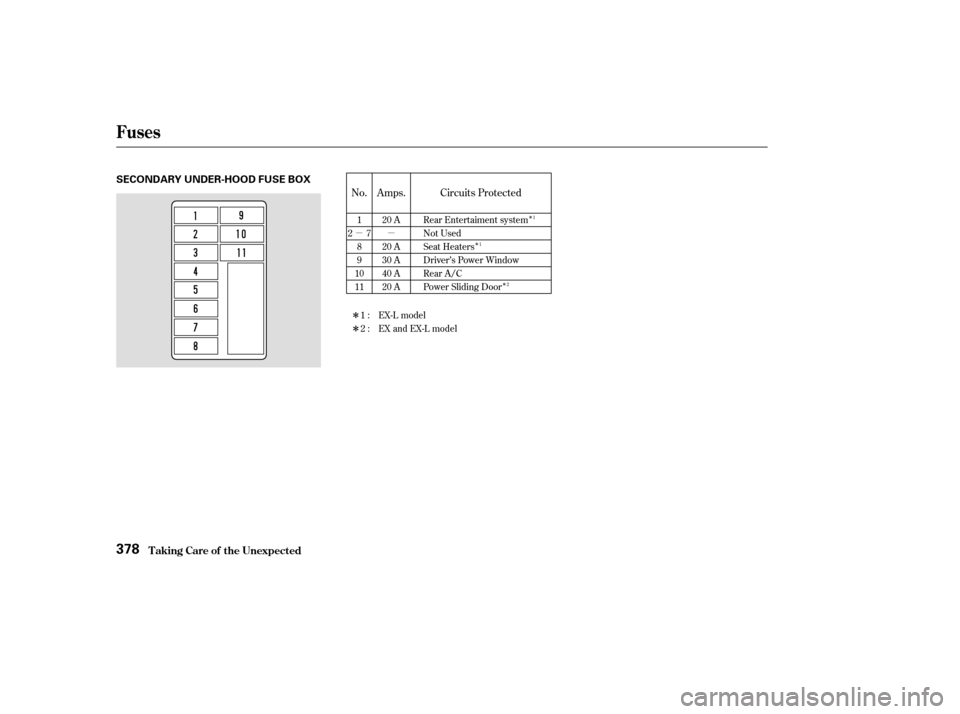
No. Amps. Circuits Protected
1
27 8
9
10
11 20 A
20 A
30 A
40 A
20 A Rear Entertaiment system
Not Used
Seat Heaters
Driver’s Power Window
Rear A/C
Power Sliding Door
1:
2: EX-L model
EX and EX-L model1
1
2
Fuses
T aking Care of t he Unexpect ed378
SECONDARY UNDER-HOOD FUSE BOX
Page 382 of 415
�Î�Î
�Î �Î
�Î
�Î �Î
�Î
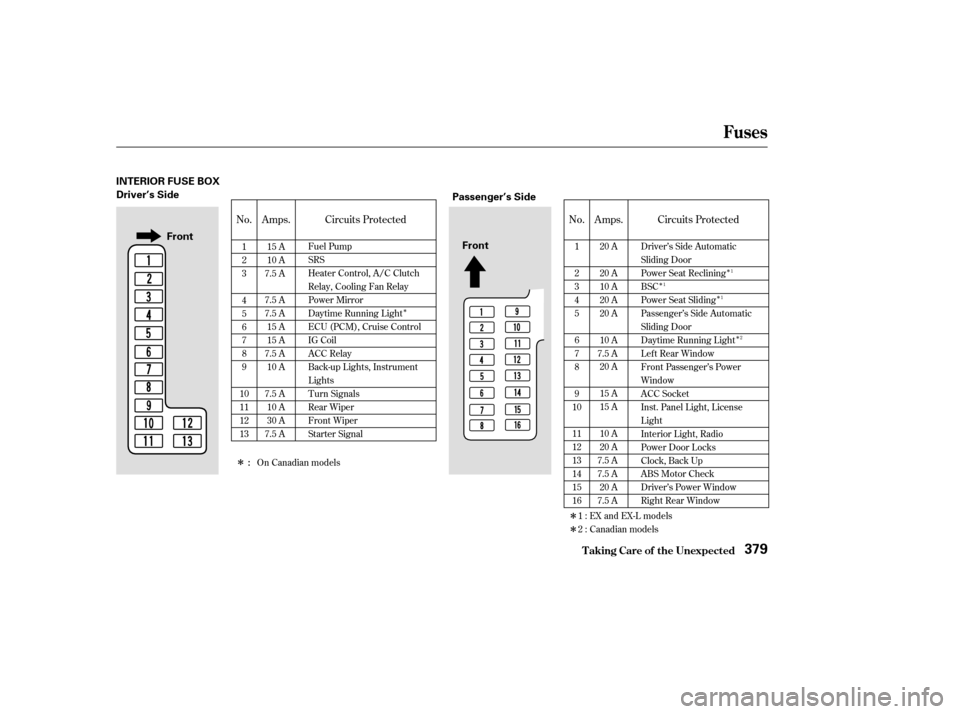
On Canadian models
1
2
3
4
5
6
7
8
9
10
11
12
13 15 A
10 A
7.5 A
7.5 A
7.5 A 15 A
15 A
7.5 A 10 A
7.5 A 10 A
30 A
7.5 A Fuel Pump
SRS
Heater Control, A/C Clutch
Relay, Cooling Fan Relay
Power Mirror
Daytime Running Light
ECU(PCM),CruiseControl
IG Coil
ACC Relay
Back-up Lights, Instrument
Lights
Turn Signals
Rear Wiper
Front Wiper
Starter Signal Driver’s Side Automatic
Sliding Door
Power Seat Reclining
BSC
Power Seat Sliding
Passenger’s Side Automatic
Sliding Door
Daytime Running Light
Left Rear Window
Front Passenger’s Power
Window
ACC Socket
Inst. Panel Light, License
Light
Interior Light, Radio
Power Door Locks
Clock, Back Up
ABS Motor Check
Driver’s Power Window
Right Rear Window
1
2
3
4
5
6
7
8
9
10
11
12
13
14
15
16 20 A
20 A
10 A
20 A
20 A
10 A
7.5 A 20 A
15 A
15 A
10 A
20 A
7.5 A
7.5 A 20 A
7.5 A
1:
2: EX and EX-L models
Canadian models
No. Amps. Circuits Protected
Circuits Protected
No. Amps.
1
1 1
2
Fuses
T aking Care of t he Unexpect ed379
Driver’s Side INTERIOR FUSE BOX Passenger’s Side
Front Front
:
Page 383 of 415

�µ
�µ �µ
If your vehicle needs to be towed,
call a prof essional towing service or,
if youbelongtoone,anorganization
that provides roadside assistance.
Never tow your vehicle behind
another vehicle with just a rope or
chain. It is very dangerous.
The tow
truck uses metal cables with hooks
on the ends. These hooks go around
parts of the f rame or suspension and
the cables lif t that end of the vehicle
of f the ground. Your vehicle’s sus-
pension and body can be seriously
damaged.
If your Honda cannot be transported
by f lat-bed, it should be towed by
wheel-lif t equipment with the f ront
wheels of f the ground. If , due to
damage, your vehicle must be towed
with the f ront wheels on the ground,
do the f ollowing. With the f ront wheels on the ground,
it is best to tow the vehicle no farther
than 50 miles (80 km), and keep the
speedbelow35mph(55km/h).
There are three popular types of
prof essional towing equipment.
The operator
loads your vehicle on the back of a
truck.
The tow
truck uses two pivoting arms that go
under the tires (f ront or rear) and lif t
them of f the ground. The other two
tires remain on the ground. Release the parking brake.
Start the engine.
ShifttoD,thentoN.
Turn of f the engine.Sling-t ype Equipment
Flat -bed Equipment Wheel-lif t Equipment
T his method of towing
is unacceptable.
This is the best way to trans-
port your Honda.
T his is
an acceptable way to tow your
Honda.
Emergency T owing
T aking Care of t he Unexpect ed380
Improper towing preparation will
damage the transmission. Follow the
above procedure exactly. If you cannot
shif t the transmission or start the
engine, your vehicle must be trans-
ported with the f ront wheels of f the
ground.
Page 384 of 415
If you decide to tow your vehicle
with all f our wheels on the ground,
make sure you use a properly-
designed and attached tow bar.
Prepare the vehicle for towing as
described above, and leave the
ignition switch in Accessory (I) so
the steering wheel does not lock.
Make sure the radio and any items
plugged into the accessory power
socket are turned of f so they do not
rundownthebattery.
Emergency T owing
T aking Care of t he Unexpect ed381
The steering system can be damaged if
the steering wheel is locked. Leave the
ignition switch in Accessory (I), and
make sure the steering wheel turns
f reely bef ore you begin towing.Trying to lif t or tow your vehicle by the
bumpers will cause serious damage.
The bumpers are not designed to
support the vehicle’s weight.
Page 386 of 415

Thediagramsinthissectiongive
you the dimensions and capacities of
your Honda, and the locations of the
identif ication numbers. It also
includes inf ormation you should
know about your vehicle’s tires and
emissions control systems.................
Identif ication Numbers . 384
................................
Specif ications .386
DOT Tire Quality Grading .......................
(U.S Vehicles) .388
Unif orm Tire Quality ..................................
Grading .388
.................................
Treadwear .388
......................................
Traction .388
.............................
Temperature .389 .........................
Oxygenated Fuels .390
......
Driving in Foreign Countries . 391
.......................
Emissions Controls .392
.....................
The Clean Air Act .392
Crankcase Emissions Control ....................................
System .392
Evaporative Emissions Control ....................................
System .392
Onboard Ref ueling Vapor ................................
Recovery .392
...
Exhaust Emissions Controls . 393
....................
PGM-FI System .393
Ignition Timing Control ................................
System .393
Exhaust Gas Recirculation ...................
(EGR) System . 393
Three Way Catalytic ...........................
Converter .393
....................
Replacement Parts . 393
..
Three Way Catalytic Converter . 394
..............
State Emissions Testing . 395
T echnical Inf ormat ion
T echnical Inf ormation383
Page 391 of 415

�µ
The treadwear grade is a compara-
tive rating based on the wear rate of
the tire when tested under controlled
conditions on a specif ied government
test course. For example, a tire
graded 150 would wear one and one-
half (1 1/2) times as well on the
government course as a tire graded
100. The relative perf ormance of
tires depends upon the actual condi-
tions of their use, however, and may
depart signif icantly f rom the norm
due to variations in driving habits,
service practices and dif f erences in
road characteristics and climate. The traction grades, f rom highest to
lowest, are AA, A, B, and C. Those
grades represent the tire’s ability to
stop on wet pavement as measured
under controlled conditions on
specif ied government test surf aces
of asphalt and concrete. A tire
marked C may have poor traction
perf ormance.
The tires on your vehicle meet all
U.S. Federal Saf ety Requirements.
All tires are also graded f or
treadwear, traction, and temperature
perf ormance according
to Department of Transportation
(DOT) standards. The f ollowing
explains these gradings.
Quality grades can be f ound where
applicable on the tire sidewall
between the tread shoulder and the
maximum section width. For
example:
Warning: The traction grade
assignedtothistireisbasedon
straight-ahead braking traction tests,
and does not include acceleration,
cornering, hydroplaning, or peak
traction characteristics.
All passenger car tires must conf orm
to Federal Saf ety Requirements in
addition to these grades.
T echnical Inf ormation
DOT T ire Quality Grading (U.S. Vehicles)
Treadwear Traction AA, A, B, C
Unif orm T ire Quality Grading T readwear 200
Traction AA
Temperature A
388
Page 393 of 415

Some conventional gasolines are
being blended with alcohol or an
ether compound. These gasolines
are collectively ref erred to as
oxygenated f uels. To meet clean air
standards, some areas of the United
States and Canada use oxygenated
f uels to help reduce emissions.
If you use an oxygenated f uel, be
sure it is unleaded and meets the
minimum octane rating requirement.
Bef ore using an oxygenated f uel, try
to conf irm the f uel’s contents. Some
states/provinces require this
informationtobepostedonthe
pump.The f ollowing are the U.S. EPA and
Canadian CGSB approved
percentages of oxygenates:
(Methyl Tertiary Butyl
Ether)
You may use gasoline containing up
to 15 percent MTBE by volume. (ethyl or grain alcohol)
You may use gasoline containing up
to 10 percent ethanol by volume.
Gasoline containing ethanol may be
marketed under the name ‘‘Gasohol.’’
(methyl or wood
alcohol)
Your vehicle was not designed to use
fuel that contains methanol.
Methanol can corrode metal parts in
the fuel system, and also damage
plastic and rubber components. This
damage would not be covered by
your warranties. If you notice any undesirable
operating symptoms, try another
service station or switch to another
brand of gasoline.
Fuel system damage or perf ormance
problems resulting f rom the use of
an oxygenated f uel containing more
than the percentages of oxygenates
given above are not covered under
warranty.
MT BE ET HA NOL
MET HA NOL
T echnical Inf ormation
Oxygenated Fuels
390