2003 HONDA ODYSSEY maintenance
[x] Cancel search: maintenancePage 83 of 415
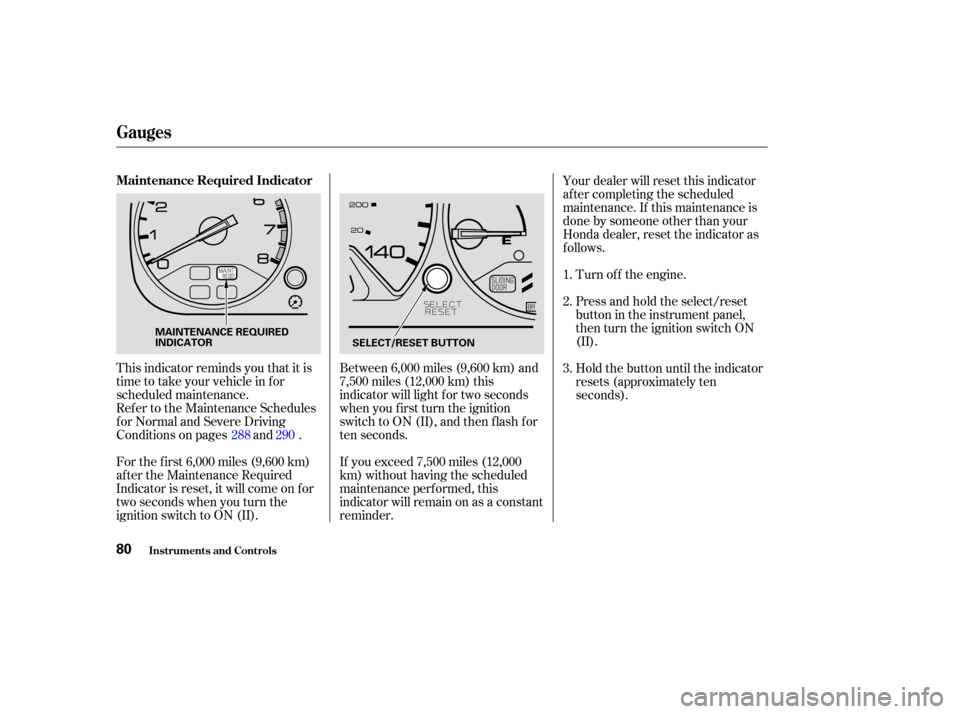
Ref er to the Maintenance Schedules
f or Normal and Severe Driving
Conditions on pages and .
For the f irst 6,000 miles (9,600 km)
af ter the Maintenance Required
Indicator is reset, it will come on f or
two seconds when you turn the
ignition switch to ON (II).Between 6,000 miles (9,600 km) and
7,500 miles (12,000 km) this
indicator will light f or two seconds
when you first turn the ignition
switch to ON (II), and then flash for
ten seconds.
If you exceed 7,500 miles (12,000
km) without having the scheduled
maintenance perf ormed, this
indicator will remain on as a constant
reminder.Your dealer will reset this indicator
af ter completing the scheduled
maintenance. If this maintenance is
done by someone other than your
Honda dealer, reset the indicator as
f ollows.
Turn of f the engine.
This indicator reminds you that it is
time to take your vehicle in for
scheduled maintenance. Press and hold the select/reset
buttonintheinstrumentpanel,
then turn the ignition switch ON
(II).
Hold the button until the indicator
resets (approximately ten
seconds).
1.
2.
3.
288 290
Gauges
Maintenance Required Indicator
Inst rument s and Cont rols80
MAINTENANCE REQUIRED
INDICATOR SELECT/RESET BUTTON
Page 247 of 415

Help assure your vehicle’s f uture
reliability and perf ormance by paying
extra attention to how you drive
during the f irst 600 miles (1,000 km).
During this period:Avoid full-throttle starts and rapid
acceleration.
Avoidhardbraking.Newbrakes
need to be broken-in by moderate
use f or the f irst 200 miles (300
km). Your Honda is designed to operate
on unleaded gasoline with a pump
octane number of 86 or higher. Use
of a lower octane gasoline can cause
a persistent, heavy metallic rapping
noise in the engine that can lead to
mechanical damage.
Youshouldfollowthesesamere-
commendations with an overhauled
or exchanged engine, or when the
brakes are replaced.
We also recommend that you should
not tow a trailer during the f irst 500
miles (800 km).
We recommend gasolines containing
detergent additives that help prevent
f uel system and engine deposits.
Using gasoline containing lead will
damage your vehicle’s emissions
controls. This contributes to air
pollution.
Do not change the oil until the
recommended time or mileage
intervalshowninthemaintenance
schedule.
Break-in Period, Gasoline
Bef ore Driving
Break-in Period
Gasoline
244
Page 252 of 415
Refer toon page f or inf ormation
on checking other items in your
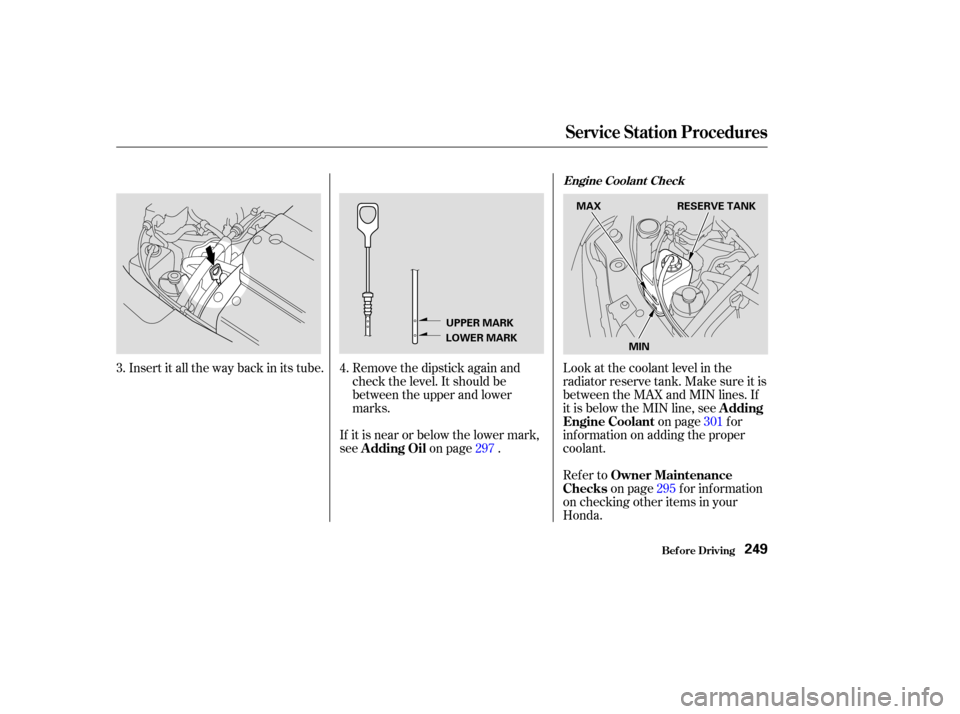
Honda. Look at the coolant level in the
radiator reserve tank. Make sure it is
between the MAX and MIN lines. If
it is below the MIN line, see on page f or
inf ormation on adding the proper
coolant.
If it is near or below the lower mark,
see
on page .
Insert it all the way back in its tube. Remove the dipstick again and
check the level. It should be
between the upper and lower
marks.
4.
3.
297301
295
Bef ore Driving
Service Station Procedures
Owner Maintenance
Checks A dding
Engine Coolant
A dding Oil
Engine Coolant Check
249
UPPER MARK
LOWER MARK MAX
RESERVE TANK
MIN
Page 253 of 415

The condition of your vehicle and
your driving habits are the two most
important things that affect the fuel
mileage you get.
Always maintain your vehicle accord-
ing to the maintenance schedule.
This will keep it in top operating
condition.A cold engine uses more f uel than a
warm engine. It is not necessary to
‘‘warm-up’’ a cold engine by letting it
idle f or a long time. You can drive
away in about a minute, no matter
how cold it is outside. The engine
will warm up f aster, and you get
better f uel economy. To cut down on
the number of ‘‘cold starts,’’ try to
combine several short trips into one.
You can improve f uel economy by
driving moderately. Rapid acceler-
ation, abrupt cornering, and hard
braking use more f uel.
Always drive in the highest gear that
allows the engine to run and acceler-
ate smoothly.
Depending on traf f ic conditions, try
to maintain a constant speed. Every
time you slow down and speed up,
your vehicle uses extra f uel. Use the
cruise control, when appropriate, to
increase f uel economy.
The air conditioning puts an extra
load on the engine which makes it
usemorefuel.Turnoff theA/Cto
cut down on air conditioning use.
Use the f low-through ventilation
when the outside air temperature is
moderate.
In winter, the build-up of snow on
your vehicle’s underside adds weight
and rolling resistance. Frequent
cleaning helps your f uel mileage and
reduces the chance of corrosion. An important part of that mainte-
nance is the (see page ). For
example, an underinf lated tire
causes more ‘‘rolling resistance,’’
which uses f uel. It also wears out
f aster, so check the tire pressure at
least monthly. 295
Vehicle Condition
Driving Habits
Owner Maintenance
Checks
Bef ore Driving
Fuel Economy
250
Page 282 of 415

CONT INUED
When preparing to tow, and bef ore
driving away, be sure to check the
f ollowing:The vehicle has been properly
serviced, and the tires, brakes,
suspension, and cooling system
are in good operating condition.
If you tow f requently, f ollow the
Severe Conditions maintenance
schedule.
All weights and loads are within
limits (see pages and ). The trailer has been properly
serviced and is in good condition.
Many states and Canadian provinces
require special outside mirrors when
towing a trailer. Even if they don’t,
you should install special mirrors if
you cannot clearly see behind you, or
if the trailer creates a blind spot.
Askyourtrailersalesorrental
agency if any other items are
recommended or required f or your
towing situation.
Since lighting and wiring vary in
trailer type and brand, you should
also have a qualif ied mechanic install
a suitable connector between the
vehicleandthetrailer.
When towing a trailer, you should
carry a f ull-size wheel and tire as a
spare in case you have a flat. If you
use the compact spare tire that came
with the vehicle, it may adversely
af f ect vehicle handling. See page
f or inf ormation on proper tire
size, and page f or inf ormation on
how to store a f ull-size tire. When
storing a f ull-size spare tire in the
trailer, f ollow the trailer maker’s
instructions. Thehitch,safetychains,andany
other attachments are secure.
328
359
274 276
Towing a Trailer
Driving
Pre-T ow ChecklistAdditional Trailer Equipment
Spare Vehicle T ire
279
Page 286 of 415

This section explains the importance
of keeping your vehicle well
maintained and why you should
f ollow basic maintenance saf ety
precautions.
If you have the skills and tools to per-
f orm more complex maintenance
tasks on your Honda, you may want
to purchase the Service Manual. See
page f or inf ormation on how to
obtain a copy, or see your Honda
dealer. This section also includes
Maintenance Schedules f or normal
driving and severe driving conditions,
a Maintenance Record, and instruc-
tions f or simple maintenance tasks
you may want to take care of
yourself .......................
Maintenance Saf ety .284
.
Important Safety Precautions . 285
.................
Maintenance Schedule . 286
...
Required Maintenance Record . 293
.......
Owner Maintenance Checks . 295
..............................
Fluid Locations .296
......................................
Engine Oil .297
..................................
Adding Oil .297
....................
Recommended Oil .297
..............................
Synthetic Oil .298
....................................
Additives .299
.....
Changing the Oil and Filter . 299
.............................
Cooling System .301
............
Adding Engine Coolant . 301
.......
Replacing Engine Coolant . 303
....................
Windshield Washers .306
....
Automatic Transmission Fluid . 307
....................................
Brake Fluid .309
............................
Brake System .309
..............................
Power Steering .310
.....................
Air Cleaner Element .311
....................................
Hood Latch .313
....................................
Spark Plugs .313
..............................
Replacement .313
............................
Specif ications .316
...........................................
Battery .317 .................................
Wiper Blades .319
..............
Air Conditioning System . 321
..................
Dust and Pollen Filter . 322
.....................................
Drive Belts .322
....................................
Timing Belt .323
...............................................
Tires .323
......................................
Inf lation .323
..................................
Inspection .325
..............................
Maintenance .326
.............................
Tire Rotation .326
...
Replacing Tires and Wheels . 327
......................
Wheels and Tires .328
..........................
Winter Driving .328
.............................
Snow Tires .329
............................
Tire Chains .329
.............................................
Lights .330
.....................
Headlight Aiming .332
........................
Replacing Bulbs .332
....................
Storing Your Vehicle .341
401
Maintenance
Maint enance283
Page 287 of 415
Regularly maintaining your vehicle is
the best way to protect your
investment. Proper maintenance is
essential to your saf ety and the
saf ety of your passengers. It will also
reward you with more economical,
trouble-f ree driving, and help reduce
air pollution.This section includes instructions f or
simple maintenance tasks, such as
checking and adding oil. Any service
items not detailed in this section
should be perf ormed by a Honda
technician or other qualif ied
mechanic.
Some of the most important saf ety
precautions are given here. However,
we cannot warn you of every
conceivable hazard that can arise in
perf orming maintenance. Only you
can decide whether or not you
should perf orm a given task.
Maintenance Saf ety
Maint enance284
Failure to properly follow
maintenance instructions and
precautions can cause you to
be seriously hurt or killed.
Always follow the procedures
and precautions in this owner’s
manual.
Improperly maintaining this
vehicle or failing to correct a
problem before driving can
cause a crash in which you can
be seriously hurt or killed.
Always follow the inspection
and maintenance
recommendations and
schedules in this owner’s
manual.
Page 288 of 415

Bef ore you begin any maintenance,
make sure your vehicle is parked on
level ground and that the parking
brake is set. Also, be sure the engine
is of f . This will help to eliminate
several potential hazards:Be sure
there is adequate ventilation
whenever you operate the engine.
Let the
engine and exhaust system cool
bef ore touching any parts. Read the instructions before you
begin, and make sure you have the
tools and skills required.
To reduce the possibility of f ire or
explosion, be caref ul when working
around gasoline or batteries. Use a
commercially available degreaser or
parts cleaner, not gasoline, to clean
parts. Keep cigarettes, sparks, and
flames away from the battery and all
f uel-related parts.
Do
not run the engine unless in-
structed to do so. You should wear eye protection and
protective clothing when working
near the battery or when using
compressed air.
Maintenance Saf ety
Maint enance
Important Saf ety Precautions
Carbon monoxide poisoning
f rom engine exhaust.
Burns f rom hot parts.
Injury f rom moving parts.
285