Page 12 of 415

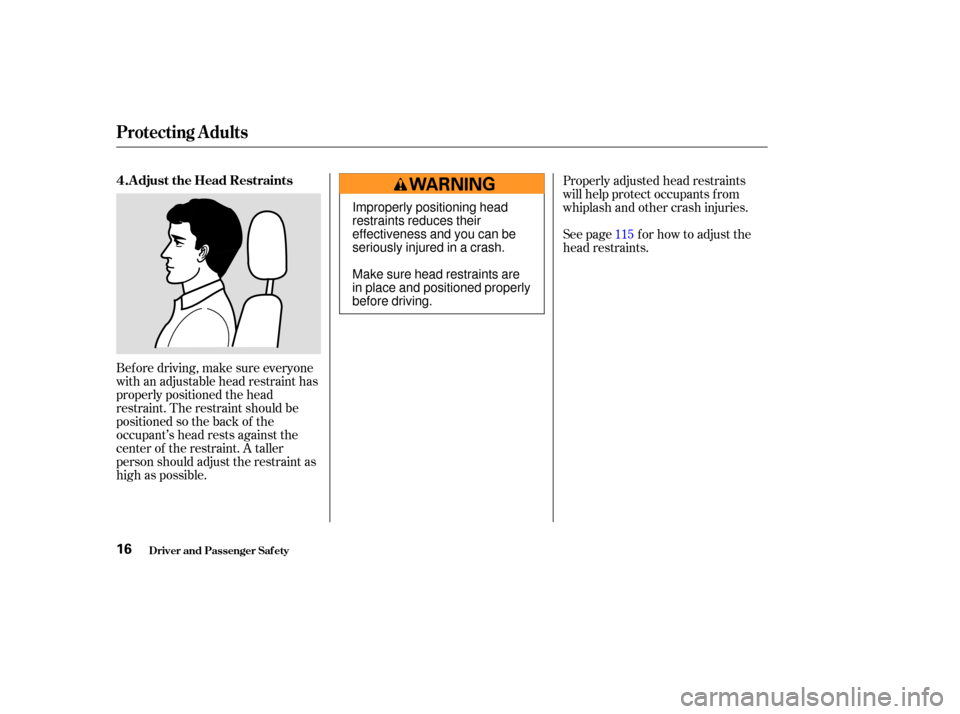
Help keep you f rom being thrown
against the inside of the vehicle
and against other occupants.
Keep you f rom being thrown out
of the vehicle.
Help keep you in a good position
should the airbags ever deploy. A
good position reduces the risk of
injury f rom an inf lating airbag, and
allows you to get the best
advantage f rom the airbag.Of course, seat belts cannot
completely protect you in every
crash.Butinmostcases,seatbelts
can reduce your risk of serious
injury.
Always wear
your seat belt, and make sure you
wear it properly.
Help protect you in almost every
type of crash, including f rontal,
side, and rear impacts and
rollovers. Keep you connected to the vehicle
so you can take advantage of the
vehicle’s built-in saf ety f eatures.
When properly worn, seat belts:
What you should do:
Your Vehicle’s Saf ety Features
Driver and Passenger Saf ety9
Not wearing a seat belt properly
increases the chance of serious
injury or death in a crash, even
if you have airbags.
Be sure you and your
passengers always wear seat
belts and wear them properly.
Page 13 of 415
Always wear
your seat belt properly, and sit
upright and as f ar back as possible
f rom the steering wheel or
dashboard. They are designed to supplement
the seat belts.
To do their job, airbags must
inf late with tremendous f orce and
speed. So while airbags help save
lives, they can cause minor injuries,
or more serious or even fatal
injuries if occupants are not
properly restrained or sitting
properly.
The most important things you need
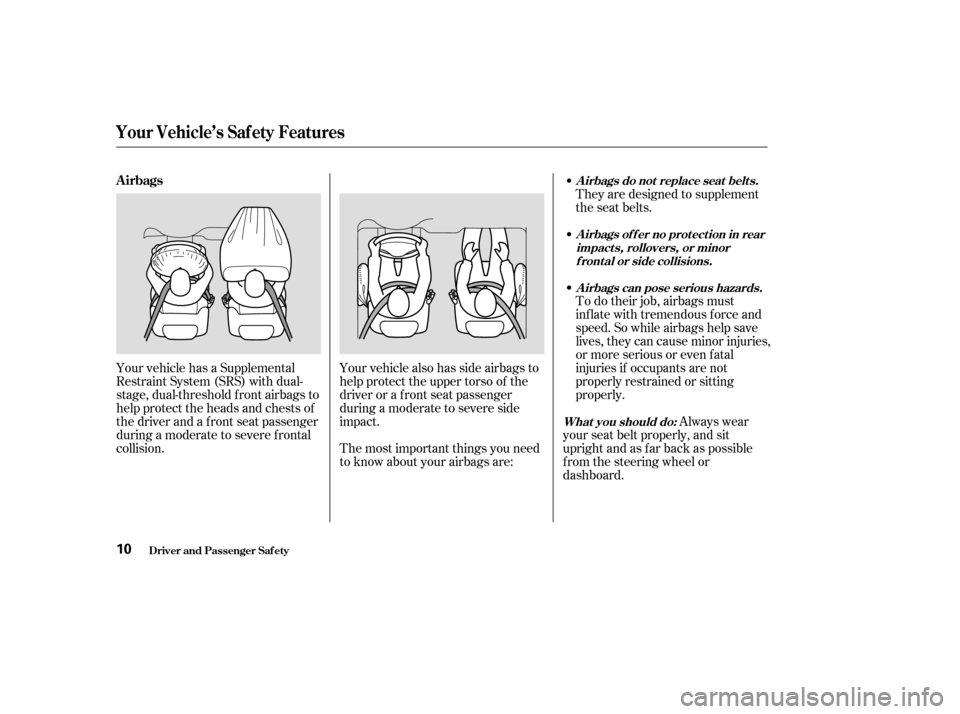
to know about your airbags are: Your vehicle also has side airbags to
help protect the upper torso of the
driver or a f ront seat passenger
during a moderate to severe side
impact.
Your vehicle has a Supplemental
Restraint System (SRS) with dual-
stage, dual-threshold f ront airbags to
help protect the heads and chests of
the driver and a f ront seat passenger
during a moderate to severe frontal
collision.What you should do:
Airbags do not replace seat belts.
A irbags of f er no prot ect ion in rearimpact s, rollovers, or minorf ront al or side collisions.
Airbags can pose serious hazards.
Airbags
Your Vehicle’s Saf ety Features
Driver and Passenger Saf ety10
Page 14 of 415

Head restraints can help protect you
f rom whiplash and other injuries. For
maximum protection, the back of
your head should rest against the
center of the head restraint.
Reclining a seat-back too f ar reduces
the seat belt’s ef f ectiveness and
increases the chance that the seat’s
occupant will slide under the seat
belt in a crash and be seriously
injured. Move the f ront
seats as far back as possible, and
keep adjustable seat-backs in an
upright position whenever the
vehicle is moving.
Your vehicle’s seats are designed to
keep you in a comf ortable, upright
position so you can take f ull
advantage of the protection offered
by seat belts and the energy
absorbing materials in the seats.
How you adjust your seats and seat-
backs can also affect your safety. For
example, sitting too close to the
steering wheel or dashboard
increases the risk of you or your
passenger being injured by striking
theinsideof thevehicle,orbyan
inf lating airbag. Keeping your doors locked reduces
thechanceof beingthrownoutof
the vehicle during a crash. It also
helps prevent occupants f rom
accidentally opening a door and
f alling out, and outsiders f rom
unexpectedly opening your doors.
Seats & Seat-Backs
Head RestraintsDoor L ocks
What you should do:
Your Vehicle’s Saf ety Features
Driver and Passenger Saf ety11
Page 15 of 415

To make sure you and your
passengers get the maximum
protection f rom your vehicle’s saf ety
f eatures, check the f ollowing each
time before you drive away:Any inf ant or small child is
properly restrained in a child seat
in a back seat (see page ). The rest of this section gives more
detailed inf ormation about how you
can maximize your saf ety.
Remember, however, that no saf ety
system can prevent all injuries or
deaths that can occur in severe
crashes, even when seat belts are
properly worn and the airbags deploy.
Frontseatoccupantsaresitting
upright and as f ar back as possible
f rom the steering wheel and
dashboard (see page ).
Seat-backs are upright (see page
).
Head restraints are properly
adjusted (see page ).
Alldoorsandthetailgateare
closed and locked (see page ).
All cargo is properly stored or
secured (see page ).
All adults, and children who have
outgrown child saf ety seats, are
wearing their seat belts and
wearingthemproperly(seepage
).
24 13
15 1613
253
17
Pre-Drive Saf ety Checklist
Your Vehicle’s Saf ety Features
Driver and Passenger Saf ety12
Page 16 of 415
The f ollowing pages provide
instructions on how to properly
protect the driver and other adult
occupants.
These instructions also apply to
children who have outgrown child
seats and are large enough to wear
lap/shoulder belts. (See page f or
important additional guidelines on
how to properly protect larger
children.)Your vehicle has a door and tailgate
monitor light on the instrument
panel to indicate when a specif ic
door or the tailgate is not tightly
closed. Af ter everyone has entered the
vehicle, be sure the doors and
tailgate are closed and locked.
For security, locked doors can
prevent an outsider f rom
unexpectedly opening a door when
you come to a stop.
See page f or how to lock the
doors. For saf ety, locking the doors reduces
the chance that a passenger,
especially a child, will open a door
while the vehicle is moving and
accidentally f all out. It also reduces
the chance of someone being thrown
out of the vehicle during a crash.
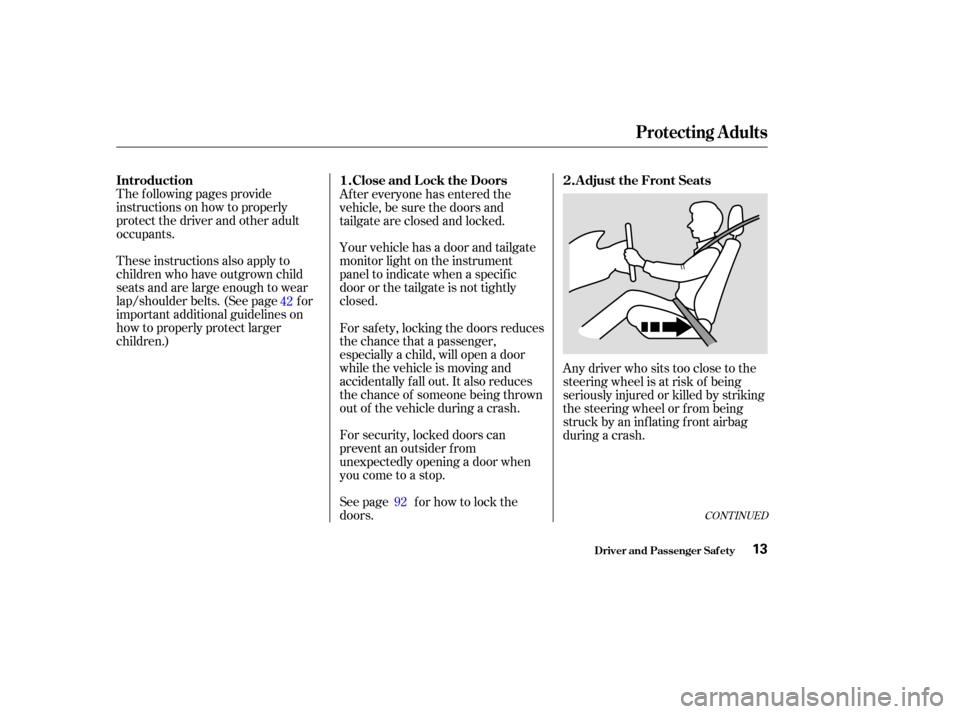
Any driver who sits too close to the
steering wheel is at risk of being
seriously injured or killed by striking
the steering wheel or f rom being
struck by an inflating front airbag
during a crash.
42
92
CONT INUED
Introduction A djust the Front Seats
Close and L ock the Doors
1. 2.
Protecting Adults
Driver and Passenger Saf ety13
Page 17 of 415
See page f or how to adjust the
f ront seats. Once your seat is adjusted correctly,
rock it back and f orth to make sure
the seat is locked in position. Most shorter drivers can get f ar
enough away f rom the steering
wheel and still reach the pedals.
However, if you are concerned about
sitting too close, we recommend that
you investigate whether some type
of adaptive equipment may help.
The National Highway Traffic Safety
Administration and Transport
Canada recommend that drivers
adjust the seat so the center of the
chest is at least 10 inches (25 cm)
away f rom the center of the steering
wheel.Alsomakesureyourfront
seat passenger moves the seat as f ar
to the rear as possible. To reduce the chance of injury, wear
your seat belt properly, sit upright
with your back against the seat, and
movetheseatawayfromthe
steering wheel to the f arthest
distance that allows you to maintain
f ull control of the vehicle.
110
Protecting Adults
Driver and Passenger Saf ety14
Sitting too close to a front
airbag can result in serious
injury or death if the front
airbags inflate.
Always sit as far back from the
front airbags as possible.
Page 18 of 415
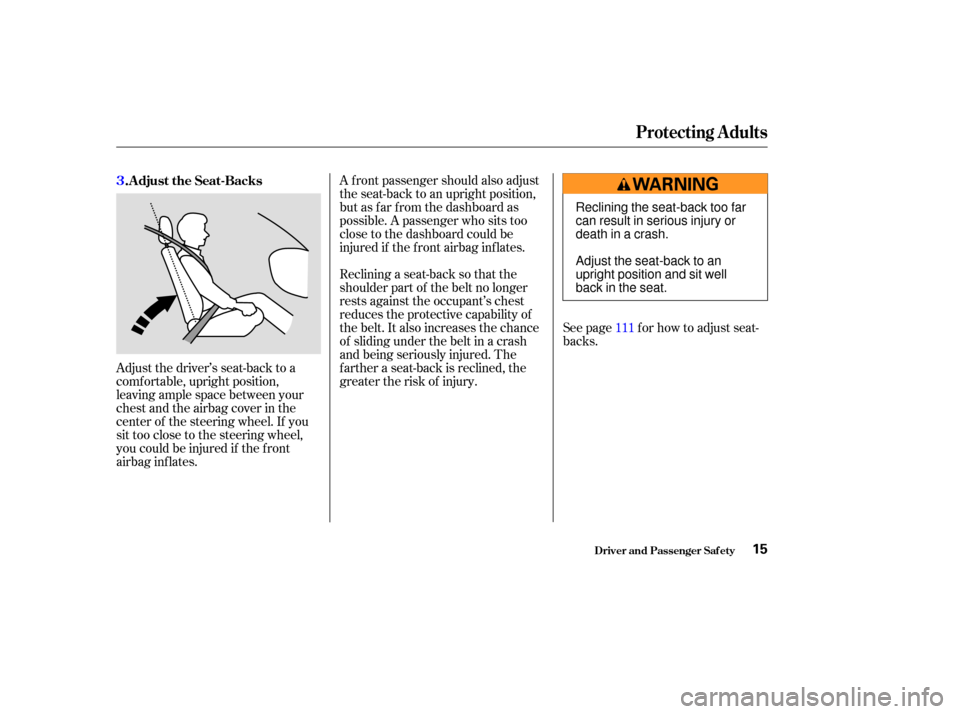
See page f or how to adjust seat-
backs.
A f ront passenger should also adjust
the seat-back to an upright position,
but as f ar f rom the dashboard as
possible. A passenger who sits too
close to the dashboard could be
injured if the f ront airbag inf lates.
Reclining a seat-back so that the
shoulder part of the belt no longer
rests against the occupant’s chest
reduces the protective capability of
the belt. It also increases the chance
of sliding under the belt in a crash
and being seriously injured. The
farther a seat-back is reclined, the
greater the risk of injury.
Adjust the driver’s seat-back to a
comf ortable, upright position,
leaving ample space between your
chest and the airbag cover in the
center of the steering wheel. If you
sit too close to the steering wheel,
you could be injured if the f ront
airbag inflates. 111
Adjust the Seat-Backs
3.
Protecting Adults
Driver and Passenger Saf ety15
Reclining the seat-back too far
can result in serious injury or
death in a crash.
Adjust the seat-back to an
upright position and sit well
back in the seat.
Page 19 of 415
Bef ore driving, make sure everyone
with an adjustable head restraint has
properly positioned the head
restraint. The restraint should be
positioned so the back of the
occupant’s head rests against the
center of the restraint. A taller
person should adjust the restraint as
high as possible.Properly adjusted head restraints
will help protect occupants f rom
whiplash and other crash injuries.
See page f or how to adjust the
head restraints.
115
Driver and Passenger Saf ety
Protecting Adults
A djust the Head Restraints
4.
16
Improperly positioning head
restraints reduces their
effectiveness and you can be
seriously injured in a crash.
Make sure head restraints are
in place and positioned properly
before driving.