Page 73 of 411

This indicator reminds you that the
exterior lights are on. It comes on
when the light switch is in either theor position. If you turn the
ignition switch to the ACCESSORY
(I) or the LOCK (0) position without
turning of f the light switch, this
indicator will remain on. A reminder
chime will also sound when you open
the driver’s door.
This indicator comes on with the
high beam headlights. For more
inf ormation, see page .
This indicator also comes on with
reduced brightness when the
daytime running lights (DRL) are on
(see page ).
The lef t or right turn signal indicator
blinks when you signal a lane change
or turn. If an indicator does not blink
or blinks rapidly, it usually means
one of the turn signal bulbs is
burned out (see pages and ).
Replace the bulb as soon as possible,
since other drivers cannot see that
you are signaling.
When you press the hazard warning
button, both turn signal indicators
and all turn signals on the outside of
the vehicle f lash.
This indicator comes on when you
turn on the cruise control system by
pressing the CRUISE button on the
steering wheel (see page ).
This indicator comes on when you
set the cruise control. See page
f or inf ormation on operating the
cruise control.
121
123
325 327
222
222On LX and EX models
On LX and EX models
Cruise Main Indicator
Lights On Indicator
High Beam Indicator
Turn Signal and
Hazard Warning
Indicators
Cruise Control Indicator
Instrument Panel Indicators
Inst rument s and Cont rols
69
Page 129 of 411
If you do not insert the key in the
ignition switch af ter opening the
driver’s door, the illumination turns
of f about 30 seconds af ter you close
the door.
If you insert the key but do not turn
the ignition switch to the ON (II)
position, the illumination turns of f in
about 10 seconds.Push the button next to the audio
system to turn on the hazard
warning lights (f our-way f lashers).
This causes all f our outside turn
signal lights and both turn signal
indicators in the instrument panel to
f lash. Use the hazard warning lights
if you need to park in a dangerous
area near heavy traffic, or if your
vehicle is disabled. Hazard Warning Button
Instrument Panel Brightness, Hazard Warning Button
Inst rument s and Cont rols
125
HAZARD WARNING BUTTON
Page 145 of 411
�µ
The height of your driver’s seat is
adjustable. To raise the seat,
repeatedly pull up the lever on the
outside of the seat cushion. To lower
the seat, push the lever down
repeatedly.
To change the seat-back angle of the
f ront seat, pull up the lever on the
outside of the seat bottom.
Once a seat is adjusted correctly,
rock it back and f orth to make sure it
is locked in position.
To adjust the seat f orward or
backward, pull up on the bar under
the seat cushion’s f ront edge. Move
the seat to the desired position, and
releasethebar.Trytomovetheseat
to make sure it is locked in position. Make all adjustments bef ore you
start driving.
See pages f or important saf ety
inf ormation and warnings about how toproperly position seats and seat-backs. 14 15
Driver’s Seat Height A djustment
FrontSeatAdjustments
Seats
Inst rument s and Cont rols
141
Page 146 of 411
See page f or important saf etyinf ormation and a warning aboutimproperly positioning head restraints. 16
Your vehicle is equipped with head
restraints in all seating positions to
help protect you and your
passengers f rom the likelihood of
whiplash and other injuries.
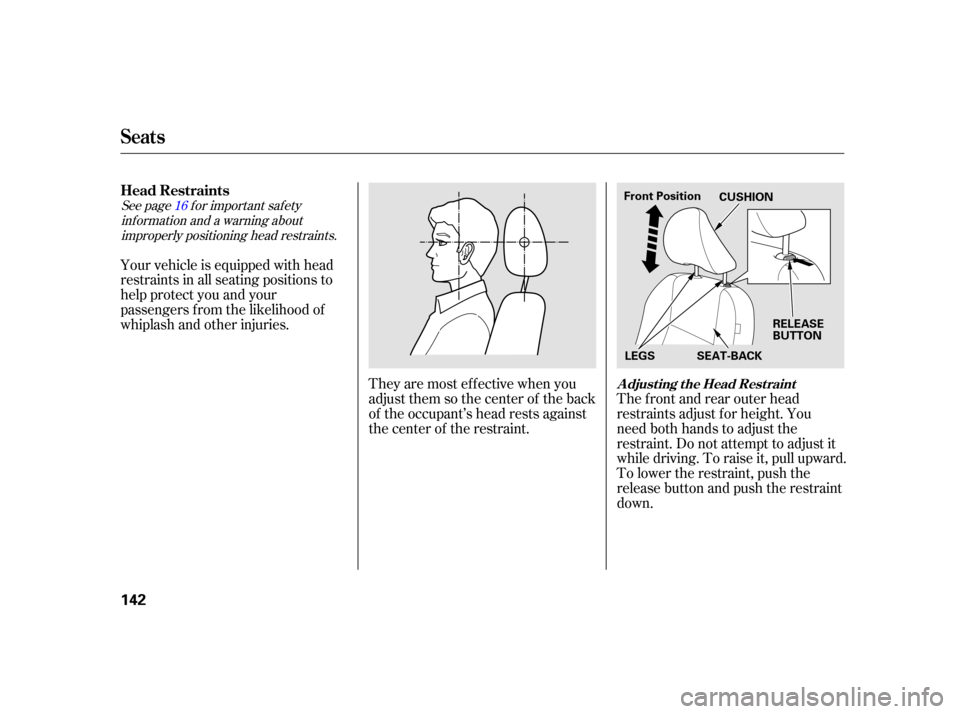
They are most ef f ective when you
adjust them so the center of the back
of the occupant’s head rests against
the center of the restraint.The f ront and rear outer head
restraints adjust f or height. You
need both hands to adjust the
restraint. Do not attempt to adjust it
while driving. To raise it, pull upward.
To lower the restraint, push the
release button and push the restraint
down.
Head Restraints
A djust ing t he Head Rest raint
Seats
142
LEGS
SEAT-BACK RELEASE
BUTTON
Front Position
CUSHION
Page 295 of 411

This indicator and the warning
message on the multi-inf ormation
display will go of f , af ter several miles
(kilometers) driving, when the spare
tire is replaced with the specified
regular tire equipped with the tire
pressure monitor sensor.
Also, the low tire pressure/TPMS
indicator begins to f lash, then stays
on (see page ).
If the low tire pressure/TPMS
indicator comes on, or the multi-
inf ormation display shows a
‘‘CHECK TPMS SYSTEM’’ message,
the VSA system automatically turns
on even when the VSA system is
turned of f by pressing the VSA OFF
switch (see page ). If this
happens, you cannot turn the VSA
system of f by pressing the VSA OFF
switch again.
When you restart the vehicle with
thecompactsparetire,theTPMS
system message will also be
displayed on the multi-inf ormation
display af ter several miles
(kilometers) driving. If you have a f lat tire, the low tire
pressure/TPMS indicator will come
on. Replace the f lat tire with the
compact spare tire (see page ).
After the flat tire is replaced with the
spare tire, the low tire pressure/
TPMS indicator stays on while
driving. Af ter several miles
(kilometers) driving, this indicator
begins to f lash, then stays on again.
You will also see a ‘‘CHECK TPMS
SYSTEM’’ message on the multi-
inf ormation display. This is normal;
the system cannot monitor the spare
tire pressure. Manually check the
sparetirepressuretobesureitis
correct.
Each wheel (except the compact
sparetirewheel)isequippedwitha
tire pressure sensor. You must use
TPMS specif ic wheels. It is
recommended that you always have
your tires serviced by your dealer or
qualif ied technician.
289
294 349
CONT INUED
Changing a T ire with T PMS
Tire Pressure Monitoring System (TPMS)
Driving
291
Page 348 of 411
�µ
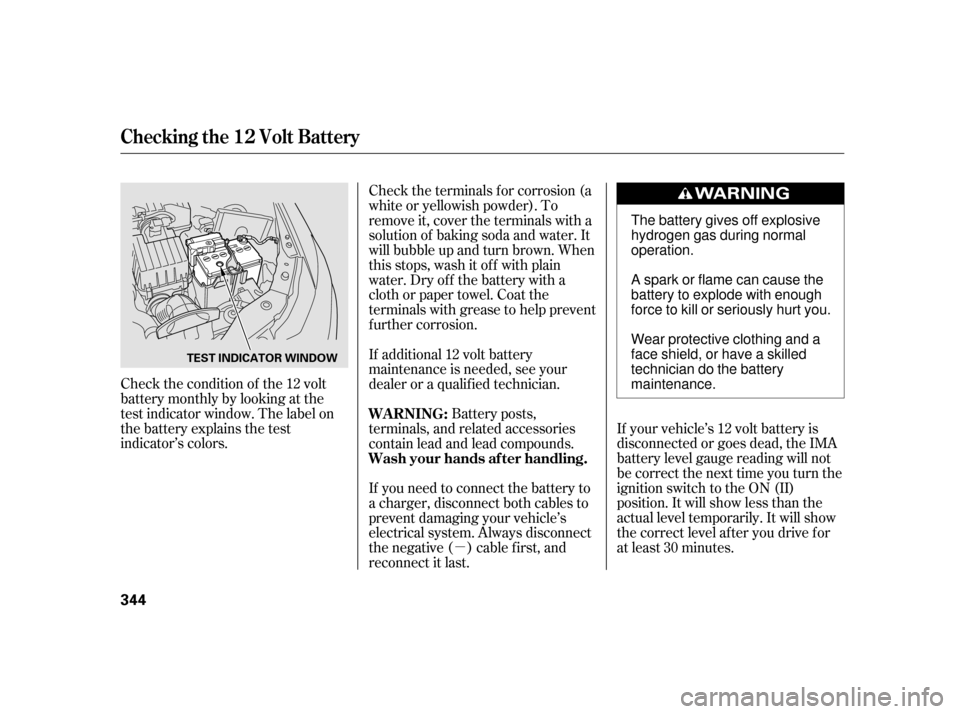
Check the condition of the 12 volt
battery monthly by looking at the
test indicator window. The label on
the battery explains the test
indicator’s colors.
If your vehicle’s 12 volt battery is
disconnected or goes dead, the IMA
battery level gauge reading will not
be correct the next time you turn the
ignition switch to the ON (II)
position. It will show less than the
actual level temporarily. It will show
the correct level af ter you drive f or
at least 30 minutes.
Check the terminals f or corrosion (a
white or yellowish powder). To
remove it, cover the terminals with a
solution of baking soda and water. It
will bubble up and turn brown. When
this stops, wash it of f with plain
water. Dry off the battery with a
cloth or paper towel. Coat the
terminals with grease to help prevent
f urther corrosion.
Battery posts,
terminals, and related accessories
contain lead and lead compounds.
If you need to connect the battery to
a charger, disconnect both cables to
prevent damaging your vehicle’s
electrical system. Always disconnect
the negative ( ) cable first, and
reconnect it last. If additional 12 volt battery
maintenance is needed, see your
dealer or a qualif ied technician.
WARNING:
Wash your hands af ter handling.
Checking the 12 Volt Battery
344
TEST INDICATOR WINDOW
The battery gives off explosive
hydrogen gas during normal
operation.
A spark or flame can cause the
battery to explode with enough
force to kill or seriously hurt you.
Wear protective clothing and a
face shield, or have a skilled
technician do the battery
maintenance.
Page 353 of 411
CONT INUED
If you have a f lat tire while driving,
stop in a saf e place to change it.
Drive slowly along the shoulder until
you get to an exit or an area to stop
that is far away from the traffic lanes.Park the vehicle on f irm, level, and
non-slippery ground. Put the
transmission in Park. Apply the
parking brake.
Turn on the hazard warning lights,
and turn the ignition switch to the
LOCK (0) position. Have all
passengers get out of the vehicle
while you change the tire.Open the hatch.
Remove the cargo area floor by
caref ully pulling the f ront edge of
the f loor straight up.
4. 3.
2. 1.
Changing a Flat T ire
T aking Care of t he Unexpect ed
349
HOLDER
FLOOR
TABThe vehicle can easily roll off
the jack, seriously injuring
anyone underneath.
Follow the directions for
changing a tire exactly, and
never get under the vehicle
when it is supported only by the
jack.
Page 365 of 411

CONT INUED
Saf ely pull to the side of the road.
Put the transmission in Park, and
set the parking brake. Turn of f all
the accessories, and turn on the
hazard warning lights.If you see steam and/or spray
coming f rom under the hood, turn
of f the engine. Wait until you see
no more signs of steam or spray,
then open the hood.
If you do not see steam or spray,
leave the engine running, and
check the high temperature
indicator. If the high heat is due to
overloading, the engine should
start to cool down almost
immediately. If it does, wait until
the high temperature indicator
goes of f , then continue driving.
If the high temperature indicator
stays on, turn of f the engine.Look f or any obvious coolant leaks,
such as a split radiator hose.
Everything is still extremely hot,
so use caution. If you f ind a leak, it
must be repaired bef ore you
continue driving (see
on page ).
If you don’t f ind an obvious leak,
check the coolant level in the
radiator reserve tank (see page ). Add coolant if the level is
below the MIN mark.
If there was no coolant in the
reserve tank, you may need to add
coolant to the radiator. Let the
engine cool down until the high
temperature indicator goes of f
bef ore checking the radiator.
1. 2.
3.
4.5.
6.
7.
374
250
If theEngineOverheats
Emergency
Towing
T aking Care of t he Unexpect ed
361
Steam and spray from an
overheated engine can
seriously scald you.
Do not open the hood if steam
is coming out.