Page 66 of 338
On models without side airbagsOn models with side airbags
Saf ety L abels
Driver and Passenger Saf ety62
HOOD
RADIATOR CAP
Page 224 of 338
Fluid Locations
Maint enance220
ENGINE OIL
FILL CAP
ENGINE OIL
DIPSTICK
(Orange loop)
POWER STEERING
FLUID
(Red cap)
WASHER FLUID
(Blue cap)
RADIATOR CAPBRAKE FLUID
(Gray cap)
AUTOMATIC
TRANSMISSION
FLUID DIPSTICK
(Yellow loop)
ENGINE COOLANT
RESERVOIR CLUTCH FLUID
(5-speed Manual
Transmission only)
(Gray cap)
Page 229 of 338

If the coolant level in the reserve
tank is at or below the MIN line, add
coolant to bring it up to the MAX line.
Inspect the cooling system f or leaks.
The coolant you add should always
be a mixture of 50 percent antif reeze
and 50 percent water. Never add
straight antif reeze or plain water.Always use Honda All Season
Antif reeze/Coolant Type 2. This
coolant is pre-mixed with 50 percent
antif reeze and 50 percent water. It
does not require any additional
mixing. If it is not available, you may
use another major-brand non-silicate
coolant as a temporary replacement.
Make sure it is a high-quality coolant
recommended f or aluminum engines.
However, continued use of any non-
Honda coolant can result in
corrosion, causing the cooling
system to malf unction or f ail. Have
the cooling system f lushed and
ref illed with Honda antif reeze/
coolant as soon as possible.
If the reserve tank is completely
empty, you should also check the
coolant level in the radiator.
Make sure the engine and radiator
are cool.
1.
CONT INUED
A dding Engine Coolant
Cooling Syst em
Maint enance225
RESERVE TANK
Removing the radiator cap
while the engine is hot can
cause the coolant to spray out,
seriously scalding you.
Always let the engine and
radiator cool down before
removing the radiator cap.
Page 230 of 338
The coolant level should be up to
the base of the f iller neck. Add
coolant if it is low.
Turn the radiator cap counter-
clockwise, without pressing down
on it, until it stops. This relieves
any pressure remaining in the
cooling system.
Remove the radiator cap by
pushing down and turning
counterclockwise. Do not add any rust inhibitors or
other additives to your vehicle’s
cooling system. They may not be
compatible with the coolant or
engine components.
Put the radiator cap back on.
Tighten it f ully.
Pour coolant into the reserve tank.
Fill it to half way between the MAX
and MIN marks. Put the cap back
on the reserve tank.
Pour the coolant slowly and caref ully
so you do not spill. Clean up any
spills immediately. Spilled coolant
could damage components in the
engine compartment.
2.
3.
4.5.
6.
Cooling Syst em
Maint enance226
RADIATOR CAP
RESERVE TANK
Page 231 of 338
CONT INUED
Thecoolingsystemshouldbe
completely drained and ref illed with
new coolant according to the time
and distance recommendations in
the maintenance schedule. Only use
Honda All Season Antif reeze/
Coolant Type 2.
Draining the coolant requires access
to the underside of the vehicle.
Unless you have the tools and
knowledge, you should have this
maintenance done by a skilled
mechanic.Turn the ignition ON (II). Turn
the heater temperature control
dial f ully clockwise. Turn the
ignition of f .
Openthehood.Makesurethe
engine and radiator are cool to the
touch. Remove the radiator cap.
Loosen the drain plug on the
bottom of the radiator. The
coolant will drain through the
splash guard.
1.
2. 3.
4.
Replacing Engine Coolant
Cooling Syst em
Maint enance227
Page 233 of 338
Fill the reserve tank to the MAX
mark. Install the reserve tank cap.
Install the radiator cap, and
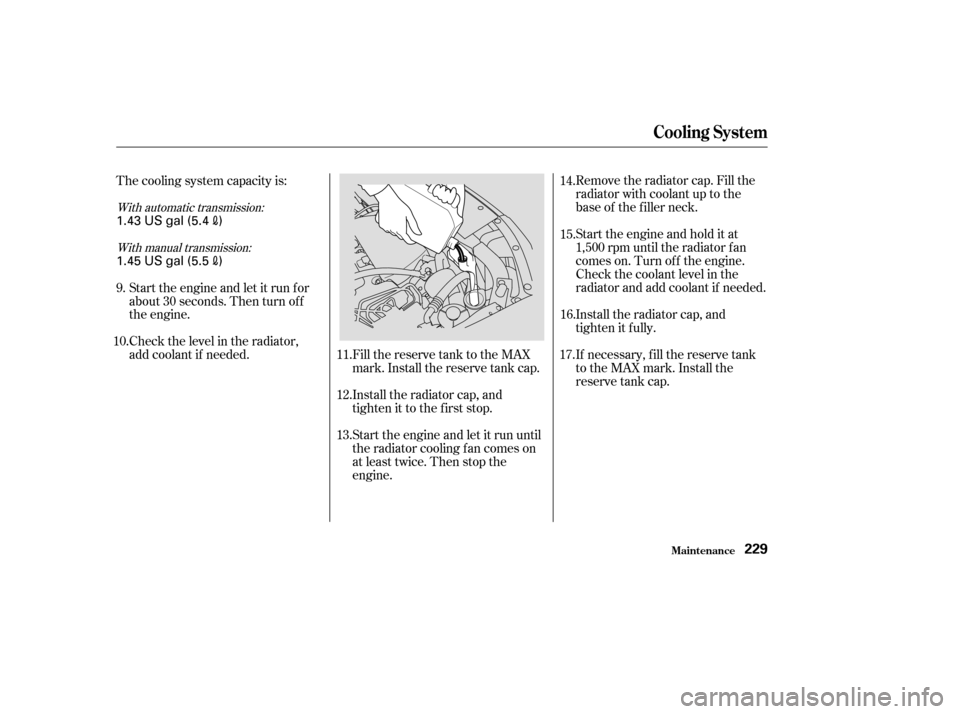
tighten it to the first stop.Remove the radiator cap. Fill the
radiator with coolant up to the
base of the f iller neck.
Start the engine and hold it at
1,500 rpm until the radiator f an
comes on. Turn of f the engine.
Check the coolant level in the
radiator and add coolant if needed.
Install the radiator cap, and
tighten it fully.
If necessary, f ill the reserve tank
to the MAX mark. Install the
reserve tank cap.
Start the engine and let it run until
the radiator cooling f an comes on
at least twice. Then stop the
engine.
Start the engine and let it run f or
about 30 seconds. Then turn of f
the engine.
Check the level in the radiator,
add coolant if needed.
The cooling system capacity is:
9.
10. 11.
12.
13.14.
15.
16.
17.
With automatic transmission:
With manual transmission:
Maint enance
Cooling Syst em
229
1.43 US gal (5.4)
1.45 US gal (5.5
)
Page 249 of 338

Run the air conditioning at least once
a week during the cold weather
months. Run it f or at least ten
minutes while you are driving at a
steady speed with the engine at
normal operating temperature. This
circulates the lubricating oil con-
tained in the ref rigerant.If the air conditioning does not get as
cold as before, have your dealer
check the system. Recharge the
system with Ref rigerant HFC-134a
(R-134a). (See Specif ications on page
.)
Your vehicle’s air conditioning is a
sealed system. Any major mainte-
nance, such as recharging, should be
done by a qualif ied mechanic. You
can do a couple of things to make
sure the air conditioning works
ef f iciently.
Periodically check the engine’s
radiator and air conditioning
condenser f or leaves, insects, and
dirt stuck to the f ront surf ace. These
block the air f low and reduce cooling
ef f iciency. Use a light spray f rom a
hose or a sof t brush to remove them. 307
On U.S. EX, and Canadian DX and EX
models
A ir Condit ioning Syst em
Maint enance245
AIR CONDITIONING CONDENSER
Whenever you have the air conditioning
system serviced, make sure the service
f acility uses a ref rigerant recycling
system. This system captures the
ref rigerant f or reuse. Releasing
ref rigerant into the atmosphere can
damage the environment.
The condenser and radiator f ins bend
easily. Only use a low-pressure spray
or sof t-bristle brush to clean them.
Page 293 of 338

Look f or any obvious coolant leaks,
such as a split radiator hose.
Everything is still extremely hot,
so use caution. If you f ind a leak, it
must be repaired bef ore you
continue driving (seeon page ).
If you don’t f ind an obvious leak,
check the coolant level in the
radiator reserve tank (see page ). If the level is below the
MIN mark, add coolant to halfway
between the MIN and MAX marks. Using gloves or a large heavy
cloth, turn the radiator cap
counterclockwise, without pushing
down, to the f irst stop. This
releases any remaining pressure in
the cooling system. After the
pressure releases, push down on
the cap and turn it until it comes
off.Start the engine and set the
temperature control dial to
maximum. Add coolant to the
radiator up to the base of the f iller
neck. If you do not have the
proper coolant mixture available,
you can add plain water.
Remember to have the cooling
system drained and ref illed with
the proper mixture as soon as you
can.
If there was no coolant in the
reserve tank, you may also have to
add coolant to the radiator. Let the
engine cool down until the pointer
reaches the middle of the tempera-
ture gauge, or lower, bef ore check-
ing the radiator. Put the radiator cap back on
tightly. Run the engine and watch
the temperature gauge. If it goes
back to the red mark, the engine
needs repair. (See
on page .)
If the temperature stays normal,
check the coolant level in the
radiator reserve tank. If it has
gone down, add coolant to the
MAX mark. Put the cap back on
tightly.
10.
9.
8. 7.
6.
11.
12.301
301
163 Emergency
Towing
Emergency
Towing
If Your Engine Overheats
T aking Care of t he Unexpect ed289
Removing the radiator cap
while the engine is hot can
cause the coolant to spray out,
seriously scalding you.
Always let the engine and
radiator cool down before
removing the radiator cap.