Page 233 of 338
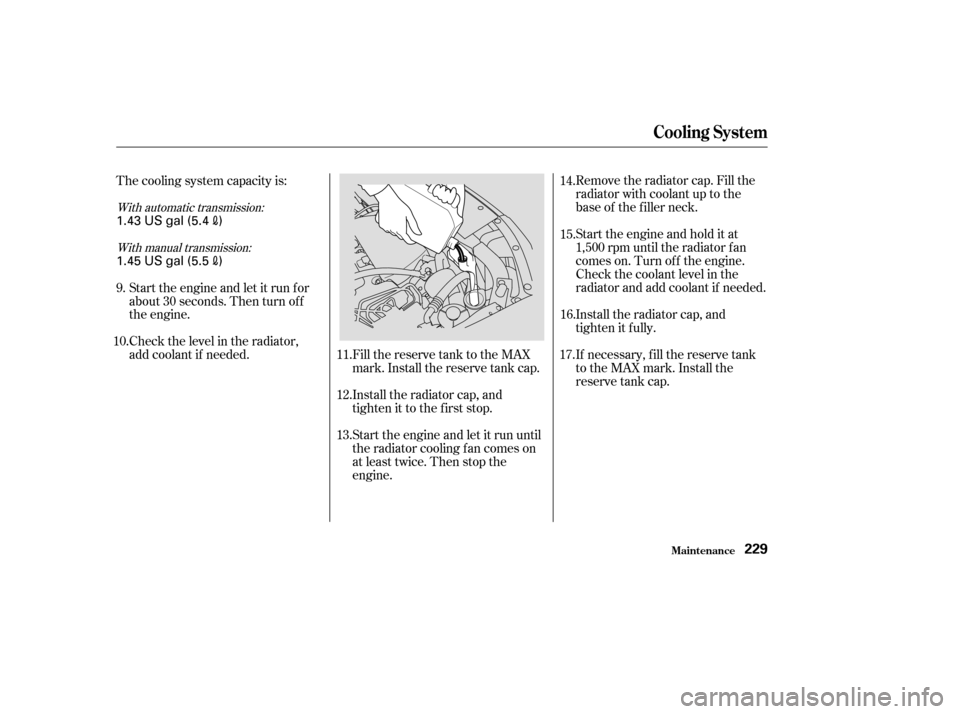
Fill the reserve tank to the MAX
mark. Install the reserve tank cap.
Install the radiator cap, and
tighten it to the first stop.Remove the radiator cap. Fill the
radiator with coolant up to the
base of the f iller neck.
Start the engine and hold it at
1,500 rpm until the radiator f an
comes on. Turn of f the engine.
Check the coolant level in the
radiator and add coolant if needed.
Install the radiator cap, and
tighten it fully.
If necessary, f ill the reserve tank
to the MAX mark. Install the
reserve tank cap.
Start the engine and let it run until
the radiator cooling f an comes on
at least twice. Then stop the
engine.
Start the engine and let it run f or
about 30 seconds. Then turn of f
the engine.
Check the level in the radiator,
add coolant if needed.
The cooling system capacity is:
9.
10. 11.
12.
13.14.
15.
16.
17.
With automatic transmission:
With manual transmission:
Maint enance
Cooling Syst em
229
1.43 US gal (5.4)
1.45 US gal (5.5
)
Page 249 of 338

Run the air conditioning at least once
a week during the cold weather
months. Run it f or at least ten
minutes while you are driving at a
steady speed with the engine at
normal operating temperature. This
circulates the lubricating oil con-
tained in the ref rigerant.If the air conditioning does not get as
cold as before, have your dealer
check the system. Recharge the
system with Ref rigerant HFC-134a
(R-134a). (See Specif ications on page
.)
Your vehicle’s air conditioning is a
sealed system. Any major mainte-
nance, such as recharging, should be
done by a qualif ied mechanic. You
can do a couple of things to make
sure the air conditioning works
ef f iciently.
Periodically check the engine’s
radiator and air conditioning
condenser f or leaves, insects, and
dirt stuck to the f ront surf ace. These
block the air f low and reduce cooling
ef f iciency. Use a light spray f rom a
hose or a sof t brush to remove them. 307
On U.S. EX, and Canadian DX and EX
models
A ir Condit ioning Syst em
Maint enance245
AIR CONDITIONING CONDENSER
Whenever you have the air conditioning
system serviced, make sure the service
f acility uses a ref rigerant recycling
system. This system captures the
ref rigerant f or reuse. Releasing
ref rigerant into the atmosphere can
damage the environment.
The condenser and radiator f ins bend
easily. Only use a low-pressure spray
or sof t-bristle brush to clean them.
Page 293 of 338

Look f or any obvious coolant leaks,
such as a split radiator hose.
Everything is still extremely hot,
so use caution. If you f ind a leak, it
must be repaired bef ore you
continue driving (seeon page ).
If you don’t f ind an obvious leak,
check the coolant level in the
radiator reserve tank (see page ). If the level is below the
MIN mark, add coolant to halfway
between the MIN and MAX marks. Using gloves or a large heavy
cloth, turn the radiator cap
counterclockwise, without pushing
down, to the f irst stop. This
releases any remaining pressure in
the cooling system. After the
pressure releases, push down on
the cap and turn it until it comes
off.Start the engine and set the
temperature control dial to
maximum. Add coolant to the
radiator up to the base of the f iller
neck. If you do not have the
proper coolant mixture available,
you can add plain water.
Remember to have the cooling
system drained and ref illed with
the proper mixture as soon as you
can.
If there was no coolant in the
reserve tank, you may also have to
add coolant to the radiator. Let the
engine cool down until the pointer
reaches the middle of the tempera-
ture gauge, or lower, bef ore check-
ing the radiator. Put the radiator cap back on
tightly. Run the engine and watch
the temperature gauge. If it goes
back to the red mark, the engine
needs repair. (See
on page .)
If the temperature stays normal,
check the coolant level in the
radiator reserve tank. If it has
gone down, add coolant to the
MAX mark. Put the cap back on
tightly.
10.
9.
8. 7.
6.
11.
12.301
301
163 Emergency
Towing
Emergency
Towing
If Your Engine Overheats
T aking Care of t he Unexpect ed289
Removing the radiator cap
while the engine is hot can
cause the coolant to spray out,
seriously scalding you.
Always let the engine and
radiator cool down before
removing the radiator cap.
Page 334 of 338

�Î
Onboard Ref ueling Vapor....................................
Recovery .313
..
Operation in Foreign Countries . 312
............................
Outside Mirrors .106
.......................................
Overdrive .181
....................
Overheating, Engine .288
.......
Owner Maintenance Checks . 219
.........................
Oxygenated Fuels .311
..............................
Paint Touch-up .270
..............
Panel Brightness Control . 77
........................
Park Gear Position .179
...........................................
Parking .184
...............................
Parking Brake .111
Parking Brake and Brake .................
System Indicator . 66,294
.................................
Parking Lights .76
Parking Over Things that ....................................
Burn .184, 314
.............................
PGM-FI System .314
..................
Polishing and Waxing . 269
............
Pre-Drive Saf ety Checklist . 12
.........
Pregnancy, Using Seat Belts . 21
............................
Protecting Adults .13 ...
Additional Safety Precautions . 22
.....
Advice f or Pregnant Women . 21
........................
Protecting Children .24
.......................
Protecting Inf ants .34
.......
Protecting Larger Children . 42
.........
Protecting Small Children . 38
Using Child Seats with .....................................
Tethers .46
.............................
Using LATCH .47
...................
Radiator Overheating . 288
.....
Radio/CD Sound System . 126,137
...........................
Readiness Codes .293
.................
Rear Dif f erential Fluid . 233
.......................................
Rear Doors .88
..
Rear Lights, Bulb Replacement . 261
............................
Rear Seat Access .95
..........................
Rear Seat, Folding .99
..........................
Rear View Mirror .106
.................
Rear Window Def ogger . 81
.
Rear Window Wiper and Washer . 80
...............
Reclining the Seat-Backs . 92
.......
Recommended Shif t Speeds . 177
.............................
Reminder Lights .65 ............
Removing the Rear Seats . 101
Replacement Inf ormation .................
Air Cleaner Element . 236
..............
Dust and Pollen Filter . 246
..........................
Engine Coolant .227
................
Engine Oil and Filter . 223
..........................................
Fuses .296
................................
Light Bulbs .258
....................................
Schedule .210
................................
Spark Plugs .238
...........................................
Tires .253
.............................
Wiper Blades .242
Replacing Seat Belts Af ter a ............................................
Crash .53
Reserve Tank, Engine ...............................
Coolant .163, 225
...............................
Restraint, Child .24
..................
Reverse Gear Position . 180
...........................
Reverse Lockout .183
................................
Rotation, Tire .252
..................................
Saf ety Belts .8, 50
.........
Safety Defects, Reporting . 322
...........
Saf ety Checklist, Pre-Drive . 12
Index
R
P
S
VI