Page 115 of 338
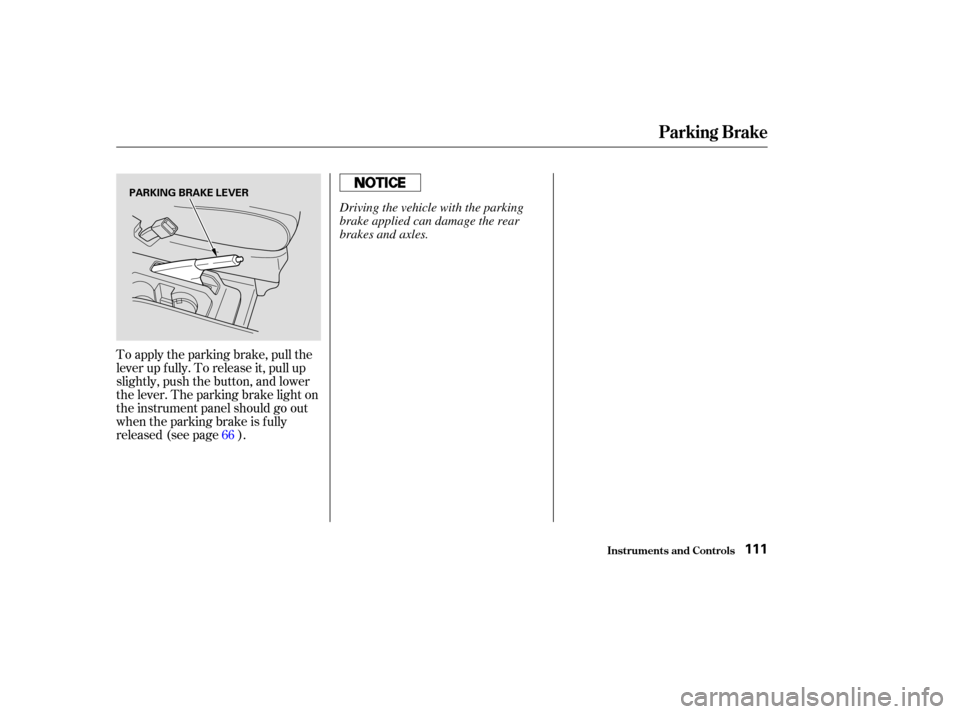
To apply the parking brake, pull the
lever up f ully. To release it, pull up
slightly, push the button, and lower
the lever. The parking brake light on
the instrument panel should go out
when the parking brake is f ully
released (see page ).66
Parking Brake
Inst rument s and Cont rols111
PARKING BRAKE LEVER
Driving the vehicle with the parking
brake applied can damage the rear
brakes and axles.
Page 164 of 338
Shift to Park or Neutral and set
the parking brake. Pull the hood
release handle located under the
lower lef t corner of the dashboard.
The hood will pop up slightly.
Screw the f uel f ill cap back on,
tighten it until it clicks several
times. If you do not properly
tighten the cap, the Malfunction
Indicator Lamp may come on (see
page ).
Standing in f ront of the vehicle,
put your f ingers between the f ront
edge of the hood and the f ront
grille. The hood latch handle is
above the ‘‘H’’ logo. Push this
handle up until it releases the
hood. Lif t the hood.
Push the f uel f ill door closed.
1. 2.
5.
6.
292
Service Station Procedures
Bef ore Driving
Opening the Hood
160
HOOD RELEASE HANDLE
LATCH
Page 175 of 338

This section gives you tips on
starting the engine under various
conditions, and how to operate the
5-speed manual and automatic
transmissions. It also includes
important inf ormation on parking
your vehicle, the braking system,
and f acts you need if you are plan-
ning to tow a trailer or drive off-
highway.........................
Driving Guidelines .172
........................
Preparing to Drive .173
.......................
Starting the Engine .174
Starting in Cold Weather ....................
at High Altitude .175
....
5-speed Manual Transmission . 176
.....
Recommended Shif t Points . 177
..............
Engine Speed Limiter . 177
..............
Automatic Transmission . 178
.
Shif t Lever Position Indicator . 178
................
Shif t Lever Positions . 179
..............
Engine Speed Limiter . 182
....................
Shif t Lock Release . 183
...........................................
Parking .184
.....................
The Braking System .185
.............
Brake Wear Indicators . 185
...............
Brake System Design . 186
.......................
Anti-lock Brakes .186
Important Saf ety .........................
Reminders .187
........................
ABS Indicator .188
...............
Driving in Bad Weather . 189
...........................
Towing a Trailer .191
Towing Your Vehicle Behind a ................................
Motorhome .198 ..............
Of f -Highway Guidelines . 200
.................
General Inf ormation . 200
Important Saf ety ............................
Precautions .201
...............................
Driving Tips .202
Driving
Driving171
Page 178 of 338

If the engine still does not start,
press the accelerator pedal all the
way down and hold it there while
starting in order to clear f looding.
As bef ore, keep the ignition key in
the START (III) position f or no
more than 15 seconds. Return to
step 5 if the engine does not start.
If it starts, lif t your f oot of f the
accelerator pedal so the engine
does not race.
If the engine does not start within
15 seconds, or starts but stalls
right away, repeat step 4 with the
accelerator pedal pressed half-way
down. If the engine starts, release
pressure on the accelerator pedal
so the engine does not race. Without touching the accelerator
pedal, turn the ignition key to the
START (III) position. If the engine
does not start right away, do not
hold the key in START (III) f or
more than 15 seconds at a time.
Pause f or at least 10 seconds
bef ore trying again.
Apply the parking brake.
In cold weather, turn of f all
electrical accessories to reduce
the drain on the battery.
Make sure the shif t lever is in
Park. Press on the brake pedal. Push the clutch pedal down all the
way. START (III) does not
f unction unless the clutch pedal is
pressed.
1.
2.
3.
4.
5.6.
Manual Transmission:
Automatic Transmission:
Driving
Starting the Engine
174
Page 187 of 338

This allows you to move the shif t
lever out of Park if the normal
method of pushing on the brake
pedal does not work. This procedure
is also used to release the Reverse
Lockout.Put a cloth on the edge of the Shif t
Lock Release slot cover next to
theshiftlever.Useasmallflat-
tipped screwdriver or small metal
plate (neither are included in the
tool kit) to remove the cover.
Caref ully pry on the edge of the
cover. To release the Reverse Lockout,
make sure the ignition switch is in
the ACCESSORY(I) position. Make sure the ignition switch is in
the LOCK (0) position. Set the Parking brake. Insert a screwdriver in the Shif t
Lock Release slot.
If you need to use the Shif t Lock
Release, it means your vehicle is
developing a problem. Have the
vehicle checked by your Honda
dealer.
Push down on the screwdriver
while you press the release button
on the side of the shif t lever and
move the shift lever out of Park to
Neutral.
To release the Reverse Lockout,
move the shift lever from Neutral
to Reverse, then to Park. Remove the screwdriver f rom the
Shif t Lock Release slot, then
install a new cover. Make sure the
notchonthecoverisontheright
side. Press the brake pedal, and
restart the engine.
1.
2.
3.
4.
5.
6.
Shif t L ock Release
Automatic Transmission
Driving183
COVER
SHIFT LOCK RELEASE SLOT
Page 188 of 338

�µ
Always use the parking brake when
you park your vehicle. The indicator
on the instrument panel shows that
the parking brake is not f ully
released; it does not indicate that the
parking brake is f irmly set. Make
sure the parking brake is set f irmly
or your vehicle may roll if it is
parked on an incline.
If your vehicle has an automatic
transmission, set the parking brake
bef ore you put the transmission in
Park. This keeps the vehicle f rom
moving and putting pressure on the
parking mechanism in the
transmission making it easier to
move the shift lever out of Park
when you want to drive away. If the vehicle is f acing uphill, turn
the f ront wheels away f rom the curb.
If you have a manual transmission,
putitinfirstgear.
If the vehicle is f acing downhill, turn
the f ront wheels toward the curb. If
you have a manual transmission, put
it in reverse gear.
Make sure the parking brake is f ully
released bef ore driving away.
Driving with the parking brake
partially set can overheat or damage
the rear brakes.
Place any packages, valuables, etc.,
in the cargo area or take them
with you. Turn of f the lights.
Lock the doors and the hatch with
the key.
Never park over dry leaves, tall
grass, or other f lammable
materials. The three way catalytic
converter gets very hot, and could
cause these materials to catch on
fire. Make sure the skylight and the
windows are closed.
Parking T ips
Driving
Parking
184
Page 192 of 338
The ABS is self -checking. If anything
goes wrong, the ABS indicator on
the instrument panel comes on (see
page ). This means the anti-lock
f unction of the braking system has
shut down. The brakes still work like
a conventional system without anti-
lock, providing normal stopping
ability. You should have the dealer
inspect your vehicle as soon as
possible.If the ABS indicator and the brake
system indicator come on together,
and the parking brake is f ully
released, the front-to-rear braking
distribution system may also shut
down.
Test your brakes as instructed on
page . If the brakes f eel normal,
drive slowly and have your vehicle
repaired by your dealer as soon as
possible. Avoid sudden hard braking
which could cause the rear wheels to
lock up and possibly lead to a loss of
control.
68 294
A BS Indicat or
The Braking System
Driving188
ABS INDICATOR
Page 200 of 338

The added weight, length, and
height of a trailer will af f ect your
vehicle’s handling and perf ormance,
so driving with a trailer requires
some special driving skills and
techniques.
Foryoursafetyandthesafetyof
others,taketimetopracticedriving
maneuvers bef ore heading f or the
open road, and f ollow the guidelines
discussed below.When climbing hills, closely watch
your temperature gauge. If it nears
the red mark, turn the air
conditioning of f , reduce speed and, if
necessary, pull to the side of the
road to let the engine cool.
Make turns more slowly and wider
than normal. The trailer tracks a
smaller arc than your vehicle, and it
canhitorrunoversomethingthe
vehicle misses. Allow more time and
distance f or braking. Do not brake or
turn suddenly as this could cause the
trailer to jackknif e or turn over. If youmuststopwhenfacinguphill,
use the f oot brake or parking brake.
Do not try to hold the vehicle in
placebypressingontheaccelerator,
as this can cause the automatic
transmission to overheat.
Drive slower than normal in all
driving situations, and obey posted
speed limits f or vehicles with trailers.
If you have an automatic
transmission, use the overdrive
(O/D) mode when towing a trailer
on level roads. Turn of f the
overdrive (O/D) mode when towing
a trailer in hilly terrain (see page
). (See ‘‘ ’’ in the
next column f or additional gear
inf ormation.) If the automatic transmission shif ts
f requently between 3rd and 4th
gears while going up a hill, turn of f
the overdrive (O/D) mode (see page
).
181
181
Driving Saf ely With a T railer
Towing a Trailer
Driving
Driving on Hills
Making T urns and Braking
T owing Speeds and Gears
Driving on Hills
196