Page 279 of 374
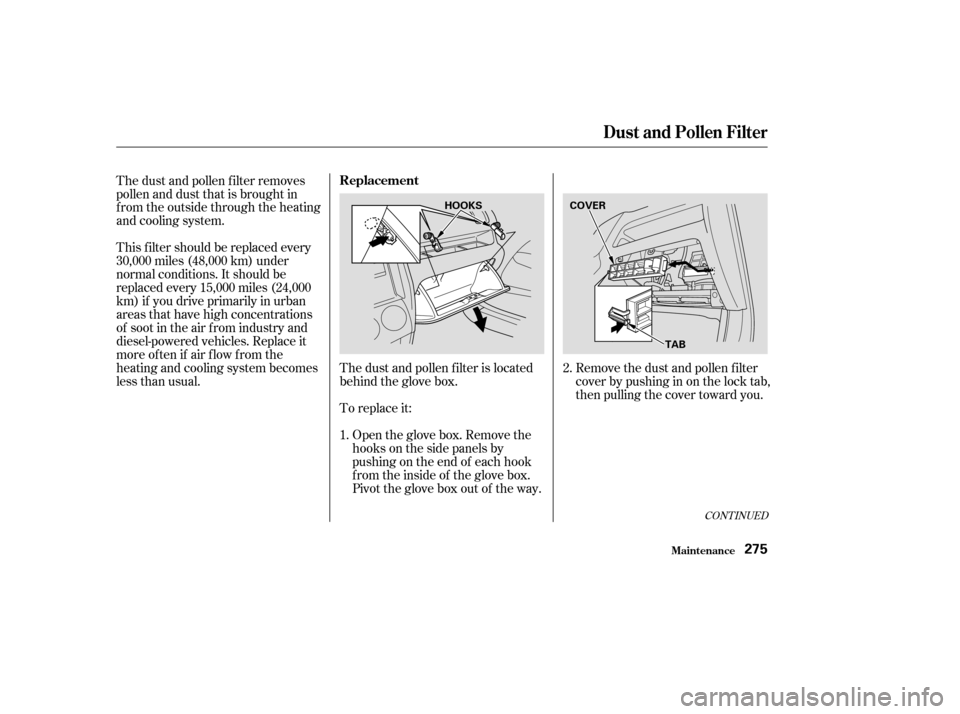
To replace it: The dust and pollen f ilter is located
behind the glove box.Remove the dust and pollen f ilter
cover by pushing in on the lock tab,
then pulling the cover toward you.
The dust and pollen f ilter removes
pollen and dust that is brought in
f rom the outside through the heating
andcoolingsystem.
This f ilter should be replaced every
30,000 miles (48,000 km) under
normal conditions. It should be
replaced every 15,000 miles (24,000
km) if you drive primarily in urban
areas that have high concentrations
of soot in the air f rom industry and
diesel-powered vehicles. Replace it
more of ten if air f low f rom the
heating and cooling system becomes
less than usual.
Open the glove box. Remove the
hooks on the side panels by
pushingontheendof eachhook
fromtheinsideof theglovebox.
Pivot the glove box out of the way.
1. 2.
CONT INUED
Maint enance
Dust and Pollen Filter
Replacement
275
HOOKS
COVER
TAB
Page 327 of 374
If you see steam and/or spray
coming f rom under the hood, turn
of f the engine.If you do not see steam or spray,
leave the engine running and
watch the temperature gauge. If
the high heat is due to overloading
(climbing a long, steep hill on a
hot day with the A/C running, for
example), the engine should start
to cool down almost immediately.
If it does, wait until the tempera-
ture gauge comes down to the mid-
point then continue driving.
The pointer of your vehicle’s
temperature gauge should stay in
the midrange under most conditions.
Itmaygohigherif youaredrivingup
a long steep hill on a very hot day. If
it climbs to the red mark, you should
determine the reason.
Saf ely pull to the side of the road.
Put the transmission in Neutral or
Park, and set the parking brake.
Turn of f the heating and cooling
system and all other accessories.
Turn on the hazard warning
indicators.If the temperature gauge stays at
the red mark, turn of f the engine.
Wait until you see no more signs
of steam or spray, then open the
hood.
Your vehicle can overheat for several
reasons, such as lack of coolant or a
mechanical problem. The only
indication may be the temperature
gauge climbing to or above the red
mark. Or you may see steam or
spray coming f rom under the hood.
In either case, you should take
immediate action. 1.
2.3.
4.
5.
CONT INUED
If Your Engine Overheats
T aking Care of t he Unexpect ed323
Steam and spray from an
overheated engine can
seriously scald you.
Do not open the hood if steam
is coming out.
Driving with the temperature gauge
pointer at the red mark can cause
serious damage to your engine.
Page 328 of 374

Look f or any obvious coolant leaks,
such as a split radiator hose.
Everything is still extremely hot,
so use caution. If you f ind a leak, it
must be repaired bef ore you
continue driving (seeon page ).
If you don’t f ind an obvious leak,
check the coolant level in the
radiator reserve tank (see page ). If the level is below the
MIN mark, add coolant to halfway
between the MIN and MAX marks. Using gloves or a large heavy
cloth, turn the radiator cap
counterclockwise, without pushing
down, to the f irst stop. This
releases any remaining pressure in
the cooling system. After the
pressure releases, push down on
the cap and turn it until it comes
off.Start the engine and set the
temperature control dial to
maximum. Add coolant to the
radiator up to the base of the f iller
neck. If you do not have the
proper coolant mixture available,
you can add plain water.
Remember to have the cooling
system drained and ref illed with
the proper mixture as soon as you
can.
If there was no coolant in the
reserve tank, you may also have to
add coolant to the radiator. Let the
engine cool down until the pointer
reaches the middle of the tempera-
ture gauge, or lower, bef ore check-
ing the radiator. Put the radiator cap back on
tightly. Run the engine and watch
the temperature gauge. If it goes
back to the red mark, the engine
needs repair. (See
on page .)
If the temperature stays normal,
check the coolant level in the
radiator reserve tank. If it has
gone down, add coolant to the
MAX mark. Put the cap back on
tightly.
10.
9.
8. 7.
6.
11.
12.
337
189
337
Emergency
Towing
Emergency
Towing
If Your Engine Overheats
T aking Care of t he Unexpect ed324
Removing the radiator cap
while the engine is hot can
cause the coolant to spray out,
seriously scalding you.
Always let the engine and
radiator cool down before
removing the radiator cap.
Page 340 of 374
�µ
�µ
�µ
No. Amps. Circuits Protected
1
2
3
4
5
6
7
8
9
10
11
12
13
14
15
16
17
18
19
20 20 A
15 A
15 A
20 A
15 A
15 A
15 A
10 A
30 A
20 A
40 A
40 A
40 A
15 A
20 A
15 A
30 A
100 A 50 A Condenser Fan
Small Light
Interior Light
Cooling Fan
Hazard
FI ECU
Horn, Stop
Not Used
Back Up
ABS Motor
Rear Defroster
Heater Motor
Power Window
Option
Lef t Headlight
Door Lock
Right Headlight
ABS F/S
Battery
Ignition 1
Spare Fuses
21 257.5A 30A
T aking Care of t he Unexpect ed
Fuses
336
UNDER-HOOD FUSE BOX
Page 368 of 374

.............Halogen Headlight Bulbs .287
.....................................Hatch Glass.94
..............Hazard Warning Flashers .81
Headlights
........................................Aiming.287
............Daytime Running Lights .77
..................High Beam Indicator .69
........................Reminder Beeper.76
........Replacing Halogen Bulbs .287
...................................Turning on.76
..............................Head Restraints.99
.....................Heating and Cooling.128
.............High Altitude, Starting at .201
.................High-Low Beam Switch .76
..............High-mount Brake Light .292
....................................Hood Latch.266
.......................Hood, Opening the.186
..............................................Horn.3,75
...........................Hydraulic Clutch.264
.................................Hydroplaning.216
Fluids
..........Automatic Transmission .260
..........................................Brake.263
.........................................Clutch.264
..............Manual Transmission .261
..........................Power Steering.264
.......................Rear Differential.262
..................Windshield Washer .258
FM Stereo Radio
...................................Reception.161
.........................Folding Rear Seat.104
.....Foreign Countries, Driving in .348
..........................Four-way Flashers.81
............................Front Airbags.10,54
.................................................Fuel.184
......................Fill Door and Cap.185
...........................................Gauge.74
................Octane Requirement .184
...............................Oxygenated.347
........................Reserve Indicator.69
........................Tank, Filling the.185
.....................Fuses, Checking the.331
...............Gas Mileage, Improving .190
..........................................Gasohol.347
.........................................Gasoline.184
...............Fuel Reserve Indicator .69
...........................................Gauge.74
................Octane Requirement .184
........................Tank, Filling the.185
................Gas Station Procedures .185
Gauges
...Engine Coolant Temperature .74
...............................................Fuel.74
...............................Speedometer.72
.................................Tachometer.72
Gearshif t Lever Positions
..........Automatic Transmission .204
5-speed Manual
.........................Transmission.203
..............................Glass Cleaning.303
........................................Glove Box.96
...Identif ication Number, Vehicle .340
Ignition
..............................................Keys.84
...........................................Switch.86
............Timing Control System .350
........................Immobilizer System.85
.........Important Safety Precautions .6
.........Indicators, Instrument Panel .65
Index
G
H
I
IV