Page 202 of 374

Your CR-V has higher ground
clearance than a passenger vehicle
designed only f or use on pavement.
Higher ground clearance has many
advantages for off-highway driving.
It allows you to travel over bumps
and unpaved roads. It also provides
good visibility so you can anticipate
problems earlier.
Theseadvantagescomeatsomecost.
Because your vehicle is taller and
rides higher of f the ground, it has a
high center of gravity. This means
that your vehicle can tip or roll over
if you make abrupt turns. Utility
vehicles have a signif icantly higher
rollover rate than other types of
vehicles.Avoid sharp turns and abrupt
maneuvers whenever possible.
Do not modif y your vehicle in any
way that would raise the center of
gravity.
Do not carry heavy cargo on the
roof .
Your CR-V is equipped with a unique
f our-wheel drive (4WD) system.
Normally, power is delivered only to
the f ront wheels. When the system
senses a loss of f ront-wheel traction,
it automatically transfers some
power to the rear wheels. This gives
you better traction and mobility.
While this system can provide
increasedtractiononslippery
surf aces, you still need to exercise
thesamecarewhenaccelerating,
steering, and braking that you would
in a two-wheel drive vehicle.
To prevent the risk of rollover or
loss of control: Take corners at slower speeds
than you would with a passenger
vehicle.
See page f or additional guidelinesf or driving of f -highway.
Four-wheel Drive Models
226
Driving Guidelines
Driving198
Page 266 of 374
Put a new washer on the f iller bolt,
then reinstall the f iller bolt and
tighten it securely.
Only use Honda Dual Pump Fluid.
Do not use Automatic Transmission
Fluid (ATF).
The rear dif f erential should be
drained and ref illed with new f luid
accordingtothetimeanddistance
recommendations in the mainte-
nance schedule.
Check the f luid level with the rear
dif f erential at normal operating
temperature and the vehicle sitting
on level ground. Remove the
dif f erential f luid f iller bolt and
washer and caref ully f eel inside the
bolt hole with your f inger. The f luid
level should be up to the edge of the
bolt hole. If it is not, slowly add
Honda Dual Pump Fluid until it
starts to run out of the hole.
Rear Dif f erential Fluid
Maint enance
4WD models only
262
Correct
level FILLER BOLT WASHER
Page 267 of 374
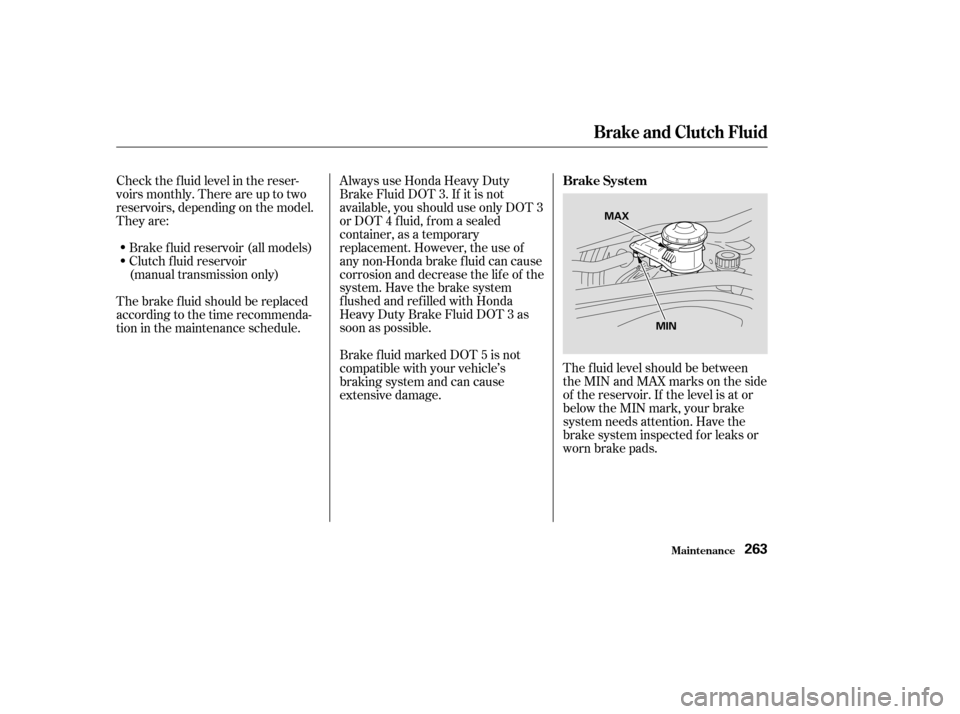
The f luid level should be between
theMINandMAXmarksontheside
of the reservoir. If the level is at or
below the MIN mark, your brake
system needs attention. Have the
brake system inspected f or leaks or
worn brake pads.
Always use Honda Heavy Duty
Brake Fluid DOT 3. If it is not
available, you should use only DOT 3
or DOT 4 f luid, f rom a sealed
container, as a temporary
replacement. However, the use of
any non-Honda brake fluid can cause
corrosion and decrease the lif e of the
system. Have the brake system
f lushed and ref illed with Honda
Heavy Duty Brake Fluid DOT 3 as
soon as possible.
Check the f luid level in the reser-
voirs monthly. There are up to two
reservoirs, depending on the model.
They are:
Brake f luid reservoir (all models)
Clutch f luid reservoir
(manual transmission only)
The brake f luid should be replaced
according to the time recommenda-
tion in the maintenance schedule. Brake f luid marked DOT 5 is not
compatible with your vehicle’s
braking system and can cause
extensive damage.Brake System
Brake and Clutch Fluid
Maint enance263
MAX
MIN
Page 319 of 374
CONT INUED
Step back to check the alignment
of the logo. If needed, pivot the
cover until the logo is straight.
Holdthecoveratthe10o’clock
and 2 o’clock positions, then place
the top of it over the spare tire.
Store the tool kit in the storage bin
under the cargo area f loor.
Close the tailgate.
Install the spare tire cover.
26.
27.
28.
29.30.
OnLXandEXmodelsintheU.S.and
Canada
Changing a Flat T ire
T aking Care of t he Unexpect ed
Sof t vinyl spare t ire cover
315
Loose items can fly around the
interior in a crash and could
seriously injure the occupants.
Store the wheel, jack, and tools
securely before driving.
Make sure the cover is at room
temperature bef ore you install it. If it’s
too cold, it won’t f it easily over the tire.
Page 331 of 374

This indicator should light when the
ignition switch is ON (II), and go out
af ter the engine starts. If it comes on
at any other time, it indicates one of
the engine’s emissions control
systems may have a problem. Even
though you may f eel no dif f erence in
your vehicle’s perf ormance, it can
reduce your f uel economy and cause
your vehicle to put out excessive
emissions. Continued operation may
cause serious damage.If you have recently ref ueled your
vehicle, the cause of this indicator
coming on could be a loose or
missing f uel f ill cap. Check the cap
and tighten it until it clicks several
times. Replace the f uel f ill cap if it is
missing. Tightening the cap will not
make the indicator turn of f
immediately; it takes one driving trip.
If the indicator remains on past one
driving trip, or the f uel cap was not
loose or missing, have the vehicle
checked by the dealer as soon as
possible. Drive moderately until the
dealer has inspected the problem.
Avoid full-throttle acceleration and
driving at high speed.
Youshouldalsohavethedealer
inspect your vehicle if this indicator
comes on repeatedly, even though it
may turn of f as you continue driving.
This indicator may also come on
along with the ‘‘D’’ indicator.
Malf unction Indicator L amp
T aking Care of t he Unexpect ed327
MALFUNCTION INDICATOR LAMP
If you keep driving with the
malf unction indicator lamp on, you can
damage your vehicle’s emissions
controls and engine. Those repairs may
not be covered by your vehicle’s
warranties.

