Page 228 of 374

When preparing to tow your CR-V,
make sure the transmission is
f illed to the correct level (see page). Do not overf ill.
Leave the key in the ignition
switch and the ignition switch in
ACCESSORY (I) so the steering
wheel does not lock. Make sure
the radio and any items plugged
into the accessory power sockets
are turned of f so you do not run
down the battery. Shif t the transmission to Neutral. Release the parking brake.
After attaching the tow bar to your
motorhome, do the following to
prepare your CR-V f or ‘‘f lat towing’’: When purchasing a tow bar, make
sure you select a reputable
manuf acturer and installer. Follow
the manufacturer’s attachment
instructions caref ully. Your CR-V can be towed behind a
motorhome at legal highway speeds
up to 65 mph(100 km/h). Do not
exceed 65 mph(100km/h).
Otherwise, severe transmission
damage will occur. To avoid damage
to the 4WD system, it must be towed
with all f our wheels on the ground
(f lat towing). When preparing to tow your CR-V,
make sure the transmission is f ull of
fluid (see page ). Maintaining
the correct level is very important.
Do not overf ill. Do the f ollowing
Follow the procedure exactly.
Otherwise, severe automatic
transmission damage will occur.
261
260
every day immediately bef ore you begin
towing.
5-speed Manual T ransmission A ut omat ic T ransmission
Towing Your Vehicle Behind a Motorhome
Driving224
Page 229 of 374

Start the engine.
Press on the brake pedal. Shif t the
lever through all the positions (P,
R, N, D, 2, 1)
ShifttoD,thentoN.Letthe
engine run f or three minutes, then
turn of f the engine.
Release the parking brake.
Leave the ignition switch in
ACCESSORY (I) so the steering
wheel does not lock. Make sure
the radio and any items plugged
into the accessory power sockets
are turned of f so you do not run
down the battery.If you tow more than 8 hours in one
day, you should repeat the above
procedure at least every 8 hours.
(when you stop f or f uel, etc.)
If youtowaCR-Vwithanautomatic
transmission, the transmission f luid
must be changed every two years or
30,000 miles (48,000 km), whichever
comes f irst.Ext ended T owing
Towing Your Vehicle Behind a Motorhome
Driving225
Failure to f ollow the above instructions
exactly will result in severe automatic
transmission damage. If you cannot
shif t the transmission or start the
engine, your vehicle must be
transported on a f lat-bed truck or
trailer. The steering system can be damaged if
the steering wheel is locked. Leave the
ignition switch in Accessory (I), and
make sure the steering wheel turns
f reely bef ore you begin towing.Severe automatic transmission damage
will occur if the vehicle is shif ted f rom
reverse to neutral and then towed with
the drive wheels on the ground.
Page 237 of 374

This section explains why it is
important to keep your vehicle well
maintained and to f ollow basic
maintenance saf ety precautions.
This section also includes
Maintenance Schedules f or normal
driving and severe driving conditions,
a Maintenance Record, and instruc-
tions f or simple maintenance tasks
you may want to take care of
yourself .
If you have the skills and tools to per-
f orm more complex maintenance
tasks on your Honda, you may want
to purchase the Service Manual. See
page f or inf ormation on how to
obtain a copy, or see your Honda
dealer.......................
Maintenance Saf ety .234
.
Important Safety Precautions . 235
.................
Maintenance Schedule . 236 ...
Required Maintenance Record . 243
.......
Owner Maintenance Checks . 245
..............................
Fluid Locations .246
......................................
Engine Oil .247
..................................
Adding Oil .247
....................
Recommended Oil .247
..............................
Synthetic Oil .248
....................................
Additives .248
.....
Changing the Oil and Filter . 249
.............................
Cooling System .251
............
Adding Engine Coolant . 251
.......
Replacing Engine Coolant . 253
....................
Windshield Washers .258
.......................
Transmission Fluid .260
..........
Automatic Transmission . 260
5-speed Manual .........................
Transmission .261
.................
Rear Dif f erential Fluid . 262
................
Brake and Clutch Fluid . 263
............................
Brake System .263
...........................
Clutch System .264
..............................
Power Steering .264
.....................
Air Cleaner Element .265
....................................
Hood Latch .266
....................................
Spark Plugs .267
..............................
Replacement .267 ............................
Specif ications .268
...........................................
Battery .269
.................................
Wiper Blades .271
..............
Air Conditioning System . 274
..................
Dust and Pollen Filter . 275
.......................................
Drive Belt .277
...............................................
Tires .278
......................................
Inf lation .278
Recommended Tire Pressures f or Normal ...........................
Driving .279
Tire Pressure Adjustment f or ..........
High Speed Driving . 279
..................................
Inspection .280
..............................
Maintenance .280
.............................
Tire Rotation .281
...
Replacing Tires and Wheels . 282
......................
Wheels and Tires .283
..........................
Winter Driving .283
.............................
Snow Tires .283
............................
Tire Chains .284
.............................................
Lights .285
.....................
Headlight Aiming .287
........................
Replacing Bulbs .287
....................
Storing Your Vehicle .295
357
Maintenance
Maint enance233
Page 249 of 374
�µ�µ�µ �µ
�µ
�µ �µ
Engine oil level Check every
time you fill the fuel tank. See
page .
Engine coolant level Check the
radiator reserve tank every time
you f ill the f uel tank. See page .
Windshield washer f luid Check
the level in the reservoir monthly.
If weather conditions cause you to
use the washers f requently, check
the reservoir each time you stop
f or f uel. See page .
Youshouldcheckthefollowing
items at the specif ied intervals. If
you are unsure of how to perf orm
any check, turn to the page given.
Tires Check the tire pressure
monthly. Examine the tread f or
wear and foreign objects. See page
.
Automatic transmission Check
the f luid level monthly. See page .
Brakes Check the f luid level
monthly. See page . Lights Check the operation of
the headlights, parking lights,
taillights, high-mount brake light,
turn signals, brake lights, and
license plate light monthly. See
page .
188
189
258
260 278
285
263
Owner Maintenance Checks
Maint enance245
Page 250 of 374
Fluid Locations
Maint enance246
ENGINE OIL
FILL CAP
POWER STEERING
FLUID
(Red cap)
ENGINE
COOLANT
RESERVOIRRADIATOR CAP BRAKE FLUID
(Gray cap)
WASHER FLUID
(Blue cap)
CLUTCH FLUID
(5-speed Manual
Transmission only)
(Gray cap)
AUTOMATIC
TRANSMISSION
FLUID DIPSTICK
(Yellow loop)
ENGINE OIL
DIPSTICK
(Orange handle)
Page 261 of 374
Fill the reserve tank to the MAX
mark. Install the reserve tank cap.
Install the radiator cap, and
tighten it to the first stop.Remove the radiator cap. Fill the
radiator with coolant up to the
base of the f iller neck.
Start the engine and hold it at
1,500 rpm until the radiator f an
comes on. Turn of f the engine.
Check the coolant level in the
radiator and add coolant if needed.
Install the radiator cap, and
tighten it fully.
If necessary, f ill the reserve tank
to the MAX mark. Install the
reserve tank cap.
Start the engine and let it run until
the radiator cooling f an comes on
at least twice. Then stop the
engine.
Start the engine and let it run f or
about 30 seconds. Then turn of f
the engine.
Check the level in the radiator,
add coolant if needed.
The cooling system capacity is:
17.
18. 19.
20.
21.22.
23.
24.
25.
With automatic transmission:
With manual transmission:
Maint enance
Cooling Syst em
257
RESERVE TANK
1.43 US gal (5.4)
1.45 US gal (5.5
)
Page 264 of 374
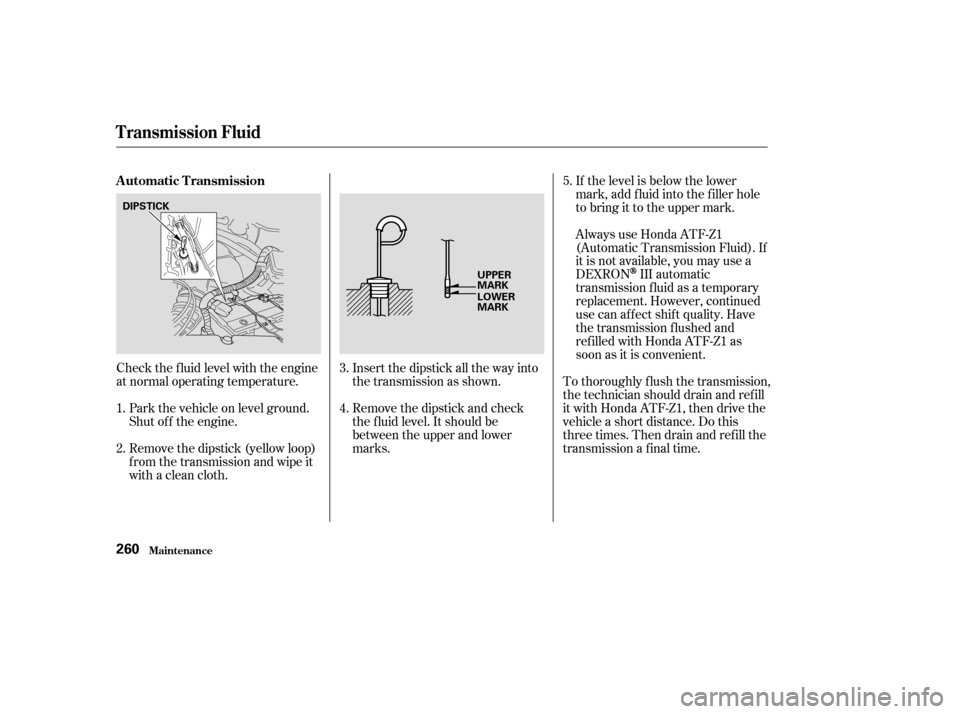
Remove the dipstick and check
the f luid level. It should be
between the upper and lower
marks.
Remove the dipstick (yellow loop)
f rom the transmission and wipe it
with a clean cloth. Park the vehicle on level ground.
Shut of f the engine.
Check the f luid level with the engine
at normal operating temperature.
Insert the dipstick all the way into
the transmission as shown.If the level is below the lower
mark, add f luid into the f iller hole
to bring it to the upper mark.
Always use Honda ATF-Z1
(Automatic Transmission Fluid). If
it is not available, you may use a
DEXRON
III automatic
transmission f luid as a temporary
replacement. However, continued
use can affect shift quality. Have
the transmission f lushed and
ref illed with Honda ATF-Z1 as
soon as it is convenient.
To thoroughly f lush the transmission,
the technician should drain and ref ill
it with Honda ATF-Z1, then drive the
vehicle a short distance. Do this
three times. Then drain and ref ill the
transmission a final time.
1.
2. 3.5.
4.
Automatic Transmission
Maint enance
T ransmission Fluid
260
DIPSTICK
UPPER
MARK
LOWER
MARK
Page 266 of 374
Put a new washer on the f iller bolt,
then reinstall the f iller bolt and
tighten it securely.
Only use Honda Dual Pump Fluid.
Do not use Automatic Transmission
Fluid (ATF).
The rear dif f erential should be
drained and ref illed with new f luid
accordingtothetimeanddistance
recommendations in the mainte-
nance schedule.
Check the f luid level with the rear
dif f erential at normal operating
temperature and the vehicle sitting
on level ground. Remove the
dif f erential f luid f iller bolt and
washer and caref ully f eel inside the
bolt hole with your f inger. The f luid
level should be up to the edge of the
bolt hole. If it is not, slowly add
Honda Dual Pump Fluid until it
starts to run out of the hole.
Rear Dif f erential Fluid
Maint enance
4WD models only
262
Correct
level FILLER BOLT WASHER


