Page 197 of 374
�Î
�Î
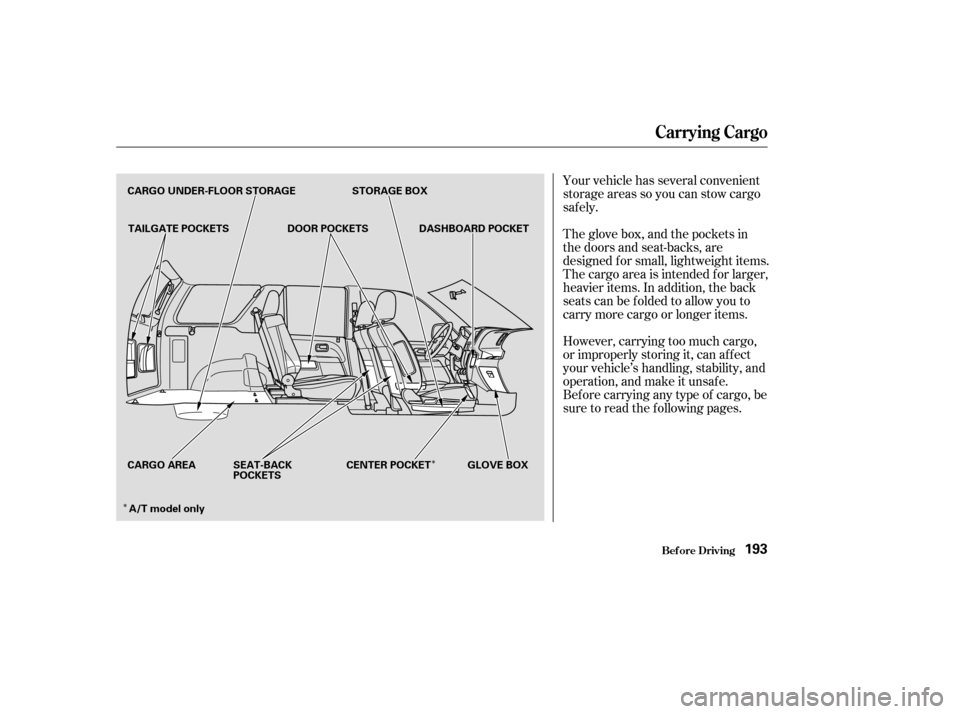
Your vehicle has several convenient
storage areas so you can stow cargo
saf ely.
However, carrying too much cargo,
or improperly storing it, can af f ect
your vehicle’s handling, stability, and
operation, and make it unsaf e.
Bef ore carrying any type of cargo, be
sure to read the f ollowing pages. The glove box, and the pockets in
the doors and seat-backs, are
designed f or small, lightweight items.
The cargo area is intended f or larger,
heavier items. In addition, the back
seats can be folded to allow you to
carry more cargo or longer items.
Carrying Cargo
Bef ore Driving193
CARGO UNDER-FLOOR STORAGE TAILGATE POCKETS DOOR POCKETSSTORAGE BOX
DASHBOARD POCKET
CARGO AREA SEAT-BACK POCKETS CENTER POCKET GLOVE BOX
A/T model only
Page 198 of 374

�·�µ
Subtract the combined weight of
the driver and passengers f rom
850 lbs (395 kg).
The resulting f igure equals the
available amount of cargo and
luggage load capacity.
This f igure includes the total weight
of all occupants, cargo, accessories,
and the tongue weight if you are
towing a trailer. The maximum load limit f or your car
is 850 lbs (395 kg).
Following are the steps f or
determining the correct cargo and
luggage load limit. For example, if there will be f our 150
lbs (70 kg) occupants in your vehicle,
the amount of available cargo and
luggage load capacity is 250 lbs (115
kg).
4 150 lbs (70 kg) = 600 lbs (280
kg)
850 lbs (395 kg) 600 lbs (280 kg) =
250 lbs (115 kg)
Locate the statement, ‘‘the
combined weight of occupants and
cargo should never exceed 850 lbs
(395 kg)’’ on your vehicle’s placard
(on the driver’s doorjamb).
Determine the combined weight
of the driver and passengers that
will be riding in your vehicle. (Five
is the seating capacity of your
vehicle.) If your vehicle will be towing a
trailer, load f rom your trailer will
be transf erred to your vehicle.
Consult this manual to determine
how this reduces the available
cargo and luggage load capacity of
your vehicle.
Determine the combined weight
of accessories, luggage, and cargo
beingloadedinthevehicle.The
weight may not saf ely exceed the
available cargo and luggage load
capacity calculated in step 4 [250
lbs(115kg)inthisexample].
1.
2. 3.
4.
5.
6.
Load Limit
Carrying Cargo
Bef ore Driving194
Overloading or improper
loading can affect handling and
stability and cause a crash in
which you can be hurt or killed.
Follow all load limits and other
loading guidelines in this
manual.
Page 199 of 374
Distribute cargo evenly on the
f loor of the cargo area, placing the
heaviest items on the bottom and
as far forward as possible. Tie
down items that could be thrown
about the vehicle during a crash or
sudden stop.
If you carry large items that
prevent you f rom closing the
tailgate or the hatch glass, exhaust
gas can enter the passenger area.
To avoid the possibility of, f ollow the
instructions on page . If you can carry any items on a
roof rack,besurethetotalweight
of the rack and the items does not
exceed the maximum allowable
weight. Please contact your Honda
dealer f or f urther inf ormation.
If you use an accessory roof rack,
the roof rack weight limit may be
lower. Ref er to the inf ormation that
came with your roof rack.
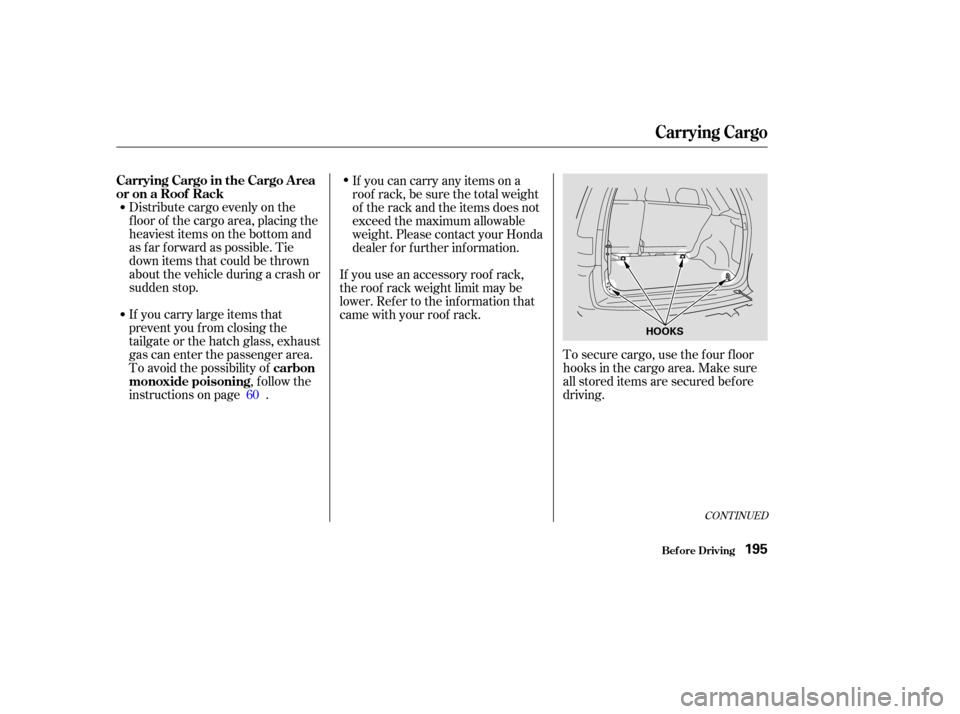
To secure cargo, use the f our f loor
hooks in the cargo area. Make sure
all stored items are secured before
driving.
60
CONT INUED
Carrying Cargo in the Cargo A rea
or on a Roof Rack
carbon
monoxide poisoning
Carrying Cargo
Bef ore Driving195
HOOKS
Page 200 of 374
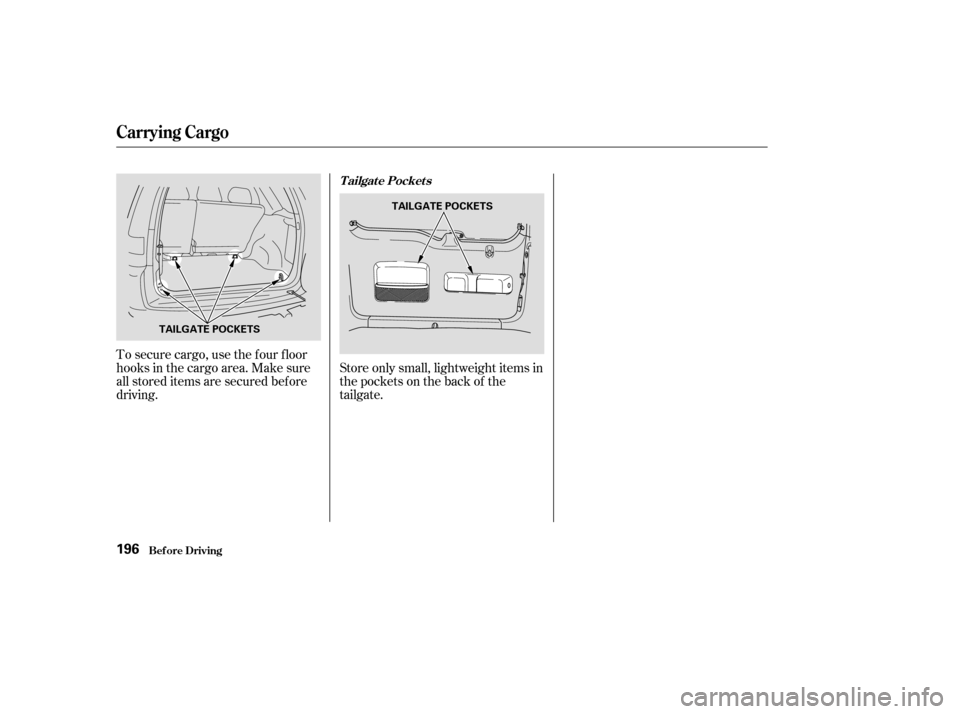
Store only small, lightweight items in
the pockets on the back of the
tailgate.
To secure cargo, use the f our f loor
hooks in the cargo area. Make sure
all stored items are secured before
driving.
Carrying Cargo
Bef ore Driving
T ailgat e Pocket s
196
TAILGATE POCKETS
TAILGATE POCKETS
Page 221 of 374
Your Honda has been designed
primarily to carry passengers and
their cargo. You can use it to tow a
trailer if you caref ully observe the
load limits, use the proper equipment,
and f ollow the guidelines in this
section.The weight that
the tongue of a f ully-loaded trailer
puts on the hitch should be
approximately 10 percent of the
trailer weight. Too little tongue
load can make the trailer unstable
and cause it to sway. Too much
tongue load reduces f ront-tire
traction and steering control.
The total
weight of the trailer and
everything loaded in it must not
exceed 1,500 lbs (680 kg). Towing
a load that is too heavy can
seriously af f ect your vehicle’s
handling and perf ormance. It can
also damage the engine and
drivetrain.
CONT INUED
Tongue Load:
Load Limits
T otal T railer Weight:
Towing a Trailer
Driving217
Page 222 of 374
To achieve a proper tongue load,
start by loading 60 percent of the
load toward the front of the trailer
and 40 percent toward the rear, then
re-adjust the load as needed.The total weight of the vehicle, all
occupants, all cargo, the
tongue load must not exceed: The total weight of the vehicle, all
occupants, all cargo, and the
tongue load must not exceed:
on the f ront axle
on the rear axle
and
Gross Vehicle Weight Rating
(GVWR):
Gross Axle Weight Rating
(GA WR):
Towing a Trailer
Driving218
4,320 lbs (1,960 kg)
2,160 lbs (980 kg)
2,250 lbs (1,020 kg)Exceeding load limits or
improperly loading your vehicle
and trailer can cause a crash in
which you can be seriously
injured or killed.
Check the loading of your
vehicle and trailer carefully
beforestartingtodrive.
Page 223 of 374

The best way to conf irm that vehicle
and trailer weights are within limits
is to have them checked at a public
scale.
Using a suitable scale or a special
tongue load gauge, check the tongue
load the f irst time you set up a
towing combination (a f ully-loaded
vehicle and trailer), then recheck the
tongue load whenever the conditions
change.Towing can require a variety of
equipment, depending on the size of
your trailer, how it will be used, and
how much load you are towing.
Discuss your needs with your trailer
sales or rental agency, and f ollow the
guidelines in the rest of this section.
Also make sure that all equipment is
properly installed and that it meets
f ederal, state, province, and local
regulations.Any hitch used on your vehicle must
be properly bolted to the underbody.
Always use saf ety chains. Make sure
they are secured to both the trailer
and hitch, and that they cross under
the tongue so they can catch the
trailer if it becomes unhitched.
Leave enough slack to allow the
trailer to turn corners easily, but do
not let the chains drag on the ground.
CONT INUED
Checking L oads
T owing Equipment and
A ccessoriesHitches
Saf et y Chains
Towing a Trailer
Driving219
Page 224 of 374
Honda recommends that any trailer
having a total weight of 1,000 lbs
(450 kg) or more be equipped with
its own electric or surge-type brakes.
If you choose electric brakes, be
sure they are electronically actuated.
Do not attempt to tap into your
vehicle’s hydraulic system. No
matter how successf ul it may seem,
any attempt to attach trailer brakes
to your vehicle’s hydraulic system
will lower braking ef f ectiveness and
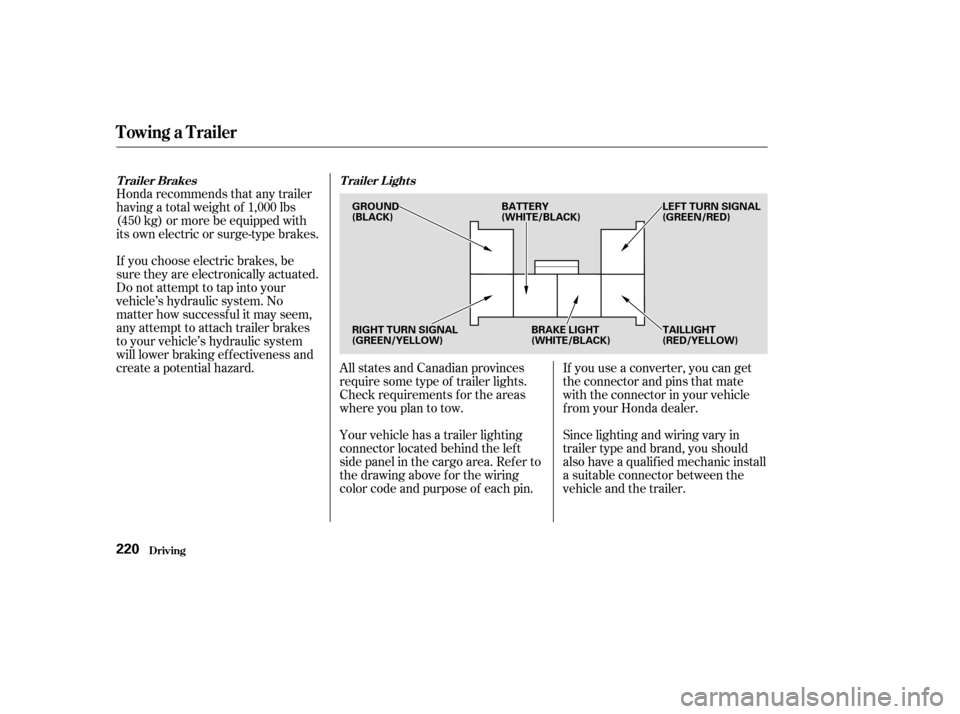
create a potential hazard.Your vehicle has a trailer lighting
connector located behind the lef t
side panel in the cargo area. Ref er to
thedrawingaboveforthewiring
color code and purpose of each pin. All states and Canadian provinces
require some type of trailer lights.
Check requirements f or the areas
where you plan to tow.If you use a converter, you can get
the connector and pins that mate
with the connector in your vehicle
f rom your Honda dealer.
Since lighting and wiring vary in
trailer type and brand, you should
also have a qualif ied mechanic install
a suitable connector between the
vehicle and the trailer.
Trailer Brakes
Trailer Lights
Towing a Trailer
Driving220
GROUND
(BLACK) LEFT TURN SIGNAL
(GREEN/RED)
RIGHT TURN SIGNAL
(GREEN/YELLOW) BRAKE LIGHT
(WHITE/BLACK)TAILLIGHT
(RED/YELLOW)
BATTERY
(WHITE/BLACK)