Page 333 of 374
�Î
�Î
If you must drive the vehicle a short
distance in this condition, drive
slowly and cautiously.
If it comes on at any other time, it
indicates a problem with the vehicle’s
brake system. In most cases, the
problem is a low f luid level in the
brake f luid reservoir. Press lightly on
the brake pedal to see if it f eels
normal. If it does, check the brake
f luid level the next time you stop at a
service station (see page ). If the
f luid level is low, take the vehicle to
your dealer and have the brake
system inspected f or leaks or worn
brake pads.
However, if the brake pedal does not
f eel normal, you should take
immediate action. Because of the
brake system’s dual-circuit design, a
problem in one part of the system
will still give you braking at two
wheels. You will f eel the brake pedal
go down much f arther bef ore the
vehicle begins to slow down, and you
will have to press harder on the
pedal. The distance needed to stop
will be much longer. Slow down by shif ting to a lower
gear, and pull to the side of the road
when it is saf e. Because of the
longer distance needed to stop, it is
hazardous to drive the vehicle. You
should have it towed, and repaired as
soon as possible. (See
on page .)
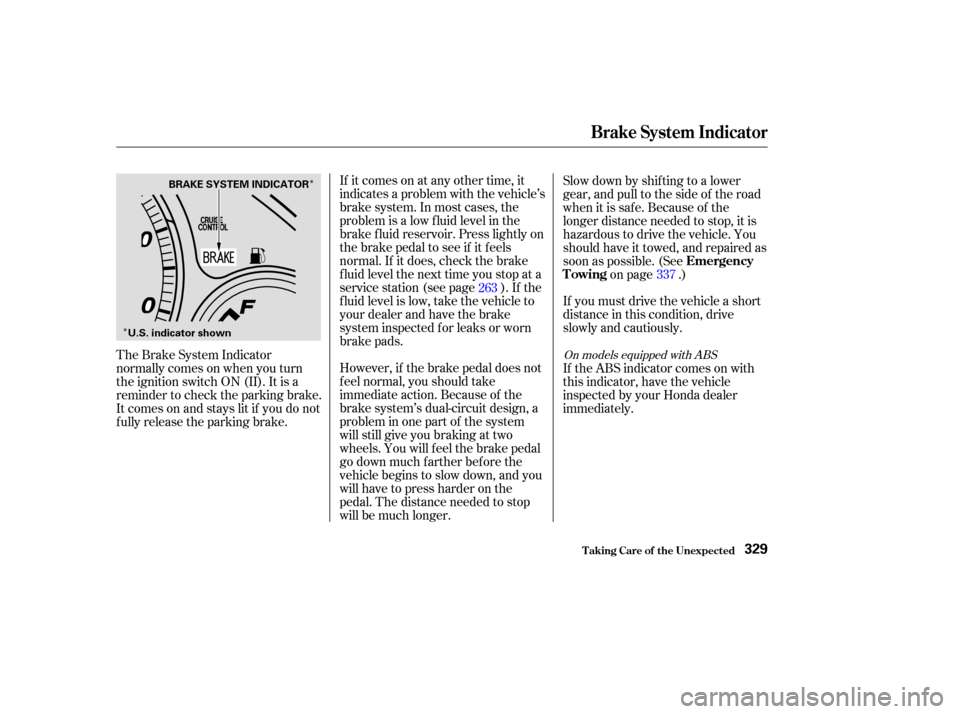
The Brake System Indicator
normallycomesonwhenyouturn
the ignition switch ON (II). It is a
reminder to check the parking brake.
It comes on and stays lit if you do not
f ully release the parking brake. If the ABS indicator comes on with
this indicator, have the vehicle
inspected by your Honda dealer
immediately.
263
337
On models equipped with ABS
Emergency
Towing
Brake System Indicator
T aking Care of t he Unexpect ed329
BRAKE SYSTEM INDICATOR
U.S. indicator shown
Page 336 of 374
If something electrical in your
vehicle stops working, the first thing
youshouldcheckforisablownfuse.
Determine f rom the chart on pagesand , or the diagram on the
fuse box lid, which fuse or fuses
control that component. Check those
f uses f irst, but check all the f uses
bef ore deciding that a blown f use is
not the cause. Replace any blown
f uses and check the component’s
operation. Check each of the large f uses in
the under-hood f use box by
looking through the top at the wire
inside. Removing these f uses
requires a Phillips-head screw-
driver.
Remove the cover f rom the f use
box. Turn the ignition switch to LOCK
(0). Make sure the headlights and
all other accessories are off.
3.
1.
2.
335 336
Checking and Replacing Fuses
Fuses
T aking Care of t he Unexpect ed332
FUSE
BLOWN
Page 339 of 374
�µ�µ
�µ
�Î �Î
�Î
No. No.
CONT INUED
Amps. Circuits ProtectedAmps. Circuits Protected
1
2
3
4
5 6
7
8
9
10
11
12
13
14
15
16
17
18
19
20
21
22
23
24
25
15 A
10 A
10 A
10 A
Ignition Coil
Daytime running lights
ACG
Not Used 7.5 A
20 A
7.5 A
7.5 A
7.5 A
7.5 A 10 A
10 A
20 A
20 A
15 A
15 A
7.5 A 20 A
20 A
20 A
20 A
20 A Power Window Relay
Moonroof
Accessory, Radio
Rear Wiper
Meter
Not Used
Daytime running lights
SRS
Remote Control Mirrors
LAF Heater
Heated Seat
Fuel Pump
Turn Signal Lights
Front Wiper
Not Used
Front Right Power Window
Front Left Power Window
Rear Lef t Power Window
Rear Right Power Window
: On Canadian models
Rear Accessory Power Socket Front Accessory Power Socket
Fuses
T aking Care of t he Unexpect ed335
INTERIOR FUSE BOX
Page 340 of 374
�µ
�µ
�µ
No. Amps. Circuits Protected
1
2
3
4
5
6
7
8
9
10
11
12
13
14
15
16
17
18
19
20 20 A
15 A
15 A
20 A
15 A
15 A
15 A
10 A
30 A
20 A
40 A
40 A
40 A
15 A
20 A
15 A
30 A
100 A 50 A Condenser Fan
Small Light
Interior Light
Cooling Fan
Hazard
FI ECU
Horn, Stop
Not Used
Back Up
ABS Motor
Rear Defroster
Heater Motor
Power Window
Option
Lef t Headlight
Door Lock
Right Headlight
ABS F/S
Battery
Ignition 1
Spare Fuses
21 257.5A 30A
T aking Care of t he Unexpect ed
Fuses
336
UNDER-HOOD FUSE BOX
Page 347 of 374

�µ�µ�µ
�µ
�µ
�µ
�µ
�µ
�µ
�µ
�µ
�µ
�µ
�µ
�µ
�µ
�µ
Specif ications
T echnical Inf ormation343
Air Conditioning
Battery
Tires Alignment Fuses
Lights HFC-134a (R-134a)
17.0 18.7 oz (480 530 g) SP-10
12 V
12 V 60/55 W
21/5 W
36 AH/5 HR
12 V 12 V
12 V
12 V
12 V
12 V
12 V
12 V
12 V
21 W
3CP
8W
4CP
8W
5W
21 W
21/5 W
21 W
12 V 3 CP
Refrigerant type
Charge quantity
Lubricant type
Capacity
12 V See page
335or the fuse label
attached to the inside of the fuse
box door under the steering
column.
45 AH/20 HR 26 psi (180 kPa , 1.8 kgf/cm
)
26 psi (180 kPa , 1.8 kgf/cm)
P205/70R15 95S
Size
Pressure Toe-in
Camber
Caster 1°45’1°
0°
0.08 in (2.0 mm) 0.0in(0mm)
See page
336or the fuse box
cover.
Interior
Under-hood
Headlights
Front turn signal/side marker
lights
Parking lights
Rear turn signal lights
Stop/Taillights
Back-up lights
License plate light
Ceiling light
Spotlights
Cargo area Light
Rear side marker lights
High-mount brake light
12 V Front
Rear
Front
Rear
Front
Front/Rear
Front
Rear
(H4/HB2)
Page 353 of 374

�Î
�ÎThe burning of gasoline in your
vehicle’s engine produces several by-
products. Some of these are carbon
monoxide (CO), oxides of nitrogen
(NOx) and hydrocarbons (HC).
Gasoline evaporating f rom the tank
also produces hydrocarbons. Con-
trolling the production of NOx, CO,
and HC is important to the environ-
ment. Under certain conditions of
sunlight and climate, NOx and HC
react to f orm photochemical ‘‘smog.’’
Carbon monoxide does not contri-
bute to smog creation, but it is a
poisonous gas. The United States Clean Air Act
sets standards f or automobile
emissions. It also requires that
automobile manufacturers explain to
owners how their emissions controls
workandwhattodotomaintain
them. This section summarizes how
the emissions controls work.
Scheduled maintenance is on page
.
In Canada, Honda vehicles comply
with the Canadian Motor Vehicle
Saf ety Standards (CMVSS) f or
Emissions valid at the time they are
manuf actured.
Your vehicle has a Positive
Crankcase Ventilation System. This
keeps gasses that build up in the
engine’s crankcase f rom going into
the atmosphere. The Positive Crank-
case Ventilation valve routes them from the crankcase back to the
intake manif old. They are then
drawn into the engine and burned.
As gasoline evaporates in the f uel
tank, an evaporative emissions
control canister f illed with charcoal
adsorbs the vapor. It is stored in this
canister while the engine is of f . Af ter
the engine is started and warmed up,
the vapor is drawn into the engine
and burned during driving.
The Onboard Ref ueling Vapor
Recovery (ORVR) system captures
the f uel vapors during ref ueling. The
vapors are adsorbed in a canister
f illed with activated carbon. While
driving, the f uel vapors are drawn
into the engine and burned of f .
238
The Clean Air Act
Crankcase Emissions Control
System Evaporative Emissions Control
System
Onboard Ref ueling Vapor
Recovery
Emissions Cont rols
T echnical Inf ormation349
Page 357 of 374
Then drive in city/suburban
traffic for at least 10 minutes.
When traf f ic conditions allow, let
the vehicle coast f or several
seconds without using the
accelerator pedal or the brake
pedal.
If the testing f acility determines the
readiness codes are still not set, see
your Honda dealer.
Select a nearby lightly traveled
major highway where you can
maintain a speed of 50 to 60 mph
(80to97km/h)foratleast20
minutes. Drive on the highway in
D (A/T) or 5th (M/T). Do not use
thecruisecontrol.Whentraffic
allows, drive f or 90 seconds
without moving the accelerator
pedal. (Vehicle speed may vary
slightly; this is okay.) If you cannot
do this f or a continuous 90
seconds because of traf f ic
conditions, drive f or at least 30
seconds, then repeat it two more
times (for a total of 90 seconds).
St at e Emissions T est ing
T echnical Inf ormation353
Page 365 of 374

CONT INUED
BatteryCharging System ...........................
Indicator .66, 326
............................
Jump Starting .320
..............................
Maintenance .269
............................
Specif ications .343
..............................
Bef ore Driving .183
....................................
Belts,Seat .8,50
.........................
Beverage Holders .116
.................................
Body Repairs .305 Brakes
...........
Anti-lock System (ABS) . 212
.............
Break-in, New Linings . 184
....................
Bulb Replacement .290
...........................................
Fluid .263
.........................................
Parking .82
.................
System Indicator . 66,329
........................
Wear Indicators .211
.............................
Braking System .211
.................
Break-in, New Vehicle . 184
..
Brightness Control, Instruments . 77
........................
Brights, Headlights .76
.................................
Built-in Table .117
Bulb Replacement ..........................
Back-up Lights .290
..............................
Brake Lights .290
......................
Cargo Area Light .293
..............................
Ceiling Light .293
................
Front Parking Lights . 289
........
Front Side Marker Lights . 288
.................................
Headlights .287
.........
High-mount Brake Light . 292
...........................
Interior Lights .293
...................
License Plate Light . 291
...
Accessories and Modif ications . 191
................................
Accessories .191
.
Additional Safety Precautions . 192
............................
Modif ications .192
ACCESSORY (Ignition Key .......................................
Position) .87
............
Accessory Power Sockets . 122
....................
Additives, Engine Oil . 248
.............................
Airbag (SRS) .10, 54
.....................
Air Cleaner Element .265
..............
Air Conditioning System . 128
..............................
Maintenance .274
.........................................
Usage .128
.......................
Air Outlets (Vents) .130
.......................
Air Pressure, Tires .278
..................
High Speed Driving . 279
.........................
Normal Driving .279
.......................
Alcohol in Gasoline .347
......................................
Antif reeze .251
Anti-lock Brakes (ABS) ...............................
Indicator .68, 214
...................................
Operation .212
..............
Anti-thef t, Audio System . 178Anti-thef t Steering Column
..............................................
Lock .87
..........................
Appearance Care .297
................................
Audio System .137
...
Automatic Seat Belt Tensioners . 52
.............
Automatic Speed Control . 179
..............
Automatic Transmission . 204
..........................
Capacity, Fluid .342
...............
Checking Fluid Level . 260
.......................................
Shif ting .205
.
Shif t Lever Position Indicator . 204
................
Shif t Lever Positions . 205
....................
Shif t Lock Release . 209
Index
A
B
I