Page 209 of 380
Your car has several convenient
storage areas so you can stow cargo
saf ely.
However, carrying too much cargo,
or improperly storing it, can af f ect
your car’s handling, stability, and
operation, and make it unsaf e.
Bef ore carrying any type of cargo, be
sure to read the f ollowing pages.
The glove box, and the pockets in
the doors and seat-backs, are
designed f or small, lightweight items.
The trunk is intended f or larger,
heavier items. In addition, the back
seatcanbefoldeddowntoallowyou
to carry more cargo or longer items.
Carrying Cargo
Bef ore Driving214
CONSOLE COMPARTMENT FRONT DOOR POCKET
TRUNK GLOVE BOX
SEAT-BACK POCKET
REAR DOOR POCKET
CENTER POCKET
�����—�����—�����y���������������y���
�(�����������y�����
���y
Page 212 of 380

Make sure all windows, mirrors,
and outside lights are clean and
unobstructed. Remove f rost, snow,
or ice.
Check that the hood and trunk are
f ully closed.Check the adjustment of the seat
(see page ).
Check the adjustment of the
inside and outside mirrors (see
page ).
Check the adjustment of the
steering wheel (see page ).
Make sure the doors are securely
closed and locked.
Fasten your seat belt. Check that
your passengers have f astened
their seat belts (see page ).Turn the ignition switch ON (II).
Check the indicator lights in the
instrument panel.
Start the engine (see page ).
Check the gauges and indicator
lights in the instrument panel (see
page ).
Check that any items you may be
carrying with you inside are stored
properly or f astened down
securely.
Visually check the tires. If a tire
looks low, use a gauge to check its
pressure.
Youshoulddothefollowingchecks
and adjustments every day bef ore
you drive your car.
3.2.
1.
4. 5.
6. 7. 8. 9. 11.
12. 10.
15
87
219
57
101
73
Preparing to Drive
Driving218
�����—�����—�����y���������������y���
�(�����������y�������
�y
Page 222 of 380

�µMake sure the parking brake is f ully
released bef ore driving away.
Driving with the parking brake
partially set can overheat or damage
the rear brakes.
Always use the parking brake when
you park your car. The indicator on
the instrument panel shows that the
parking brake is not f ully released; it
does not indicate that the parking
brakeisfirmlyset.Makesurethe
parking brake is set f irmly or your
car may roll if it is parked on an
incline.
If your car has an automatic
transmission, set the parking brake
bef ore you put the transmission in
Park.Thiskeepsthecarfrom
moving and putting pressure on the
parking mechanism in the
transmission making it easier to
move the shift lever out of Park
when you want to drive away. If the car is f acing uphill, turn the
f ront wheels away f rom the curb. If
you have a manual transmission, put
it in f irst gear.
If the car is f acing downhill, turn the
f ront wheels toward the curb. If you
have a manual transmission, put it in
reverse gear.
Make sure the moonroof (if
equipped) and the windows are
closed.
Lockthedoorswiththekeyorthe
remote transmitter.
Place any packages, valuables, etc.,
in the trunk or take them with you.
Turn of f the lights.
Never park over dry leaves, tall
grass, or other f lammable
materials. The three way catalytic
converter gets very hot, and could
cause these materials to catch on
fire.
Check the indicator on the
instrument panel to verif y that the
security system is set.
On EX, LX-V6, and Canadian LX-G
models
Parking T ips
Driving
Parking
228
�����—�����—�����y�������������
�y���
�(�����������y�������
�y
Page 223 of 380

Your Honda is equipped with f ront
disc brakes. The brakes on the rear
wheels may be disc or drum,
depending on the model. A power
assist helps reduce the ef f ort needed
on the brake pedal.
Put your f oot on the brake pedal only
when you intend to brake. Resting
your f oot on the pedal keeps the
brakes applied lightly, causing them
to build up heat. Heat build-up can
reduce how well your brakes work. It
also keeps your brake lights on all
the time, conf using drivers behind
you.Constant application of the brakes
when going down a long hill builds
up heat and reduces their ef f ective-
ness. Use the engine to assist the
brakes by downshif ting to a lower
gear and taking your f oot of f the
accelerator pedal.
Check your brakes af ter driving
through deep water. Apply the
brakes moderately to see if they f eel
normal. If not, apply them gently and
f requently until they do. Since a
longer distance is needed to stop
with wet brakes, be extra cautious
and alert in your driving. Your brakes may sometimes squeal
or squeak when you apply them
lightly. Do not conf use this with the
brakewearindicators.Theymakea
very audible ‘‘screeching.’’
The f ront disc brakes on all models
have audible brake wear indicators.
They are also on the rear brakes of
cars equipped with rear disc brakes
(EX, EX-V6, and LX-V6 models) as
standard equipment.
When the brake pads need replacing,
you will hear a distinctive metallic
‘‘screeching’’ sound when you apply
the brakes. If you do not have the
brake pads replaced, they will begin
screeching all the time.
Brake Wear Indicators
The Braking System
Driving229
�����—�����—�����y���������������y���
�(�����������y���������y
Page 226 of 380
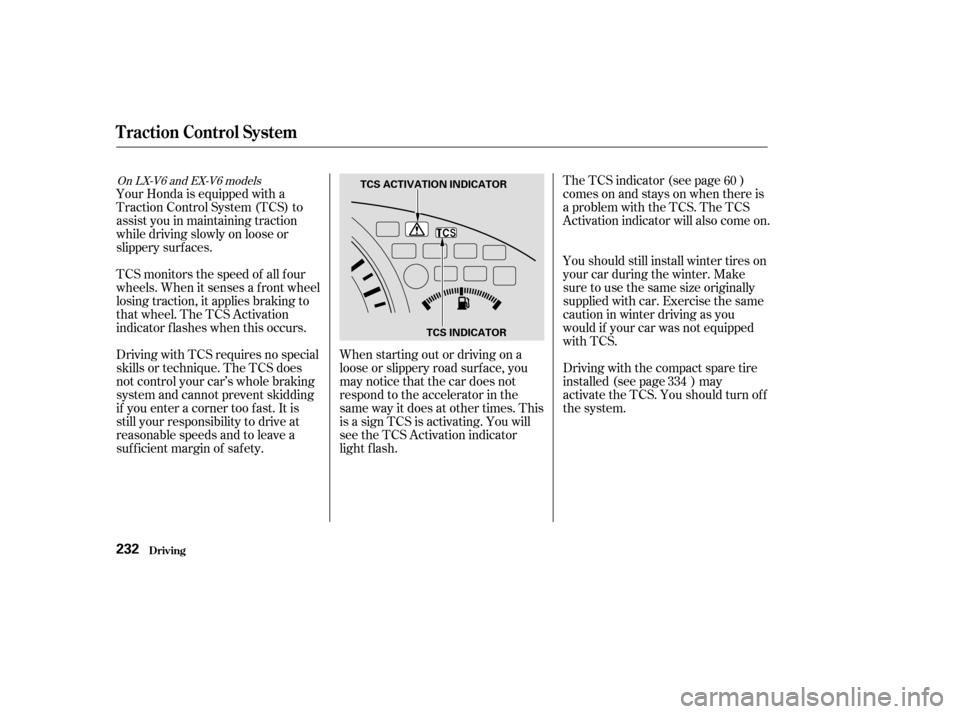
Your Honda is equipped with a
Traction Control System (TCS) to
assist you in maintaining traction
while driving slowly on loose or
slippery surf aces.
TCS monitors the speed of all f our
wheels. When it senses a f ront wheel
losing traction, it applies braking to
that wheel. The TCS Activation
indicator f lashes when this occurs.
Driving with TCS requires no special
skills or technique. The TCS does
not control your car’s whole braking
system and cannot prevent skidding
if you enter a corner too f ast. It is
still your responsibility to drive at
reasonable speeds and to leave a
suf f icient margin of saf ety.When starting out or driving on a
loose or slippery road surf ace, you
may notice that the car does not
respond to the accelerator in the
samewayitdoesatothertimes.This
is a sign TCS is activating. You will
seetheTCSActivationindicator
light f lash.TheTCSindicator(seepage )
comesonandstaysonwhenthereis
a problem with the TCS. The TCS
Activation indicator will also come on.
You should still install winter tires on
your car during the winter. Make
sure to use the same size originally
supplied with car. Exercise the same
cautioninwinterdrivingasyou
would if your car was not equipped
with TCS.
Driving with the compact spare tire
installed (see page ) may
activate the TCS. You should turn of f
the system.
60
334
On LX-V6 and EX-V6 models
Traction Control System
Driving232
TCS INDICATOR
TCS ACTIVATION INDICATOR
�����—�����—�����y���������������y���
�(�����������y���������y
Page 227 of 380
The TCS indicator comes on or
f lashes under the f ollowing condi-
tions:When you turn the ignition switch
to ON (II).
When you manually turn of f TCS.
It f lashes when TCS is regulating
wheelspin.
The Traction Control System turns
on every time you start the engine,
even if you turned it of f the last time
you drove the car.
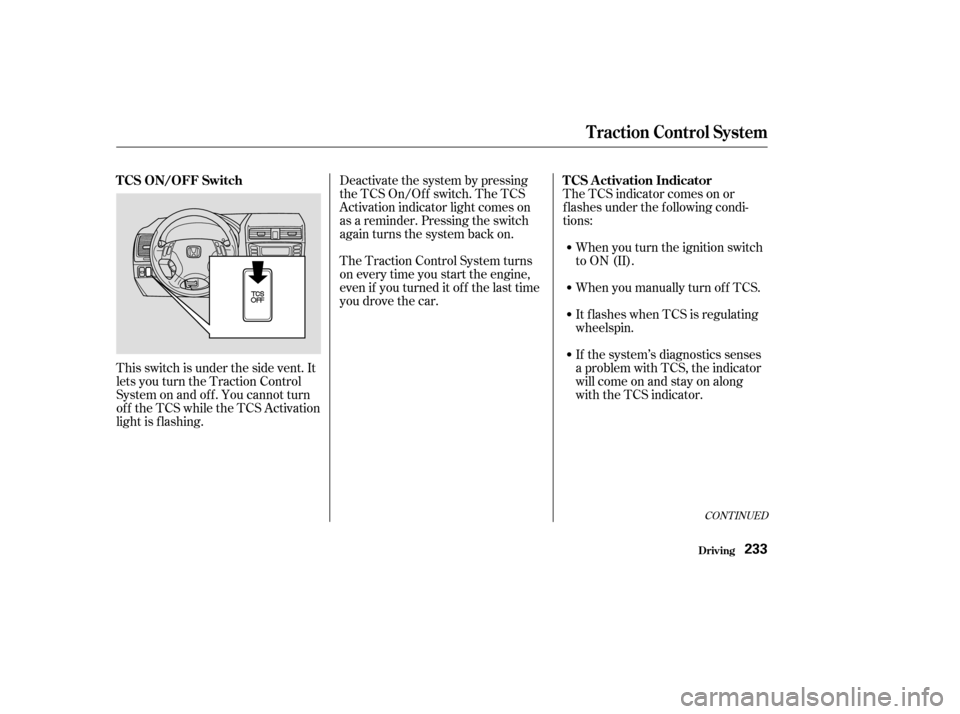
This switch is under the side vent. It
letsyouturntheTractionControl
System on and of f . You cannot turn
of f the TCS while the TCS Activation
light is f lashing. Deactivate the system by pressing
the TCS On/Off switch. The TCS
Activation indicator light comes on
as a reminder. Pressing the switch
again turns the system back on.
If the system’s diagnostics senses
a problem with TCS, the indicator
will come on and stay on along
with the TCS indicator.
CONT INUED
TCS ON/OFF Switch TCS Activation Indicator
Traction Control System
Driving233
�����—�����—�����y���������������y���
�(�����������y���������y
Page 230 of 380

�µ�µBeing able to see
clearly in all directions and being
visible to other drivers are important
in all weather conditions. This is
more dif f icult in bad weather. To be
seen more clearly during daylight
hours, turn on your headlights. Check your tires
f requently f or wear and proper
pressure. Both are important in
preventing ‘‘hydroplaning’’ (loss of
traction on a wet surface). In the
winter, mount snow tires on all f our
wheels f or the best handling.
Watch road conditions caref ully,
they can change f rom moment to
moment. Wet leaves can be as slip-
pery as ice. ‘‘Clear’’ roads can have
patches of ice. Driving conditions
can be very hazardous when the
outside temperature is near f reezing.
The road surf ace can become
covered with areas of water puddles
mixed with areas of ice, so your
traction can change without warning.
Be caref ul when downshif ting. If
traction is low, you can lock up the
drive wheels f or a moment and cause
askid. Be very cautious when passing, or
beingpassedbyothervehicles.The
spray f rom large vehicles reduces
your visibility, and the wind buf f eting
can cause you to lose control.
Inspect your windshield wipers and
washers f requently. Keep the wind-
shield washer reservoir f ull of the
proper f luid. Have the windshield
wiper blades replaced if they start to
streak the windshield or leave parts
unwiped. Use the def roster and air
conditioning to keep the windows
f rom f ogging up on the inside (see
pages and ).
131
125
Visibility Traction
Driving
Driving in Bad Weather
236
�����—�����—�����y�����������
�
�y���
�(�����������y���������y
Page 234 of 380
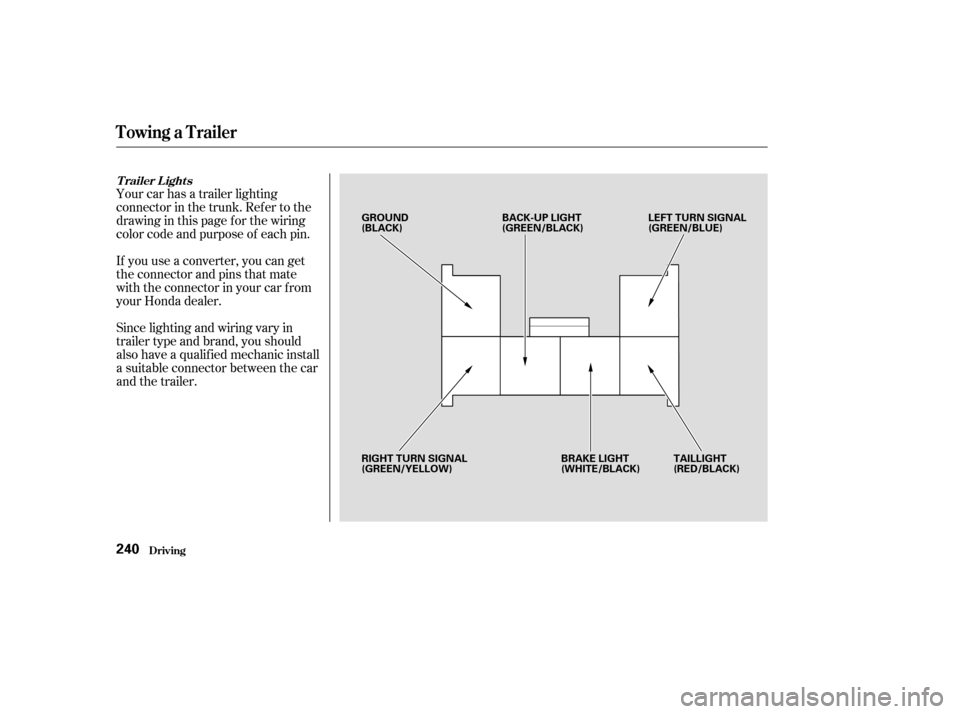
Your car has a trailer lighting
connector in the trunk. Ref er to the
drawing in this page f or the wiring
color code and purpose of each pin.
If you use a converter, you can get
the connector and pins that mate
with the connector in your car f rom
your Honda dealer.
Since lighting and wiring vary in
trailer type and brand, you should
also have a qualif ied mechanic install
a suitable connector between the car
and the trailer.
T railer L ights
Towing a Trailer
Driving240
GROUND
(BLACK)BACK-UP LIGHT
(GREEN/BLACK) LEFT TURN SIGNAL
(GREEN/BLUE)
RIGHT TURN SIGNAL
(GREEN/YELLOW) BRAKE LIGHT
(WHITE/BLACK)TAILLIGHT
(RED/BLACK)
�����—�����—�����y���������������y���
�(�����������y���������y