Page 302 of 380

If you ever hear the chains
contacting the body or chassis, stop
and investigate. If the chains have
loosened, retighten them. Make sure
they do not contact the brake lines
or suspension.
Removethechainsassoonasyou
begin driving on cleared roads.
Thesechainsaretheonlyonesthat
have been approved by Honda f or
use on your car. Since Honda cannot
test all chains, you must be
personally responsible f or proper
selection, installation, and use of
snow chains.
The chains listed here are available
at many auto supply stores. For a
complete list of stores, visit the SCC
website at www.scc-chain.com.
When installing chains, f ollow the
manuf acturer’s instructions, and
mount them as tightly as you can.
Drive slowly with chains installed.
Tires
Maint enance309
Using the wrong chains, or not
properly installing chains, can
damage the brake lines and
cause a crash in which you can
be seriously injured or killed.
Follow all instructions in this
owner’s manual regarding the
selection and use of tire chains.
�����—�����—�����y���������������y���
�(�����������y�����
���y
Page 304 of 380
Check the f ollowing:Headlights (low and high beam)
Parking lights
Taillights
Brake lights
High-mount brake light
Turn signals
Back-up lights
Hazard light f unction
License plate light
Daytime running lights
(Canadian models)
If you f ind any bulbs are burned out,
replace them as soon as possible.
Refer to the chart on page to
determine what type of replacement
bulb is needed. 365
Lights
Maint enance311
HIGH-MOUNT BRAKE LIGHT
TAILLIGHT
TURN SIGNAL LIGHT BACK-UP LIGHT LICENSE PLATE LIGHT
STOP/TAILLIGHT
�����—�����—�����y���������������y���
�(�����������y�����
���y
Page 312 of 380
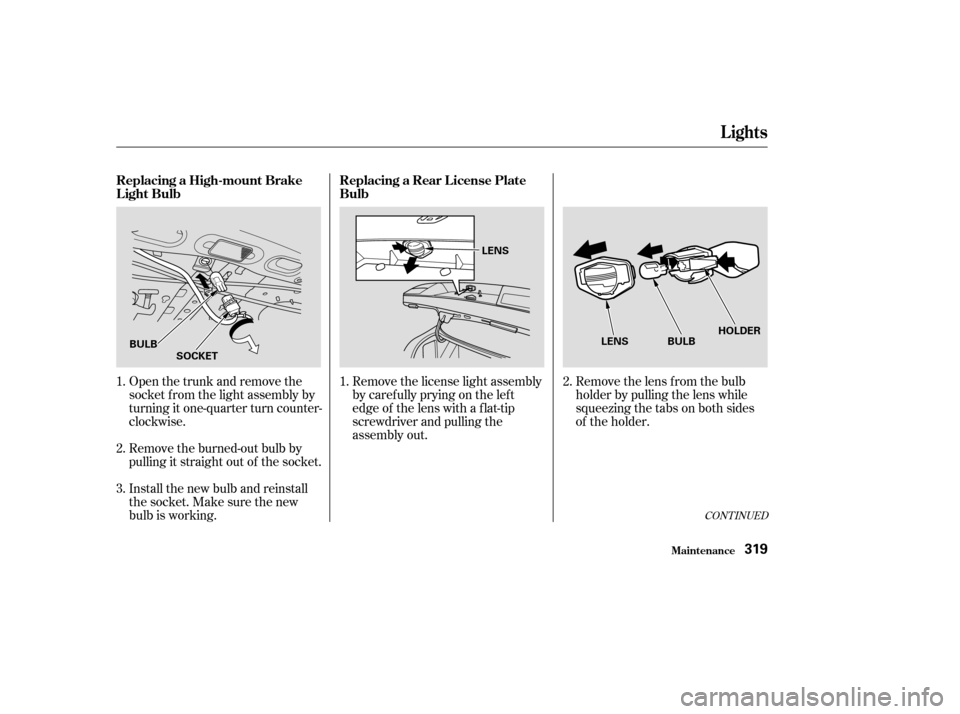
Open the trunk and remove the
socket f rom the light assembly by
turning it one-quarter turn counter-
clockwise.
Remove the burned-out bulb by
pulling it straight out of the socket.
Install the new bulb and reinstall
the socket. Make sure the new
bulb is working.Remove the license light assembly
by caref ully prying on the lef t
edge of the lens with a f lat-tip
screwdriver and pulling the
assembly out.
Remove the lens f rom the bulb
holder by pulling the lens while
squeezing the tabs on both sides
of the holder.
1.
2. 3. 1.
2.
CONT INUED
Replacing a High-mount Brake
Light BulbReplacing a Rear License PlateBulb
Lights
Maint enance319
LENS
BULB
BULB
SOCKET HOLDER
LENS
�����—�����—�����y���������������y���
�(�����������y���������y
Page 316 of 380

Block the rear wheels.
Fill the f uel tank.
Wash and dry the exterior
completely.
Cleantheinterior.Makesurethe
carpeting, floor mats, etc. are
completely dry.
Leave the parking brake off. Put
the transmission in Reverse
(5-speed manual) or Park
(automatic).
If you need to park your car f or an
extended period (more than one
month), there are several things you
should do to prepare it f or storage.
Proper preparation helps prevent
deterioration and makes it easier to
get your car back on the road. If
possible, store your car indoors.
If the car is to be stored for a
longer period, it should be
supported on jackstands so the
tires are of f the ground.
Leave one window open slightly (if
the car is being stored indoors).
Disconnect the battery.
Support the f ront wiper blade
arms with a f olded towel or rag so
they do not touch the windshield.
To minimize sticking, apply a
silicone spray lubricant to all door
and trunk seals. Also, apply a car
body wax to the painted surf aces
that mate with the door and trunk
seals.
Change the engine oil and f ilter
(see page ).
If you store your car f or 1 year or
longer, have your Honda dealer
perf orm the inspections as soon as
youtakeitoutof storage(seepages
, ). The 6-cylinder model
needs the inspections called f or in
the 2 years/30,000 miles (48,000 km)
maintenance schedule (Normal
Conditions) and the 4-cylinder model
needs the inspections called f or in
the 2 years/40,000 miles (64,000 km)
maintenance schedule (Normal
Conditions). The replacements
called f or in the maintenance
schedule are not needed unless the
car has actually reached that time or
mileage.
Coverthecarwitha‘‘breathable’’
cover, one made f rom a porous
material such as cotton. Nonporous materials, such as
plastic sheeting, trap moisture,
which can damage the paint.
If possible, run the engine f or a
while periodically (pref erably once
amonth).
270 250 255
St oring Your Car
Maint enance323
�����—�����—�����y��������
��
���y���
�(�����������y���������y
Page 326 of 380

If you have a f lat tire while driving,
stop in a saf e place to change it.
Stopping in traf f ic or on the shoulder
of a busy road is dangerous. Drive
slowly along the shoulder until you
gettoanexitoranareatostopthat
is far away from the traffic lanes.Open the trunk. Raise the trunk
f loor by lif ting up on the back edge.
Park the car on f irm, level and
non-slippery ground away f rom
traffic. Put the transmission in
Park (automatic) or Reverse
(manual). Apply the parking brake.
Turn on the hazard warning lights
and turn the ignition switch to
LOCK (0). Have all the
passengers get out of the car while
you change the tire. Take the tool kit out of the trunk.
Unscrew the wing bolt and take
the spare tire out of its well.
5. 4.
3.
2. 1.
CONT INUED
Changing a Flat T ire
T aking Care of t he Unexpect ed335
TRUNK FLOOR
SPARE TIRE JACK
TOOL KIT
The car can easily roll off the
jack, seriously injuring anyoneunderneath.
Follow the directions for
changing a tire exactly, and
never get under the car when it
is supported only by the jack.
�����—�����—�����y���������������y���
�(�����������y���������y
Page 329 of 380
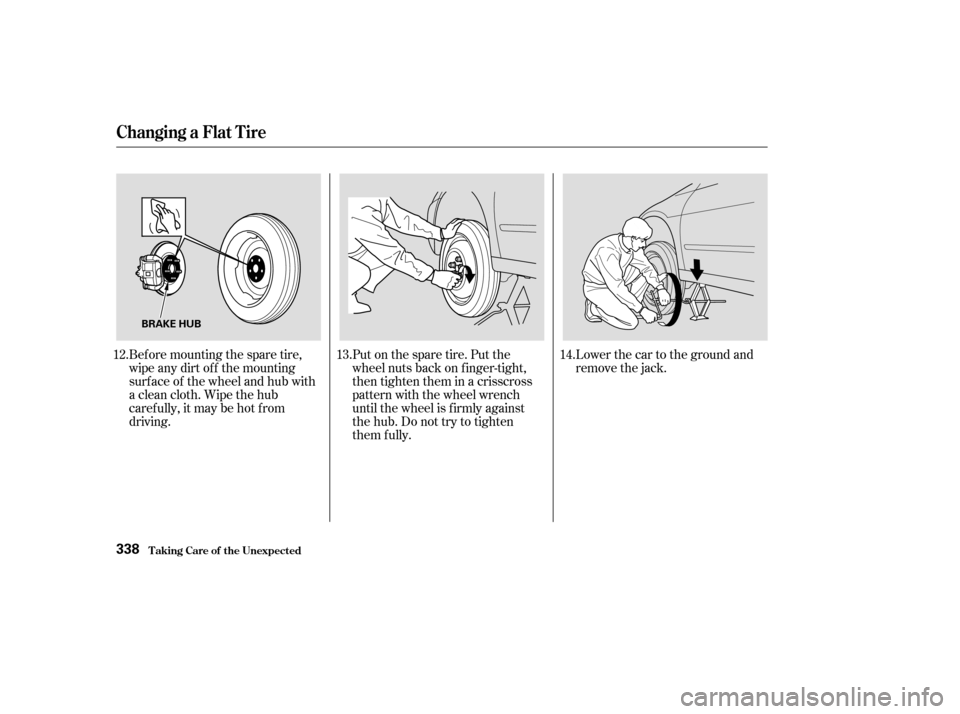
Put on the spare tire. Put the
wheel nuts back on f inger-tight,
then tighten them in a crisscross
pattern with the wheel wrench
until the wheel is f irmly against
the hub. Do not try to tighten
them f ully.
Bef ore mounting the spare tire,
wipeanydirtoff themounting
surface of the wheel and hub with
a clean cloth. Wipe the hub
carefully,itmaybehotfrom
driving.
Lowerthecartothegroundand
remove the jack.
12.
13. 14.
T aking Care of t he Unexpect ed
Changing a Flat T ire
338
BRAKE HUB
�����—�����—�����y���������������y���
�(�����������y�������
�y
Page 333 of 380

Turn of f all the electrical acces-
sories: climate control, stereo
system, lights, etc.
Put the transmission in Neutral or
Park, and set the parking brake.
Open the hood and check the
physical condition of the battery
(see page ). In very cold
weather, check the condition of
the electrolyte. If it seems slushy
or like ice, do not try jump starting
until it thaws.
To jump start your car, f ollow these
directions closely:
If your car’s battery has run down,
you may be able to start the engine
by using a booster battery. Although
this seems like a simple procedure,
you should take several precautions.
You cannot start a Honda with an
automatic transmission by pushing
or pulling it.1. 2.294
T aking Care of t he Unexpect ed
Jump Starting
342
A battery can explode if you do
not follow the correct procedure,
seriously injuring anyonenearby.
Keep all sparks, open flames,
and smoking materials away
from the battery.
If a battery sits in extreme cold, the
electrolyte inside can f reeze.
Attempting to jump start with a f rozen
battery can cause it to rupture.
�����—�����—�����y���������������y���
�(�����������y���������y
Page 336 of 380

If you see steam and/or spray
coming f rom under the hood, turn
of f the engine.
If you do not see steam or spray,
leave the engine running and
watch the temperature gauge. If
the high heat is due to overloading
(climbing a long, steep hill on a
hot day with the A/C running, for
example), the engine should start
to cool down almost immediately.
If it does, wait until the tempera-
ture gauge comes down to the mid-
point then continue driving.
Saf ely pull to the side of the road.
Put the transmission in Neutral or
Park, and set the parking brake.
Turn of f the heating and cooling
system and all other accessories.
Turn on the hazard warning
indicators.
The pointer of your car’s tempera-
ture gauge should stay in the mid-
range under most conditions. It may
go higher if you are driving up a long
steep hill on a very hot day. If it
climbs to the red mark, you should
determine the reason.
Your car can overheat f or several
reasons, such as lack of coolant or a
mechanical problem. The only
indication may be the temperature
gauge climbing to or above the red
mark. Or you may see steam or
spray coming f rom under the hood.
In either case, you should take
immediate action. 1.
2. 3.
CONT INUED
If Your Engine Overheats
T aking Care of t he Unexpect ed345
Steam and spray from an
overheated engine can
seriously scald you.
Do not open the hood if steam
is coming out.
Driving with the temperature gauge
pointer at the red mark can cause
serious damage to your engine.
�����—�����—�����y���������������y���
�(�����������y���������y