Page 235 of 380

Many states and Canadian provinces
require special outside mirrors when
towing a trailer. Even if they don’t,
you should install special mirrors if
you cannot clearly see behind you, or
if the trailer creates a blind spot.
Askyourtrailersalesorrental
agency if any other items are
recommended or required f or your
towing situation.When preparing to tow, and bef ore
driving away, be sure to check the
f ollowing:
All weights and loads are within
limits (see pages and ).
Thehitch,safetychains,andany
other attachments are secure.
Allitemsonandinthetrailerare
properly secured and cannot shif t
while you drive.
The car has been properly
serviced, and the tires, brakes,
suspension, and cooling system
are in good operating condition.
The lights and brakes on your car
and the trailer are working
properly. Your car tires and spare are
properly inf lated (see page ),
and the trailer tires and spare are
inflated as recommended by the
trailer maker.
237 238 303
Additional Trailer EquipmentPre-T ow Checklist
Towing a Trailer
Driving241
�����—�����—�����y���������������y���
�(�����������y���������y
Page 236 of 380

When driving down hills, reduce
your speed and shif t down to 2nd
gear. Do not ‘‘ride’’ the brakes, and
remember it will take longer to slow
downandstopwhentowingatrailer.
When climbing hills, closely watch
your temperature gauge. If it nears
the red (Hot) mark, turn the air
conditioning of f , reduce speed and, if
necessary, pull to the side of the
road to let the engine cool.
The added weight, length, and
height of a trailer will af f ect your car’s
handling and perf ormance, so
driving with a trailer requires some
special driving skills and techniques.
Foryoursafetyandthesafetyof
others,taketimetopracticedriving
maneuvers bef ore heading f or the
open road, and f ollow the guidelines
discussed below.
Make turns more slowly and wider
than normal. The trailer tracks a
smaller arc than your car, and it can
hit or run over something the car
misses. Allow more time and
distance f or braking. Do not brake or
turn suddenly as this could cause the
trailer to jackknif e or turn over.
If youmuststopwhenfacinguphill,
use the f oot brake or parking brake.
Do not try to hold the car in place by
pressing on the accelerator, as this
can cause the automatic
transmission to overheat.
Drive slower than normal in all
driving situations, and obey posted
speed limits f or cars with trailers. If
you have an automatic transmission,
use D position when towing a trailer
on level roads. D is the proper shif t
lever position to use when towing a
trailer in hilly terrain. (See ‘‘ ’’ in the next column f or
additional gear information.) If the automatic transmission shif ts
f requently while going up a hill, shif t
to D .
3
3
Driving Saf ely With a T railerMaking T urns and Braking
Driving on Hills
T owing Speeds and Gears
Driving
on Hills
Towing a Trailer
Driving242
�����—�����—�����y�����������
���y���
�(�����������y���������y
Page 237 of 380
Always drive slowly and have
someone guide you when backing up.
Grip the of the steering
wheel; then turn the wheel to the lef t
to get the trailer to move to the lef t,
andturnthewheelrighttomovethe
trailer to the right.Follow all normal precautions when
parking, including f irmly setting the
parking brake and putting the
transmission in Park (automatic) or
in 1st or Reverse (manual). Also,
place wheel chocks at each of the
trailer’s tires.
Crosswinds and air turbulence
caused by passing trucks can disrupt
your steering and cause trailer
swaying. When being passed by a
large car, keep a constant speed and
steer straight ahead. Do not try to
make quick steering or braking
corrections.
bottom
Handling Crosswinds and Buf f et ing
Backing Up Parking
Towing a Trailer
Driving243
�����—�����—�����y�����������
���y���
�(�����������y���������y
Page 242 of 380

�Ì
�µ U.S. Cars:
According to state and federal
regulations, f ailure to perf orm
maintenance on the items marked
with will not void your emissions
warranties. However, Honda
recommends that all maintenance
services be perf ormed at the
recommended time or mileage
period to ensure long-term reliability.
Your authorized Honda dealer
knows your car best and can provide
competent, ef f icient service.
However, service at a dealer is not
mandatory to keep your warranties
in effect. Maintenance may be done
by any qualif ied service f acility or
person who is skilled in this type of
automotive service. Keep all the
receipts as proof of completion, and
have the person who does the work
f ill out the Maintenance Record.
Check your warranty booklet f or
more inf ormation.
We recommend the use of genuine
Honda parts and f luids whenever you
have maintenance done. These are
manuf actured to the same high-
quality standards as the original
components, so you can be conf ident
of their perf ormance and durability.
Trailer towing, driving with a roof
rack, or driving in mountainous
conditions.
Driving on muddy, dusty, or
deiced roads.
NOTE: If you only
drive under a ‘‘severe’’ condition, you
should f ollow the Normal Conditions
Maintenance Schedule. Follow the
Maintenance Schedule f or Severe
Conditions.
OCCASIONALLY
Maintenance Schedule
Maint enance
Maintenance, replacement or
repair of emissions control
devices and systems may be done
by any automotive repair
establishment or individual using
parts that are ‘‘certif ied’’ to EPA
standards.
Canadian Owners
249
�����—�����—�����y���������������y���
�(�����������y���������y
Page 287 of 380
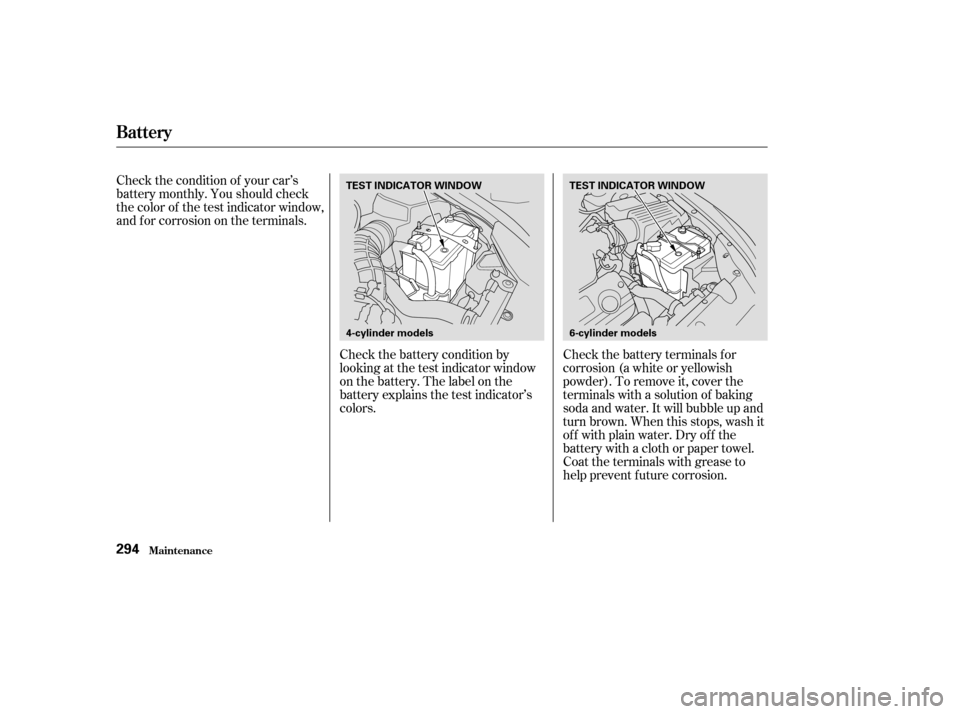
Check the battery condition by
looking at the test indicator window
on the battery. The label on the
battery explains the test indicator’s
colors.Check the battery terminals for
corrosion (a white or yellowish
powder). To remove it, cover the
terminals with a solution of baking
soda and water. It will bubble up and
turn brown. When this stops, wash it
of f with plain water. Dry of f the
battery with a cloth or paper towel.
Coat the terminals with grease to
help prevent f uture corrosion.
Check the condition of your car’s
battery monthly. You should check
the color of the test indicator window,
and f or corrosion on the terminals.
Battery
Maint enance294
TEST INDICATOR WINDOW
4-cylinder models
TEST INDICATOR WINDOW
6-cylinder models
�����—�����—�����y���������������y���
�(�����������y���������y
Page 290 of 380
Check the condition of the wiper
blades at least every six months.
Look f or signs of cracking in the
rubber, or areas that are getting
hard. Replace the blades if you f ind
these signs, or if they leave streaks
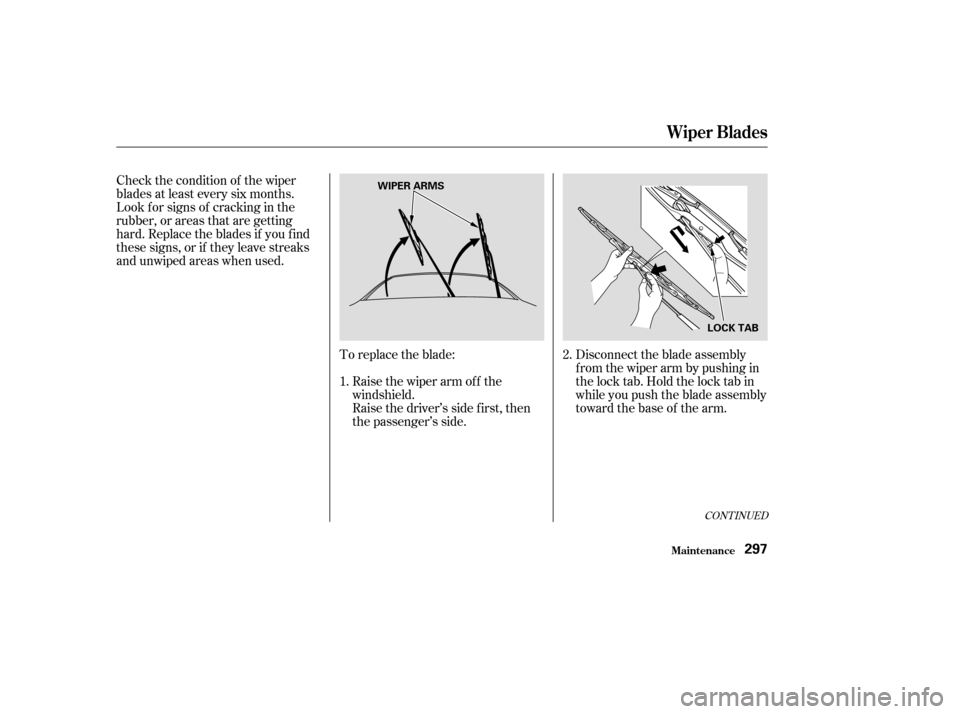
and unwiped areas when used.Disconnect the blade assembly
fromthewiperarmbypushingin
the lock tab. Hold the lock tab in
while you push the blade assembly
toward the base of the arm.
Raise the wiper arm of f the
windshield.
To replace the blade:
Raise the driver’s side f irst, then
the passenger’s side. 2.
1.
CONT INUED
Wiper Blades
Maint enance297
WIPER ARMS
LOCK TAB
�����—�����—�����y���������������y���
�(�����������y���������y
Page 316 of 380

Block the rear wheels.
Fill the f uel tank.
Wash and dry the exterior
completely.
Cleantheinterior.Makesurethe
carpeting, floor mats, etc. are
completely dry.
Leave the parking brake off. Put
the transmission in Reverse
(5-speed manual) or Park
(automatic).
If you need to park your car f or an
extended period (more than one
month), there are several things you
should do to prepare it f or storage.
Proper preparation helps prevent
deterioration and makes it easier to
get your car back on the road. If
possible, store your car indoors.
If the car is to be stored for a
longer period, it should be
supported on jackstands so the
tires are of f the ground.
Leave one window open slightly (if
the car is being stored indoors).
Disconnect the battery.
Support the f ront wiper blade
arms with a f olded towel or rag so
they do not touch the windshield.
To minimize sticking, apply a
silicone spray lubricant to all door
and trunk seals. Also, apply a car
body wax to the painted surf aces
that mate with the door and trunk
seals.
Change the engine oil and f ilter
(see page ).
If you store your car f or 1 year or
longer, have your Honda dealer
perf orm the inspections as soon as
youtakeitoutof storage(seepages
, ). The 6-cylinder model
needs the inspections called f or in
the 2 years/30,000 miles (48,000 km)
maintenance schedule (Normal
Conditions) and the 4-cylinder model
needs the inspections called f or in
the 2 years/40,000 miles (64,000 km)
maintenance schedule (Normal
Conditions). The replacements
called f or in the maintenance
schedule are not needed unless the
car has actually reached that time or
mileage.
Coverthecarwitha‘‘breathable’’
cover, one made f rom a porous
material such as cotton. Nonporous materials, such as
plastic sheeting, trap moisture,
which can damage the paint.
If possible, run the engine f or a
while periodically (pref erably once
amonth).
270 250 255
St oring Your Car
Maint enance323
�����—�����—�����y��������
��
���y���
�(�����������y���������y
Page 318 of 380

When you have washed and rinsed
the whole exterior, dry it with a
chamois or sof t towel. Letting it
air-dry will cause dulling and water
spots.
Fill a bucket with cool water. Mix
in a mild detergent, such as
dishwashing liquid or a product
made especially f or car washing.
Only use the solvents and cleaners
recommendedinthisOwner’s
Manual.
Frequent washing helps preserve
your car’s beauty. Dirt and grit can
scratch the paint, while tree sap and
bird droppings can permanently ruin
the f inish.
Wash your car in a shady area, not in
direct sunlight. If the car is parked in
the sun, move it into the shade and
let the exterior cool down bef ore you
start.
Rinse the car thoroughly with cool
water to remove loose dirt.
As you dry the car, inspect it f or
chips and scratches that could allow
corrosion to start. Repair them with
touch-up paint (see page ).
Wash the car using the water and
detergent solution and a sof t-
bristle brush, sponge, or sof t cloth.
Start at the top and work your way
down. Rinse f requently.
Check the body f or road tar, tree
sap, etc. Remove these stains with
tar remover or turpentine. Rinse it
of f immediately so it does not
harm the f inish. Remember to re-
wax these areas, even if the rest of
the car does not need waxing. 327
Exterior Care
Appearance Care
Washing
326
Chemical solvents and strong cleaners
can damage the paint, metal, and
plastic on your car.
�����—�����—�����y��������
������y���
�(�����������y���������y