Page 260 of 380
6-cylinder Models
Fluid Locations
Maint enance267
ENGINE OIL FILL CAPBRAKE FLUID
(Gray cap)
AUTOMATIC
TRANSMISSION
FLUID DIPSTICK
(Yellow loop)
COOLANT
RESERVOIR
RADIATOR CAP
POWER STEERING
FLUID (Red cap)
WASHER FLUID
(Blue cap) ENGINE OIL DIPSTICK
(Orange loop)
�����—�����—�����y��������
������y���
�(�����������y���������y
Page 265 of 380

Refill the engine with the recom-
mended oil.
Engine oil change capacity
(including f ilter):Let the engine run f or several
minutes, then check the drain bolt
and oil f ilter f or leaks.
Turn of f the engine, let it sit f or
several minutes, then check the oil
level. If necessary, add oil to bring
the level to the upper mark on the
dipstick.
Replace the engine oil f ill cap.
Start the engine. The oil pressure
indicator light should go out within
f ive seconds. If it does not, turn of f
the engine and reinspect your
work.
If the coolant level in the reserve
tank is at or below the MIN line, add
coolant to bring it up to the MAX line.
Inspect the cooling system f or leaks.
The coolant you add should always
be a mixture of 50 percent antif reeze
and 50 percent water. Never add
straight antif reeze or plain water.
9.
8.
7.
6. (4-cylinder models)
(6-cylinder models) A dding Engine Coolant
Engine Oil, Cooling Syst em
Maint enance272
OIL FILTER
6-cylinder models
4-cylinder modelsRESERVE TANK
4.4 US qt (4.2)
4.5 US qt (4.3
) Improper disposal of engine oil can be
harmf ul to the environment. If you
change your own oil, please dispose of
the used oil properly. Put it in a sealed
container and take it to a recycling
center. Do not discard it in a trash bin
or dump it on the ground.
�����—�����—�����y���������������y���
�(�����������y���������y
Page 266 of 380

Always use Honda All Season
Antif reeze/Coolant Type 2. This
coolant is pre-mixed with 50 percent
antif reeze and 50 percent water. It
does not require any additional
mixing. If it is not available, you may
use another major-brand non-silicate
coolant as a temporary replacement.
Make sure it is a high-quality coolant
recommended f or aluminum engines.
However, continued use of any non-
Honda coolant can result incorrosion, causing the cooling
system to malf unction or f ail. Have
the cooling system f lushed and
ref illed with Honda antif reeze/
coolant as soon as possible.
If the reserve tank is completely
empty, you should also check the
coolant level in the radiator.
Make sure the engine and radiator
are cool.
Turn the radiator cap counter-
clockwise, without pressing down
on it, until it stops. This relieves
any pressure remaining in the
cooling system.
Remove the radiator cap by
pushing down and turning
counterclockwise.
1. 2. 3.
CONT INUED
Cooling Syst em
Maint enance273
6-cylinder models RESERVE TANK RADIATOR CAP
4-cylinder modelsRemoving the radiator cap
while the engine is hot can
cause the coolant to spray out,
seriously scalding you.
Always let the engine and
radiator cool down before
removing the radiator cap.
�����—�����—�����y���������������y���
�(�����������y���������y
Page 267 of 380
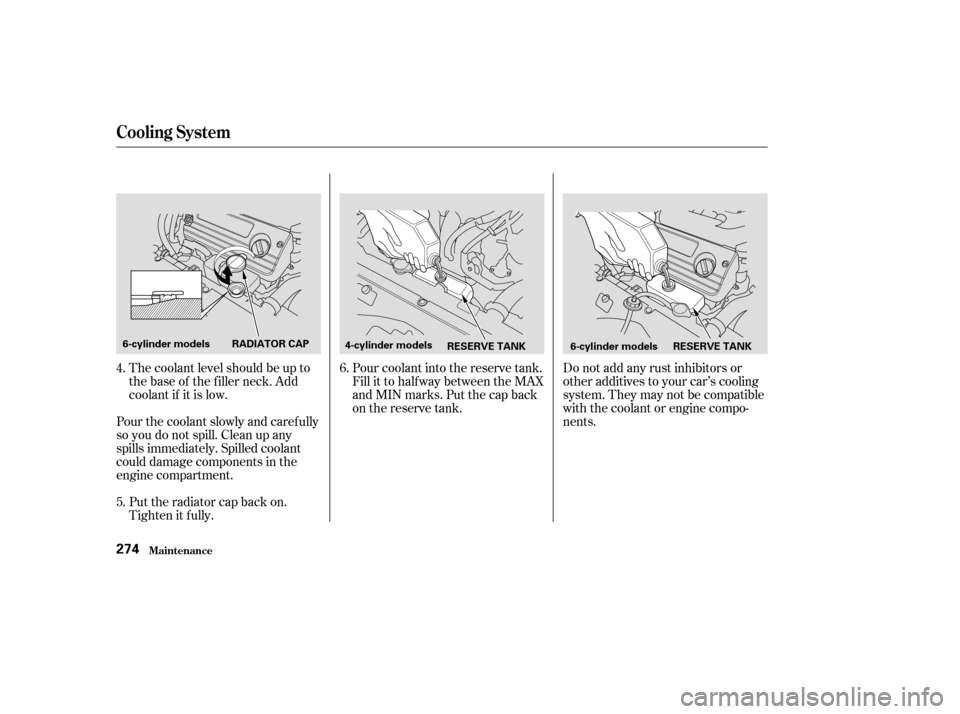
The coolant level should be up to
the base of the f iller neck. Add
coolant if it is low.
Pour the coolant slowly and caref ully
so you do not spill. Clean up any
spills immediately. Spilled coolant
could damage components in the
engine compartment. Put the radiator cap back on.
Tighten it f ully. Pour coolant into the reserve tank.
Fill it to half way between the MAX
and MIN marks. Put the cap back
on the reserve tank.
Do not add any rust inhibitors or
other additives to your car’s cooling
system. They may not be compatible
with the coolant or engine compo-
nents.
4. 5. 6.
Cooling Syst em
Maint enance274
4-cylinder models
6-cylinder models RADIATOR CAP
RESERVE TANK
RESERVE TANK 6-cylinder models
�����—�����—�����y���������������y���
�(�����������y���������y
Page 268 of 380
Thecoolingsystemshouldbe
completely drained and ref illed with
new coolant according to the time
and distance recommendations in
the maintenance schedule. Only use
Honda All Season Antif reeze/
Coolant Type 2. Use of any non-
Honda coolant or plain water can
result in corrosion and deposits in
the cooling system.
Draining the coolant requires access
to the underside of the car. Unless
you have the tools and knowledge,
you should have this maintenance
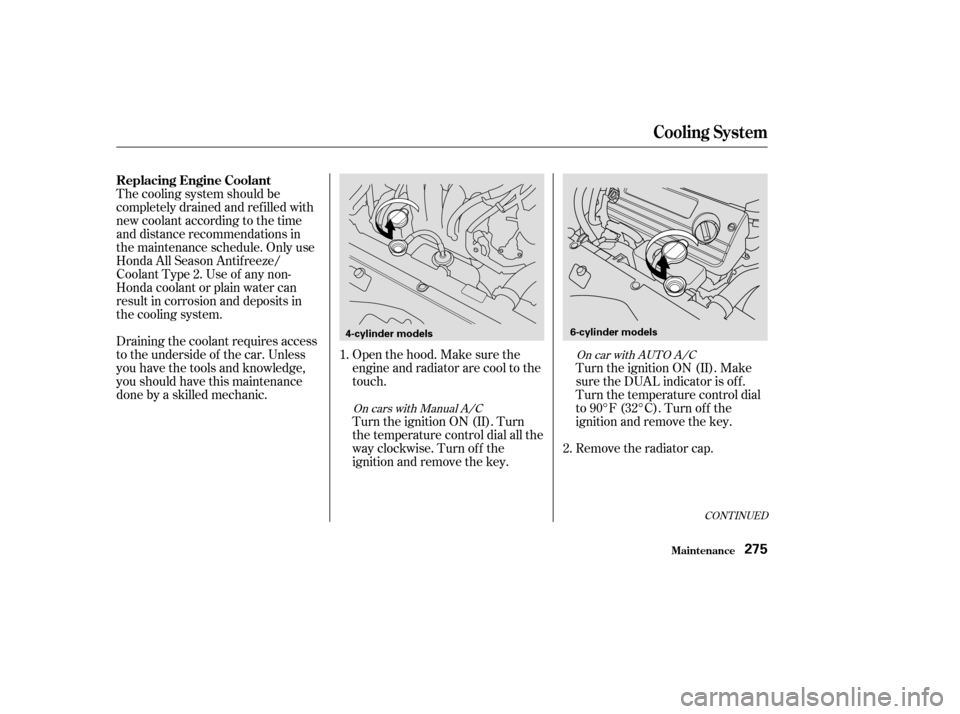
done by a skilled mechanic.Openthehood.Makesurethe
engine and radiator are cool to the
touch.
Turn the ignition ON (II). Turn
the temperature control dial all the
way clockwise. Turn off the
ignition and remove the key.Turn the ignition ON (II). Make
sure the DUAL indicator is off.
Turn the temperature control dial
to 90°F (32°C). Turn of f the
ignition and remove the key.
Remove the radiator cap.
1.
2.
CONT INUED
On cars with Manual A/COn car with AUTO A/C
Replacing Engine Coolant
Cooling Syst em
Maint enance275
4-cylinder models
6-cylinder models
�����—�����—�����y���������������y���
�(�����������y���������y
Page 271 of 380

The cooling system capacity is: Start the engine and let it run forabout 30 seconds. Then turn of f
the engine.
Fill the radiator with coolant up to
the base of the f iller neck.
Fill the reserve tank to the MAX
mark. Install the reserve tank cap.
Install the radiator cap, and
tighten it to the first stop.
Start the engine and let it run until
the radiator cooling f an comes on
at least twice. Then stop the
engine.
Remove the radiator cap. Pour
coolant into the radiator up to the
base of the f iller neck and into the
reserve tank up to the MAX mark.Start the engine and hold it at
1,500 rpm until the cooling f an
comes on. Turn of f the engine.
Check the coolant level in the
radiator and add coolant if needed.
Install the radiator cap, and
tighten it fully.
If necessary, f ill the reserve tank
to the MAX mark. Install the
reserve tank cap.
8. 9.
10. 16.
15.
14.
11. 12. 13.
With 5-speed manual transmission: With automatic transmission:6-cylinder models
Cooling Syst em
Maint enance278
1.35 US gal (5.1)
1.32 US gal (5.0
)
1.77 US gal (6.7
)
�����—�����—�����y���������������y���
�(�����������y�������
�y
Page 336 of 380

If you see steam and/or spray
coming f rom under the hood, turn
of f the engine.
If you do not see steam or spray,
leave the engine running and
watch the temperature gauge. If
the high heat is due to overloading
(climbing a long, steep hill on a
hot day with the A/C running, for
example), the engine should start
to cool down almost immediately.
If it does, wait until the tempera-
ture gauge comes down to the mid-
point then continue driving.
Saf ely pull to the side of the road.
Put the transmission in Neutral or
Park, and set the parking brake.
Turn of f the heating and cooling
system and all other accessories.
Turn on the hazard warning
indicators.
The pointer of your car’s tempera-
ture gauge should stay in the mid-
range under most conditions. It may
go higher if you are driving up a long
steep hill on a very hot day. If it
climbs to the red mark, you should
determine the reason.
Your car can overheat f or several
reasons, such as lack of coolant or a
mechanical problem. The only
indication may be the temperature
gauge climbing to or above the red
mark. Or you may see steam or
spray coming f rom under the hood.
In either case, you should take
immediate action. 1.
2. 3.
CONT INUED
If Your Engine Overheats
T aking Care of t he Unexpect ed345
Steam and spray from an
overheated engine can
seriously scald you.
Do not open the hood if steam
is coming out.
Driving with the temperature gauge
pointer at the red mark can cause
serious damage to your engine.
�����—�����—�����y���������������y���
�(�����������y���������y
Page 337 of 380

If the temperature gauge stays at
the red mark, turn of f the engine.
Wait until you see no more signs
of steam or spray, then open thehood.
If there was no coolant in the
reserve tank, you may also have to
add coolant to the radiator. Let the
engine cool down until the pointerreaches the middle of the tempera-
ture gauge, or lower, bef ore check-
ing the radiator.
Using gloves or a large heavy
cloth, turn the radiator cap
counterclockwise, without pushing
down, to the f irst stop. This
releases any remaining pressure in
the cooling system. After the
pressure releases, push down on
the cap and turn it until it comes
off.
If you don’t f ind an obvious leak,
check the coolant level in the
radiator reserve tank (see page
). If the level is below the
MIN mark, add coolant to halfway
between the MIN and MAX marks. Start the engine and set the
temperature control dial to
maximum (climate control to
FULL AUTO at 90°F/32°C). Add
coolant to the radiator up to the
base of the f iller neck. If you do
not have the proper coolant
mixture available, you can add
plain water. Remember to have
the cooling system drained and
ref illed with the proper mixture as
soon as you can.
If the temperature stays normal,
check the coolant level in the
radiator reserve tank. If it has
gone down, add coolant to the
MAX mark. Put the cap back on
tightly.
Look f or any obvious coolant leaks,
such as a split radiator hose.
Everything is still extremely hot,
so use caution. If you f ind a leak, it
must be repaired bef ore you
continue driving (see
on page ). Put the radiator cap back on
tightly. Run the engine and watch
the temperature gauge. If it goes
back to the red mark, the engine
needs repair. (See on page .)
4. 5.
6. 7. 8. 9.
11.12.10.
210 358
358
T aking Care of t he Unexpect ed
If Your Engine Overheats
Emergency
Towing
Emergency
Towing
346
Removing the radiator cap
while the engine is hot can
cause the coolant to spray out,
seriously scalding you.
Always let the engine and
radiator cool down before
removing the radiator cap.
�����—�����—�����y���������������y���
�(�����������y���������y