Page 30 of 380
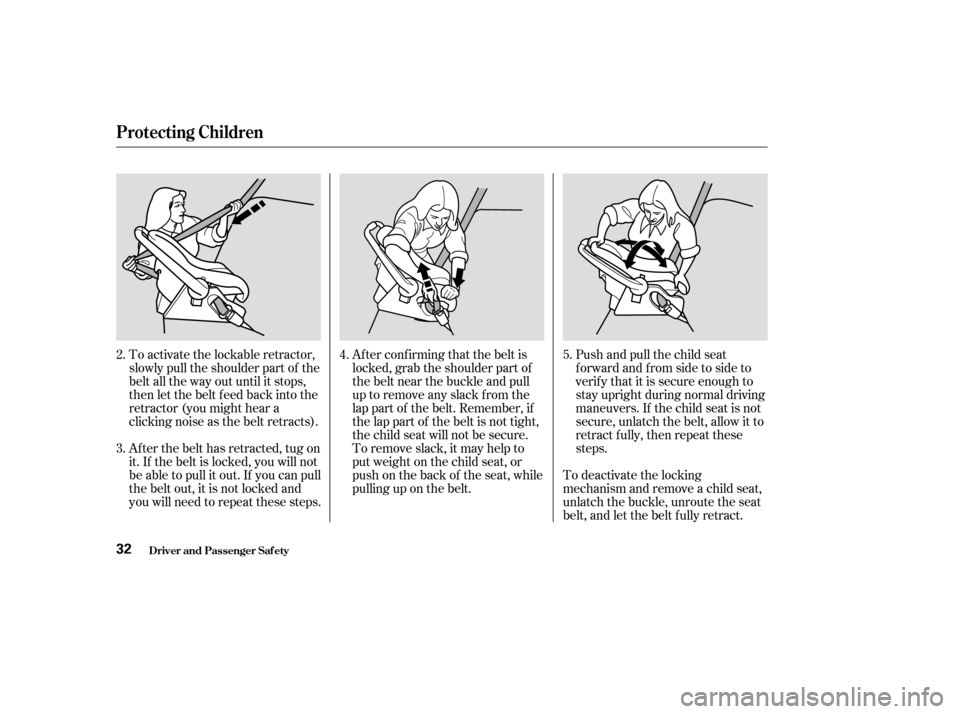
To activate the lockable retractor,
slowly pull the shoulder part of the
belt all the way out until it stops,
then let the belt f eed back into the
retractor (you might hear a
clicking noise as the belt retracts).
Af ter the belt has retracted, tug on
it. If the belt is locked, you will not
be able to pull it out. If you can pull
the belt out, it is not locked and
you will need to repeat these steps.Af ter conf irming that the belt is
locked, grab the shoulder part of
the belt near the buckle and pull
up to remove any slack from the
lap part of the belt. Remember, if
the lap part of the belt is not tight,
the child seat will not be secure.
To remove slack, it may help to
putweightonthechildseat,or
push on the back of the seat, while
pulling up on the belt.
Push and pull the child seat
f orward and f rom side to side to
verif y that it is secure enough to
stay upright during normal driving
maneuvers. If the child seat is not
secure, unlatch the belt, allow it to
retract f ully, then repeat these
steps.
To deactivate the locking
mechanism and remove a child seat,
unlatch the buckle, unroute the seat
belt, and let the belt f ully retract.
2. 3.
4.
5.
Protecting Children
Driver and Passenger Saf ety32
�����—�����—�����y���
�����������y���
�(�����������y���������y
Page 32 of 380
The lap/shoulder belts in the back
and f ront passenger seating positions
have a locking mechanism that must
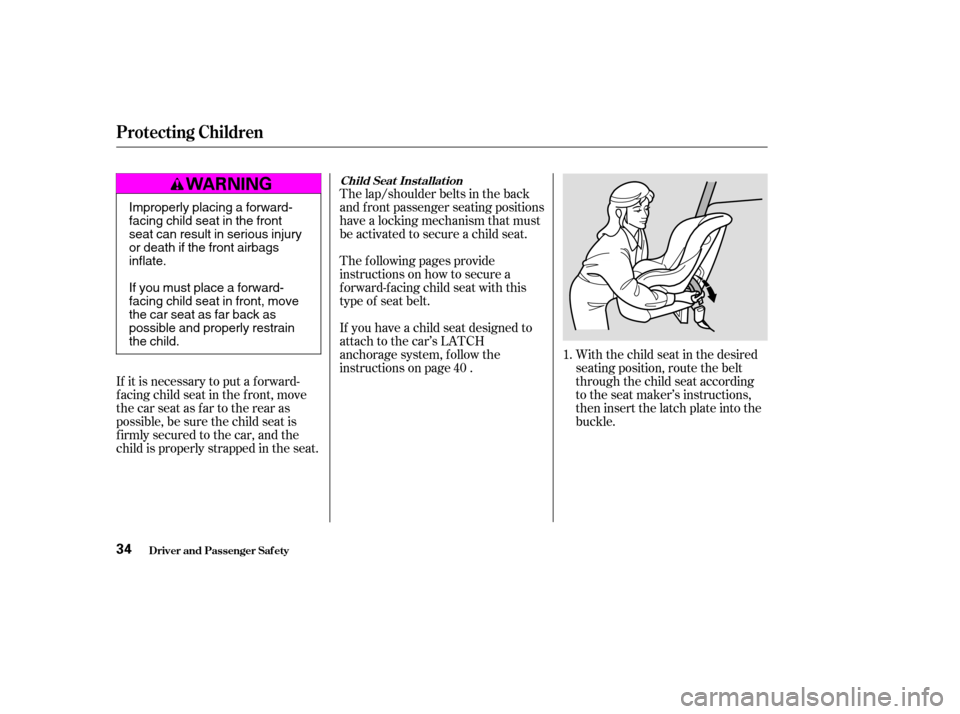
be activated to secure a child seat.With the child seat in the desired
seating position, route the belt
through the child seat according
to the seat maker’s instructions,
then insert the latch plate into the
buckle.
The f ollowing pages provide
instructions on how to secure a
f orward-f acing child seat with this
type of seat belt.
If it is necessary to put a f orward-
f acing child seat in the f ront, move
the car seat as far to the rear as
possible, be sure the child seat is
f irmly secured to the car, and the
child is properly strapped in the seat. If you have a child seat designed to
attach to the car’s LATCH
anchorage system, follow the
instructions on page .
1.
40
Child Seat Inst allat ion
Protecting Children
Driver and Passenger Saf ety34
Improperly placing a forward-
facing child seat in the front
seat can result in serious injury
or death if the front airbagsinflate.
Ifyoumustplaceaforward-
facing child seat in front, move
the car seat as far back as
possible and properly restrain
the child.
�����—�����—�����y���
�������
���y���
�(�����������y���������y
Page 33 of 380
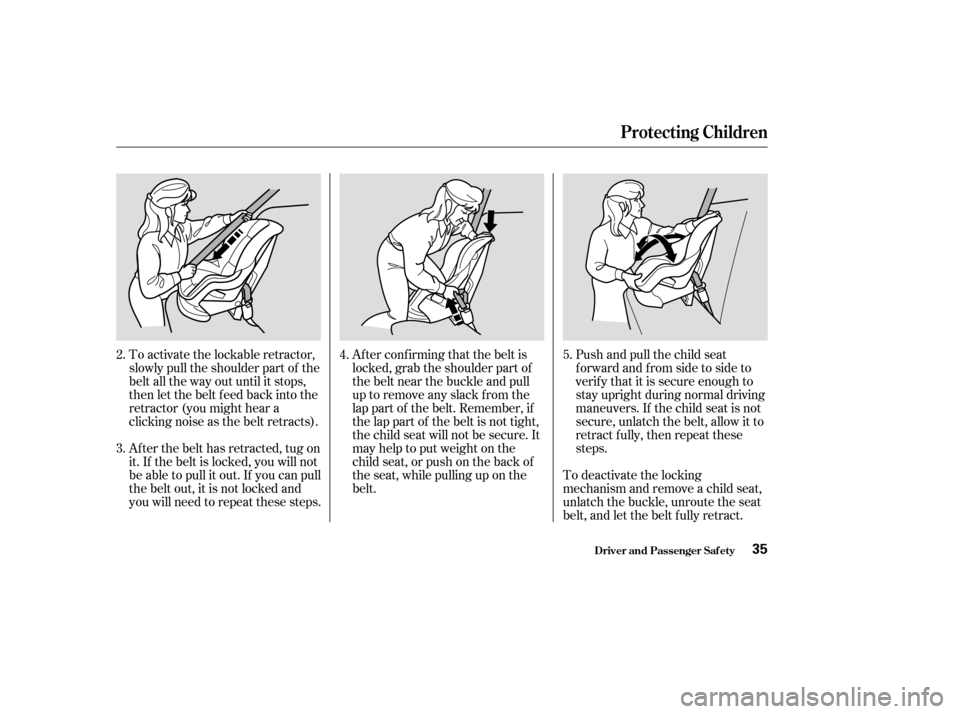
To activate the lockable retractor,
slowly pull the shoulder part of the
belt all the way out until it stops,
then let the belt f eed back into the
retractor (you might hear a
clicking noise as the belt retracts).
Af ter the belt has retracted, tug on
it. If the belt is locked, you will not
be able to pull it out. If you can pull
the belt out, it is not locked and
you will need to repeat these steps.Af ter conf irming that the belt is
locked, grab the shoulder part of
the belt near the buckle and pull
up to remove any slack from the
lap part of the belt. Remember, if
the lap part of the belt is not tight,
the child seat will not be secure. It
mayhelptoputweightonthe
child seat, or push on the back of
the seat, while pulling up on the
belt.
Push and pull the child seat
f orward and f rom side to side to
verif y that it is secure enough to
stay upright during normal driving
maneuvers. If the child seat is not
secure, unlatch the belt, allow it to
retract f ully, then repeat these
steps.
To deactivate the locking
mechanism and remove a child seat,
unlatch the buckle, unroute the seat
belt, and let the belt f ully retract.
2. 3.
4.
5.
Protecting Children
Driver and Passenger Saf ety35
�����—�����—�����y���
�����������y���
�(�����������y���������y
Page 40 of 380

This seat belt has a single belt that
goes over your shoulder, across your
chest and across your hips. The seat belts in all seating positionsexcept the driver’s have an additional
locking mechanism that must be
activated to secure a child seat. (See
pages and f or instructions on
how to secure child seats with this
type of seat belt.)
All seat belts have an emergency
locking retractor. In normal driving,
the retractor lets you move f reely in
your seat while it keeps some
tension on the belt. During a collision
or sudden stop, the retractor
automatically locks the belt to help
restrain your body.
Guide the belt across your body to
the door pillar. Af ter exiting the car,
be sure the belt is out of the way and
will not get closed in the door.
To unlock the belt, push the red
PRESSbuttononthebuckle.
To fasten the belt, insert the latch
plate into the buckle, then tug on the
belt to make sure the buckle is
latched.
Your seat belt system includes lap/
shoulder belts in all f ive seating
positions. The f ront seat belts are
also equipped with automatic seat
belt tensioners.
The seat belt system also
includes a light on the
instrument panel to remind you and
your passengers to f asten your belts.
If the driver’s seat belt is not
fastened before the ignition is turned
ON (II), the light will come on and a
beeper will also sound. The beeper
will stop af ter a f ew seconds, but the
light will stay on until the driver’s
seat belt is f astened.
31 34
Seat Belt System Components L ap/Shoulder Belt
Additional Inf ormation About Your Seat Belts
Driver and Passenger Saf ety42
�����—�����—�����y���
�����������y���
�(�����������y���������y
Page 41 of 380

See page f or instructions on how
to wear the lap/shoulder belt
properly.
To deactivate the locking
mechanism, unlatch the buckle and
let the seat belt f ully retract. To
ref asten the belt, pull it out only as
f ar as needed.
If the shoulder part of the belt is
pulled all the way out, the locking
mechanism will activate. The belt
will retract, but it will not allow the
passenger to move f reely.
For added protection, the f ront seat
belts are equipped with automatic
seat belt tensioners. When activated,
the tensioners immediately tighten
the belts to help hold the driver and
a f ront passenger in place.
The tensioners are designed to
activate primarily in f rontal collisions.
The tensioners are independent of
the airbag system, so they can be
activated during a collision thatmight not cause the airbags to
deploy. In this case, the airbags
would not be needed but the
additional seat belt tension can be
helpf ul.
The tensioners will be activated in a
collision severe enough to cause the
f ront airbags to inf late.
When the tensioners are activated,
the seat belts will remain tight until
they are unbuckled in the normal
way.
The SRS indicator light will
come on if there is a
problem with your automatic seat
belt tensioners (see page ).
15
48
Additional Inf ormation About Your Seat Belts
Driver and Passenger Saf ety
A utomatic Seat Belt T ensioners
43
�����—�����—�����y���
�����������y���
�(�����������y���������y
Page 53 of 380
Inst rument s and Cont rols
Control L ocations
56
MIRROR CONTROLS
DOOR LOCK SWITCH
POWER WINDOW
SWITCHESHOOD RELEASE
HANDLE
(P.79)
(P.96) AUDIO SYSTEM
DIGITAL CLOCK
(P.101)
(P.206) (P.139, 156, 174)
HEATING/COOLING
CONTROLS
(P.112)
TRUNK RELEASE HANDLE/
FUEL FILL DOOR RELEASE (P.134, 150, 169)
(P.84/204) (P.72)
HAZARD WARNING
LIGHTS
�����—�����—�����y���
�������
���y���
�(�����������y���������y
Page 54 of 380
The U.S. instrument panel is shown. Dif f erences f or the Canadian models are noted in thetext.
Indicator L ights
Inst rument s and Cont rols57
CRUISE CONTROL INDICATOR
LOW FUEL INDICATOR LIGHT ON INDICATOR
SEAT BELT REMINDER LIGHT MAINTENANCE REQUIRED
INDICATOR
HIGH BEAM INDICATOR
MALFUNCTION
INDICATOR LAMP TRACTION CONTROL SYSTEM
INDICATOR
CRUISE MAIN INDICATOR ANTI-LOCK BRAKE SYSTEM
INDICATOR
PARKING BRAKE AND BRAKE
SYSTEM INDICATOR TCS ACTIVATION INDICATOR
LOW OIL PRESSURE
INDICATOR (P.58)
CHARGING SYSTEM
INDICATOR (P.62)
(P.62)
DOOR MONITOR
SECURITY SYSTEM INDICATOR SUPPLEMENTAL
RESTRAINT SYSTEM
INDICATOR
(P.58)
(P.59)
(P.59)
(P.62)
(P.61)
(P.61) (P.59)
(P.65)
(P.60)
(P.58)
(P.61)
(P.58)
(P.58) (P.60)
IMMOBILIZER SYSTEM INDICATOR (P.62)
(P.59)
SIDE AIRBAG CUTOFF
INDICATOR
�����—�����—�����y�
�������������y���
�(�����������y���������y
Page 56 of 380

This light normally comes on f or a
f ew seconds when you turn the
ignition switch ON (II), and when
the ignition switch is turned to
START (III). If this light comes on at
any other time, there is a problem in
theABS.If thishappens,takethe
cartoyourdealertohaveitchecked.
With the light on, your car still has
normal braking ability but no anti-
lock. For complete inf ormation, see
page .
This indicator lights brief ly when
you turn the ignition switch to ON
(II). If it comes on at any other time,
it indicates a potential problem with
your f ront airbags. This light will
also alert you to a potential problem
with your side airbags, passenger’s
side airbag automatic cutoff system,
automatic seat belt tensioners, or
side curtain airbags. For complete
inf ormation, see page .
This indicator comes on as a
reminder that you have turned of f
the Traction Control System. It
normally comes on f or a f ew seconds
when you turn the ignition switch to
ON (II). If the TCS activation
indicator and the TCS indicator
comeonandstayonatanyother
time, or if they do not come on when
you turn the ignition switch to ON
(II), there is a problem with the TCS.
Take the car to your dealer to have it
checked.
This indicator lights when you turn
the ignition switch ON (II). If it
comes on at any other time, it
indicates that the passenger’s side
airbag has automatically shut off.
For complete inf ormation, see page .49 231
48
On all V6 models
Only on models equipped with side airbags
Indicator L ights
Inst rument s and Cont rols
Supplemental Restraint
System Indicator Anti-lock Brake System (ABS)
Indicator T CS A ctivation Indicator
Side A irbag Cutof f
Indicator
59
�����—�����—�����y���
�����������y���
�(�����������y���������y

