Page 266 of 380

Always use Honda All Season
Antif reeze/Coolant Type 2. This
coolant is pre-mixed with 50 percent
antif reeze and 50 percent water. It
does not require any additional
mixing. If it is not available, you may
use another major-brand non-silicate
coolant as a temporary replacement.
Make sure it is a high-quality coolant
recommended f or aluminum engines.
However, continued use of any non-
Honda coolant can result incorrosion, causing the cooling
system to malf unction or f ail. Have
the cooling system f lushed and
ref illed with Honda antif reeze/
coolant as soon as possible.
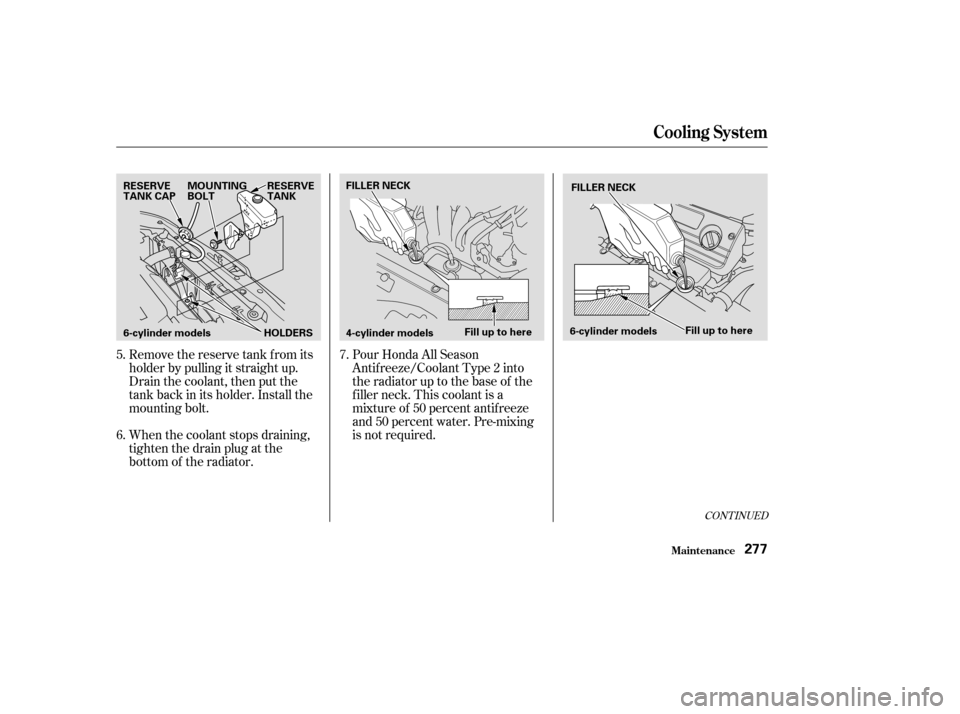
If the reserve tank is completely
empty, you should also check the
coolant level in the radiator.
Make sure the engine and radiator
are cool.
Turn the radiator cap counter-
clockwise, without pressing down
on it, until it stops. This relieves
any pressure remaining in the
cooling system.
Remove the radiator cap by
pushing down and turning
counterclockwise.
1. 2. 3.
CONT INUED
Cooling Syst em
Maint enance273
6-cylinder models RESERVE TANK RADIATOR CAP
4-cylinder modelsRemoving the radiator cap
while the engine is hot can
cause the coolant to spray out,
seriously scalding you.
Always let the engine and
radiator cool down before
removing the radiator cap.
�����—�����—�����y���������������y���
�(�����������y���������y
Page 268 of 380
Thecoolingsystemshouldbe
completely drained and ref illed with
new coolant according to the time
and distance recommendations in
the maintenance schedule. Only use
Honda All Season Antif reeze/
Coolant Type 2. Use of any non-
Honda coolant or plain water can
result in corrosion and deposits in
the cooling system.
Draining the coolant requires access
to the underside of the car. Unless
you have the tools and knowledge,
you should have this maintenance
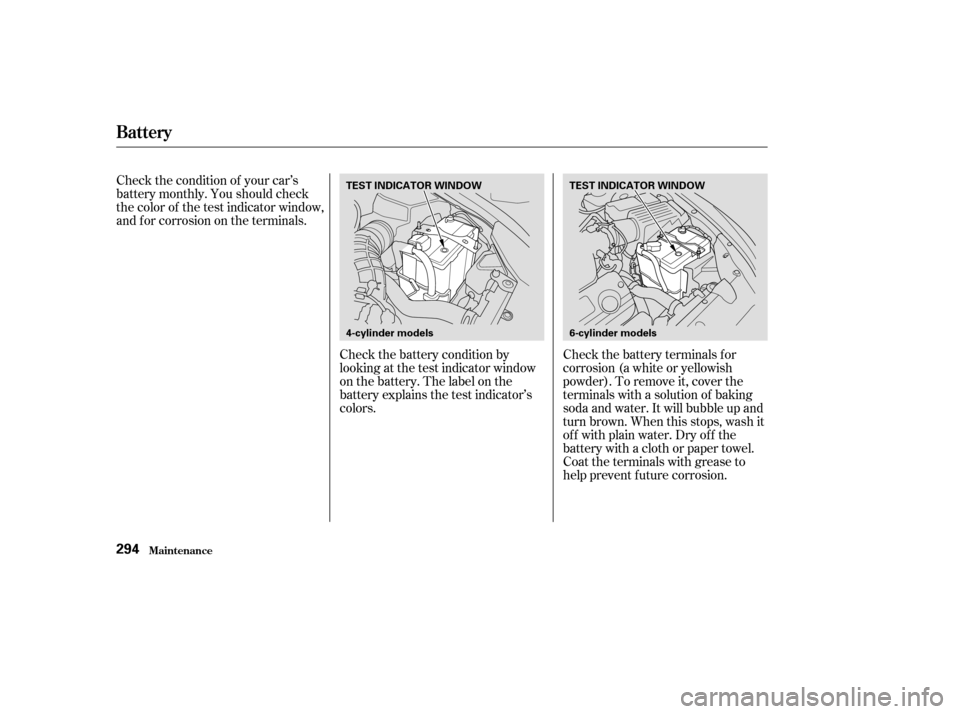
done by a skilled mechanic.Openthehood.Makesurethe
engine and radiator are cool to the
touch.
Turn the ignition ON (II). Turn
the temperature control dial all the
way clockwise. Turn off the
ignition and remove the key.Turn the ignition ON (II). Make
sure the DUAL indicator is off.
Turn the temperature control dial
to 90°F (32°C). Turn of f the
ignition and remove the key.
Remove the radiator cap.
1.
2.
CONT INUED
On cars with Manual A/COn car with AUTO A/C
Replacing Engine Coolant
Cooling Syst em
Maint enance275
4-cylinder models
6-cylinder models
�����—�����—�����y���������������y���
�(�����������y���������y
Page 270 of 380
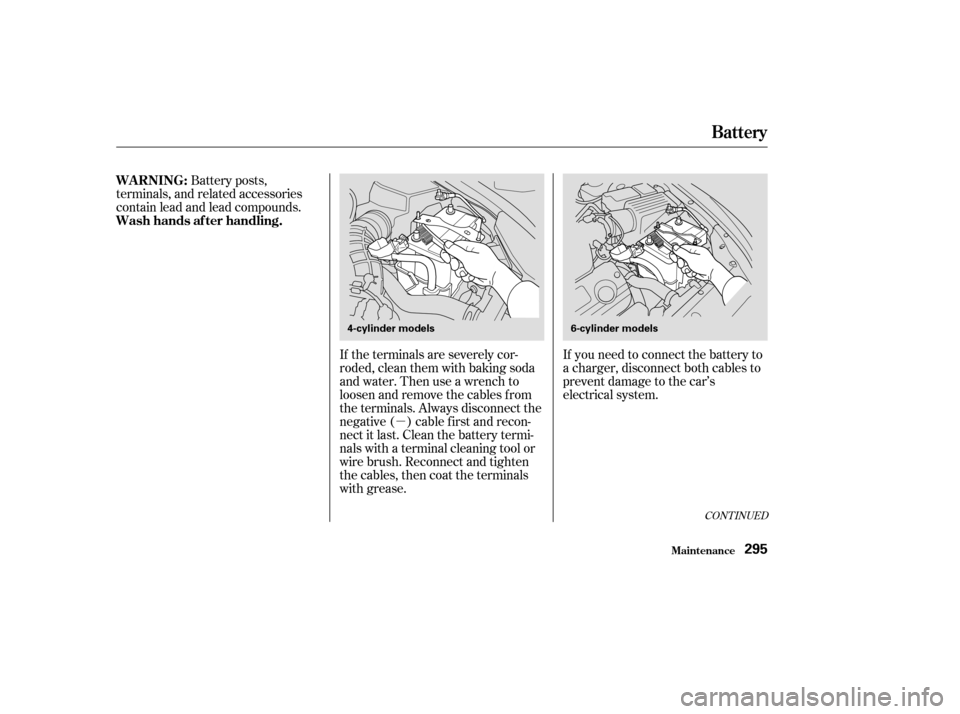
Remove the reserve tank f rom its
holder by pulling it straight up.
Drain the coolant, then put the
tank back in its holder. Install the
mounting bolt.
When the coolant stops draining,
tightenthedrainplugatthe
bottom of the radiator.Pour Honda All Season
Antif reeze/Coolant Type 2 into
the radiator up to the base of the
f iller neck. This coolant is a
mixture of 50 percent antif reeze
and 50 percent water. Pre-mixing
is not required.
5. 6. 7.
CONT INUED
Maint enance
Cooling Syst em
277
4-cylinder models
RESERVE
TANK CAP
RESERVE
TANK
6-cylinder models HOLDERS MOUNTINGBOLT
FILLER NECK
Fill up to hereFILLER NECK
6-cylinder models Fill up to here
�����—�����—�����y�
�������������y���
�(�����������y���������y
Page 272 of 380

Check the level in the windshield
washer reservoir at least monthly
during normal usage. In bad weather,
when you use the washers of ten,
check the level every time you stop
for fuel.
Check the reservoir’s f luid level by
removing the cap and looking at the
level gauge attached to the cap.
The low washer level indicator will
light when the level is low (see page).
Fill the reservoir with a good-quality
windshield washer f luid. This
increases the cleaning capability and
prevents f reezing in cold weather. When you ref ill the reservoir, clean
the edges of the windshield wiper
blades with windshield washer f luid
on a clean cloth. This will help to
condition the blade edges.
The windshield washer reservoir is
located behind the right headlight.
62
Canadian Models
Windshield Washers
Maint enance279
LEVEL GAUGE
4-cylinder models 6-cylinder models LEVEL GAUGE
Do not use engine antif reeze or a
vinegar/water solution in the
windshield washer reservoir.
Antif reeze can damage your car’s paint,
while a vinegar/water solution can
damage the windshield washer pump.
Use only commercially-available
windshield washer f luid.
�����—�����—�����y���������������y���
�(�����������y���������y
Page 287 of 380
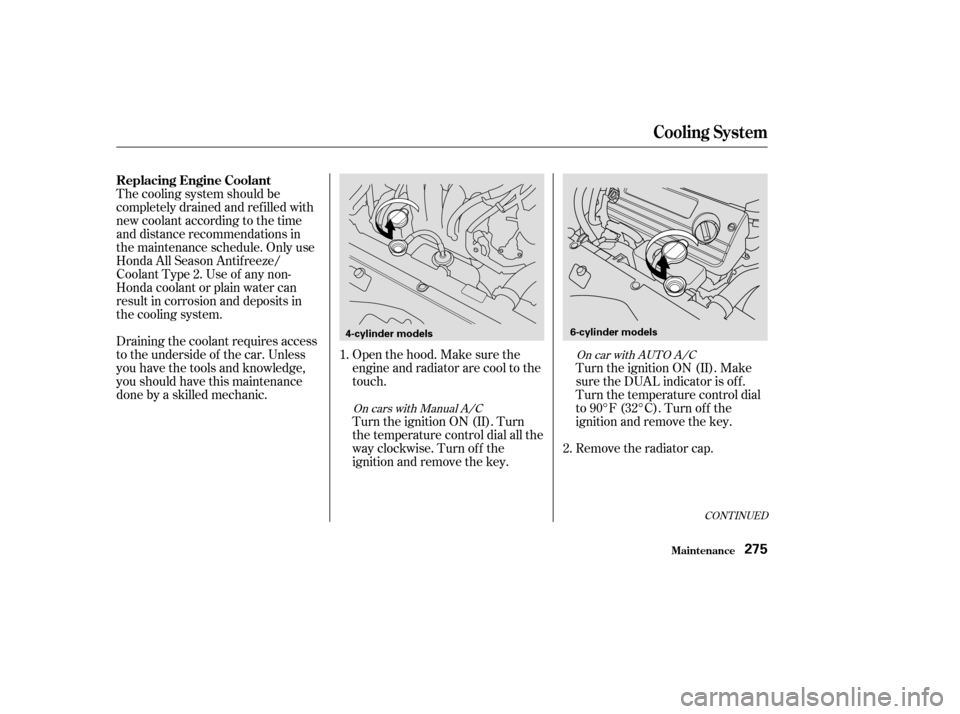
Check the battery condition by
looking at the test indicator window
on the battery. The label on the
battery explains the test indicator’s
colors.Check the battery terminals for
corrosion (a white or yellowish
powder). To remove it, cover the
terminals with a solution of baking
soda and water. It will bubble up and
turn brown. When this stops, wash it
of f with plain water. Dry of f the
battery with a cloth or paper towel.
Coat the terminals with grease to
help prevent f uture corrosion.
Check the condition of your car’s
battery monthly. You should check
the color of the test indicator window,
and f or corrosion on the terminals.
Battery
Maint enance294
TEST INDICATOR WINDOW
4-cylinder models
TEST INDICATOR WINDOW
6-cylinder models
�����—�����—�����y���������������y���
�(�����������y���������y
Page 288 of 380
�µIf you need to connect the battery to
a charger, disconnect both cables to
prevent damage to the car’s
electrical system.
If the terminals are severely cor-
roded, clean them with baking soda
and water. Then use a wrench to
loosen and remove the cables f rom
the terminals. Always disconnect the
negative ( ) cable f irst and recon-
nect it last. Clean the battery termi-
nals with a terminal cleaning tool or
wire brush. Reconnect and tighten
the cables, then coat the terminals
with grease.
Battery posts,
terminals, and related accessories
contain lead and lead compounds.
CONT INUED
WARNING:
Wash hands af ter handling.
Battery
Maint enance295
4-cylinder models 6-cylinder models
�����—�����—�����y���������������y���
�(�����������y���������y
Page 318 of 380

When you have washed and rinsed
the whole exterior, dry it with a
chamois or sof t towel. Letting it
air-dry will cause dulling and water
spots.
Fill a bucket with cool water. Mix
in a mild detergent, such as
dishwashing liquid or a product
made especially f or car washing.
Only use the solvents and cleaners
recommendedinthisOwner’s
Manual.
Frequent washing helps preserve
your car’s beauty. Dirt and grit can
scratch the paint, while tree sap and
bird droppings can permanently ruin
the f inish.
Wash your car in a shady area, not in
direct sunlight. If the car is parked in
the sun, move it into the shade and
let the exterior cool down bef ore you
start.
Rinse the car thoroughly with cool
water to remove loose dirt.
As you dry the car, inspect it f or
chips and scratches that could allow
corrosion to start. Repair them with
touch-up paint (see page ).
Wash the car using the water and
detergent solution and a sof t-
bristle brush, sponge, or sof t cloth.
Start at the top and work your way
down. Rinse f requently.
Check the body f or road tar, tree
sap, etc. Remove these stains with
tar remover or turpentine. Rinse it
of f immediately so it does not
harm the f inish. Remember to re-
wax these areas, even if the rest of
the car does not need waxing. 327
Exterior Care
Appearance Care
Washing
326
Chemical solvents and strong cleaners
can damage the paint, metal, and
plastic on your car.
�����—�����—�����y��������
������y���
�(�����������y���������y
Page 319 of 380

�µ�µ
Always wash and dry the whole car
bef ore waxing it. You should wax
your car, including the metal trim,
whenever water sits on the surf ace
in large patches. It should f orm into
beads or droplets af ter waxing.
You should use a quality liquid or
paste wax. Apply it according to the
instructions on the container. In
general, there are two types of
products:
Waxes A wax coats the finish and
protects it f rom damage by exposure
to sunlight, air pollution, etc. You
should use a wax on your Honda
when it is new.
Polishes Polishes and cleaner/
waxes can restore the shine to paint
that has oxidized and lost some of its
shine. They normally contain mild
abrasives and solvents that remove
the top layer of the f inish. You should use a polish on your Honda if
the f inish does not have its original
shine af ter using a wax.
Cleaning tar, insects, etc. with
removers also takes off the wax.
Remember to re-wax those areas,
even if the rest of the car does not
need waxing.
Clean your Honda’s aluminum alloy
wheels as you do the rest of the
exterior.Washthemwiththesame
solution, and rinse them thoroughly.
The wheels have a protective clear-
coat that keeps the aluminum from
corroding and tarnishing. Using
harsh chemicals, including some
commercial wheel cleaners, or stif f
brushes can damage this clear-coat.
Only use a mild detergent and sof t
brush or sponge to clean the wheels.
Your dealer has touch-up paint to
match your car’s color. The color
code is printed on a sticker on the
driver’s doorjamb. Take this code to
your dealer so you are sure to get
the correct color.
Inspect your car f requently f or chips
or scratches in the paint. Repair
them right away to prevent corrosion
of the metal underneath. Use the
touch-up paint only on small chips
and scratches. More extensive paint
damage should be repaired by a
prof essional.
All EX models
Exterior Care
Appearance Care
Waxing
A luminum WheelsPaint T ouch-up
327
�����—�����—�����y��������
������y���
�(�����������y���������y