Page 73 of 429

This meter shows the number of
miles (U.S.) or kilometers (Canada)
driven since you last reset it.This shows the temperature of the
engine’s coolant. During normal
operation, the pointer should rise
from the bottom white mark to about
the middle of the gauge. In severe
driving conditions, such as very hot
weather or a long period of uphill
driving, the pointer may rise into the
upper half of the gauge. If it reaches
the red (Hot) mark, pull safely to the
side of the road. Turn to page f or
instructions and precautions on
checking the engine’s cooling
system.This shows how much f uel you have.
It is most accurate when the car is on
level ground. It may show slightly
more or less than the actual amount
whenyouaredrivingoncurvyor
hilly roads.
The needle returns to the bottom
after you turn off the ignition. The
gauge shows the f uel level reading
immediately af ter you turn the
ignition switch back ON (II).
There are two trip meters: Trip A
and Trip B. Switch between these
displays and the odometer/outside
temperature display by pressing the
Select/Reset knob repeatedly. Each
trip meter works independently, so
you can keep track of two dif f erent
distances.
When you turn the ignition switch to
ON (II), what you last selected is
displayed.
To reset a trip meter, display it, and
then press and hold the Select/Reset
knob until the number resets to ‘‘0.0’’. 376
Trip Meter
Temperature GaugeFuel Gauge
Gauges
Inst rument s and Cont rols70
Avoid driving with an extremely low
f uel level. Running out of f uel could
cause the engine to misf ire, damaging
the catalytic converter.
Page 128 of 429
CONT INUED
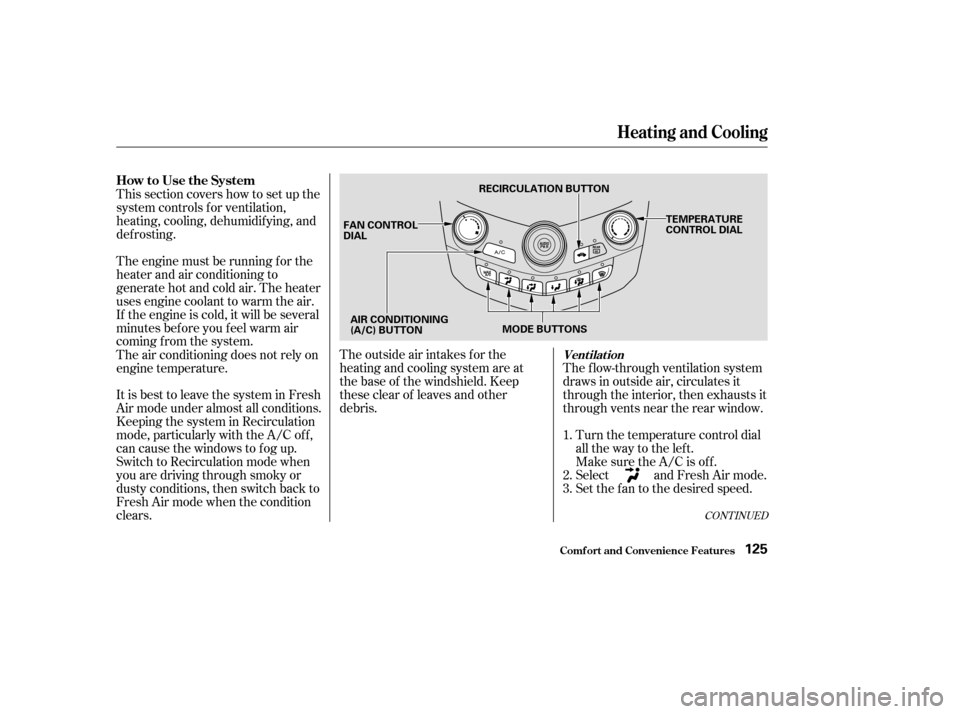
The f low-through ventilation system
draws in outside air, circulates it
through the interior, then exhausts it
through vents near the rear window.Turn the temperature control dial
all the way to the lef t.
Make sure the A/C is of f .
Select and Fresh Air mode.
Set the f an to the desired speed.
The outside air intakes f or the
heating and cooling system are at
the base of the windshield. Keep
these clear of leaves and other
debris.
This section covers how to set up the
system controls f or ventilation,
heating, cooling, dehumidif ying, and
def rosting.
The engine must be running f or the
heater and air conditioning to
generate hot and cold air. The heater
uses engine coolant to warm the air.
If the engine is cold, it will be several
minutes bef ore you f eel warm air
coming from the system.
It is best to leave the system in Fresh
Air mode under almost all conditions.
Keeping the system in Recirculation
mode, particularly with the A/C of f ,
can cause the windows to fog up.
Switch to Recirculation mode when
you are driving through smoky or
dusty conditions, then switch back to
Fresh Air mode when the condition
clears. The air conditioning does not rely on
engine temperature.
1.
2.
3.
Heating and Cooling
Comf ort and Convenience Feat ures
Vent ilat ion
How to Use the System
125
RECIRCULATION BUTTONTEMPERATURE
CONTROL DIAL
FAN CONTROL
DIAL
AIR CONDITIONING
(A/C) BUTTON MODE BUTTONS
Page 130 of 429

Air conditioning, as it cools, removes
moisture from the air. When used in
combination with the heater, it
makes the interior warm and dry.To remove f og f rom the inside of the
windows:
Set the f an to the desired speed.
Turn on the air conditioning.
Select and Fresh Air mode.
Adjust the temperature control
dial so the mixture of heated and
cooled air f eels comf ortable.
Once the engine is warmed up, this
setting is suitable f or all driving
conditions. Set the f an to the desired speed.
Select .
When you select , the
system automatically switches to
Fresh Air mode and turns on the
A/C. (The indicator above the
A/C button stays off.)
Adjust the temperature control
dial so the air flow from the
def roster vents f eels warm.
Turn on the rear window def ogger
to help clear the rear window.
When you switch to another mode
f rom , the A/C turns of f .
Butifitwasontostartwith,it
stays on.
Air conditioning places an extra load
on the engine. Watch the engine
coolant temperature gauge (see page
) when driving in stop-and-go
traf f ic or climbing a long, steep hill.
If it moves near the red zone, turn
of f the A/C until the gauge reads
normally.
To warm the interior:
Start the engine.
Select .
When you select , the
system automatically switches to
Fresh Air mode.
Set the f an to the desired speed.
Adjust the warmth of the air with
the temperature control dial. 1.
2.
3.
4.
1.
2.
3.
4.
1.
2.
3.
4. 70
CONT INUED
Heating and Cooling
Comf ort and Convenience Feat ures
T o Heat and Dehumidif y wit h A ir
Condit ioning T o Def og and Def rost
To Heat
127
Page 304 of 429
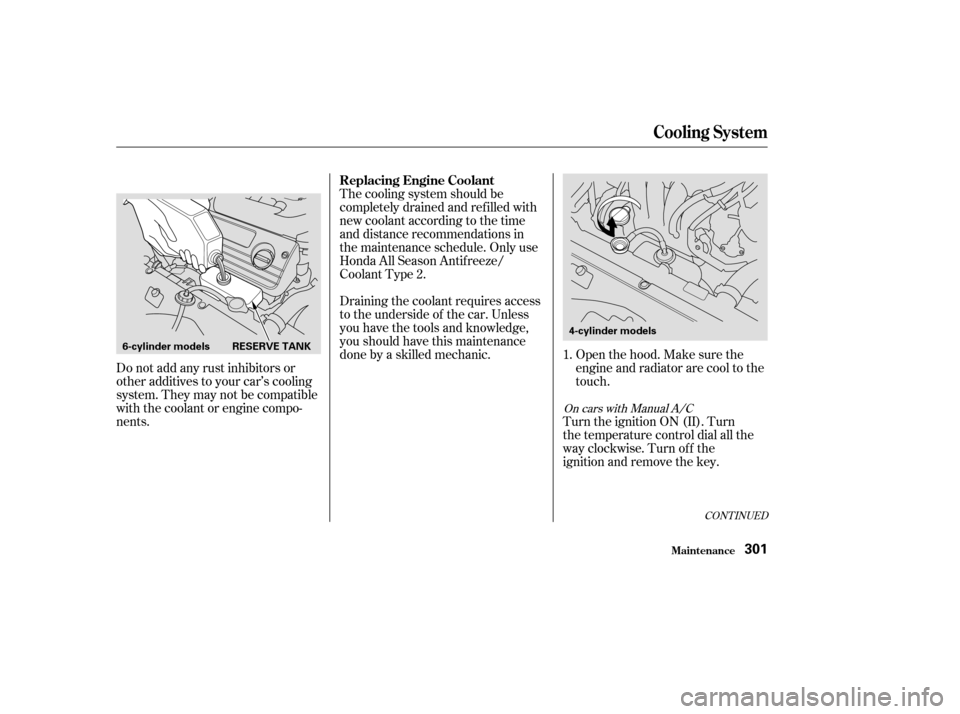
Thecoolingsystemshouldbe
completely drained and ref illed with
new coolant according to the time
and distance recommendations in
the maintenance schedule. Only use
Honda All Season Antif reeze/
Coolant Type 2.
Draining the coolant requires access
to the underside of the car. Unless
you have the tools and knowledge,
you should have this maintenance
done by a skilled mechanic.
Do not add any rust inhibitors or
other additives to your car’s cooling
system. They may not be compatible
with the coolant or engine compo-
nents. Openthehood.Makesurethe
engine and radiator are cool to the
touch.
Turn the ignition ON (II). Turn
the temperature control dial all the
way clockwise. Turn off the
ignition and remove the key. 1.
CONT INUED
On cars with Manual A/C
Replacing Engine Coolant
Cooling Syst em
Maint enance301
4-cylinder models
6-cylinder models RESERVE TANK
Page 305 of 429
Loosen the drain plug on the
bottom of the radiator. The
coolant will drain through the
splash guard. Drain the coolant
into an appropriate container.
Turn the ignition ON (II).Make
sure the DUAL indicator is off.
Turn the driver’s side temperature
control dial to 90°F (32°C). Turn
of f the ignition and remove the
key.
Remove the radiator cap. 3.
2.On car with Climate Control System
Cooling Syst em
Maint enance302
4-cylinder models 6-cylinder models
6-cylinder models DRAIN PLUG
DRAIN PLUG
Page 379 of 429

If you see steam and/or spray
coming f rom under the hood, turn
of f the engine.
The pointer of your car’s tempera-
ture gauge should stay in the mid-
range under most conditions. It may
go higher if you are driving up a long
steep hill on a very hot day. If it
climbs to the red mark, you should
determine the reason.
Your car can overheat f or several
reasons, such as lack of coolant or a
mechanical problem. The only
indication may be the temperature
gauge climbing to or above the red
mark. Or you may see steam or
spray coming f rom under the hood.
In either case, you should take
immediate action. Saf ely pull to the side of the road.
Put the transmission in Neutral or
Park and set the parking brake.
Turn of f the heating and cooling/
climate control system and all
otheraccessories.Turnonthe
hazard warning indicators.
1.
2.
If Your Engine Overheats
T aking Care of t he Unexpect ed376
Steam and spray from an
overheated engine can
seriously scald you.
Do not open the hood if steam
is coming out.
Driving with the temperature gauge
pointer at the red mark can cause
serious damage to your engine.
Page 380 of 429

If you do not see steam or spray,
leave the engine running and
watch the temperature gauge. If
the high heat is due to overloading
(climbing a long, steep hill on a
hot day with the A/C running, f or
example), the engine should start
to cool down almost immediately.
If it does, wait until the tempera-
ture gauge comes down to the mid-
point, then continue driving.
If the temperature gauge stays at
the red mark, turn of f the engine.Wait until you see no more signs
of steam or spray, then open the
hood.
Look f or any obvious coolant leaks,
such as a split radiator hose.
Everything is still extremely hot,
so use caution. If you f ind a leak, it
must be repaired bef ore you
continue driving (see
on page ).
If you don’t f ind an obvious leak,
check the coolant level in the
radiator reserve tank (see page ). If the level is below the
MIN mark, add coolant to halfway
between the MIN and MAX marks. If there was no coolant in the
reserve tank, you may also have to
add coolant to the radiator. Let the
engine cool down until the pointer
reaches the middle of the tempera-
ture gauge, or lower, bef ore check-
ing the radiator.
3.
4. 5.
6.
7. 8.
230 391
CONT INUED
If Your Engine Overheats
Emergency
Towing
T aking Care of t he Unexpect ed377
Removing the radiator cap
while the engine is hot can
cause the coolant to spray out,
seriously scalding you.
Always let the engine and
radiator cool down before
removing the radiator cap.
Page 381 of 429

Using gloves or a large heavy
cloth, turn the radiator cap
counterclockwise, without pushing
down, to the f irst stop. This
releases any remaining pressure in
the cooling system. After the
pressure releases, push down on
the cap and turn it until it comes
off.Start the engine and set the
temperature control dial to
maximum (climate control to
AUTO at 90°F/32°C). Add
coolant to the radiator up to the
base of the f iller neck. If you do
not have the proper coolant
mixture available, you can add
plain water. Remember to have
the cooling system drained and
ref illed with the proper mixture as
soon as you can.Put the radiator cap back on
tightly. Run the engine and watch
the temperature gauge. If it goes
back to the red mark, the engine
needs repair. (See
on page .)
If the temperature stays normal,
check the coolant level in the
radiator reserve tank. If it has
gone down, add coolant to the
MAX mark. Put the cap back on
tightly.
9.
11.
12.
10.
391
T aking Care of t he Unexpect ed
If Your Engine Overheats
Emergency
Towing
378