2003 GMC YUKON front axle
[x] Cancel search: front axlePage 397 of 520

Properly torqued wheel nuts are necessary to help
prevent brake pulsation. When tires are rotated, inspect
brake pads for wear and evenly tighten wheel nuts in
the proper sequence to GM torque specifications.
Brake linings should always be replaced as complete
axle sets.
SeeBrake System Inspection on page 6-16.
Brake Pedal Travel
See your dealer if the brake pedal does not return to
normal height, or if there is a rapid increase in
pedal travel. This could be a sign of brake trouble.
Brake Adjustment
Every time you make a brake stop, your disc brakes
adjust for wear.
Replacing Brake System Parts
The braking system on a vehicle is complex. Its many
parts have to be of top quality and work well together if
the vehicle is to have really good braking. Your
vehicle was designed and tested with top-quality GM
brake parts. When you replace parts of your brakingsystem–for example, when your brake linings wear
down and you need new ones put in–be sure you get
new approved GM replacement parts. If you don’t,
your brakes may no longer work properly. For example,
if someone puts in brake linings that are wrong for
your vehicle, the balance between your front and rear
brakes can change—for the worse. The braking
performance you’ve come to expect can change in many
other ways if someone puts in the wrong replacement
brake parts.
Battery
Your new vehicle comes with a maintenance free
ACDelco®battery. When it’s time for a new battery, get
one that has the replacement number shown on the
original battery’s label. We recommend an ACDelco
®
battery. SeeEngine Compartment Overview on
page 5-12for battery location.
Warning:Battery posts, terminals and related
accessories contain lead and lead compounds,
chemicals known to the State of California to cause
cancer and reproductive harm. Wash hands after
handling.
5-43
2003 - Yukon/Yukon XL
Page 406 of 520
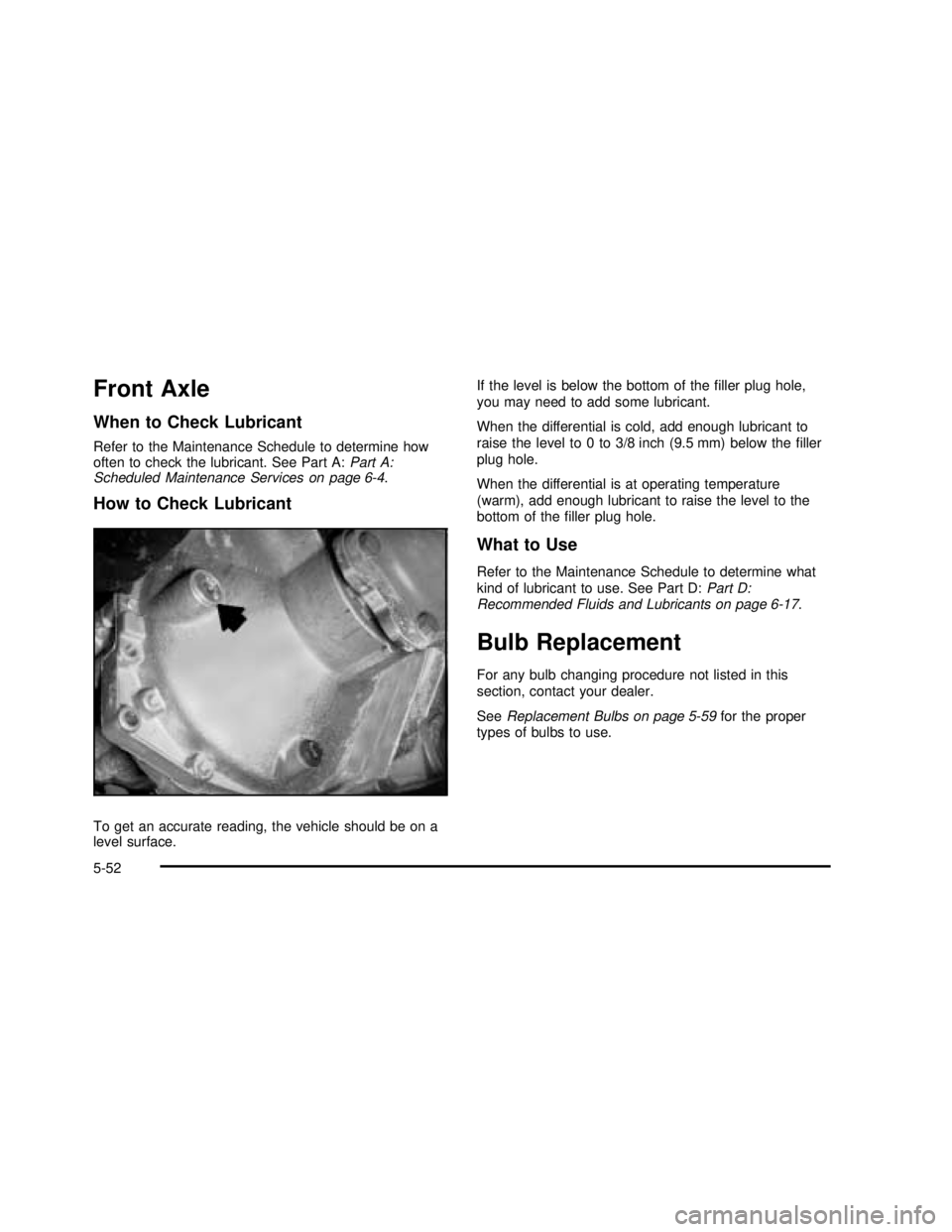
Front Axle
When to Check Lubricant
Refer to the Maintenance Schedule to determine how
often to check the lubricant. See Part A:Part A:
Scheduled Maintenance Services on page 6-4.
How to Check Lubricant
To get an accurate reading, the vehicle should be on a
level surface.If the level is below the bottom of thefiller plug hole,
you may need to add some lubricant.
When the differential is cold, add enough lubricant to
raise the level to 0 to 3/8 inch (9.5 mm) below thefiller
plug hole.
When the differential is at operating temperature
(warm), add enough lubricant to raise the level to the
bottom of thefiller plug hole.
What to Use
Refer to the Maintenance Schedule to determine what
kind of lubricant to use. See Part D:Part D:
Recommended Fluids and Lubricants on page 6-17.
Bulb Replacement
For any bulb changing procedure not listed in this
section, contact your dealer.
SeeReplacement Bulbs on page 5-59for the proper
types of bulbs to use.
5-52
2003 - Yukon/Yukon XL
Page 431 of 520
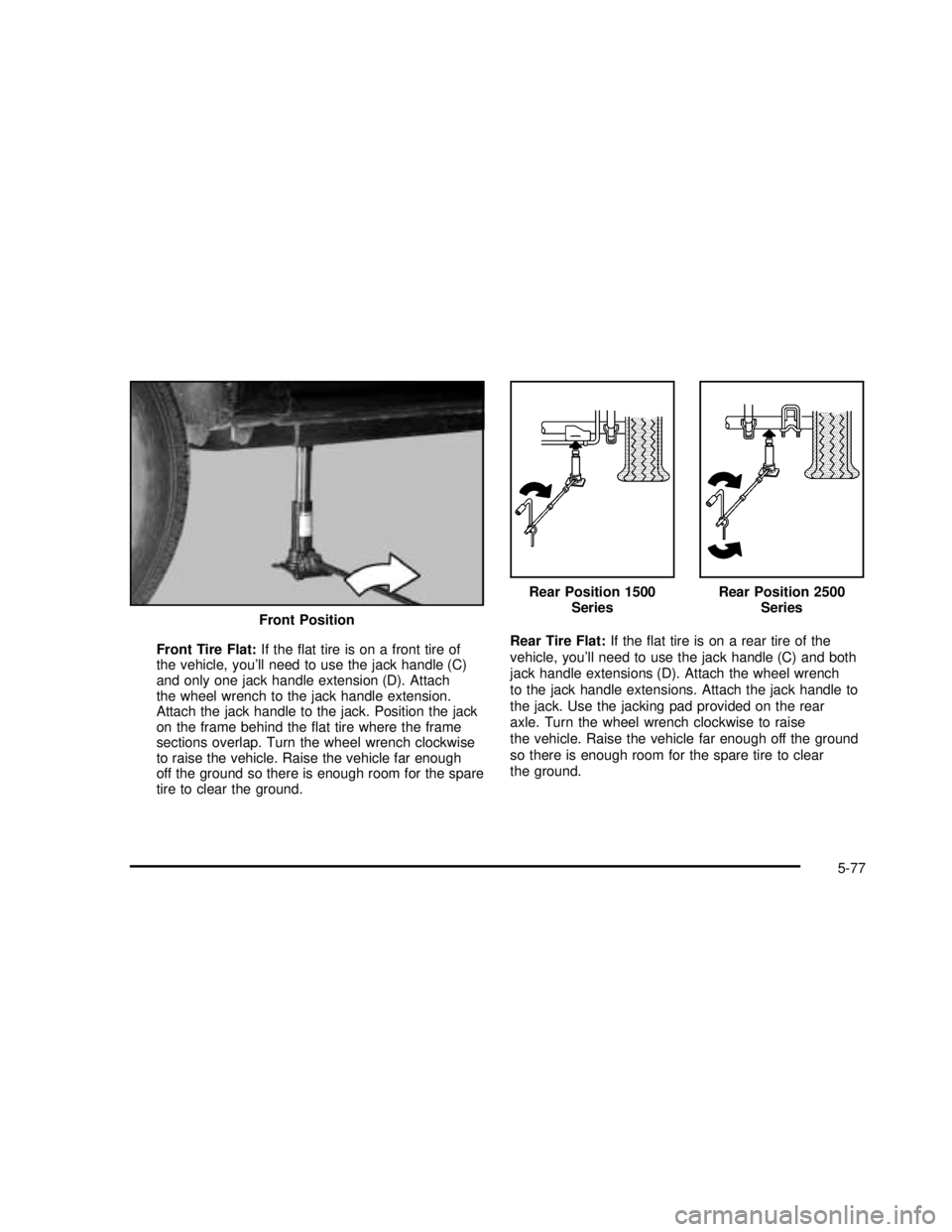
Front Tire Flat:If theflat tire is on a front tire of
the vehicle, you’ll need to use the jack handle (C)
and only one jack handle extension (D). Attach
the wheel wrench to the jack handle extension.
Attach the jack handle to the jack. Position the jack
on the frame behind theflat tire where the frame
sections overlap. Turn the wheel wrench clockwise
to raise the vehicle. Raise the vehicle far enough
off the ground so there is enough room for the spare
tire to clear the ground.Rear Tire Flat:If theflat tire is on a rear tire of the
vehicle, you’ll need to use the jack handle (C) and both
jack handle extensions (D). Attach the wheel wrench
to the jack handle extensions. Attach the jack handle to
the jack. Use the jacking pad provided on the rear
axle. Turn the wheel wrench clockwise to raise
the vehicle. Raise the vehicle far enough off the ground
so there is enough room for the spare tire to clear
the ground. Front Position
Rear Position 1500
SeriesRear Position 2500
Series
5-77
2003 - Yukon/Yukon XL
Page 465 of 520

Maintenance Schedule......................................6-2
Introduction...................................................6-2
Your Vehicle and the Environment....................6-2
Maintenance Requirements..............................6-2
How This Section is Organized.........................6-3
Part A: Scheduled Maintenance Services...........6-4
Using Your Maintenance Schedule....................6-4
Scheduled Maintenance...................................6-5
Part B: Owner Checks and Services................6-11
At Each Fuel Fill..........................................6-11
At Least Once a Month.................................6-11
At Least Twice a Year...................................6-12At Least Once a Year
...................................6-12
Part C: Periodic Maintenance Inspections
.........6-15
Steering and Suspension Inspection
................6-15
Exhaust System Inspection
............................6-15
Fuel System Inspection
..................................6-15
Engine Cooling System Inspection
...................6-16
Transfer Case and Front Axle (Four-Wheel
Drive) Inspection
.......................................6-16
Brake System Inspection
................................6-16
Part D: Recommended Fluids and Lubricants
. . . .6-17
Part E: Maintenance Record
...........................6-19
Section 6 Maintenance Schedule
6-1
2003 - Yukon/Yukon XL
Page 470 of 520

If the system is ever reset accidentally, you must
change your oil at 3,000 miles (5 000 km) since your
last oil change. Remember to reset the oil life system
whenever the oil is changed. SeeEngine Oil on
page 5-16for information on resetting the system.
An Emission Control Service.
Lubricate chassis components with each engine oil
and filter change.
Lubricate the front suspension, ball joints, steering
linkage, transmission shift linkage, transfer case shift
linkage and parking brake cable guides. Ball joints
should not be lubricated unless their temperature is
10°F(−12°C) or higher, or they could be damaged.
See the mileage intervals following for additional
services that may be performed with an engine oil
change and chassis lubrication. After the services are
performed, record the date, odometer reading and
who performed the service on the maintenance record
pages in Part E of this schedule.7,500 Miles (12 500 km)
❑Check rear/front axlefluid level and addfluid as
needed. Check constant velocity joints and axle seals
for leaking.
❑Rotate tires. SeeTire Inspection and Rotation on
page 5-61for proper rotation pattern and additional
information.(See footnote +.)
15,000 Miles (25 000 km)
❑Inspect engine air cleanerfilter or change indicator (if
equipped). If necessary, replace thefilter. If vehicle is
driven in dusty/dirty conditions, inspectfilter or
change indicator (if equipped) at every engine oil
change. SeeEngine Air Cleaner/Filter on page 5-21
for more information.An Emission Control Service.
(See footnote†.)
❑Check rear/front axlefluid level and addfluid as
needed. Check constant velocity joints and axle seals
for leaking.
❑Rotate tires. SeeTire Inspection and Rotation on
page 5-61for proper rotation pattern and additional
information.(See footnote +.)
6-6
2003 - Yukon/Yukon XL
Page 471 of 520

22,500 Miles (37 500 km)
❑Check rear/front axlefluid level and addfluid as
needed. Check constant velocity joints and axle seals
for leaking.
❑Rotate tires. SeeTire Inspection and Rotation on
page 5-61for proper rotation pattern and additional
information.(See footnote +.)
30,000 Miles (50 000 km)
❑Check rear/front axlefluid level and addfluid as
needed. Check constant velocity joints and axle seals
for leaking.
❑Rotate tires. SeeTire Inspection and Rotation on
page 5-61for proper rotation pattern and additional
information.(See footnote +.)
❑Replace fuelfilter.An Emission Control Service. (See
footnote†.)
❑Replace engine air cleanerfilter on vehicles without
a restriction indicator. If equipped with a change
indicator, inspect the indicator. If necessary, replace
thefilter. If vehicle is driven in dusty/dirty conditions,
inspect the change indicator (if equipped) at every
engine oil change. SeeEngine Air Cleaner/Filter on
page 5-21for more information.An Emission
Control Service. (See footnote†.)
37,500 Miles (62 500 km)
❑Check rear/front axlefluid level and addfluid as
needed. Check constant velocity joints and axle seals
for leaking.
❑Rotate tires. SeeTire Inspection and Rotation on
page 5-61for proper rotation pattern and additional
information.(See footnote +.)
45,000 Miles (75 000 km)
❑Inspect engine air cleanerfilter or change indicator (if
equipped). If necessary, replace thefilter. If vehicle is
driven in dusty/dirty conditions, inspectfilter or
change indicator (if equipped) at every engine oil
change. SeeEngine Air Cleaner/Filter on page 5-21
for more information.An Emission Control Service.
(See footnote†.)
❑Check rear/front axlefluid level and addfluid as
needed. Check constant velocity joints and axle seals
for leaking.
❑Rotate tires. SeeTire Inspection and Rotation on
page 5-61for proper rotation pattern and additional
information.(See footnote +.)
6-7
2003 - Yukon/Yukon XL
Page 472 of 520

50,000 Miles (83 000 km)
❑Change automatic transmissionfluid andfilter if the
vehicle’s GVWR is over 8600 lbs or if the vehicle is
mainly driven under one or more of these conditions:
In heavy city traffic where the outside
temperature regularly reaches 90°F (32°C) or
higher.
In hilly or mountainous terrain.
When doing frequent trailer towing.
Uses such as found in taxi, police or delivery
service.
If you do not use your vehicle under any of these
conditions, change the fluid and filter at 100,000 miles
(166 000 km).
❑Change transfer case uid.
52,500 Miles (87 500 km)
❑Check rear/front axle uid level and add uid as
needed. Check constant velocity joints and axle seals
for leaking.
❑Rotate tires. SeeTire Inspection and Rotation on
page 5-61for proper rotation pattern and additional
information.(See footnote +.)
60,000 Miles (100 000 km)
❑Check rear/front axle uid level and add uid as
needed. Check constant velocity joints and axle seals
for leaking.
❑Rotate tires. SeeTire Inspection and Rotation on
page 5-61for proper rotation pattern and additional
information.(See footnote +.)
❑Replace fuel lter.An Emission Control Service.
(See footnote †.)
❑Replace engine air cleaner lter on vehicles without
a restriction indicator. If equipped with a change
indicator, inspect the indicator. If necessary, replace
the lter. If vehicle is driven in dusty/dirty conditions,
inspect the change indicator (if equipped) at every
engine oil change. SeeEngine Air Cleaner/Filter on
page 5-21for more information.An Emission
Control Service. (See footnote †.)
❑Inspect Evaporative Control System. Check all fuel
and vapor lines and hoses for proper hook-up,
routing and condition. Check that the purge valve
works properly, if equipped. Replace as needed.An
Emission Control Service. (See footnote †.)
6-8
2003 - Yukon/Yukon XL
Page 473 of 520

67,500 Miles (112 500 km)
❑Check rear/front axleuid level and adduid as
needed. Check constant velocity joints and axle seals
for leaking.
❑Rotate tires. SeeTire Inspection and Rotation on
page 5-61for proper rotation pattern and additional
information.(See footnote +.)
75,000 Miles (125 000 km)
❑Inspect engine air cleanerlter or change indicator (if
equipped). If necessary, replace thelter. If vehicle is
driven in dusty/dirty conditions, inspectlter or
change indicator (if equipped) at every engine oil
change. SeeEngine Air Cleaner/Filter on page 5-21
for more information.An Emission Control Service.
(See footnote†.)
❑Check rear/front axleuid level and adduid as
needed. Check constant velocity joints and axle seals
for leaking.
❑Rotate tires. SeeTire Inspection and Rotation on
page 5-61for proper rotation pattern and additional
information.(See footnote +.)
82,500 Miles (137 500 km)
❑Check rear/front axleuid level and adduid as
needed. Check constant velocity joints and axle seals
for leaking.
❑Rotate tires. SeeTire Inspection and Rotation on
page 5-61for proper rotation pattern and additional
information.(See footnote +.)
90,000 Miles (150 000 km)
❑Check rear/front axleuid level and adduid as
needed. Check constant velocity joints and axle seals
for leaking.
❑Replace fuellter.An Emission Control Service.
(See footnote†.)
❑Replace engine air cleanerlter on vehicles without
a restriction indicator. If equipped with a change
indicator, inspect the indicator. If necessary, replace
thelter. If vehicle is driven in dusty/dirty conditions,
inspect the change indicator (if equipped) at every
engine oil change. SeeEngine Air Cleaner/Filter on
page 5-21for more information.An Emission
Control Service. (See footnote†.)
❑Rotate tires. SeeTire Inspection and Rotation on
page 5-61for proper rotation pattern and additional
information.(See footnote +.)
6-9
2003 - Yukon/Yukon XL