Page 15 of 424

Rear Seats
Rear Seat Operation
The rear seatback can be tilted forward to let you reach
the area behind it.
To tilt the seatback
forward, lift up on the lever
located at the base of
the seatback on the
driver’s or passenger’s
side. Then tilt the
seatback forward.
To return the seatback to the upright position, push the
seatback rearward until it latches. After returning the
seatback to its upright position, try to pull the seatback
forward to make sure it is locked.
{CAUTION:
If the seatback isn’t locked, it could move
forward in a sudden stop or crash. That could
cause injury to the person sitting there.
Always press rearward on the seatback to be
sure it is locked.
{CAUTION:
A safety belt that is improperly routed, not
properly attached, or twisted won’t provide the
protection needed in a crash. The person
wearing the belt could be seriously injured.
After raising the rear seatback, always check
to be sure that the safety belts are properly
routed and attached, and are not twisted.
1-9
2003 - Sonoma OM
Page 17 of 424
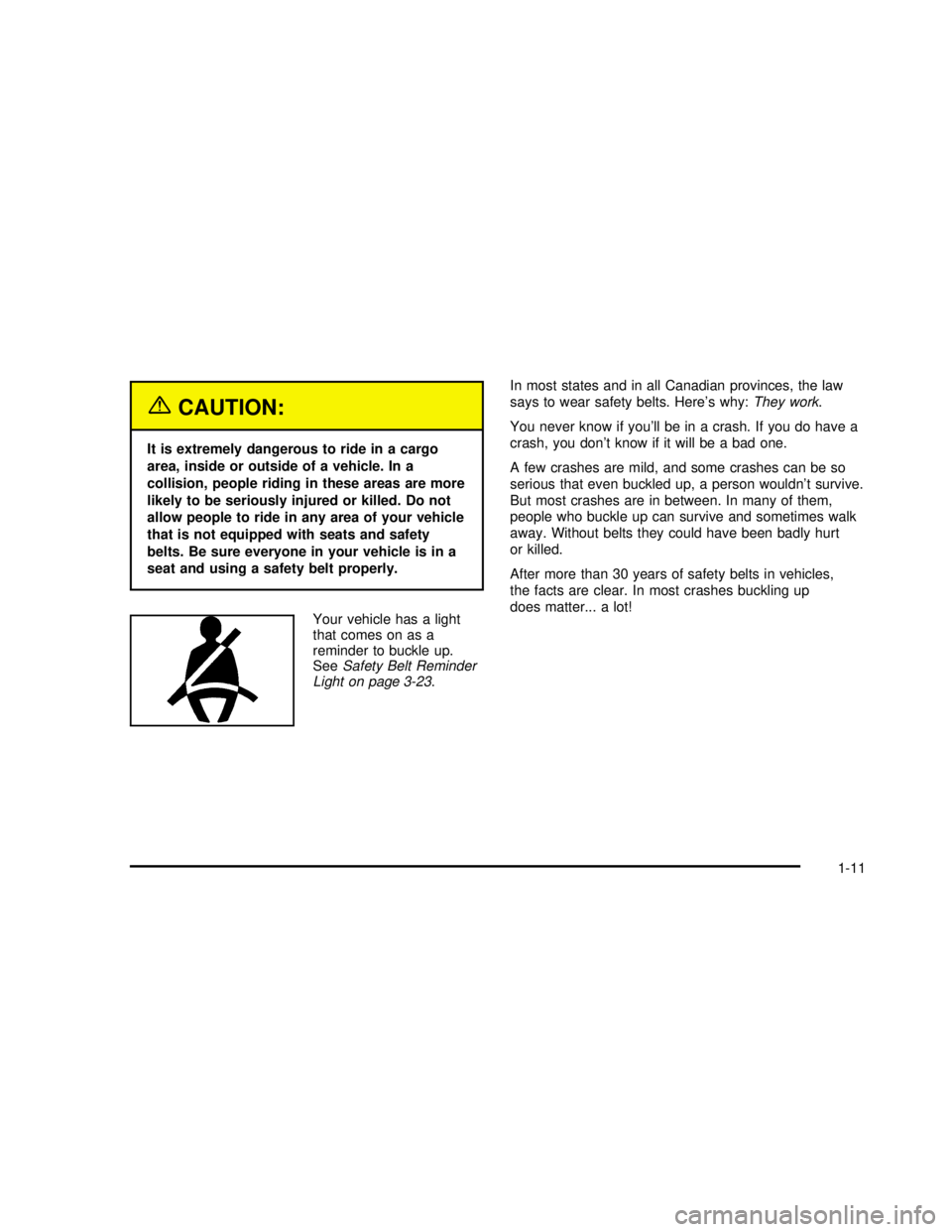
{CAUTION:
It is extremely dangerous to ride in a cargo
area, inside or outside of a vehicle. In a
collision, people riding in these areas are more
likely to be seriously injured or killed. Do not
allowpeople to ride in any area of your vehicle
that is not equipped with seats and safety
belts. Be sure everyone in your vehicle is in a
seat and using a safety belt properly.
Your vehicle has a light
that comes on as a
reminder to buckle up.
SeeSafety Belt Reminder
Light on page 3-23.In most states and in all Canadian provinces, the law
says to wear safety belts. Here’s why:They work.
You never know if you’ll be in a crash. If you do have a
crash, you don’t know if it will be a bad one.
A few crashes are mild, and some crashes can be so
serious that even buckled up, a person wouldn’t survive.
But most crashes are in between. In many of them,
people who buckle up can survive and sometimes walk
away. Without belts they could have been badly hurt
or killed.
After more than 30 years of safety belts in vehicles,
the facts are clear. In most crashes buckling up
does matter... a lot!
1-11
2003 - Sonoma OM
Page 22 of 424
Driver Position
This part describes the driver’s restraint system.
Lap-Shoulder Belt
The driver has a lap-shoulder belt. Here’s how to wear
it properly.
1. Close and lock the door.
2. Adjust the seat so you can sit up straight. To see
how, see“Seats”in the Index.3. Pick up the latch plate and pull the belt across you.
Don’t let it get twisted.
The shoulder belt may lock if you pull the belt
across you very quickly. If this happens, let the belt
go back slightly to unlock it. Then pull the belt
across you more slowly.
4. Push the latch plate into the buckle until it clicks.
Pull up on the latch plate to make sure it is secure.
If the belt isn’t long enough, seeSafety Belt
Extender on page 1-29.
Make sure the release button on the buckle is
positioned so you would be able to unbuckle the
safety belt quickly if you ever had to.
1-16
2003 - Sonoma OM
Page 36 of 424
Child Restraints
Older Children
Older children who have outgrown booster seats should
wear the vehicle’s safety belts.If you have a choice, a child should sit next to a window
so that the child can wear a lap-shoulder belt and get
the additional restraint a shoulder belt can provide.
Q:What is the proper way to wear safety belts?
A:If possible, an older child should wear a
lap-shoulder belt and get the additional restraint a
shoulder belt can provide. The shoulder belt
should not cross the face or neck. The lap belt
shouldfit snugly below the hips, just touching the
top of the thighs. It should never be worn over
the abdomen, which could cause severe or even
fatal internal injuries in a crash.
In a crash, children who are not buckled up can strike
other people who are buckled up, or can be thrown
out of the vehicle. Older children need to use safety
belts properly.
1-30
2003 - Sonoma OM
Page 43 of 424
A forward-facing child seat (C-E) provides restraint for
the child’s body with the harness and also sometimes
with surfaces such as T-shaped or shelf-like shields.A booster seat (F-G) is a child restraint designed to
improve thefit of the vehicle’s safety belt system.
Some booster seats have a shoulder belt positioner,
and some high-back booster seats have afive-point
harness. A booster seat can also help a child to see
out the window.
1-37
2003 - Sonoma OM
Page 58 of 424

You’ll be using the lap-shoulder belt. SeeTop Strap on
page 1-41if the child restraint has one. Be sure to
follow the instructions that came with the child restraint.
Secure the child in the child restraint when and as
the instructions say.
1. Your vehicle has a right front passenger air bag.
If your vehicle is a regular cab pickup or extended
cab pickup and you are using a rear-facing child
restraint in this seat, make sure the air bag is turned
off. SeeAir Bag Off Switch on page 1-60.Onall
models, if your child restraint is forward-facing,
always move the seat as far back as it will go before
securing it in this seat. SeeManual Seats on
page 1-3orPower Seats on page 1-4.
2. Put the restraint on the seat.
3. Pick up the latch plate, and run the lap and shoulder
portions of the vehicle’s safety belt through or
around the restraint. The child restraint instructions
will show you how.4. Buckle the belt. Make sure the release button is
positioned so you would be able to unbuckle the
safety belt quickly if you ever had to.
1-52
2003 - Sonoma OM
Page 121 of 424
Front Storage Area
If your vehicle has this console compartment, squeeze
the front lever while lifting the top to open it. You can
store cassettes and compact discs in the slots in front of
the compartment.If your vehicle has the center armrest compartment,
lift the cover to expose the storage area.
Some vehicles may have a storage pocket on the back
of the bucket or 60/40 bench seats.
2-49
2003 - Sonoma OM
Page 148 of 424

Operation Tips
Clear away any ice, snow or leaves from the air
inlets at the base of the windshield that may
block theow of air into your vehicle.
Use of non-GM approved hood deectors may
adversely affect the performance of the system.
Keep the path under the front seats clear of objects
to help circulate the air inside of your vehicle more
effectively.
Warning Lights, Gages and
Indicators
This part describes the warning lights and gages that
may be on your vehicle. The pictures will help you
locate them.
Warning lights and gages can signal that something is
wrong before it becomes serious enough to cause
an expensive repair or replacement. Paying attention to
your warning lights and gages could also save you
or others from injury.Warning lights come on when there may be or is a
problem with one of your vehicle’s functions. As you will
see in the details on the next few pages, some
warning lights come on briey when you start the
engine just to let you know they’re working. If you are
familiar with this section, you should not be alarmed
when this happens.
Gages can indicate when there may be or is a problem
with one of your vehicle’s functions. Often gages
and warning lights work together to let you know when
there’s a problem with your vehicle.
When one of the warning lights comes on and stays on
when you are driving, or when one of the gages shows
there may be a problem, check the section that tells you
what to do about it. Please follow this manual’s advice.
Waiting to do repairs can be costly–and even
dangerous. So please get to know your warning lights
and gages. They’re a big help.
3-20
2003 - Sonoma OM


