2003 GMC SIERRA DIC
[x] Cancel search: DICPage 1 of 408

Seats and Restraint Systems........................... 1-1
Front Seats
............................................... 1-2
Rear Seats
............................................... 1-6
Safety Belts
.............................................. 1-7
Child Restraints
.......................................1-29
Air Bag Systems
......................................1-55
Restraint System Check
............................1-71
Features and Controls..................................... 2-1
Keys
........................................................ 2-2
Doors and Locks
....................................... 2-6
Windows
.................................................2-11
Theft-Deterrent Systems
............................2-13
Starting and Operating Your Vehicle
...........2-15
Mirrors
....................................................2-28
OnStar
®System
......................................2-33
HomeLink®Transmitter
.............................2-35
Storage Areas
.........................................2-39
Vehicle Personalization
.............................2-41
Instrument Panel............................................. 3-1
Instrument Panel Overview
.......................... 3-2
Climate Controls
......................................3-18
Warning Lights, Gages and Indicators
.........3-24
Driver Information Center (DIC)
..................3-42
Audio System(s)
.......................................3-56Driving Your Vehicle....................................... 4-1
Your Driving, the Road, and Your Vehicle
..... 4-2
Towing
...................................................4-46
Service and Appearance Care.......................... 5-1
Service
..................................................... 5-3
Fuel
......................................................... 5-4
Checking Things Under
the Hood
.............................................5-10
All-Wheel Drive
........................................5-45
Rear Axle
...............................................5-46
Front Axle
...............................................5-47
Bulb Replacement
....................................5-48
Windshield Wiper Blade Replacement
.........5-56
Tires
......................................................5-56
Appearance Care
.....................................5-82
Vehicle Identication
.................................5-90
Electrical System
......................................5-91
Capacities and Specications
.....................5-99
Normal Maintenance Replacement Parts
....5-100
Maintenance Schedule..................................... 6-1
Maintenance Schedule
................................ 6-2
Customer Assistance Information.................... 7-1
Customer Assistance Information
.................. 7-2
Reporting Safety Defects
............................ 7-8
Index................................................................ 1
2003 GMC Sierra Denali Owner ManualM
2003 - Sierra Denali Owner Manual
Page 4 of 408

Vehicle Damage Warnings
Also, in this book you willfind these notices:
Notice:These mean there is something that could
damage your vehicle.
A notice will tell you about something that can damage
your vehicle. Many times, this damage would not be
covered by your warranty, and it could be costly. But the
notice will tell you what to do to help avoid the
damage.
When you read other manuals, you might see CAUTION
and NOTICE warnings in different colors or in different
words.
You’ll also see warning labels on your vehicle. They use
the same words, CAUTION or NOTICE.
Vehicle Symbols
Your vehicle has components and labels that use
symbols instead of text. Symbols, used on your vehicle,
are shown along with the text describing the operation
or information relating to a specific component, control,
message, gage or indicator.
If you need helpfiguring out a specificnameofa
component, gage or indicator, reference the following
topics:
•Seats and Restraint Systems in Section 1
•Features and Controls in Section 2
•Instrument Panel Overview in Section 3
•Climate Controls in Section 3
•Warning Lights, Gages and Indicators in Section 3
•Audio System(s) in Section 3
•Engine Compartment Overview in Section 5
iv
2003 - Sierra Denali
Page 9 of 408

Power Lumbar
If your vehicle has this
feature, the four-way
control is located on the
outboard side of the seat.
To increase or decrease support, press and hold the
front or rear of the control. Let go of the control when the
lower seatback reaches the desired level of support.
You can also reshape the side wing area of the
lower seatback for more lateral support. To increase or
decrease support, press and hold the top or bottom
of the control. Let go of the control when the lower
seatback reaches the desired level of support.
Heated Seats
If your vehicle has this
feature, the button used to
control the driver’s
heated seat is located on
the driver’s door panel.
The button used to control
the passenger’s heated
seat is located on the
passenger’s door panel.
To heat the entire seat, press the horizontal button.
Press the button to cycle through the temperature
settings of high, medium, and low. The indicator light
will glow to indicate the level of heat selected.
To heat only the seatback, press the vertical button with
the heated seatback symbol. An indicator light on the
button will glow to designate that only the seatback
is being heated.
The engine must be running for them to operate.
The heated front seats will be canceled after the ignition
is turned off. If you still want to use the heated front
seat feature after you restart your vehicle, you will need
to press the heated seat button again.
1-3
2003 - Sierra Denali
Page 44 of 408
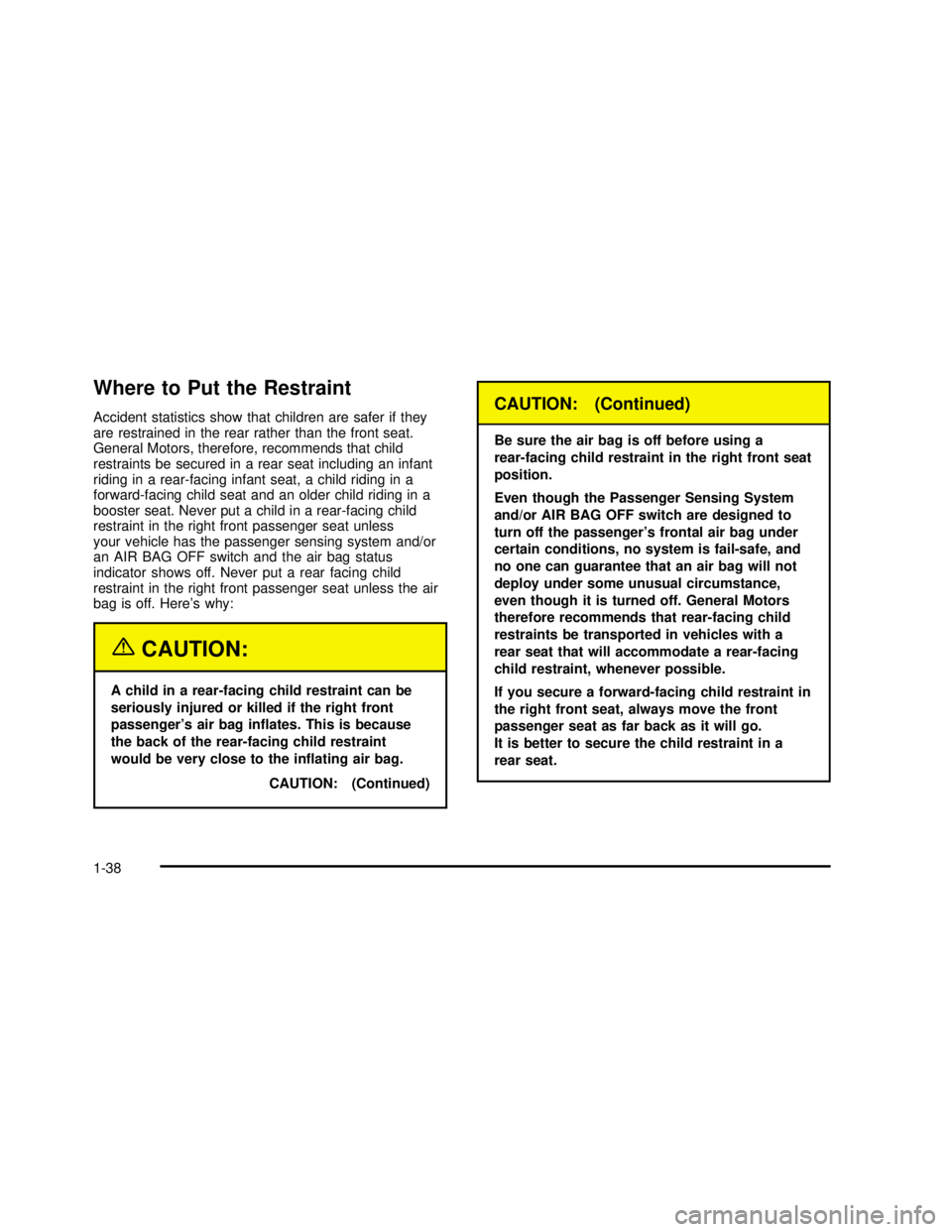
Where to Put the Restraint
Accident statistics show that children are safer if they
are restrained in the rear rather than the front seat.
General Motors, therefore, recommends that child
restraints be secured in a rear seat including an infant
riding in a rear-facing infant seat, a child riding in a
forward-facing child seat and an older child riding in a
booster seat. Never put a child in a rear-facing child
restraint in the right front passenger seat unless
your vehicle has the passenger sensing system and/or
an AIR BAG OFF switch and the air bag status
indicator shows off. Never put a rear facing child
restraint in the right front passenger seat unless the air
bag is off. Here’s why:
{CAUTION:
A child in a rear-facing child restraint can be
seriously injured or killed if the right front
passenger’s air bag inflates. This is because
the back of the rear-facing child restraint
would be very close to the inflating air bag.
CAUTION: (Continued)
CAUTION: (Continued)
Be sure the air bag is off before using a
rear-facing child restraint in the right front seat
position.
Even though the Passenger Sensing System
and/or AIR BAG OFF switch are designed to
turn off the passenger’s frontal air bag under
certain conditions, no system is fail-safe, and
no one can guarantee that an air bag will not
deploy under some unusual circumstance,
even though it is turned off. General Motors
therefore recommends that rear-facing child
restraints be transported in vehicles with a
rear seat that will accommodate a rear-facing
child restraint, whenever possible.
If you secure a forward-facing child restraint in
the right front seat, always move the front
passenger seat as far back as it will go.
It is better to secure the child restraint in a
rear seat.
1-38
2003 - Sierra Denali
Page 56 of 408

Never put a rear facing child restraint in the right front
passenger seat unless the air bag is off. Here’s why:
{CAUTION:
A child in a rear-facing child restraint can be
seriously injured or killed if the right front
passenger’s air bag inflates. This is because
the back of the rear-facing child restraint
would be very close to the inflating air bag. Be
sure to turn off the air bag before using a
rear-facing child restraint in the right front seat
position. If a forward-facing child restraint is
suitable for your child, always move the
passenger seat as far back as it will go.
Although a rear seat is a safer place, you can secure a
forward-facing child restraint in the right front seat.
{CAUTION:
If the air bag readiness light in the instrument
panel cluster ever comes on when you have
turned off the air bag, it means that something
may be wrong with the air bag system. The
right front passenger’s air bag could inflate
even though the switch is off. If this ever
happens, have the vehicle serviced promptly.
Until you have the vehicle serviced, don’t let
anyone whom the national government has
identified as a member of a passenger air bag
risk group sit in the right front passenger’s
position (for example, don’t secure a
rear-facing child restraint in your vehicle).
See″Air Bag Off Switch″in the Index.
In addition to the AIR BAG OFF switch, your vehicle
may have the passenger sensing system. See
Passenger Sensing System on page 1-66and
Passenger Air Bag Status Indicator on page 3-31for
more on this, including important safety information.
The passenger sensing system is designed to turn off
the right front passenger’s frontal air bag when a
rear facing child restraint is in the right front seat.
1-50
2003 - Sierra Denali
Page 57 of 408

In addition to the passenger sensing system, you may
use the AIR BAG OFF switch located on the instrument
panel to turn the air bag off. Never put a rear facing
child restraint in the right front passenger seat unless the
air bag is off. Here’s why.
{CAUTION:
A child in a rear-facing child restraint can be
seriously injured or killed if the right front
passenger’s air bag inflates. This is because the
back of the rear facing child restraint would be
very close to the inflating air bag. Be sure the air
bag is off before using a rear-facing child
restraint in the right front seat position.
Even though the passenger sensing system is
designed to turn off the passenger’s frontal air
bag if the system detects a rear-facing child
restraint, no system is fail-safe, and no one can
guarantee that an air bag will not deploy under
some unusual circumstance, even though it is
turned off. General Motors therefore
recommends that rear-facing child restraints be
secured in the rear seat whenever possible,
even if the air bag is off.You’ll be using the lap-shoulder belt. SeeTop Strap on
page 1-39if the child restraint has one. Be sure to
follow the instructions that came with the child restraint.
Secure the child in the child restraint when and as
the instructions say.
1. Your vehicle has a right front passenger’s air bag.
If you are using a rear-facing child restraint in this
seat, make sure the air bag is turned off. See
Air Bag Off Switch on page 1-61andPassenger
Sensing System on page 1-66. Always move
the seat as far back as it will go before securing the
child restraint in this seat. See“Seats”in the
Index.
When either the passenger sensing system and/or
the AIR BAG OFF switch has turned off the right
front passenger’s frontal air bag, the off indicator in
the passenger air bag status indicator on the
rearview mirror will light and stay lit when you turn
the ignition to RUN or START.
1-51
2003 - Sierra Denali
Page 60 of 408

If your vehicle has the passenger sensing system and
you’re using a rear-facing child restraint in this seat,
check to be sure the right front passenger’s frontal air
bag is off before you begin to drive. If the air bag
has been turned off, the off indicator will light and stay
lit in the rearview mirror.
If the on indicator is lit, the passenger’s frontal air bag
has not been turned off by the passenger sensing
system. If this ever happens, turn the vehicle off,
unbuckle the safety belt and perform the steps to install
the rear-facing restraint again. After restarting the
vehicle, if the air bag still doesn’t turn off, install the
infant restraint in a rear seat position of the vehicle or
check to make sure the AIR BAG OFF switch has been
turned to off. SeeAir Bag Off Switch on page 1-61
andPassenger Sensing System on page 1-66.
{CAUTION:
If the air bag ON indicator comes on when you
have a rear-facing child restraint installed in
the right front passenger’s seat, it means that
the passenger sensing system has not turned
off the passenger’s frontal air bag. A child in a
rear-facing child restraint can be seriously
injured or killed if the right front passenger’s
air bag inflates. This is because the back of
the rear-facing child restraint would be very
close to the inflating air bag. Don’t use a
rear-facing child restraint in the right front
passenger’s seat unless the air bag is off.
To remove the child restraint, just unbuckle the vehicle’s
safety belt and let it go back all the way. The safety
belt will remove freely again and be ready to work for an
adult or larger child passenger.
If you were using a rear-facing child restraint and had
turned the air bag off with the switch, remember to turn
on the right front passenger’s air bag when you
remove the rear-facing child restraint from the vehicle
unless the person who will be sitting there is a member
of a passenger air bag risk group. SeeAir Bag Off
Switch on page 1-61.
1-54
2003 - Sierra Denali
Page 66 of 408

{CAUTION:
When an air bag inflates, there is dust in the
air. This dust could cause breathing problems
for people with a history of asthma or other
breathing trouble. To avoid this, everyone in
the vehicle should get out as soon as it is safe
to do so. If you have breathing problems but
can’t get out of the vehicle after an air bag
inflates, then get fresh air by opening a
window or a door. If you experience breathing
problems following an air bag deployment, you
should seek medical attention.
In many crashes severe enough to inflate the air bag,
windshields are broken by vehicle deformation.
Additional windshield breakage may also occur from the
right front passenger air bag.
•Air bags are designed to inflate only once. After
they inflate, you’ll need some new parts for your
air bag system. If you don’t get them, the air
bag system won’t be there to help protect you in
another crash. A new system will include air
bag modules and possibly other parts. The service
manual for your vehicle covers the need to
replace other parts.
•Your vehicle is equipped with electronic frontal
sensors which help the sensing system distinguish
between a moderate and a more severe frontal
impact. Your vehicle is also equipped with a crash
sensing and diagnostic module, which records
information about the frontal air bag system. The
module records information about the readiness of
the system and when the system commands
are bag inflation. It records the status of the driver’s
safety belt usage in a crash in which the air bag
deploys or a crash in which the air bag nearly
deploys. The module also records speed, engine
RPM, brake and throttle data.
•Let only qualified technicians work on your air bag
systems. Improper service can mean that an air
bag system won’t work properly. See your dealer for
service.
Notice:If you damage the covering for the driver’s
or the right front passenger’s air bag, the bag
may not work properly. You may have to replace the
air bag module in the steering wheel or both the
air bag module and the instrument panel for
the right front passenger’s air bag. Do not open or
break the air bag coverings.
1-60
2003 - Sierra Denali